

Ontario Health Teams: Data Supports Guidance Document
July 2021
Introduction
The Government of Ontario is establishing a new model of care that will enable patients, families, communities, providers and system leaders to work better together, innovate, and build on what is best in Ontario’s health care system. The goal is to provide better, more connected and integrated care across the province. This model of care is called Ontario Health Teams (OHTs).
OHTs are groups of providers and organizations that will be clinically and fiscally accountable for delivering a full and coordinated continuum of care to a defined population of Ontario residents.
Purpose of this document
The Ontario Health Teams: Data Supports Guidance Document is supplementary to the attribution data package distributed to approved OHTs to support their ongoing implementation efforts. It is intended to provide an overview of the patient attribution methodology used to identify the networks of patients attributed to OHTs, an outline of new data enhancements, as well as clear guidance on how to interpret the information within the attribution data package.
As OHTs mature and implementation progresses, they will continue to require data to help inform care redesign efforts to better meet the health needs of their attributed patient populations. Data supports are also intended to allow teams to identify the impacts that their collaborative care planning and delivery efforts are having on population health outcomes and key performance metrics, and to increase integration across providers over time.
To date, the data packages issued to approved OHTs have included demographic, health, and health expenses data unique to their attributed patient populations with the intent to support enhanced data literacy across teams. These data packages have also included comparative data across key indicators and details on the health profile groups (HPGs) and health conditions associated with attributed patient populations. At the current juncture of OHT implementation, issuing data packages supports OHTs to understand:
- their attributed population’s health needs and utilization patterns
- performance on a series of indicators analyzed at the population rather than at the institution-level
- health care expenses associated with their population for the purpose of early care planning and performance improvement efforts as a collaborative group of providers
OHTs are encouraged to leverage the population health management tools included within their attribution data packages to support continued engagement activities and inform early implementation efforts with their partners.
Attributing patients to an Ontario Health Team
The method for attributing Ontario patients to OHTs is based on a study first conducted by the Institute for Clinical Evaluative Sciences (ICES).
The networks, which include the vast majority of Ontario residents
Patient attribution to a network is not based on geography or where one lives but rather on where and with whom they access care. Although network maps have been created in the past to illustrate patient flow patterns and natural linkages between providers, they are not meant to illustrate an OHT’s catchment area. Rather, the maps and patient attribution are based on how individuals access care. In other words, where patients live is less important than where they are choosing to access care.
Method for attributing patients to an OHT
The ministry has attributed patients to OHTs’ networks adopting and adapting the ICES patient attribution methodology. It’s important to note that all insured residents of Ontario have bene linked to the network(s) of an OHT. The ministry’s modified attribution methodology involves three key steps:
- Firstly, patients are linked to physicians through enrollment with a primary care provider. Every insured resident of Ontario is linked to a primary care physician based on their enrollment or their health care utilization, irrespective of where they reside. Over 90% of insured Ontario residents are assigned to a network based on enrollment with their primary care provider. There are a few exceptions.
- Where a patient is not enrolled with a primary care provider, they are assigned based on the primary care provider with whom they accessed the plurality of their primary care over a three-year window.
- Residents not associated with a network through a primary care provider since they have not used primary care in a three-year window are assigned to a network covering the geographic area where they live. This represents a very small percentage of Ontario residents.
- The ministry’s methodology also uses an 80/20 rule to keep physicians associated with a Patient Enrollment Model (PEM) assigned to the same network. Where 80% or more of patients enrolled in a PEM are referred to hospitals or specialists within an OHT’s network(s), all physicians in the PEM group are assigned to that network. Where more than 20% of patients enrolled in a PEM are referred to specialists outside an OHT’s network(s), the physicians of the PEM group may be associated with multiple OHT networks. However, patients cared for by each PEM group are not.
- Secondly, primary care physicians are linked to the hospital where most of their patients are admitted for non-maternal medical care.
- The ministry’s methodology expands hospital types captured from acute inpatient hospitals to all other institution types, including but not limited to emergency departments, day surgery centres, rehabilitation hospitals, complex continuing care hospitals, and mental health and addictions centres.
- Maternal medical care is excluded in this step in order to better target avoidable medical admissions, and maternal admissions are not avoidable.
- Thirdly, specialists are principally linked to the hospital with which they currently hold a contract. Specialists who do not have a contract with a hospital are linked to the hospital listed in their primary physician address.
- Specialists who have neither a contract with a hospital nor a hospital address are linked to the hospital where they deliver the highest volume of inpatient services. Community-based specialists are linked to hospitals where the highest proportion of their patients were attributed.
- Note that, in previous attribution data packages, the ministry linked specialists to hospitals largely based on where they deliver the highest volume of inpatient services, in alignment with the original ICES methodology. The modifications described above will yield more accurate assignments of specialists to OHT networks.
The three-part relationship described above defines the OHTs identified through the patient attribution methodology. It is important to note that small hospitals are also included in the attribution methodology.
The attribution of patients to an OHT does not impact how care is provided nor does it limit patient choice; patients can choose to receive care in any OHT. Rather, the attribution methodology aligns with current patient-provider relationships, which do not always adhere to catchment areas or municipal boundaries.
Physician network information and patient attribution will be recalculated regularly to ensure that up-to-date information informs the calculation of performance indicators over time.
What are the geographical boundaries of my team’s OHT?
Since the patient attribution methodology is based primarily on where patients seek care and not on geography or where one lives, networks, teams, and OHTs do not have geographical boundaries.
Although network maps have been created and are available in previous data packages and in the ICES paper to illustrate patient flow patterns and natural linkages between providers, they are not meant to illustrate an OHT’s catchment area. Rather, the maps and patient attribution are based on how individuals choose to access care. In other words, where patients live is less important than where they are choosing to access care.
Data sources
The ministry leveraged the following databases to ensure all Ontario patients were captured within the ministry’s attribution methodology:
- Discharge Abstract Database (DAD) for hospital admissions, procedures and transfers
- National Ambulatory Care Reporting System (NACRS) for emergency department visits and day surgery
- Chronic Care Reporting System (CCRS) for complex continuing care and longterm care
- Ontario Health Insurance Plan (OHIP) database of physician billings for type and location of service, diagnosis codes, and procedures
- Ontario Mental Health Reporting System (OMHRS) for hospitalizations related to mental health care
- Ontario Drug Benefits Plan (ODB) for outpatient drug prescriptions for those over 65 years of age
- Client Agency Program Enrolment (CAPE) registry to identify rostered patients and primary care models
- Registered Persons Database (RPDB) for patient demographic information and deaths
Linking primary care physicians
It is important to note that many primary care physicians are linked to an OHT’s network(s) through group-based practices based on different kinds of Patient Enrollment Models (PEMs).
In Ontario, primary care physicians can be compensated in different ways depending on the family medicine compensation and practice model they choose for their practice. Aside from fee-for-service compensation, family physicians have the option of joining group-based practices premised on patient enrolment and comprehensive care. The majority of group-based Ontario family physicians practice as part of a Family Health Network (FHN), Family Health Organization (FHO) or a Family Health Group (FHG). Patients have the option to enrol with their physician within any of these group practices. Enrolled patients are considered ‘rostered’ with that group practice and are expected to receive all primary care through that practice.
In the ministry’s attribution methodology, physicians are not necessarily aligned to a network as individuals – the exception being solo fee-for-service practitioners. Rather, most physicians are aligned to a network in groups.
Methodology exclusions
Some residents may receive care primarily at Nurse Practitioner-Led Clinics (NPLCs), Community Health Centres (CHCs), Aboriginal Health Access Centres (AHACs), and Indigenous Interprofessional Primary Care Teams (IIPCTs). Since patient-level service data is not submitted at these types of health centres through OHIP, linkages with these centres cannot be identified at this time.
However, residents who receive care from those settings have still been attributed to specific networks. If these residents accessed any other health care service over the last three years (e.g., through lab services, diagnostic test, drugs, hospital admissions/services), those services received were used to determine their network assignment. Patients who did not access any other services during the three-year time period were attributed based on where they lived (i.e. postal code of their residence).
The ministry is working with its partners to include CHC, NPLC, AHAC and IIPCT data in the patient attribution methodology, and to ensure that these institutions are connected to specific OHTs.
Additionally, while the vast majority of Ontario residents are included in the ministry’s patient attribution methodology, roughly 5800 residents could not be attributed to any network. The ministry is working to ensure that all Ontario residents will be able to access care through an OHT at maturity.
Population Health Management Tools: data packages
Throughout 2019 and 2020, all approved OHTs received detailed data packages specific to their unique attributed populations. These data packages included 2016/17 and 2017/18 data.
At the current state of OHT implementation, all approved OHTs are being issued more recent data to inform their implementation efforts. The updated attribution data packages include population and network data from 2019/20.
The ministry is working closely with support partners to explore how we continue to support teams with data and analytics. More routine and robust analytic supports are being considered.
New data enhancements (July 2021)
Enhanced data has been included in the attribution data package to help address common questions the ministry has received since the first round of data tools and supports were released. All approved OHTs will receive this data moving forward. Enhancements are outlined in the table below:
| Enhancement | Description | Associated document |
|---|---|---|
| Recent Data (2019/20) | Most recent population, network, and expenses data from 2019/20. | All documents |
| Additional Location Information | A new workbook that includes the count of each OHT’s attributed population in each 2016 Census Dissemination Area (DA). | Attributed Population by OHT and 2016 Census Dissemination Area (Excel) |
| Socioeconomic Status | Using the Ontario Marginalization Index (ON-MARG), the socioeconomic position of each OHT’s attributed population relative to the populations of all other OHTs and the province as a whole is provided. | Population, Performance and Utilization Measures (HTML), Subsection 1.6 (Marginalization) |
| COVID-19 Infection Rates | Calculations of COVID-19 rates, hospitalizations and fatalities in each OHT’s attributed patient population. | Population, Performance and Utilization Measures (HTML), Section 9 (COVID19 Indicators) |
The ministry recognizes further enhancements will need to be made to close remaining data gaps so that OHTs can have a more complete picture of the comprehensive care needs of their attributed populations. For instance, we recognize that the unique health care utilization patterns and needs of First Nations, Inuit, and Métis populations, as well as Francophone populations, are not well reflected in the attribution data packages. The ministry is committed to working together with our partners to ensure such data gaps are identified and considered, in close collaboration with the impacted communities.
The ministry has also received feedback from OHTs about the usefulness and importance of receiving physician identification information to support a greater understanding of their networks. The ministry is exploring opportunities to provide more detailed physician information to OHTs.
Population grouping methodology (“Pop Grouper”)
The ministry has relied on a population grouping methodology (the “Pop Grouper”) developed by the Canadian Institute for Health Information (CIHI) to identify health care needs and utilization patterns in Ontario. The Pop Grouper methodology can be summarized in three steps:
- Build a clinical profile for each individual in Ontario by summarizing all of their health conditions identified from inpatient, day surgery, emergency department, continuing care, home care, and physician claims administrative data. The POP Grouper also creates profiles for those who have not used the health care system, or who do not have any of the 226 health conditions identified in the POP Grouper.
- Identify each individual’s most complex and clinically relevant health condition from their clinical profile, and assign the patient to the relevant Health Profile Group (HPG).
- The most complex and clinically relevant health conditions are determined based on an individual’s clinical and cost profiles.
- Assign relative health care costs to each individual based on their:
- Age and sex (when no health conditions are identified);
- Health conditions, number of health conditions, health condition 2-way interactions, and long-term care activities of daily living (LTC ADL) score (when health conditions are used to profile target population); or
- HPG and LTC ADL score (when HPG is used to profile target population).
As an example, a patient who has Chronic Obstructive Pulmonary Disease (COPD), diabetes, and dementia could be categorized under the ‘dementia with significant comorbidities’ HPG and his/her relative health care costs would be the total cost weights associated with their health conditions (including COPD, diabetes and dementia), or the cost weight associated with the ‘dementia with significant comorbidities’ HPG.
The Pop Grouper allows us to predict how much the population will cost the health system as well as their use of selected health care services, including the number of ED visits, the number of physician visits, and the likelihood of entering a long term care home for those age 65+ within the next year.
What’s the difference between the “patient attribution methodology” and the “population grouping methodology”?
While the patient attribution methodology describes how patients naturally seek care by connecting patients, primary care providers, and hospitals, the population grouping methodology describes the health care needs (in terms of predicted costs and resources) of specific populations. Each OHT has been assigned a single attributed population identified through the patient attribution methodology, and the costs for caring for that attributed population have been calculated through the population grouping methodology.
Overview of data tools
The data packages teams have received include documents on: Population, Performance and Utilization Measures (HTML), Attributed Population by OHT and 2016 Census Dissemination Area (Excel), Costs by Care Type and HPG (Excel), and Expenses (PDF). If a password is required to access any of the documents, it will be provided by the ministry via email.
A short description of each document is provided below.
A. Population, Performance and Utilization Measures (HTML)
The Population, Performance and Utilization Measures document provides an overview of health characteristics and demographic information about a team’s attributed population, as well as data on performance and utilization measures. Hyperlinks are available in the table of contents at the top of the document to quickly access the different sections of the report. The following describes the type of data/information that is included in the document.
- Population overview
- This section provides a snapshot of your team’s attributed patient population, including the size of the population and demographic information such as gender and age distributions.
Subsection 1.5 shows a table listing the top 20 communities (based on 2016 Census Subdivisions) in which the patients attributed to your OHT’s network(s) happen to live. Notice that some patients reside in communities quite far from your network. One possible explanation is that a patient who is enrolled with a primary care provider in your network may have moved but the move is not yet reflected in the data. Another explanation is that students tend to remain enrolled with their primary care providers in their home address.
Is my team responsible for delivering care to the entire populations of the top 20 communities in which the patients attributed to my OHT happen to live?
Population data about the communities where an OHT’s attributed population lives does not mean that a team is responsible for the entire population of those communities. Instead, this information is a signal to OHTs that people from those communities are either already enrolled with providers in an OHT’s network or are already accessing care from within an OHT’s network. At maturity, your OHT will be clinically and fiscally accountable for your entire attributed population, including the patients identified in those communities as accessing care from your OHT.
- Subsection 1.6 Marginalization provides information on the Ontario Marginalization Index (ON-MARG), which is an area-based index developed by Public Health Ontario that measures various aspects of deprivation, using a range of census indicators. ON-MARG reflects four dimensions of marginalization - residential instability, material deprivation, ethnic concentration and dependency.
- ON-MARG is presented in two different ways for your OHT and Ontario. In the first table, all OHTs in Ontario were classified into quintiles for each ON-MARG dimension, which gives a quick sense of the OHT’s socio-economic position relative to all other OHTs and the province as a whole. The second table shows the percentage of the attributed population within each ON-MARG quintile.
- Population health
- The data in this section includes the number of births and deaths in your OHT and how those numbers compare with those of the province.
- Performance indicators
- This section outlines a number of indicators that have been calculated at the level of the attributed patient population, with the exception of patients in hallway beds, which is calculated for hospitals in the OHT’s network(s). Rates and volumes are reported for each of the 19 indicators, which allows for comparison between OHT and provincial performances.
Some of the results may appear unfamiliar as they have been calculated at the population rather than at the organizational level. For instance, a patient attributed to your OHT who was readmitted or was an ALC patient in another OHT will be captured in these indicators.
Should my team focus on the most prevalent health conditions in my attributed population?
The ministry is not suggesting through this data that teams focus on the most prevalent health conditions in their OHT. The data indicates that almost every team in Ontario has roughly the same top five conditions, and the top one and two are almost always joint/tendon disorder and upper respiratory infection. The data on this tab is provided to give teams a snapshot of the health care needs of their entire patient population.
- Hospital inpatient care
- This section includes data on hospital inpatient length of stay stratified by care types (e.g., acute, rehabilitation, complex continuing care, and inpatient mental health).
- Hospital ambulatory care
- This section reports indicator results for hospital ambulatory care (e.g., unscheduled ED visits, oncology visits).
- Long-term care (LTC) and home care
- This section reports on key indicators relating to home care and long-term care, such as number of clients that received home care services and percentage of LTC residents that are long-stay.
- Primary care
- This section reports the proportion of the patient population in a network that is enrolled with a primary care provider and the proportion that accesses primary care from fee-for-service providers.
- Primary Care Patient Enrolment Models (PEMs)
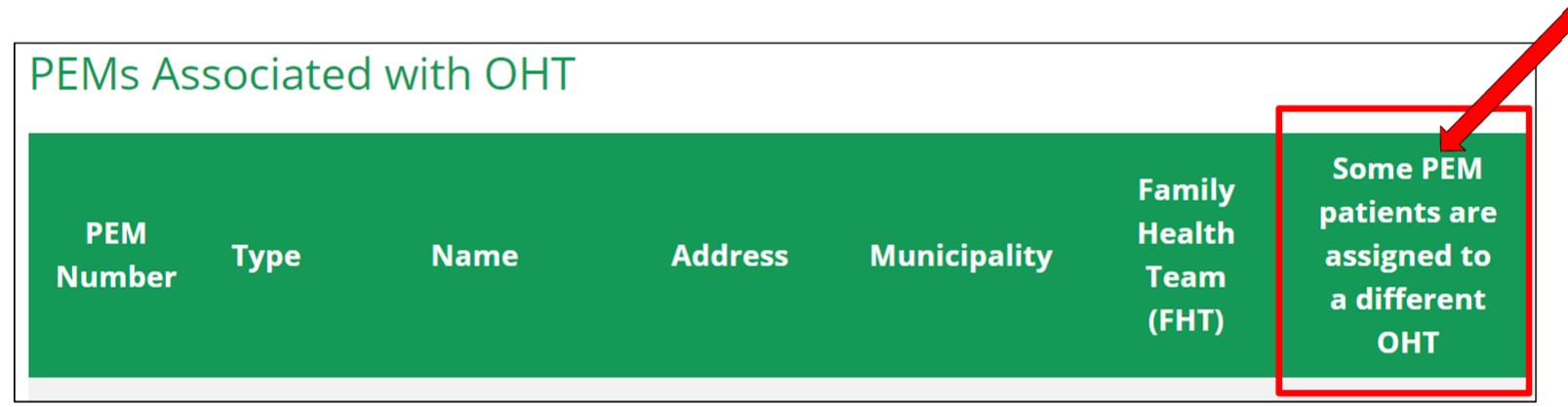
- This section identifies the PEMs that are associated with your OHT’s network(s).
The last column of the table indicates whether some patients (i.e., >20%) in each PEM are attributed to a different network:
- “No” indicates that 80% or more of the patients in that PEM access hospitals services or are referred to specialists within your OHT’s network(s). In other words, this means the PEM is highly aligned with your network, and may provide a good starting point for expanding the membership of your OHT.
- “Yes” means that some of the doctors in the PEM refer patients to hospitals or specialists outside of your OHT’s network(s). While these “split” PEMs might be connected to multiple OHTs’ networks, the patients that they care for are not attributed to multiple OHTs. That is, attributed patients have not been double counted.
PEMs listed as “yes” may require additional engagement to join your OHT, as the physicians within the PEM may have been aligned with different OHTs’ networks.
What does it mean if patients in a PEM have been attributed to the network of a different OHT?
Cases where some patients in a PEM have been attributed to a different network (i.e., “Yes” in the last column of the table) are not inherently good or bad for your OHT. Your OHT may need to have discussions with PEMs split across multiple networks to determine where they feel most aligned. Perhaps this PEM partnered with an OHT outside your network, and overtime the data will catch up to that practice’s changing referral patterns. In either case, the ministry respects these decisions, and recognizes they are not always reflected in the PEM section of this report.
- COVID-19 indicators
- This section includes COVID-19 cases, hospitalizations, and fatalities for the attributed populations for your OHT and Ontario. This analysis links the 2019/20 attributed population to the Case and Contact Management System (CCM), which collects information on all COVID-19 cases in the province.
- The analysis includes all cases, hospitalizations and fatalities for the attributed population up to March 31, 2021. However, the analysis excludes any COVID cases that were not in the 2019/20 attributed population file. In other words, this COVID-19 data for your OHT covers 2020/21, but your attributed population has only been adjusted for 2019/20. As a result, some COVID-19 cases for patients who accessed care within your OHT may not be captured in this data.
- Health conditions
- This section lists your patient population’s health conditions based on CIHI’s Pop Grouper methodology.
In order to provide a more fulsome picture of the health conditions associated with an OHT, all health conditions have been listed in this section. If an individual has more than one health condition, they would be listed multiple times. Therefore, the sum of health conditions is greater than the size of your OHT’s attributed population, since patients might have more than one condition.
Should my team focus on the most prevalent health conditions in my attributed population?
The ministry is not suggesting through this data that teams focus on the most prevalent health conditions in their OHT. The data indicates that almost every team in Ontario has roughly the same top five conditions, and the top one and two are almost always joint/tendon disorder and upper respiratory infection. The data on this tab is provided to give teams a snapshot of the health care needs of their entire patient population.
- General concepts
- This section provides some definitions and explanatory notes for key concepts used throughout the Population, Performance and Utilization Measures document.
- Performance Indicator notes
- This section includes technical notes on how the 19 indicators listed on the Performance Indicators section were calculated. It also identifies the sources and timing of the data used to calculate the indicators.
- Utilization and Population analysis notes
- This section provides technical notes on each of the sections that are in the Population, Performance and Utilization Measures document. It also identifies the sources and timing of the data reported in those sections.
B. Attributed Population by OHT and 2016 Census Dissemination Area (Excel)
This workbook includes the count of your OHT’s attributed population in each 2016 Census Dissemination Area (DA). DAs with an attributed population of less than five are suppressed.
The attributed population is assigned to a DA using the individual’s postal code from the attributed population data, linked to the November 2020 Postal Code Conversion File (Statistics Canada). Individuals with a missing or invalid postal code are not included in these tables.
C. Costs by care type and HPG (Excel)
This workbook focuses on the health care expenses of the network. It consists of 4 tabs: Overview and Definition, Total Expenses, Expenditures Per HPG Population, and Code Table. If a password is required to access the document, it will provided by the ministry.
To be able to use all the functionality of the workbook, click the “enable content” button which is located on the top of the page. Here is a short description of each tab.
- Overview & definition tab
- Provides a definition of the terms used in the workbook. Technical notes about the data reported in the workbook are also included.
- Total expenses tab
- In this tab, all of the HPGs are grouped into the broad categories defined by CIHI.
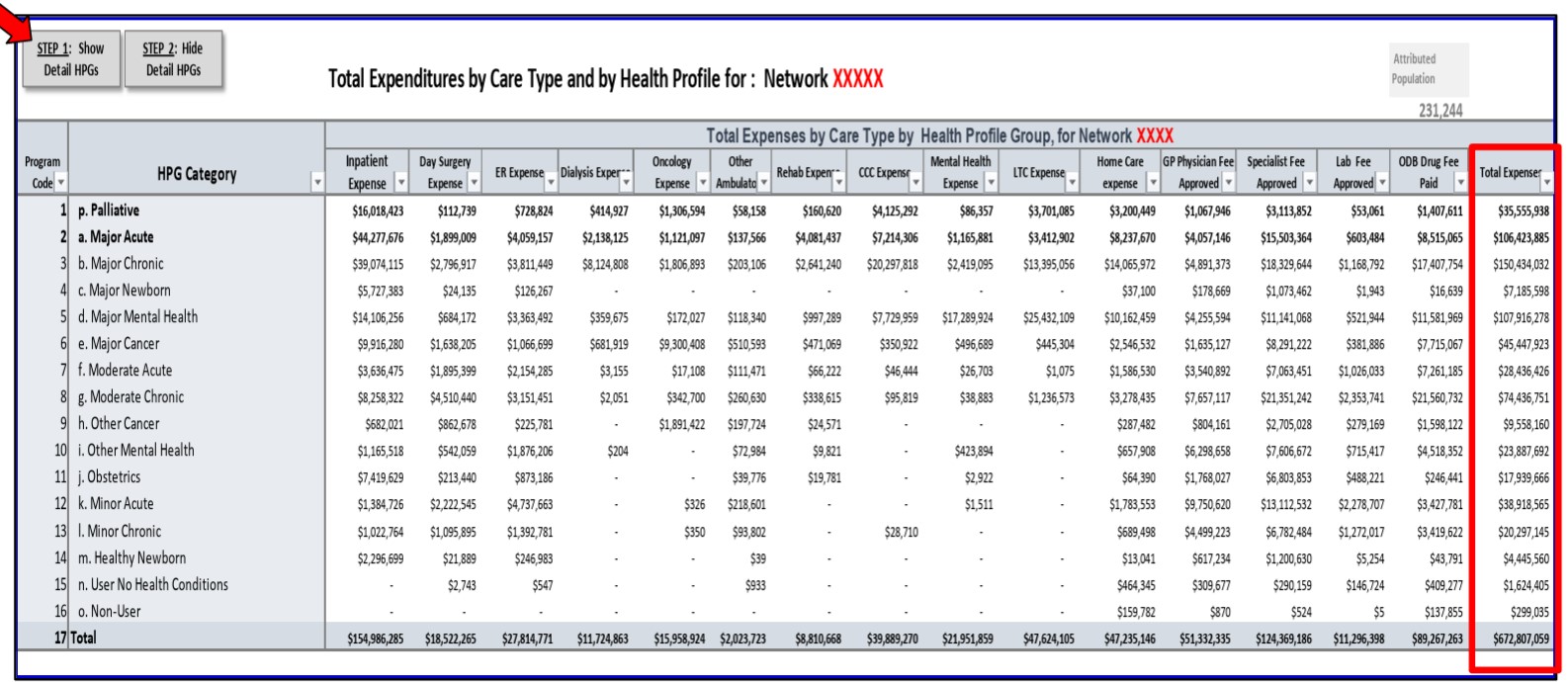
- The “Show Details” and “Hide Details” buttons located on the top left corner of the page can be used to view either a comprehensive or an abridged version of the page.
In the “Show Details” view, all HPGs are displayed and all expenses associated with each HPG by care type are listed across the columns. The total expenses associated with each HPG are listed on the very far right:
- Note that certain expenses are listed under HPGs that may not seem relevant to the HPG. For example, there are often oncology expenses listed under HPGs that are not related to cancer. Since the CIHI Population Grouper methodology categorizes patients by their most clinically relevant HPG, and all of a patient’s expenses are rolled-up into that HPG, additional seemingly unrelated expenses may be listed.
As another example, consider expenses under the palliative HPG: as soon as a patient was determined to be palliative, all of their patient costs were rolled up into the palliative HPG.
Should my team find the highest expense HPG and focus our integration efforts on that clinical condition?
Not necessarily. The challenge with the Pop Grouper methodology is that it does not paint a complete picture of each patient. In the same way that oncology costs are rolled-up into other HPGs, some conditions can be “hidden” when you look at the data in this way. As an example, opioid use disorder will be “hidden” if a person who uses or misuses opioids also happens to have diabetes. This is why the ministry provided the long list of HPGs in the Population Health Data package – to help teams get a complete picture of all HPGs associated with their patient population.
- Per HPG population tab
- This tab is the exact same list of HPGs and the exact same columns as the Total Expenses Tab, with the addition of a new column labelled “HPG Population”. This column identifies the number of patients in your attributed patient population that have been assigned to each HPG. The expenses calculated on this tab are the average cost of each of those patients.
- Unlike in the Population, Performance and Utilization Measures document where the number of health conditions associated with an OHT’s patient population was significantly greater than the size of the population, in the Expenditure Per HPG Population Tab, the number of patients and the size of the attributed patient population are the exact same.
- The ministry is not suggesting through this data that OHTs should focus their energies on the highest volume HPGs, since OHTs frequently have a more complex and nuanced understanding of patient needs than what the data depicts. The data is intended to provide a helpful lens for OHTs to see the number of patients assigned to each HPG based on the Pop Grouper methodology.
In the far-right column, the average expense associated with each HPG is reported, and at the very bottom of the page is the average expense of the attributed patient population.
How do the average expenses of my OHT’s attributed population compare to those of other OHTs?
The average expense on patient population tends to vary by region. This is neither good nor bad. The ministry will not be using average patient expense to compare OHTs as it does not appropriately account for the complexity of each OHT’s population and their unique healthcare needs.
- Code table tab
- This tab provides a list of the codes associated with the HPGs.
D. Expenses (PDF)
This document provides information on expenses and service volumes stratified by hospital care types, as well as information on the cost of providing care to each HPG, in the form of bar graphs and pie charts.
- Expenses by care type (first page)
- On the first page of the PDF, you’ll see the hospitals associated with your OHT’s network(s) and the expenses accrued by those hospitals, as well as the total expenses by care type for your network and the proportion of expenses delivered in-network.
- The three pie charts on the page identify where services were delivered by care type.
- Population expenses profile (second page)
- On the second page of the PDF, the bar graph outlines the total expenses for the top 10 HPGs for your attributed patient population. You can find a legend that defines what these HPGs are on the right-hand side.
- The pie charts indicate where hospital services were delivered for the top three HPGs.
Some teams have asked where patients not receiving care within their OHT’s network(s) are actually going for care. The Population Costing PDF document provides an indication of where that might be. In the pie charts, you will see what proportion of hospital services were delivered within your OHT’s network(s) and the proportion that were delivered out of network, including where that network happens to be.
What happens if the data shows patients from my OHT’s attributed population accessing care outside my OHT?
It is not a bad or good thing when a patient accesses or seeks care outside your OHT. Sometimes it is appropriate for patients to travel outside the OHT to receive the care they need. The data is just an indication of care patterns within the region and where patients may be going to receive treatment for specific conditions.
Conclusion
Recognizing that teams may find the data package they receive complex, this supplementary document attempts to simplify the data, making it easier for teams to understand. The ministry is committed to providing teams with data and analytics support as they progress along the pathway to maturity.
Additional resources
Rapid-Improvement and Support Exchange (RISE)
Question & comments contact your relationship manager
Footnotes
- footnote[1] Back to paragraph Stukel, Therese A; Glazier, Richard H; Schultz, Susan E; Guan, J; Zagorski, Brandon M; Gozdyra, P; Henry, David A. (2013). Multispecialty Physician Networks in Ontario. Open Medicine, 40-55.
- footnote[2] Back to paragraph Technically, “residents” refers to all Ontarians including healthy Ontarians who are not accessing health care services, and “patients” refers to only Ontarians who access care services. This document will use both terms interchangeably.
- footnote[3] Back to paragraph An exception here is noted by the 80/20 rule described above in the ministry’s modified attribution methodology.