

Agricultural residue burn characteristics
Learn about the physical and chemical characteristics of agricultural-based solid biofuels for use as a fuel on the farm. This technical information is for Ontario producers.
ISSN 1198-712X, Published March 2026
Introduction
Agricultural-based materials are grown for fuel on farms and for sale. This fact sheet outlines the physical and chemical characteristics of agricultural-based solid biofuels, explains their significance and includes detailed information on the properties of 22 common solid biofuels available in Ontario.
Solid biofuels
Solid biofuels refer to any organic material derived from plants. When burned, the energy stored in the solid biofuel is released to produce heat or electricity. Common forms of solid biofuels include agricultural crops, crop residues and forestry products (such as switchgrass) (Figure 1).
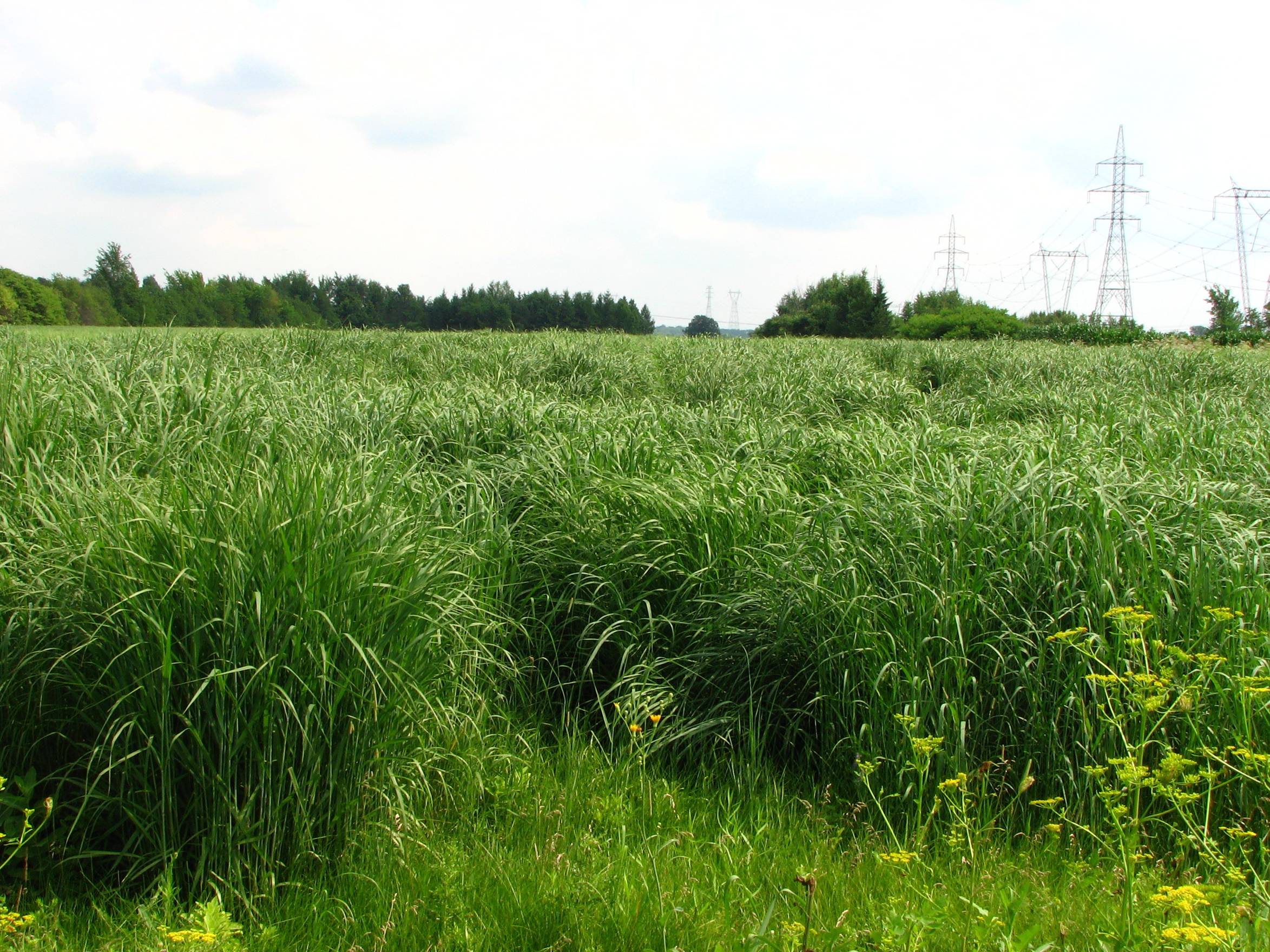
Using solid biofuel as an energy source has advantages:
- solid biofuel is an abundant and renewable source of energy
- using solid biofuel for energy will diversify the energy supply and reduce dependency on fossil fuels
- solid biofuel production may create new jobs for the local economy in Ontario
Energy content
The heating value of a fuel indicates the energy available in the fuel per unit mass — MJ/kg (BTU/lb). The net heating value is the actual energy available for heat transfer. The difference in available energy is explained by the fuel’s chemical composition, moisture and ash content. For comparison, the energy content of fuels is reported on a dry basis. For example, most agricultural residues have heating values that fall in the range of 14–19 MJ/kg (6,040–8,200 BTU/lb). Coal ranges from 17–30 MJ/kg (7,300–1,3000 BTU/lb).
Moisture
Moisture content is the key factor determining the net energy content of solid biofuel raw material. Dry residues and crops have a greater heating value (or net energy potential), as they use little of their energy to evaporate any moisture during combustion. Figure 2 shows this relationship and the connection between energy and moisture contents. Increased moisture means less energy available during combustion.
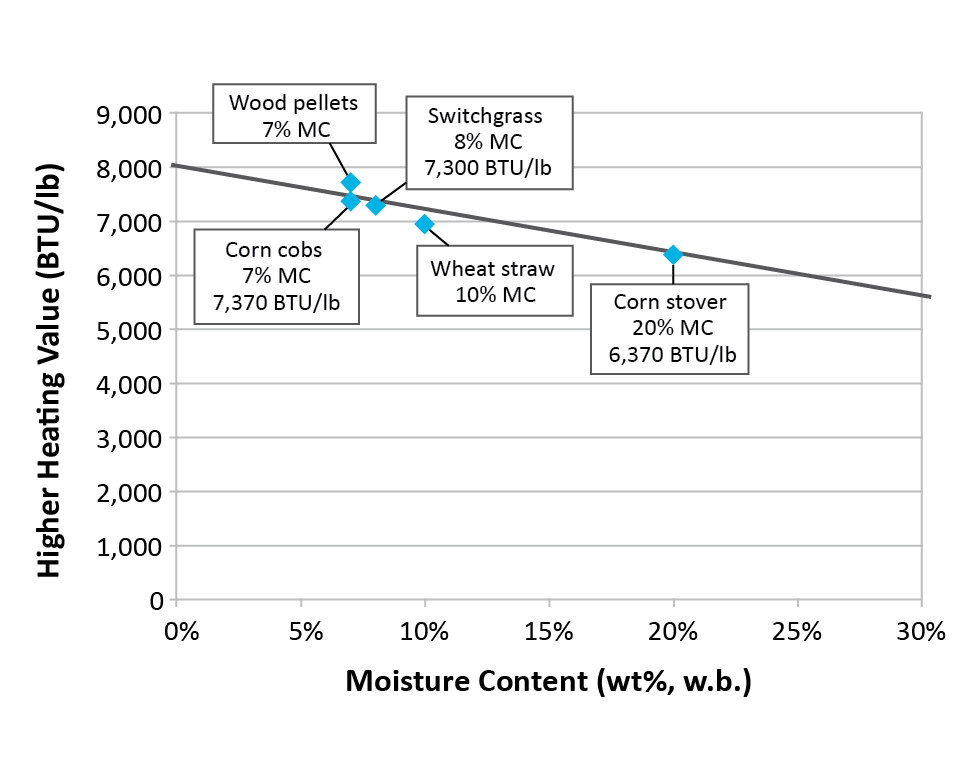
Accessible description of Figure 2
Generally, the moisture content of a solid is expressed as the quantity of water per unit mass. Moisture content is usually reported on an “as-is” or wet basis in which the water content is given as a fraction of the total weight. All solid biofuel materials contain some moisture, from as low as 8% for dried straw to over 50% for fresh-cut wood.
A high moisture content adversely affects the collection, storage, pre-processing, handling and transportation of solid biofuel. In addition, transporting wet material costs more.
The moisture content of raw solid biofuel can be reduced by:
- leaving solid biofuel in the field to dry for several weeks
- storing solid biofuel, sheltered from precipitation
- commercial drying
Composition
The composition of solid biofuel varies significantly among solid biofuel types. Fuel performance is related to the composition of the biomaterial. Important factors include ash, carbon, hydrogen, nitrogen, sulphur, oxygen and chloride content. The elemental composition of various fuels in Ontario is indicated in Table 1. All values are reported on a dry basis.
Ash
The non-combustible content of solid biofuel is referred to as ash. High ash content leads to fouling problems, especially if the ash is high in metal halides (such as potassium). Unfortunately, solid biofuel, especially agricultural crops/residues tend to have a high ash with high potassium content. As a result, the ash melts at lower temperatures, resulting in “clinkers” that can jam furnace elements (Figure 3). Alternately, slagging and fouling occur when ash is vapourized and condensed in the boiler, resulting in the production of hard formations on the heat transfer surfaces (Figure 4).
Wood (core, no bark) has less than 1% ash. Bark can have up to 3% ash. Agricultural crops have higher ash content, from 3% and higher (Figure 5). Some boilers/stoves cannot handle fuels with high ash content. More ash means more maintenance.
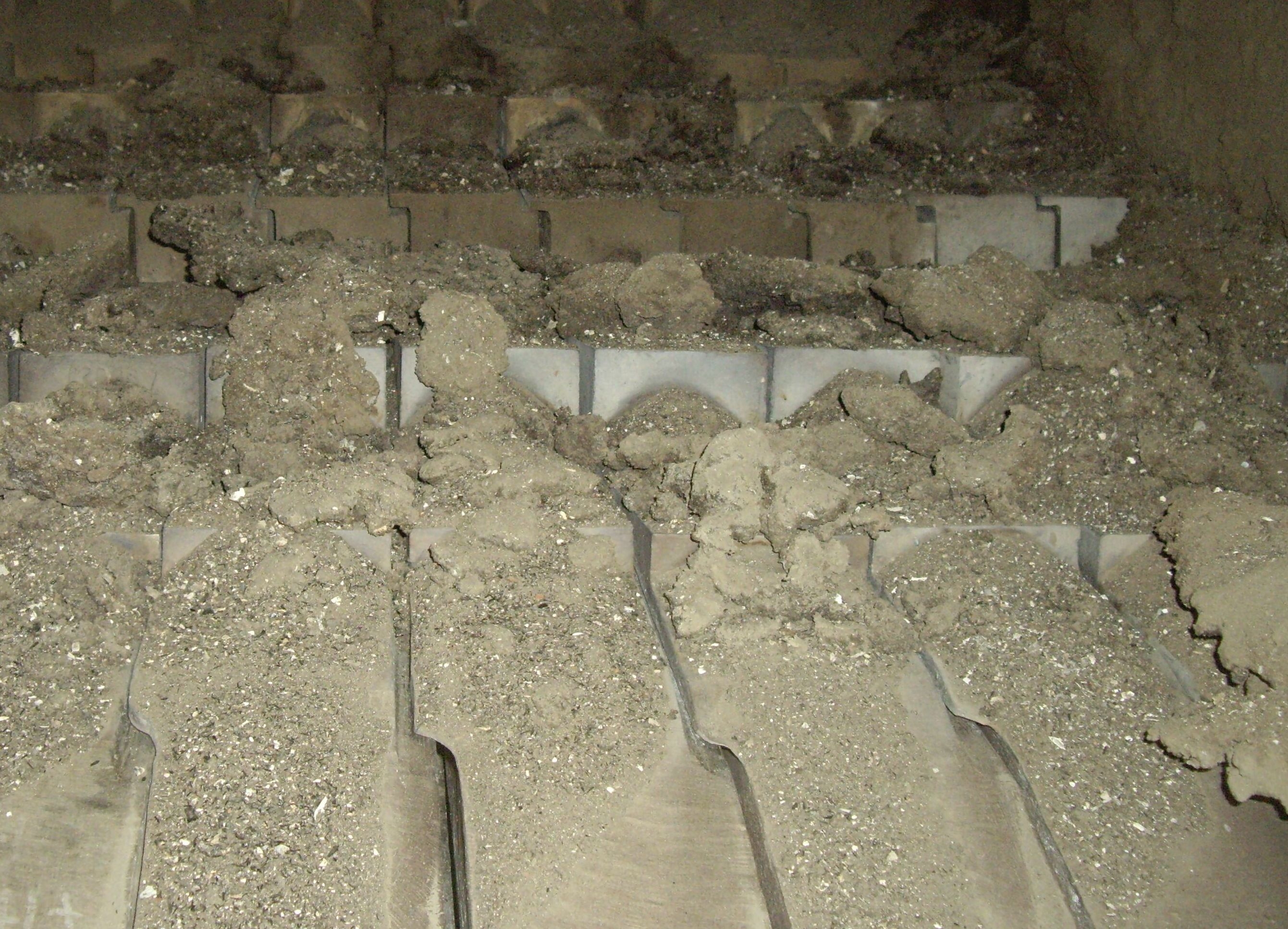
Source: CanmetENERGY.
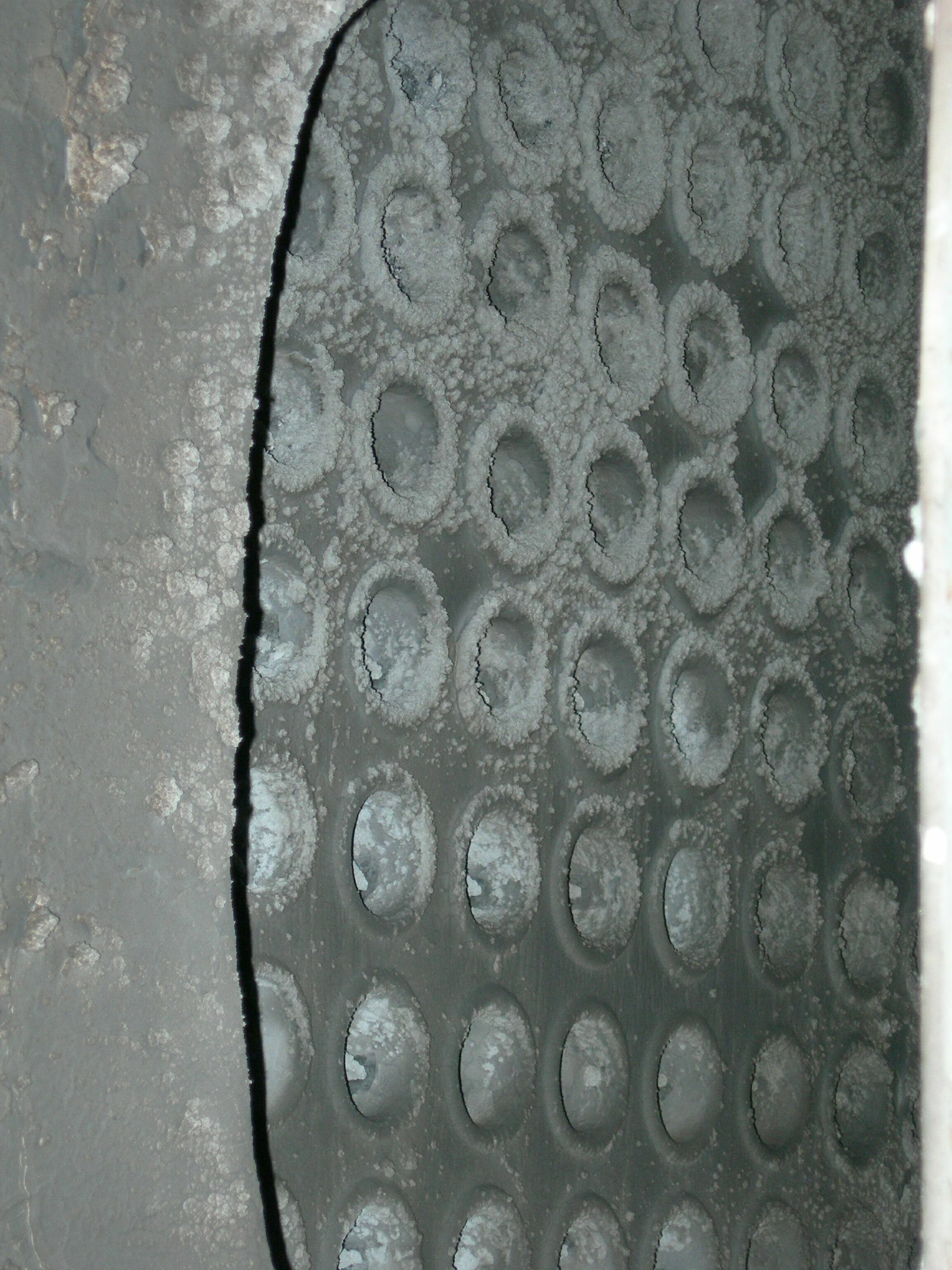
Source: CanmetENERGY.
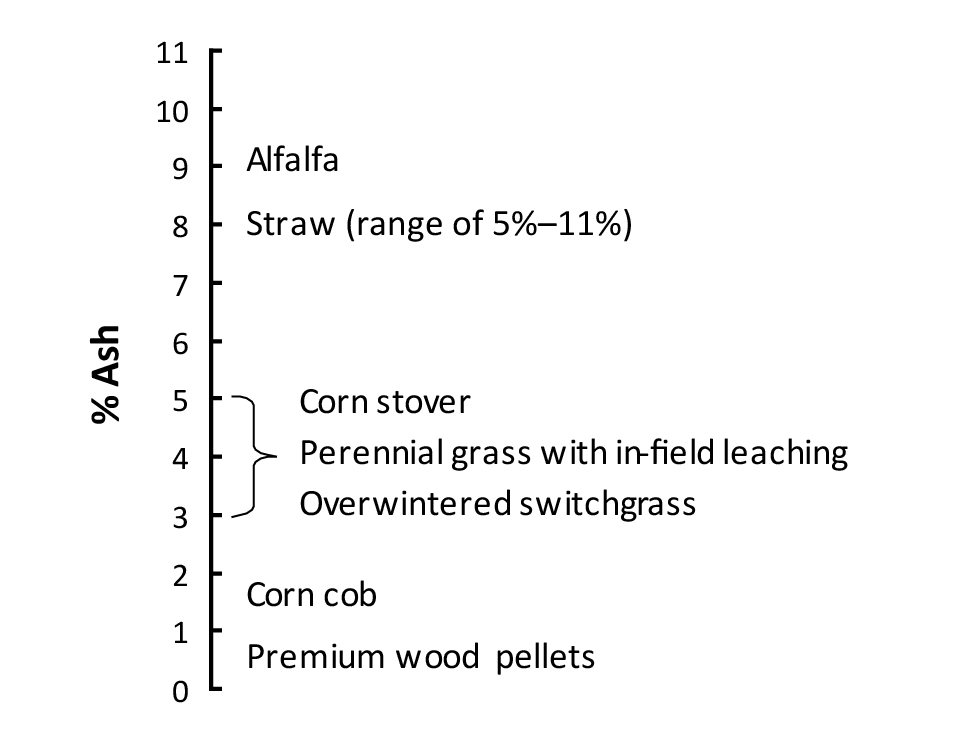
Source: AURI, 2005
Accessible description of Figure 5
Carbon
The carbon content of solid biofuel is around 45%, while coal contains 60% or greater
Hydrogen
The hydrogen content of solid biofuel is around 6%. A higher hydrogen content leads to a higher heating value.
Nitrogen
The nitrogen content of solid biofuel varies from 0.2% to more than 1%. Fuel-bound nitrogen is responsible for most nitrogen oxide (NOx) emissions produced from solid biofuel combustion. Lower nitrogen content in the fuel should lead to lower NOx emissions.
Sulphur
Most solid biofuel fuels have a sulphur content below 0.2%, with a few exceptions as high as 0.5–0.7%. Coal ranges from 0.5–7.5%
Chloride
Combustion of biomass with high chloride concentrations (over 1,000 µg/g) can lead to increased ash fouling. High chloride content leads to the formation of hydrochloric acid in the boiler tubes, resulting in corrosion, tube failure and water leaks in the boiler. This has been observed with corn stover and corn cobs fuels.
Properties
The analyses for a variety of solid biofuel materials are presented in Table 1. All results are displayed on a dry matter basis for comparison. Use the compiled data only as a general comparative guide.
It is important to note that solid biofuel materials naturally contain variability, which depends on:
- geographical location
- variety
- climate conditions
- harvest methods
| Soil biofuel source | MJ/kg | BTU/lb | Ash % | Carbon % | Hydrogen % | Nitrogen % | Sulphur % | Oxygen % | Total Chlorine (µg/g) |
|---|---|---|---|---|---|---|---|---|---|
| Off-spec (non-food) grains: Beans | 19 | 7,996 | 4.7 | 45.7 | 6.3 | 4.3 | 0.7 | 38.8 | 193 |
| Off-spec (non-food) grains: Corn | 17 | 7,350 | 1.5 | 42.1 | 6.5 | 1.2 | 0.1 | 48.9 | 472 |
| Off-spec (non-food) grains: Canola | 28 | 12,220 | 4.5 | 60.8 | 8.3 | 4.5 | 0.5 | 21.4 | 163 |
| Off-spec (non-food) grains: Dried distillers grain | 22 | 9,450 | 4.9 | 50.4 | 6.7 | 4.7 | 0.7 | 32.6 | 1,367 |
| Grass and forages: Big blue stem | 19 | 8,020 | 6.1 | 44.4 | 6.1 | 0.8 | 0.1 | 42.6 | 1,880 |
| Grass and forages: Miscanthus | 19 | 8,250 | 2.7 | 47.9 | 5.8 | 0.5 | 0.1 | 43.0 | 1,048 |
| Grass and forages: Sorghum | 17 | 7,240 | 6.6 | 45.8 | 5.3 | 1.0 | 0.1 | 42.3 | 760 |
| Grass and forages: Switchgrass | 18 | 7,929 | 5.7 | 45.5 | 6.1 | 0.9 | 0.1 | 41.7 | 1,980 |
| Straw and residue: Alfalfa | 17 | 7,435 | 9.1 | 45.9 | 5.2 | 2.5 | 0.2 | 39.5 | 3,129 |
| Straw and residue: Barley straw | 17 | 7,480 | 5.9 | 46.9 | 5.3 | 0.7 | 0.1 | 41.0 | 1,040 |
| Straw and residue: Corn cobs | 18 | 7,927 | 1.5 | 48.1 | 6.0 | 0.4 | 0.1 | 44.0 | 2,907 |
| Straw and residue: Corn stover | 19 | 7,960 | 5.1 | 43.7 | 6.1 | 0.5 | 0.1 | 44.6 | 1,380 |
| Straw and residue: Flax straw | 18 | 7,810 | 3.7 | 48.2 | 5.6 | 0.9 | 0.1 | 41.6 | 2,594 |
| Straw and residue: Wheat straw | 18 | 7,710 | 7.7 | 43.4 | 6.0 | 0.8 | 0.1 | 44.5 | 525 |
| Processing by-product: Oat hulls | 19 | 7,960 | 5.1 | 46.7 | 6.1 | 0.9 | 0.1 | 41.1 | 1,065 |
| Processing by-product: Soybean hulls | 18 | 7,720 | 4.3 | 43.2 | 6.2 | 1.8 | 0.2 | 44.3 | 266 |
| Processing by-product: Sunflower hulls | 20 | 8,530 | 4.0 | 47.5 | 6.2 | 1.0 | 0.2 | 41.2 | 3,034 |
| Wood: Bark | 19 | 8,432 | 1.5 | 47.8 | 5.9 | 0.4 | 0.1 | 45.4 | 257 |
| Wood: Willow | 19 | 8,550 | 2.1 | 50.1 | 5.8 | 0.5 | 0.1 | 41.4 | 134 |
| Wood: Hardwood | 19 | 8,300 | 0.4 | 48.3 | 6.0 | 0.2 | 0.0 | 45.1 | 472 |
| Coal: Low sulphur subbit coal – PRB | 25 | 10,520 | 6.0 | 55.0 | 3.7 | 0.9 | 0.4 | 11.5 | 35 |
| Coal: Lignite | 22 | 9,350 | 22.0 | 58.8 | 4.2 | 0.9 | 0.5 | 13.6 | 25 |
Data compiled from AURI, 2005
Processes to reduce ash, chloride and other elements
Various management strategies exist to reduce the ash and primary elements that interfere with the combustion process, including crop selection, growing conditions, plant fractions, harvesting time and minimizing soil contamination.
Crop selection
Ash is found in lower levels in warm-season grasses, such as big bluestem, switchgrass and annuals such as corn, compared to cool-season grasses, such as orchard grass, fescues and perennial ryegrass
Growing conditions
Soil type highly influences the ash levels of solid biofuel. Higher ash levels are found in crops produced on clay soils than in crops produced on sandy soils.
Plant fractions
The major components of ash are silica and potassium. The distribution and composition of ash varies among different plant fractions. Ash levels are lowest in grass stems and highest in leaves
| Component | Switchgrass ash contents (%) |
|---|---|
| Leaves | 7.0 |
| Leaf sheaths | 3.0 |
| Stems | 1.0 |
| Seed heads | 2.4 |
Source: Modified from Samson et al. 1999b.
Harvest timing to allow for leaching
Ash, chloride and potassium content are minimized by leaving the cut solid biofuel in the field to overwinter. Overwintering switchgrass in the field reduces ash levels to as low as 3.5%, due to leaching and loss of plant components that are higher in ash (such as leaves). However, harvesting in the spring comes at a cost, with solid biofuel losses of between 20% and 50%.
Minimizing soil contamination
It is important to minimize soil contamination of the crop residue, since soil particles greatly increase the ash concentration of the solid biofuel. Select mechanical harvesting techniques that avoid digging up the soil (for example, cut the solid biofuel with a higher stubble height).
Summary
Solid biofuel materials are very diverse, ranging from wood, bark, straw and other agricultural residues, grasses and forages, and off-spec grains. Despite this diversity, the composition of most solid biofuel materials is relatively uniform, especially after moisture is removed. The energy content (on a mass basis) of most dry solid biofuel is in the 17–19 MJ/kg (7,300–8,000 BTU/lb) range. Differences in energy content are due to differences in density and moisture content.
For most solid biofuel, nitrogen and sulphur levels are quite low, resulting in relatively low SOx and NOx emissions. Solid biofuel outside the normal range of these categories is mostly in the off-spec, non–food grain category.
The major difference in the composition of solid biofuel is ash content. Wood, the traditional solid biofuel, generally contains less than 0.5% ash. With bark, this increases to 2–3% and jumps to above 5% for most grasses and agricultural residues. The increased ash content can cause significant fouling, clinkering and handling issues.
Take care when using these fuels. Design conversion systems specifically for the target fuels. Systems designed for low ash wood (or coal) may not be suitable for other solid biofuel.
Conversion
| From | To | Multiply by |
|---|---|---|
| MJ/kg | BTU/lb | 430 |
| BTU/lb | GJ/ton | 0.00233 |
Resources
Biomass Resources. CanmetENERGY. Natural Resource Canada.
International Energy Agency (IEA). Biomass combustion and co-firing properties.
Phyllis2: Database for biomass and waste. Energy Data Centre.
Database of chemical properties of Australian biomass and waste. The Commonwealth Scientific and Industrial Research Organisation (CSIRO), Australia.
United States Department of Energy (USDOE). Feedstock composition and property database.
Author credits
This fact sheet was updated by Terence Sauvé, P. Eng., farmstead optimization and safety engineer, Ministry of Agriculture, Food and Agribusiness. This fact sheet was originally written by Steve Clarke, P. Eng., energy and crop engineering specialist, Ministry of Agriculture, Food and Rural Affairs, Kemptville, and Fernando Preto, PhD, research scientist, CanmetENERGY, Ottawa.
Accessible image descriptions
Figure 2. Typical net heating value (BTU/lb) as a function of moisture content. Moisture levels shown (w.b. = wet basis) are the fraction (%) of raw solid biofuel material that is water.
A line chart showing the net heating value as a function of moisture. Wood pellets have a heating moisture of 7% followed by corn cobs (7%), switchgrass (8%), wheat straw (10%) and corn stover (20%).
Figure 5. Typical ash content for selected biomass on a dry basis.
A scale showing the ash content for selected solid biofuels. Premium wood pellets have the lowest ash content at 1%, followed by corn cobbs (2%), switchgrass (3-5%), corn stover (5%), straw (5-11%) and alfalfa with the highest content at 9%.
Footnotes
- footnote[1] Back to paragraph AURI. (2005). Agricultural renewable solid fuels data. Retrieved from Agricultural Utilization Research Institute Fuels Initiative.
- footnote[2] Back to paragraph Preto, F. (2010). Properties of the 13 common biomass fuels in Ontario. Natural Resources Canada (NRCan), Ottawa, ON.
- footnote[3] Back to paragraph Demirbas, A. (2004). Combustion characteristics of biomass fuels. Progress Energy Combustion Science, 30: 219–230.
- footnote[4] Back to paragraph The content level of ash, chlorine and other elements can be lowered through crop selectivity, growing conditions, plant fractionation, harvest time and harvest method.
- footnote[5] Back to paragraph Calculated by difference. Percent by difference refers to the difference between two numbers as a percent of one of them. For example, the percentage difference from 5 to 3 is: 2/5 = 0.4 = 40%.
- footnote[6] Back to paragraph A microgram is a unit of mass equal to 1/1,000,000 of a gram (1 × 10⁻⁶), or 1/1,000 of a milligram. It is one of the smallest units of mass commonly used.
- footnote[7] Back to paragraph BIOBIB: A database for biofuels, Technical University of Vienna, Austria. Database of biomass properties.
- footnote[8] Back to paragraph Mehdi, B., & Samson, R. (1998). Strategies to reduce the ash content in perennial grasses. Resource efficient Agricultural Production-Canada. Ste. Anne de Bellevue, Quebec.
- footnote[9] Back to paragraph Samson, R., Girouard, P., & Mehdi, B. (1999b). Establishment of commercial switchgrass plantations. Resource efficient Agricultural Production-Canada. Ste. Anne de Bellevue, Quebec.