

Darlington Provincial Park Management Plan (2026)
This document provides direction on the management of Darlington Provincial Park.
Examination and adjustment of management direction
| Approval date | Examination or type of adjustment | Examination outcome (where applicable) | Link to document |
|---|---|---|---|
| March 11, 2013 | Administrative | N/A | N/A |
| October 30, 2014 | Administrative | N/A | N/A |
| November 24, 2014 | Amendment | N/A | N/A |
| March 9, 2026 | Amendment | N/A | N/A |
Amendment approval statement (2026)
March 9, 2026
I am pleased to approve this amendment to the management plan for Darlington Provincial Park. This amendment provides revised and additional direction on management of vegetation and wildlife within the park.
I would like to express my appreciation to all those who participated in the planning process.
Sincerely,
Jason Travers
Director, Ontario Parks Operations Branch
Amendment approval statement (2014)
November 24, 2014
Dear Sir or Madam:
I am pleased to approve this amendment to the 1985 management plan for Darlington Provincial Park. The amendment provides revised direction in the management plan to enable the restoration of McLaughlin Bay and a utility easement as well as general updates to the plan and associated maps.
I would like to express my appreciation to all those who participated in the planning process.
Yours Truly,
Bradley Fauteux
Managing Director
Ontario Parks
Approval statement (1985)
“We are pleased to approve the Darlington Provincial Park Management Plan, as official policy for the management and development of this park. The plan reflects this ministry’s intent to protect natural and cultural features of Darlington and maintain and develop high quality opportunities for outdoor recreation and heritage appreciation for both residents of Ontario and visitors to the Province.”
M. Fordyce
Regional Director
Central Region
N. Richards
Director
Parks and Recreational Areas Branch
1.0 Introduction
Darlington Provincial Park (hereafter referred to as “Darlington” or “the park”) is one of the Ministry’s most intensively used recreation-oriented open spaces. This popularity results from its proximity to Oshawa and Metro Toronto and its ease of access for motoring tourists, being the only provincial park located immediately adjacent to Highway 401. Major attributes of the park include a wide range of developed facilities for day use and camping, direct access to Lake Ontario and a scenic landscape, including McLaughlin Bay.
Darlington is situated on the north shore of Lake Ontario, in the Town of Newcastle (former Township of Darlington), Regional Municipality of Durham. The park is immediately adjacent to the eastern boundary of the City of Oshawa and approximately 65 km east of Metro Toronto.
The park consists of 209 ha, 114 ha of which are land and 95 ha of which are water.
The park was acquired in two separate transactions. Most of the park was originally transferred to the Ministry of Natural Resources by the Ministry of Transportation and Communications in 1957. In 1963, McLaughlin Bay, on the park’s western side, was acquired from the Oshawa Hunt Club.
It is for the purpose of planning, development and management of the park’s natural, cultural and recreational resources that this management plan is being prepared.
In 2006 the Provincial Parks Act was replaced by the Provincial Parks and Conservation Reserves Act (PPCRA).
The PPCRA has two specific principles that guide all aspects of planning and management of Ontario’s system of provincial parks and conservation reserves:
- Maintenance of ecological integrity shall be the first priority and the restoration of ecological integrity shall be considered.
- Opportunities for consultation shall be provided.
Other legislation (i.e., Endangered Species Act, 2007), policies, initiatives (e.g., climate change, invasive species) and best practices (e.g., adaptive management, landscape level planning) also provide additional direction for protecting Ontario’s biodiversity and contribute to guiding protected area planning and management.
All activities undertaken in Darlington Provincial Park must comply with project evaluation requirements for provincial parks and conservation reserves, where applicable.
2.0 Indigenous communities
Darlington Provincial Park is located within the Williams Treaties First Nations traditional territory, which includes the Mississaugas (Alderville, Hiawatha, Scugog Island and Curve Lake First Nations), and Chippewas (Beausoleil, Georgina Island and Rama First Nations), and within the Kawartha Nishnawbe asserted territory.
3.0 Summary of significant issues and policy decisions
Severe shoreline erosion, predominantly along the park’s eastern shore bluff is causing substantial loss of land, threatening existing facilities and creating an unaesthetic shoreline. Endangered roads and campsites will be removed. Future development of permanent facilities will be kept back from the shoreline due to erosion issues.
Since 1985, the nearby Oshawa Harbour has been expanded. Industrial development and the creation of the McLaughlin Bay Wildlife Reserve has occurred to the west of the park on part of what was formerly the Beaton Farm. In addition, the park is now connected to municipal water and sewer services.
The proposed new park entrance off of Wentworth Street is no longer appropriate and a 401 interchange west of the park was never developed.
Figure 1: Rregional setting map
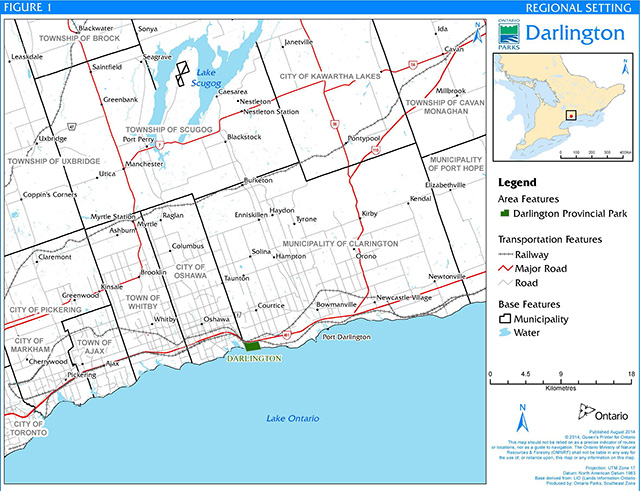
Enlarge Figure 1: Regional setting map
4.0 Park policies
4.1. Park classification
The classification of Darlington is “recreational” in recognition of the park’s outstanding recreational facilities and opportunities.
4.2. Park goals
To maintain and operate Darlington as a major urban recreation-oriented provincial park providing a wide variety of intensive and extensive outdoor recreational opportunities for the rapidly growing urban population of the Regional Municipality of Durham, as well as to provide stop-over camping facilities for the Highway 401 users. Recreational opportunities will be provided while protecting the park’s significant natural and cultural resources.
4.3. Park objectives
4.3.1. Recreation
The recreation objective of the Ontario Provincial Parks system is to provide opportunities for ecologically sustainable outdoor recreation opportunities and encourage associated economic benefits.
The recreation objective for this park is to provide year-round intensive and extensive outdoor recreation opportunities and facilities that utilize the area’s prime recreational resources, namely Lake Ontario, McLaughlin Bay and the land base.
The park provides Ontario’s residents and out-of-province visitors, especially those travelling the 401 Highway, with camping/day-use opportunities.
4.3.2. Heritage appreciation
The heritage appreciation objective of the Ontario Provincial Parks system is to provide opportunities for residents of Ontario and visitors to increase their knowledge and appreciation of Ontario’s natural and cultural heritage.
The heritage appreciation objective of this park is to provide a range of opportunities for the exploration, interpretation and appreciation of the natural features (i.e., McLaughlin Bay, Robinson Creek) and cultural resources (i.e., pioneer cemetery and log cabin) of the park.
4.3.3. Protection
The protection objective of the Ontario Provincial Parks system is to permanently protect representative ecosystems, biodiversity and provincially significant elements of Ontario’s natural and cultural heritage and to manage these areas to ensure that ecological integrity is maintained.
The protection objective of this park is to protect the resources of the park through zoning that is sensitive to the particular resource management needs of the park’s features as well as to the recreational pressures placed on these resources. Two areas within the park that are particularly sensitive to adverse forms of development and recreational use are the McLaughlin Bay area as well as Robinson Creek.
4.4. Park boundary
There are no plans to alter the park’s present boundary. Additions to the park boundary will be considered if property is needed to enhance the values of the park. Acquisition or securement will be subject to available resources and the willingness of the owners to sell or lease their properties or enter into a conservation easement.
Disposition of park land for public benefit (e.g., municipal drainage, water or sewer easements) may be considered subject to review and approval by Ontario Parks. Ontario Parks may impose terms and conditions on authorized dispositions. Dispositions for private or commercial use will not be permitted.
An easement will be provided to the Regional Municipality of Durham for use and maintenance of a section of municipal forcemain and watermain located within the park. Easement documentation should limit alterations within the easement to those that reflect as much as possible the natural environment character of the park.
4.5. Zones and zone policies
All lands within the park will be zoned (see Figure 2) in recognition of their existing and potential environmental qualities, required protection and their potential for recreational and interpretive use within the context of the overall three objectives (see 4.3 Park Objectives).
4.5.1. Development zone
(91 ha - land only)
This zone encompasses the majority of the park’s land base. Facilities for day use, camping, park maintenance/administration, and associated open space are located in this zone.
Development zone policies:
- To improve the landscape aesthetics and the environmental quality of this zone; where possible (see Section 7).
- To improve the operational/maintenance efficiency and the recreational opportunities at the park, facilities will be maintained, upgraded, expanded, altered and relocated where necessary.
4.5.2. Natural environment zone
(118 ha - land and water)
The two “natural environment” zones in the park contain aesthetic landscapes with sensitive natural characteristics. The two zones include: (a) the narrow north-south running stream valley of Robinson Creek, that separates the campground area from the day-use area, and (b) the western portion of the park including McLaughlin Bay, its barrier beach, associated marsh/wetland, wet meadows caused by groundwater seeps, adjacent backshore areas and the portion of Lake Ontario (lake bed) that lies within the park boundary.
Figure 2: Park boundary, zoning and values
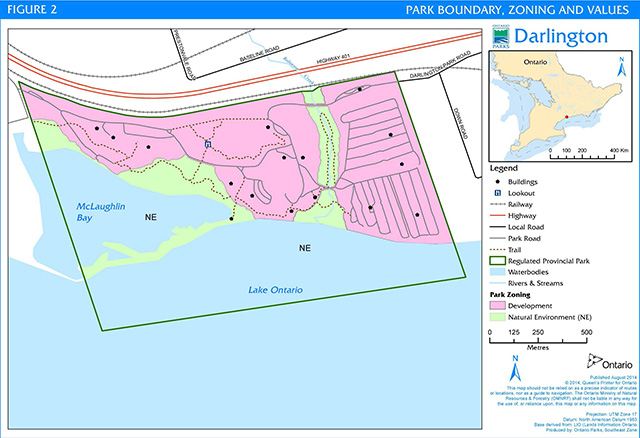
Enlarge Figure 2: Park boundary, zoning and values map
Natural environment zone policies:
- To protect through zoning and approved management procedures the natural features found in these areas from detrimental forms of development, management and recreational use.
- To allow appropriate forms of recreational activities to occur (e.g., hiking, waterfowl viewing, canoeing).
- To monitor these appropriate recreational activities to ensure no future detrimental impacts on the zone’s resources.
- To take approved management initiatives to improve and enhance the environmental qualities and resources found in these areas.
5.0 Resource management
5.1. Landform and water management
Shoreline erosion will be recognized as a natural process occurring as a result of the natural dynamics of Lake Ontario. Present day recommended methods for erosion control for such a long shoreline are cost prohibitive. Any erosion control methods developed in the future, that are cost effective and consider natural dynamics, may be initiated. This includes vegetation planting and does not include shoreline hardening methods.
Resource management projects may be undertaken in order to restore and/or rehabilitate McLaughlin Bay. These projects may include the following activities within the bay:
- Managing water levels
- Dredging or filling below high water mark for habitat creation only
- Habitat enhancement or restoration (fish and wildlife)
- Restoring natural environments (vegetation)
- Shoreline management for restoration purposes (stabilize shoreline/erosion control)
- Prevention, control and management of invasive alien species (e.g., plants, carp)
- Alter grade above high-water mark for restoration purposes
Development projects associated with the restoration of McLaughlin Bay to enhance recreational opportunities are found in Section 7.
5.2. Vegetation management
Management of existing vegetation and proposed projects will be subject to project evaluation requirements.
Park management will protect significant vegetative communities and plants including those identified in the park’s reconnaissance biological inventory (See Appendix A, A Reconnaissance Biological Inventory of Darlington Provincial Park in Darlington Provincial Park Management Plan – Background Information Document).
The vegetative communities in the park will typically be allowed to evolve with minimum management interference; however, vegetative communities may be managed as needed, including but not limited to the following situations:
- management of forest cover in the campgrounds and day-use areas to ensure visitor safety, and the long-term health of the tree(s).
- management of native plant species to maintain, enhance, rehabilitate or restore habitat (e.g., vegetation thinning to maintain Piping Plover habitat in accordance with relevant legislation).
- planting of native, local species may be undertaken in order to maintain or restore natural environments.
- insects and diseases which do not threaten ecological integrity will be allowed to develop undisturbed in all zones of the park.
- acceptable vegetative management procedures involve controlling non-native insects and diseases that threaten the values within the park as well as values outside of the park.
- where control is desirable, it will be directed as narrowly as possible to the specific insect or diseases as to have minimal effects on other components of the park’s environment.
- where invasive alien species threaten park values, a control/eradication program may be undertaken if feasible and practical. These species will not be deliberately introduced into the park.
5.3. Wildlife management
Sport fishing will be encouraged in offshore park waters.
A controlled waterfowl hunt will be allowed on McLaughlin Bay within the boundaries of the park. The waterfowl hunt is sanctioned through regulation under the Fish and Wildlife Conservation Act.
Nuisance animal control, if necessary, may be carried out under the strict supervision of /or directly by Ontario Parks. Native species with the potential to become hyperabundant (e.g., Double-crested Cormorants) may be managed, as required, to protect the park’s values and ecological integrity.
Wildlife population management would be subject to all applicable legislation and policies and any associated consultation. A report would be prepared to evaluate the need for population management based on monitoring data. The report would outline methods and an implementation strategy.
Population management will consider the broader landscape and best management practices.
5.4. Cultural heritage resources management
Cultural heritage resources that may be affected by any park projects or activities will be identified and managed (i.e., protected, maintained, used and/or disposed of) in accordance with the Standards and Guidelines of Provincial Heritage Properties (Ontario Heritage Act, Part III, 1). Staff will consult the Technical Guideline for Cultural Heritage (OMNR, 2006).
Preventive types of maintenance measures will be taken, as required, on the Pioneer Cemetery and the pioneer log cabin (Visitor Information Centre) to ensure their structural soundness.
6.0 Client services management
6.1. Natural heritage education
Darlington, as a major urban recreation oriented provincial park, with close proximity to Highway 401, provides a wide variety of quality visitor services.
The goal of Natural Heritage Education (NHE) is to develop visitor awareness and appreciation of Ontario Parks’ natural and cultural heritage, fostering a commitment to its protection for future generations. An NHE program has three components: information, interpretation and outdoor recreation.
6.1.1. Information
Objectives of this component should include the following:
- inform park visitors about the park, its services, facilities and management concerns
- inform visitors about recreation and interpretive opportunities in the local area
- inform visitors of the role of the Ministry
- instill a sense of respect in visitors for the park environment
- provide a means of feedback for visitors to communicate to the Ministry.
A comprehensive information component will be provided catering to the needs of special user groups such as the urban day users and tourists travelling on the Highway 401 corridor (especially the first time tourists to Ontario). The pioneer cabin will be utilized as an information and display centre dispensing tourist, park and ministry information via publications and signage.
The objectives outlined above will be achieved through all or some of the following: publications, signage, interpretive programs, multimedia presentations, displays, mass media and personal contact involving campsite visitation.
6.1.2. Interpretation
The following is a list of themes that will be interpreted:
- Local Settlement History (On-site features to aid this theme include the Pioneer Cabin, artifacts and Pioneer Cemetery.)
- General ecology (including the history of the park’s land base from original forest cover to agricultural fields and back to natural and planted forest cover)
- Lake Ontario (fishery, dynamics of shoreline erosion and control, changing environment of McLaughlin Bay and changing barrier beach configuration)
- Marsh ecology
- Lakeshore migration
All of the above themes can be interpreted in publications, programs, guided walks, special events and interpretive facilities.
Local and regional school boards will be encouraged to make educational use of the park’s resources.
6.1.3. Outdoor education
Limited staff-led recreation activities will be provided as funds and staff priorities permit. They may include campfire, craft and water oriented programs. Such programs should lead to an involvement with the natural and cultural features of the park.
These programs may be delivered by staff or qualified guest speakers.
6.2. Recreation management
Darlington has a high potential for self-use recreation with a waterfront for sunbathing, swimming, boating and fishing. As well, self-use recreation can occur on the park’s nature trails, Ontario’s Waterfront Trail and open landscaped areas. Winter opportunities exist as well for cross-country skiing and snowshoeing.
The park will be managed to optimize its recreational potential.
Existing facilities will be upgraded and additional ones provided, as needed, to enhance and maximize the recreational opportunities of the park.
During off-season, when the park’s facilities are closed, visitors have access to the park’s land base for recreational pursuits (e.g., walking, waterfowl hunting and viewing, and cross country skiing).
To supplement the park’s recreation facilities a free recreation equipment loan program may be offered.
6.3. Commercial services
The following existing commercial services are available at the park:
- Food concession
- Fast food/store
Additional concessions may be added or existing ones modified in some way, in keeping with park goals and objectives.
6.4. Marketing
The following is a ranking of common Provincial Park marketing strategies, listed in decreasing order of importance, as they apply to Darlington.
- Hold present customers longer.
- To increase midweek camping and day use.
- Attract day users who will stay in local service accommodations and use local services.
- Expand demand for camping by encouraging visitation to Ontario Provincial Parks as well as to private campgrounds.
- Increase day use where high volume (i.e., groups) can be achieved.
- Continued use by outside groups for special events.
7.0 Development and implementation
Though the park has a diverse and fully developed range of facilities, the following development proposals are justified in order to: improve the efficiency of operating/maintaining the park; enhance recreational experiences; upgrade existing facilities; and, accommodate increased use.
- Development of a new trailer sanitation station located east of the main park entrance (completed, near former campground entrance).
- Additional entrance lanes and upgraded fee collection facilities and gatehouse at main park entrance. (completed)
- Installation of day use (completed) and campground playground equipment.
- Expansion of hydro sites.
- Replace existing fencing around the northern boundary of the park along the C.N. Railway tracks.
- Erection of sound barriers along the north boundary in the vicinity of the campground. The design and material (structural or earth) of the barrier is yet to be determined.
- Day-use expansion west of picnic area #3 (completed).
- Park sewage hook-up with an expanded Oshawa system (completed).
The following development proposals are associated with the restoration and recreational enhancement of McLaughlin Bay:
- Shoreline boardwalk.
- Structures (docks, pier) to be developed for fishing/viewing platforms (completed).
Various types of roofed accommodation structures may be constructed on existing campsites or in other suitable areas within the development zone.
Implementation of the above actions is subject to:
- applicable legislation and provincial policies;
- availability of financial and human resources.
8.0 Summary of involvement
Indigenous community, public, and stakeholder consultation is an important part of the management planning process. The Ministry is committed to consultation during management planning for Darlington Provincial Park.
8.1. Amendment 2026
Summary and results of Indigenous community involvement
On December 6, 2021, personalized letters were sent by email inviting the following Indigenous communities of the Williams Treaties First Nations to comment on the proposed management plan amendment:
- Alderville First Nation
- Curve Lake First Nation
- Hiawatha First Nation
- Mississaugas of Scugog Island First Nation
- Chippewas of Georgina Island First Nation
- Chippewas of Rama First Nation
- Beausoleil First Nation
The project proposal notice was also sent by email to the Oshawa and Durham Region Métis Council.
Curve Lake First Nation consultation staff responded to express interest and requested to meet with Ontario Parks staff to discuss the project. A meeting took place on January 14, 2022. No changes to the proposed amendment were required as a result of the meeting.
Summary and results of public and stakeholder involvement
On December 6, 2021, the proposed management plan amendment was released for a 45-day comment period, which ended January 20, 2022.
Notice was posted on the Environmental Registry of Ontario, sent to 62 individuals or groups on the project mailing list by email or letter mail and posted at the park.
A total of 22 responses from the public and stakeholders were received throughout the 45-day comment period. These comments were received through the Environmental Registry of Ontario and by email.
Comments in support of the proposal commonly addressed protection and enhancement of McLaughlin Bay, species at risk, Piping Plover, habitat and/or biodiversity and adaptive management within the park.
Common concerns related specifically to the example of Double-crested Cormorant population management and supporting scientific information and implementation methods related to this example. Some concerns addressed topics that were not in scope of the proposed changes to the management plan (e.g., cormorant hunting and roosting deterrence).
As a result of comments received, changes to Section 5.3 Wildlife Management were revised to include additional information and to clarify requirements for wildlife population management projects in the park.
8.2. Amendment 2014
Summary and results of Indigenous community involvement
There were opportunities for local Indigenous community involvement through the amendment process. Notice and information on the park management plan amendment for Darlington Provincial Park was provided to five local Indigenous communities at the opportunity to comment stage. The park superintendent also contacted each community by phone. One comment was received acknowledging continued interest in notifications and provided contact information in the event of artifacts being uncovered during the restoration of McLaughlin Bay.
Summary and results of public and stakeholder involvement
Ontario Parks was committed to consultation with government agencies, other ministries, interest groups and the public throughout this planning process. Consultation methods included: direct mailings, advertisement in local newspapers and a policy proposal notice on the Environmental Registry.
One public consultation opportunity was provided to comment on the proposed amendment. Responses from this period were considered in determining the final policy.
The proposed amendment was released in July of 2013 through a policy proposal posting on the Environmental Registry of the Environmental Bill of Rights. Invitations to participate were mailed to persons and organizations on the park planning mandatory contact list, local landowners, stakeholders and interested individuals. The 47-day comment and review period was announced through newspaper advertisements in Oshawa/Whitby. This Week and Clarington This Week. Copies of the document were available at Darlington Provincial Park.
Four comments were received in response to the Darlington Management Plan amendment. All comments were received through email; no comments were submitted through the Environmental Registry. No contentious issues were raised during this planning stage. Three responses were specific to the Category C restoration project for McLaughlin Bay, and will be considered under the project environmental assessment process.
One comment had specific corrections/changes for the amendment which have been addressed through a second administrative update and are reflected in the final amendment. This comment also requested an enlargement of the natural environment zone which was not within the scope of this amendment but has been noted for future amendments to the plan. Because no new development is proposed in the areas noted, these lands will remain un-changed under the current development zoning.
8.3. Management plan 1985
Public consultation in 1985 focused on the local area and included a news release, newspaper advertisements and posting in the park. Adjacent landowners were informed by park management and copies of the plan were sent to local levels of government and stakeholders. All comments and suggestions received from the public were considered while finalizing the plan.
9.0 Plan examination and adjustment
This management plan will be examined in accordance with the provisions of the PPCRA to determine whether the management direction is still relevant, effective and current, or if an adjustment is required. In circumstances where this plan is not providing sufficient direction, it can be examined prior to the next scheduled examination.
External requests for adjustments to address specific concerns may be considered. Ontario Parks can provide further guidance to external parties on the process for requesting an adjustment to this plan and whether specific requests can/will be considered.
10.0 References
Department of Lands and Forests. Archaeological Survey of Darlington Provincial Parks, prepared by J.A. Burn.
Environment Canada. 1982. Oshawa Second Marsh Baseline Study, Interim, Integration and Interpretation of Ecological Data, prepared by C.P. Cecile, C. P.
Fisheries and Environment Canada. 1977. The Tourist and Outdoor Recreational Climate of Ontario, Volumes 1, 2 and 3, prepared by Crowe, McKay, Baker. Toronto: Department of the Environment.
Department of Lands and Forests. 1971. Pioneer Family Research – Darlington Park, prepared by Lindsay Martin.
Ontario Ministry of the Environment, Conservation and Parks. 2023. Ontario Parks Project Evaluation Policy.
Ontario Ministry of Natural Resources. 1982. Provincial Park Day Visitor Survey – Summary.
Ontario Ministry of Natural Resources. 1982. Statistical Report. Outdoor Recreation Group.
Ontario Ministry of Natural Resources. 1983. Lindsay District Land Use Guidelines.
Ontario Ministry of Natural Resources. 1985. Darlington Provincial Park Management Plan. Government of Ontario.
Ontario Ministry of Natural Resources. 1984. Darlington Provincial Park Management Plan – Background Information Document. Government of Ontario.
Ontario Ministry of Natural Resources. 1983. 1982 Provincial Park Camper Survey – Summary Statistical Report. Outdoor Recreation Group.
Ontario Ministry of Natural Resources. 2005. A Class Environmental Assessment for Provincial Parks and Conservation Reserves. Queen’s Printer for Ontario.
Ontario Ministry of Natural Resources. 2006. A Technical Guideline for Cultural Heritage Resources for Projects Planned Under the Class Environmental Assessment for MNR Resource Stewardship and Facility Development Projects and the Class Environmental Assessment for Provincial Parks and Conservation Reserves. Queen’s Printer for Ontario.
Suddard, Gwen. 1975. Visitor Services Report Darlington.