

January to March, 2026
Introduction
About the Ontario Employment Report
The Ontario Employment Report is released four times a year and provides an assessment of the current trends and developments in the Ontario labour market. The Ontario Employment Report is a companion report to the Ontario Economic Accounts, which provides an overall assessment of the current state of the Ontario economy.
Overview
Ontario’s labour market overview
Employment:
- -37,200 net jobs in Q1 2026, year-over-year
- +25,600 net full-time jobs in Q1 2026, year-over-year
- -5,800 net jobs in March 2026
- +12,400 net full-time jobs in March 2026
Unemployment rate:
- 7.5% in Q1 2026
- 7.6% in March 2026
Year-over-year, Ontario’s employment declined by 0.5% (-37,200) in the first quarter of 2026, marking the first year-over-year quarterly employment decline since the pandemic. At the same time, the labour force contracted (‑0.6%) and population growth, as measured by the Labour Force Survey, slowed to 0.8%, one of the lowest rates on record. This compares to a modest national employment increase of 0.3% (+57,800) over the same period. Between the first quarters of 2025 and 2026, Ontario’s unemployment rate edged down by 0.1 percentage point to 7.5%, while the national rate remained unchanged at 6.9%.
In March 2026, compared to the previous month, Ontario’s employment edged down by 5,800 (-0.1%), driven by a decrease in part-time positions (-18,200, -1.3%). However, this was partially offset by an increase in full-time employment (+12,400, +0.2%). Nationally, Canada saw modest employment growth in March (+14,100, +0.1%), primarily due to gains in part-time employment.
Compared to the previous month, Ontario’s unemployment rate remained unchanged at 7.6%, while Canada’s rate also held steady at 6.7% in March 2026.
Ontario’s labour market, January 2015 – March 2026 (seasonally adjusted)
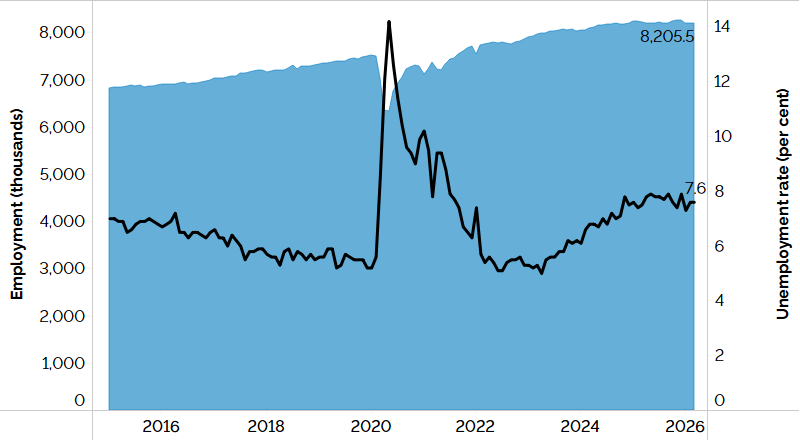
The combination line and area chart shows Ontario’s unemployment rate (line chart) and employment (area chart) from January 2015 to March 2026. Ontario’s unemployment rate trended downwards between January 2015 and January 2020, rose in early 2020 and declined afterwards. The rate has been trending upward since mid‑2023, stabilizing in recent months at 7.6% in March 2026. Employment in Ontario had risen steadily before dropping in early 2020 and then gradually rose to about 8,205,500 workers in March 2026.
Year-over-year overview
Between the first quarters of 2025 and 2026 in Ontario:
- The decline in employment was driven by a reduction in part‑time employment (-4.1%).
- Employment increased marginally in the private sector (+0.1%) but declined in the public sector (-1.3%) and among the self‑employed (-1.9%).
- Employment rose slightly in services‑producing industries (+0.1%), while declining in goods‑producing industries (-2.8%).
- Employment declined in Eastern (-3.2%) and Southwestern Ontario (-1.2%), while Northern Ontario posted the largest gain (+1.3%), followed by the Greater Toronto Area (+0.1%); employment in Central Ontario was essentially unchanged (+0.0%).
- Employment decreased among youth (-3.8%), declined modestly for core‑aged workers (-0.2%), and increased for older workers (+0.6%).
- Hourly wage growth (+4.1%) exceeded inflation (+1.7%).
Type of Work
Employment change by work status, Ontario, Q1 2026 over Q1 2025
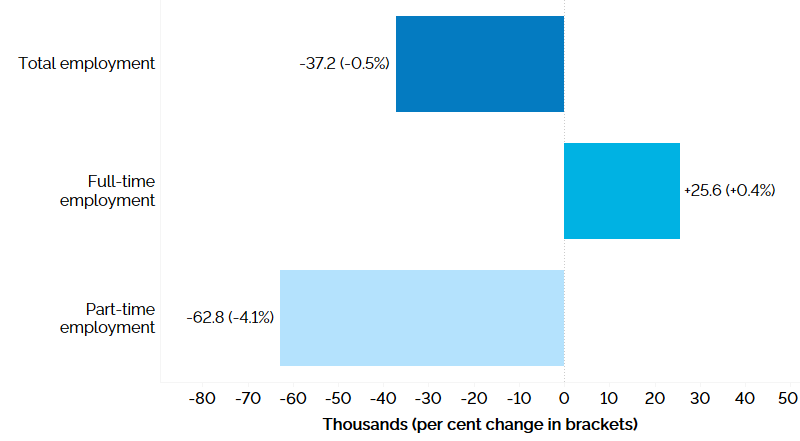
The horizontal bar chart shows a year-over-year (between the first quarters of 2025 and 2026) change in Ontario’s employment by full-time and part-time status. Total employment declined by 37,200 (-0.5%), including gains in full-time employment (+25,600, +0.4%) and declines in part‑time employment (-62,800, -4.1%).
In the first quarter of 2026, full-time employment increased by 0.4% year-over-year, while part-time employment declined by 4.1%.
Employment change by employment sector, Ontario, Q1 2026 over Q1 2025
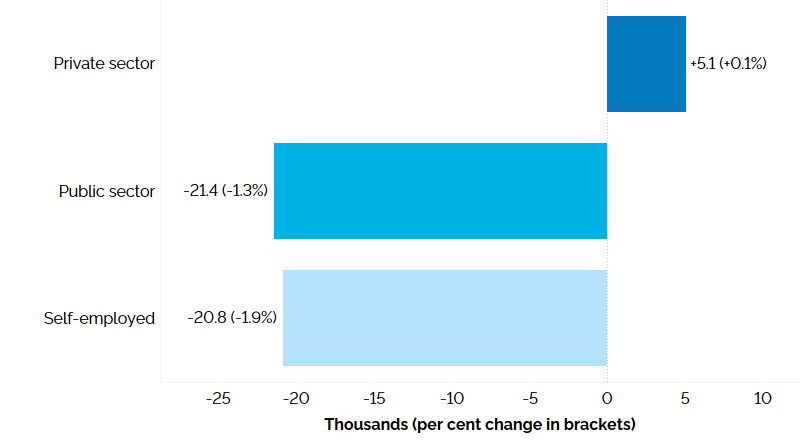
The horizontal bar chart shows a year-over-year (between the first quarters of 2025 and 2026) change in Ontario’s employment in the private sector, public sector and among the self-employed. Employment increased by 5,100 (+0.1%) in the private sector, while it declined by 21,400 (-1.3%) in the public sector and by 20,800 (-1.9%) among the self-employed.
Year-over-year, employment posted a marginal increase of 0.1% in the private sector, while it declined by 1.3% in the public sector
Industry and occupation
Employment change by industry, goods-producing industries, Ontario, Q1 2026 over Q1 2025
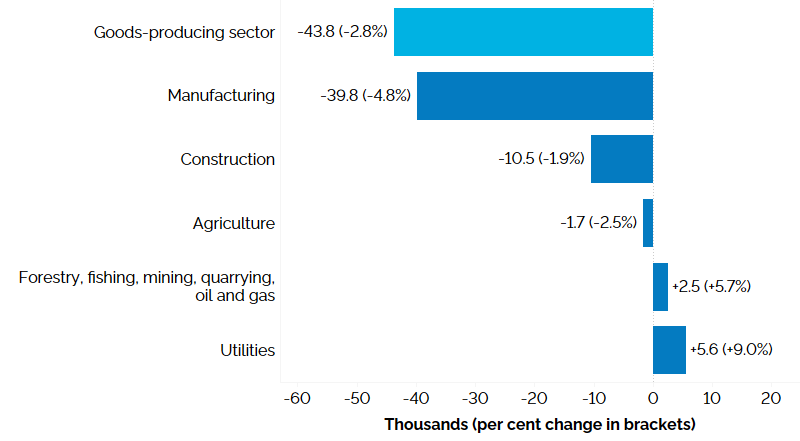
The horizontal bar chart shows year-over-year (between the first quarters of 2025 and 2026) change in Ontario’s employment for goods-producing industries, measured in thousands with percentage change in brackets. Employment increased in two out of five goods-producing industries: utilities (+5,600, +9.0%) and forestry, fishing, mining, quarrying, oil and gas (+2,500, +5.7%). Employment declined in manufacturing (-39,800, -4.8%), construction (-10,500, -1.9%), and agriculture (-1,700, -2.5%). The overall employment in goods-producing industries decreased (-43,800, -2.8%).
Employment in goods-producing industries decreased (-2.8%) in the first quarter of 2026, compared to the same period in 2025. Employment declines in manufacturing (-4.8%), construction (-1.9%), and agriculture (-2.5%) were partially offset by increases in forestry, fishing, mining, quarrying, oil and gas (+5.7%), and utilities (+9.0%).
Employment change by industry, services-producing industries, Ontario, Q1 2026 over Q1 2025
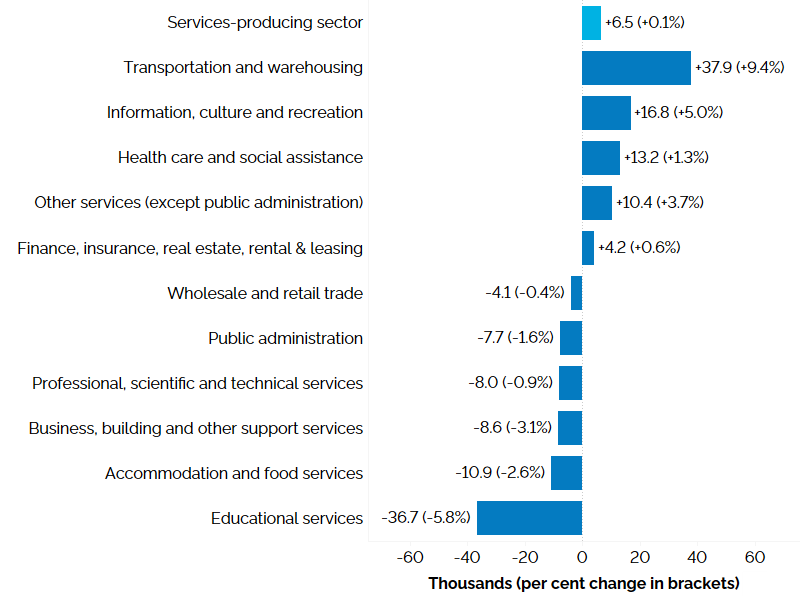
The horizontal bar chart shows year-over-year (between the first quarters of 2025 and 2026) change in Ontario’s employment for services-producing industries, measured in thousands with percentage change in brackets. Employment increased in five of the eleven services-producing industries. Transportation and warehousing (+37,900, +9.4%) experienced the largest employment gain, followed by information, culture and recreation (+16,800, +5.0%), health care and social assistance (+13,200, +1.3%), other services (except public administration) (+10,400, +3.7%), and finance, insurance, real estate, rental & leasing (+4,200, +0.6%). Employment declined in wholesale and retail trade (-4,100, -0.4%), public administration (-7,700, -1.6%), professional, scientific and technical services (-8,000, -0.9%), business, building and other support services (-8,600, -3.1%), accommodation and food services (-10,900, -2.6%), and educational services (-36,700, -5.8%). The overall employment in services-producing industries increased by 6,500 (+0.1%).
In the first quarter of 2026, employment in the services-producing industries increased slightly (+0.1%) compared to the same period in 2025. Five of eleven services-producing industries experienced employment growth. Transportation and warehousing (+9.4%) experienced the largest employment gain, followed by information, culture and recreation (+5.0%). Educational services (-5.8%) experienced the largest employment decline compared to the same period in 2025.
Employment change by occupational group, Ontario, Q1 2026 over Q1 2025footnote 2
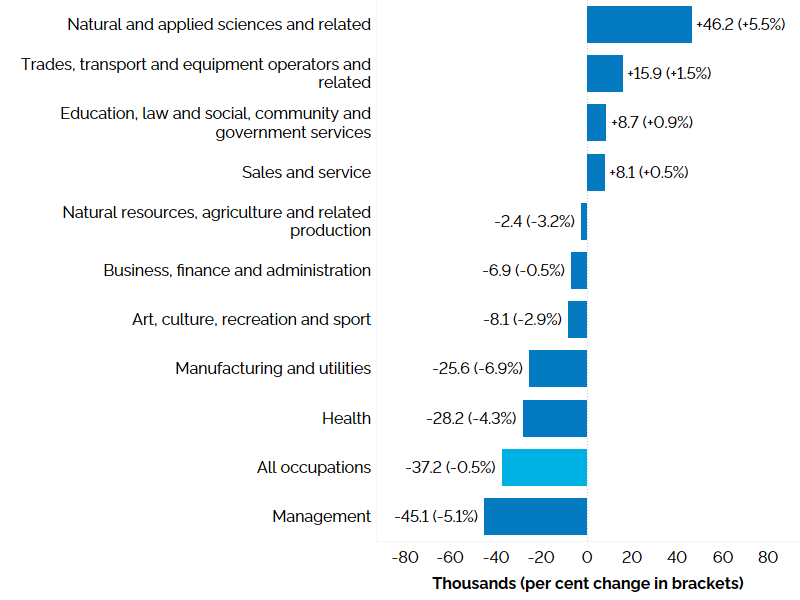
The horizontal bar chart shows a year-over-year (between the first quarters of 2025 and 2026) change in Ontario’s employment by broad occupational group, measured in thousands with percentage change in brackets. Natural and applied sciences and related occupations (+46,200, +5.5%) experienced the largest employment increase, followed by trades, transport and equipment operators and related occupations (+15,900, +1.5%), occupations in education, law and social, community and government services (+8,700, +0.9%), and sales and services occupations (+8,100, +0.5%). Employment declined in natural resources, agriculture and related production occupations (-2,400, -3.2%), business, finance and administration occupations (-6,900, -0.5%), occupations in art, culture, recreation and sport (-8,100, -2.9%), manufacturing and utilities occupations (-25,600, -6.9%), health occupations (-28,200, -4.3%), and management occupations (-45,100, -5.1%).
Year-over-year, six of ten occupational groups experienced a decline in employment, led by management occupations (-5.1%). Four occupational groups, led by natural and applied sciences and related occupations (+5.5%), recorded employment gains.
Geographic region
Employment change by Ontario region, Q1 2026 over Q1 2025footnote 3
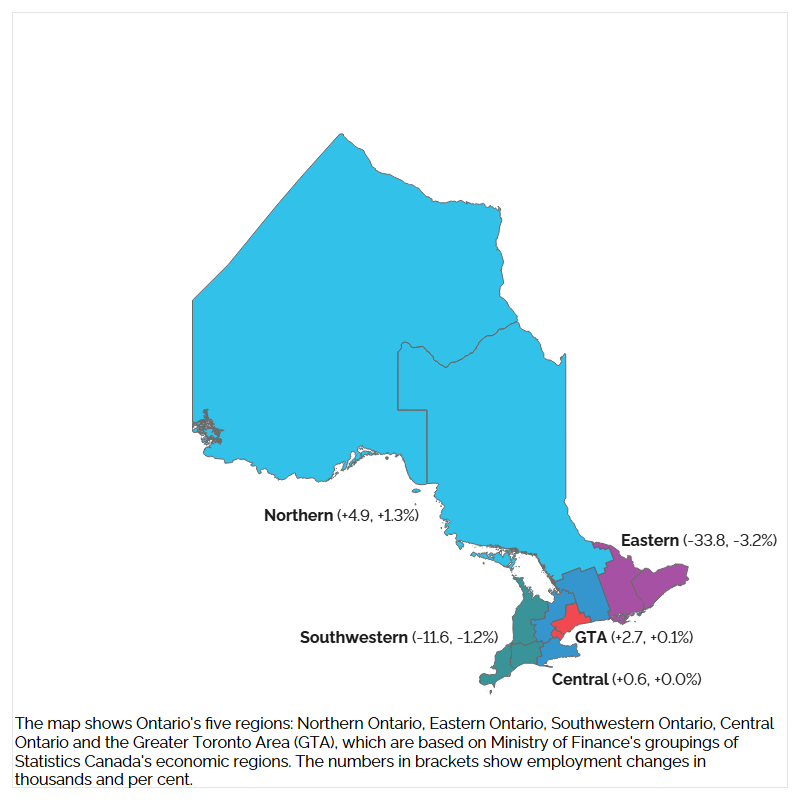
The map shows Ontario’s five regions: Northern Ontario, Eastern Ontario, Southwestern Ontario, Central Ontario, and the Greater Toronto Area (GTA), which are based on Ministry of Finance’s groupings of Statistics Canada’s economic regions. The numbers in brackets show employment changes in thousands and percentages between the first quarters of 2025 and 2026. Employment declined in Eastern Ontario (-33,800, -3.2%) and Southwestern Ontario (-11,600, -1.2%). Employment increased in Northern Ontario (+4,900, +1.3%), followed by the Greater Toronto Area (+2,700, +0.1%), and Central Ontario (+600, +0.0%).
Year-over-year, employment declined in two out of the five Ontario regions in the first quarter of 2026. Employment declines were concentrated in Eastern Ontario (-33,800, -3.2%) and Southwestern Ontario (-11,600, -1.2%). In contrast, Northern Ontario experienced the largest employment gain (+4,900, +1.3%), followed by the Greater Toronto Area (+2,700, +0.1%), while employment in Central Ontario remained essentially unchanged (+600, +0.0%).
Unemployment rates by Ontario region, Q1 2026footnote 4
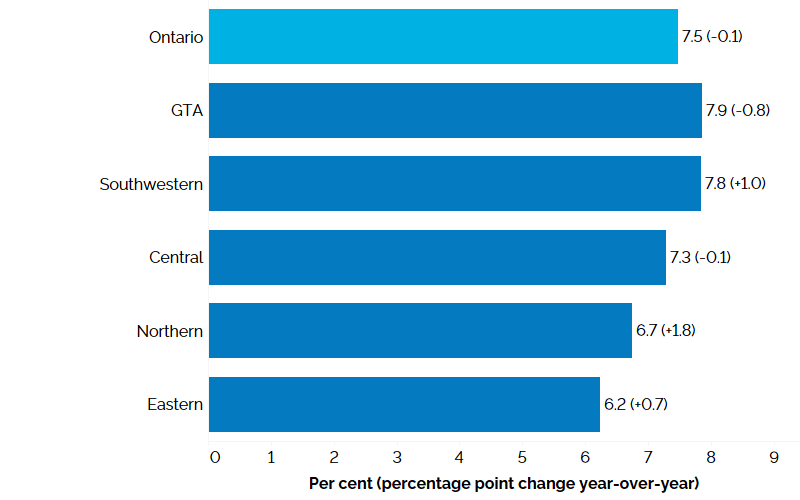
The horizontal bar chart shows unemployment rates by Ontario region in the first quarter of 2026 with percentage point changes from the first quarter of 2025 in brackets. The Greater Toronto Area had the highest unemployment rate at 7.9% (-0.8 percentage point compared to the first quarter of 2025), followed by Southwestern Ontario at 7.8% (+1.0 percentage point), Central Ontario at 7.3% (-0.1 percentage point), Northern Ontario at 6.7% (+1.8 percentage points), and Eastern Ontario at 6.2% (+0.7 percentage point). The overall unemployment rate for Ontario was 7.5% (-0.1 percentage point).
In the first quarter of 2026, the unemployment rate edged down by 0.1 percentage point compared to the same quarter last year. Increases to the unemployment rate in Southwestern Ontario (+1.0 percentage point), Northern Ontario (+1.8 percentage points), and Eastern Ontario (+0.7 percentage point) were offset by declines in the GTA (-0.8 percentage point) and Central Ontario (-0.1 percentage point). The GTA had the highest unemployment rate (7.9%), followed by Southwestern Ontario (7.8%), Central Ontario (7.3%), Northern Ontario (6.7%), and Eastern Ontario (6.2%).
Age and gender
Employment change by age group and gender, Ontario, Q1 2026 over Q1 2025
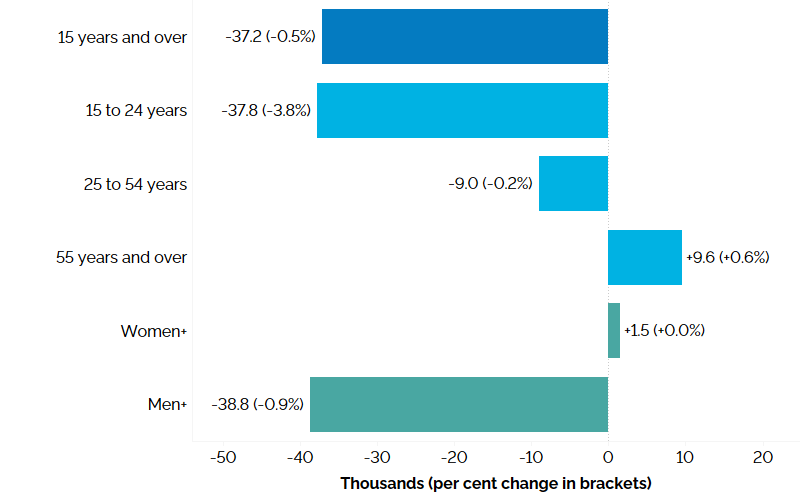
The horizontal bar chart shows year-over-year (between the first quarters of 2025 and 2026) change in Ontario’s employment for the three major age groups, as well as by gender, compared to the overall population. This is measured in thousands with percentage changes in brackets. Employment declined among youth aged 15 to 24 years (-37,800, -3.8%), and core-aged workers aged 25 to 54 years (-9,000, -0.2%), but increased among workers aged 55 years and over (+9,600, +0.6%). Employment increased by 1,500 (+0.0%) among women+ and declined by 38,800 (-0.9%) among men+. Total employment declined by 37,200 (-0.5%).
In the first quarter of 2026, compared to the same quarter last year, employment declined for youth (-3.8%), and core-aged workers aged 25 to 54 years (-0.2%), but increased among older workers aged 55 years and over (+0.6%).
Year-over-year, employment decreased for men (-0.9%) and remained essentially unchanged for women (+0.0%).
Unemployment rates by age group and gender, Ontario, Q1 2026
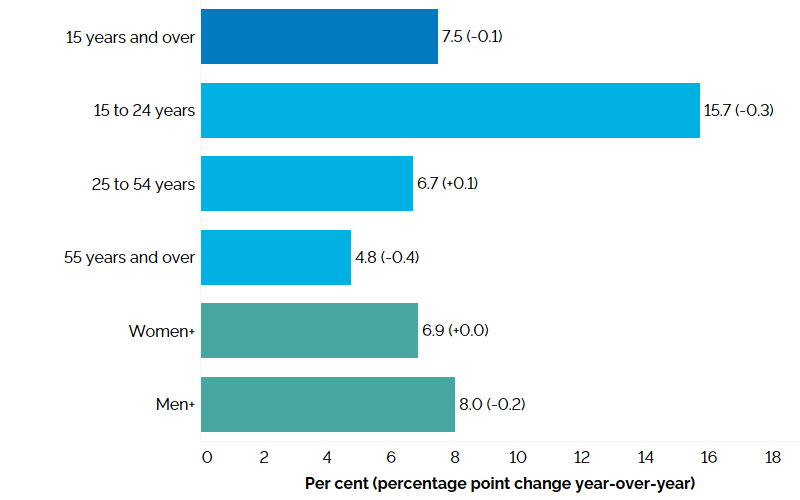
The horizontal bar chart shows unemployment rates in the first quarter of 2026 for Ontario as a whole, by major age group and by gender, with percentage point changes from the first quarter of 2025 in brackets. Ontario’s overall unemployment rate in the first quarter of 2026 was 7.5% (-0.1 percentage point compared to the first quarter of 2025). Youth aged 15 to 24 years had the highest unemployment rate at 15.7% (-0.3 percentage point), followed by the core-aged population aged 25 to 54 years at 6.7% (+0.1 percentage point) and older workers aged 55 years and over at 4.8% (-0.4 percentage point). The unemployment rate was 6.9% (+0.0 percentage point) among women+ and 8.0% (-0.2 percentage point) among men+.
Youth in Ontario experienced the highest unemployment rate (15.7%) in the first quarter of 2026, followed by core-aged individuals (6.7%) and older individuals (4.8%). Compared to the same period last year, the unemployment rate increased for core-aged workers (+0.1 percentage point) but declined among youth and older workers (-0.3 and -0.4 percentage points respectively).
In the first quarter of 2026, the unemployment rate for men (8.0%) was higher than that for women (6.9%). Compared to the same period last year, the unemployment rate was unchanged for women and declined 0.2 percentage point for men.
Education level and immigrant status
Employment rates by education level and immigrant status (core-aged population), Ontario, Q1 2026footnote 6
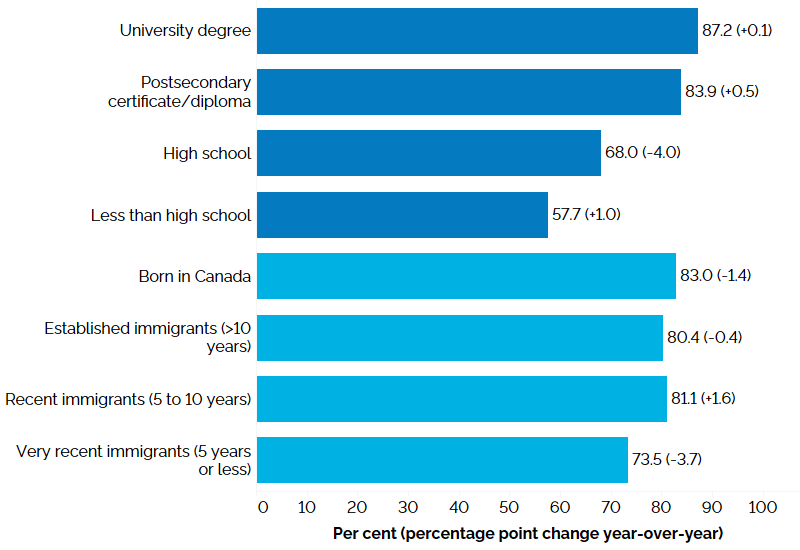
The horizontal bar chart shows employment rates by education level and immigrant status for the core-aged population (25 to 54 years) in the first quarter of 2026, with percentage point changes from the first quarter of 2025 in brackets. By education level, those with a university degree had the highest employment rate (87.2%, +0.1 percentage point), followed by those with a postsecondary certificate/diploma (83.9%, +0.5 percentage point), those with a high school diploma (68.0%, -4.0 percentage point), and those with less than high school education (57.7%, +0.1 percentage point). By immigrant status, those born in Canada had the highest employment rate (83.0%, -1.4 percentage points), followed by recent immigrants with 5 to 10 years since landing (81.1%, +1.6 percentage points), established immigrants with more than 10 years since landing (80.4%, -0.4 percentage point), and very recent immigrants with 5 years or less since landing (73.5%, -3.7 percentage points).
In the first quarter of 2026, core-aged individuals with a university degree continued to record the highest employment rate (87.2%), followed by those with a postsecondary certificate or diploma (83.9%), those with high school education (68.0%) and those with less than high school education (57.7%). Year-over-year, the employment rate for core-aged people increased across most education levels, except for those with high school education.
Those born in Canada had the highest employment rate (83.0%), followed by recent immigrants (81.1%), established immigrants (80.4%) and very recent immigrants (73.5%).
Year-over-year, the employment rate decreased for most groups by immigration status, except for recent immigrants.
Unemployment rates by education level and immigrant status (core-aged population), Ontario, Q1 2026footnote 7
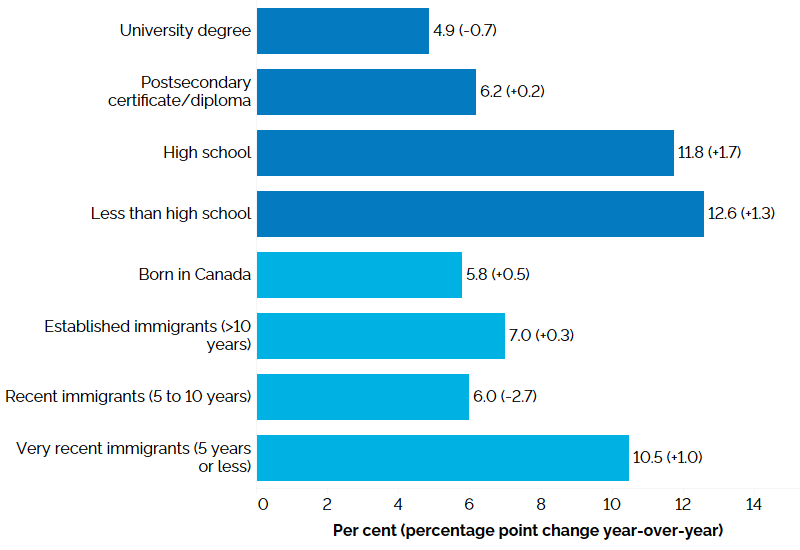
The horizontal bar chart shows unemployment rates by education level and immigrant status for the core-aged population (25 to 54 years) in the first quarter of 2026, with percentage point changes from the first quarter of 2025 in brackets. By education level, those with less than high school education had the highest unemployment rate (12.6%, +1.3 percentage points from the first quarter of 2025), followed by those with high school education (11.8%, +1.7 percentage points), those with a postsecondary certificate or diploma (6.2%, +0.2 percentage point), and university degree holders (4.9%, -0.7 percentage point). By immigrant status, very recent immigrants with 5 years or less since landing had the highest unemployment rate (10.5%, +1.0 percentage point), followed by established immigrants with more than 10 years since landing (7.0%, +0.3 percentage point), recent immigrants with 5 to 10 years since landing (6.0%, -2.7 percentage points), and those born in Canada (5.8%, +0.5 percentage point).
In the first quarter of 2026, the core-aged population with a university degree had the lowest unemployment rate (4.9%) followed by those with a postsecondary certificate/diploma (6.2%). Those with a high school diploma (11.8%) and those with less than high school education (12.6%)
The core-aged population born in Canada had the lowest unemployment rate (5.8%) in the first quarter, while very recent immigrants had the highest unemployment rate (10.5%). Year-over-year, the unemployment rate increased for most groups by immigration status, except for recent immigrants.
Wages
Average hourly wage growth by type of work, Ontario, Q1 2026 over Q1 2025footnote 9
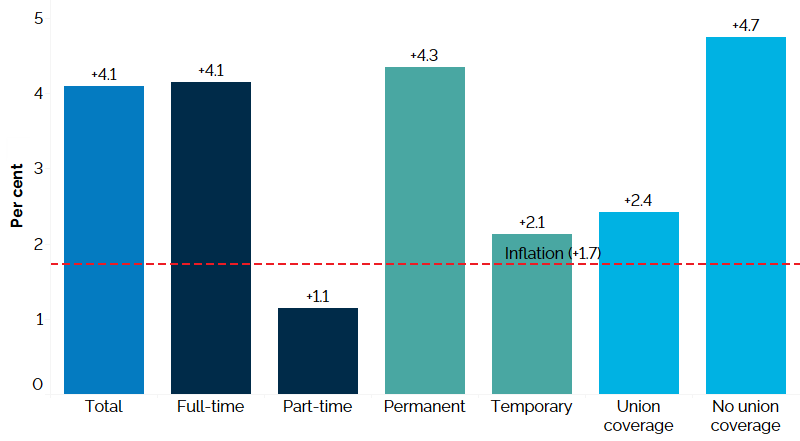
The vertical bar chart shows a year-over-year (between the first quarters of 2025 and 2026) per cent change in Ontario’s nominal hourly wages by type of work. The average hourly wage across all work types increased by 4.1%, including wage increases for full-time employees (+4.1%) and part-time employees (+1.1%), permanent employees (+4.3%) and temporary employees (+2.1%), and employees with union coverage (+2.4%) and those without union coverage (+4.7%). Inflation during the same period was 1.7%.
In the first quarter of 2026, the average hourly wage of Ontario employees was $38.85, an increase of 4.1% from the first quarter of 2025.
Full-time employees (+4.1%), part-time employees (+1.1%), permanent employees (+4.3%), temporary employees (+2.1%), employees with union coverage (+2.4%) and those without union coverage (+4.7%) all experienced increases in average hourly wages. However, only part‑time employees experienced a nominal wage increase that was below inflation.
Methodological note
In the current issue, year-over-year change represents change between the averages in the first quarter of 2025 and the first quarter of 2026. Note that the Ontario Economic Accounts report primarily shows changes between two consecutive quarters.
This report uses seasonally adjusted data in charts displaying data with a monthly frequency in the Overview section.
Unadjusted data are used in charts and tables showing the changes for the current quarter compared with the same quarter for the previous year. Unadjusted data are also used to calculate annual averages, year-to-date averages and 2026 first quarter averages.
All estimates in this report are based on Statistics Canada’s Labour Force Survey (LFS), which measures the current state of the national, provincial, and territorial labour market. The LFS is based on a household survey carried out monthly by Statistics Canada in reference weeks of each month. The reference periods for the three months of the first quarter of 2026 are January 11 to January 17, February 15 to February 21, and March 15 to March 21.
Appendix I
Overview of quarterly employment year-over-year, Ontario
| 2024Q2 | 2025Q2 | 2024Q3 | 2025Q3 | 2024Q4 | 2025Q4 | 2025Q1 | 2026Q1 | |
|---|---|---|---|---|---|---|---|---|
| Total Labour Force (000) | 8,806.5 | 8,968.5 | 8,881.5 | 8,980.6 | 8,777.9 | 8,869.3 | 8,825.7 | 8,773.8 |
| Participation Rate (%) | 65.9 | 65.5 | 65.8 | 65.4 | 64.6 | 64.5 | 64.7 | 63.8 |
| Men+ Participation Rate (%) | 70.3 | 70.1 | 70.5 | 70.1 | 69.2 | 68.8 | 69.1 | 67.8 |
| Women+ Participation Rate (%) | 61.5 | 60.9 | 61.2 | 60.9 | 60.2 | 60.3 | 60.4 | 59.8 |
| Total Employment (000) | 8,202.2 | 8,270.0 | 8,217.2 | 8,234.3 | 8,176.6 | 8,248.1 | 8,155.5 | 8,118.3 |
| - Full-time (000) | 6,756.5 | 6,757.6 | 6,847.6 | 6,863.0 | 6,704.3 | 6,762.2 | 6,623.6 | 6,649.2 |
| - Part-time (000) | 1,445.7 | 1,512.4 | 1,369.6 | 1,371.4 | 1,472.4 | 1,485.9 | 1,531.9 | 1,469.1 |
| Employment-Population Ratio (%) | 61.4 | 60.4 | 60.9 | 60.0 | 60.2 | 60.0 | 59.8 | 59.0 |
| Men+ Employment (000) | 4,319.1 | 4,374.8 | 4,364.1 | 4,373.9 | 4,322.3 | 4,355.8 | 4,290.9 | 4,252.1 |
| Women+ Employment (000) | 3,883.1 | 3,895.2 | 3,853.1 | 3,860.4 | 3,854.3 | 3,892.2 | 3,864.6 | 3,866.2 |
| Part Time (% of total) | 17.6 | 18.3 | 16.7 | 16.7 | 18.0 | 18.0 | 18.8 | 18.1 |
| Goods-Producing Sector Employment (000) | 1,600.3 | 1,574.8 | 1,613.9 | 1,600.7 | 1,562.6 | 1,571.0 | 1,555.6 | 1,511.8 |
| Services-Producing Sector Employment (000) | 6,601.8 | 6,695.2 | 6,603.3 | 6,633.6 | 6,614.0 | 6,677.0 | 6,599.9 | 6,606.4 |
| Private Sector Employment (000) | 5,473.2 | 5,513.2 | 5,520.7 | 5,549.4 | 5,400.6 | 5,532.9 | 5,400.3 | 5,405.3 |
| Public Sector Employment | 1,633.6 | 1,643.8 | 1,582.3 | 1,576.1 | 1,650.3 | 1,619.9 | 1,643.9 | 1,622.5 |
| Self-Employment (% of total) | 13.4 | 13.5 | 13.6 | 13.5 | 13.8 | 13.3 | 13.6 | 13.4 |
| Total Unemployment (000) | 604.3 | 698.5 | 664.3 | 746.2 | 601.3 | 621.2 | 670.1 | 655.5 |
| Unemployment Rate (%) | 6.9 | 7.8 | 7.5 | 8.3 | 6.9 | 7.0 | 7.6 | 7.5 |
| Men+ Unemployment Rate (%) | 7.3 | 8.1 | 7.5 | 8.2 | 7.3 | 7.1 | 8.2 | 8.0 |
| Women+ Unemployment Rate (%) | 6.4 | 7.4 | 7.4 | 8.4 | 6.4 | 6.9 | 6.9 | 6.9 |
| Long-Term (27 wks+) (% of total) | 21.2 | 25.0 | 20.3 | 26.3 | 27.8 | 30.6 | 26.9 | 27.9 |
| Average Unemployment in Weeks | 19.1 | 24.1 | 19.8 | 25.4 | 25.0 | 26.1 | 24.2 | 26.1 |
| Youth Unemployment Rate (%) | 16.6 | 16.6 | 16.6 | 17.1 | 15.0 | 14.1 | 16.0 | 15.7 |
| 25-54 y.o Unemployment Rate (%) | 5.5 | 6.7 | 6.1 | 7.1 | 5.9 | 6.2 | 6.6 | 6.7 |
| 55+ y.o Unemployment Rate (%) | 4.5 | 5.2 | 5.2 | 5.7 | 4.5 | 4.9 | 5.1 | 4.8 |
| Average Weekly Wage Rate ($) | 1,314.51 | 1,366.75 | 1,354.92 | 1,394.28 | 1,368.65 | 1,403.37 | 1,361.93 | 1,418.97 |
| Average Hourly Wage Rate ($) | 35.76 | 37.31 | 36.60 | 37.73 | 37.43 | 38.49 | 37.32 | 38.85 |
Employment by Region (000)
| Region | 2024Q2 | 2025Q2 | 2024Q3 | 2025Q3 | 2024Q4 | 2025Q4 | 2025Q1 | 2026Q1 |
|---|---|---|---|---|---|---|---|---|
| Central | 1,920.7 | 1,950.9 | 1,909.5 | 1,927.5 | 1,901.8 | 1,922.4 | 1,884.8 | 1,885.4 |
| Southwestern | 949.3 | 927.9 | 943.1 | 947.6 | 945.8 | 972.6 | 931.3 | 919.7 |
| Eastern | 1,067.4 | 1,075.8 | 1,091.4 | 1,061.1 | 1,085.7 | 1,034.7 | 1,070.3 | 1,036.5 |
| Northern | 383.9 | 391.5 | 388.8 | 402.6 | 379.3 | 394.8 | 380.8 | 385.7 |
| Greater Toronto Area (GTA) | 3,880.9 | 3,923.8 | 3,884.4 | 3,895.5 | 3,863.9 | 3,923.5 | 3,888.4 | 3,891.1 |
Unemployment Rate by Region (%)
| Region | 2024Q2 | 2025Q2 | 2024Q3 | 2025Q3 | 2024Q4 | 2025Q4 | 2025Q1 | 2026Q1 |
|---|---|---|---|---|---|---|---|---|
| Central | 6.0 | 6.7 | 6.3 | 7.3 | 6.3 | 6.7 | 7.3 | 7.3 |
| Southwestern | 6.0 | 7.3 | 7.2 | 7.6 | 6.2 | 6.3 | 6.9 | 7.8 |
| Eastern | 5.8 | 6.4 | 6.4 | 7.1 | 5.4 | 6.5 | 5.6 | 6.2 |
| Northern | 5.0 | 5.4 | 5.8 | 5.9 | 5.4 | 6.2 | 5.0 | 6.7 |
| Greater Toronto Area (GTA) | 7.9 | 9.0 | 8.6 | 9.5 | 7.8 | 7.6 | 8.7 | 7.9 |
Total Employment by CMA (000)
Greater Toronto Area
| 2024Q2 | 2025Q2 | 2024Q3 | 2025Q3 | 2024Q4 | 2025Q4 | 2025Q1 | 2026Q1 | |
|---|---|---|---|---|---|---|---|---|
| Toronto | 3,697.1 | 3,766.5 | 3,697.4 | 3,715.8 | 3,682.0 | 3,743.7 | 3,720.6 | 3,709.9 |
| Oshawa | 245.9 | 240.0 | 239.6 | 253.3 | 239.7 | 258.2 | 247.3 | 253.7 |
Central Ontario
| 2024Q2 | 2025Q2 | 2024Q3 | 2025Q3 | 2024Q4 | 2025Q4 | 2025Q1 | 2026Q1 | |
|---|---|---|---|---|---|---|---|---|
| Hamilton | 437.0 | 450.8 | 434.8 | 454.6 | 430.8 | 444.0 | 419.4 | 432.2 |
| Kitchener-Cambridge-Waterloo | 387.1 | 396.8 | 378.7 | 386.1 | 389.6 | 387.8 | 385.7 | 382.0 |
| St. Catharines-Niagara | 229.8 | 243.4 | 241.3 | 238.8 | 242.5 | 237.8 | 237.4 | 233.4 |
| Peterborough | 65.6 | 68.6 | 66.3 | 73.5 | 70.7 | 72.8 | 68.3 | 68.4 |
| Brantford | 86.6 | 88.3 | 82.6 | 89.8 | 85.5 | 87.4 | 83.4 | 87.3 |
| Guelph | 107.4 | 98.2 | 99.1 | 94.9 | 97.9 | 96.7 | 100.1 | 100.9 |
| Barrie | 134.7 | 134.9 | 137.5 | 130.9 | 130.8 | 129.6 | 125.2 | 126.5 |
Eastern Ontario
| 2024Q2 | 2025Q2 | 2024Q3 | 2025Q3 | 2024Q4 | 2025Q4 | 2025Q1 | 2026Q1 | |
|---|---|---|---|---|---|---|---|---|
| Ottawa-Gatineau (Ontario part) | 686.8 | 699.7 | 703.5 | 682.4 | 702.3 | 665.2 | 705.5 | 675.5 |
| Kingston | 95.7 | 95.1 | 92.3 | 94.3 | 96.0 | 93.6 | 96.6 | 93.6 |
| Belleville - Quinte West | 50.4 | 55.2 | 51.7 | 54.9 | 35.1 | 55.4 | 31.7 | 58.2 |
Southwestern Ontario
| 2024Q2 | 2025Q2 | 2024Q3 | 2025Q3 | 2024Q4 | 2025Q4 | 2025Q1 | 2026Q1 | |
|---|---|---|---|---|---|---|---|---|
| London | 326.2 | 326.1 | 320.7 | 333.7 | 322.3 | 328.6 | 324.2 | 313.5 |
| Windsor | 241.9 | 234.1 | 239.7 | 231.1 | 237.8 | 245.8 | 241.4 | 231.4 |
Northern Ontario
| 2024Q2 | 2025Q2 | 2024Q3 | 2025Q3 | 2024Q4 | 2025Q4 | 2025Q1 | 2026Q1 | |
|---|---|---|---|---|---|---|---|---|
| Greater Sudbury | 87.9 | 96.7 | 91.0 | 95.4 | 91.9 | 97.0 | 92.6 | 98.7 |
| Thunder Bay | 66.2 | 65.4 | 66.5 | 68.5 | 65.3 | 70.0 | 63.3 | 68.1 |
Overview of monthly* labour force characteristics, Ontario
| Jan-25 | Feb-25 | Mar-25 | Apr-25 | May-25 | Jun-25 | Jul-25 | Aug-25 | Sept-25 | Oct-25 | Nov-25 | Dec-25 | Jan-26 | Feb-26 | Mar-26 | |
|---|---|---|---|---|---|---|---|---|---|---|---|---|---|---|---|
| Employment | 8,234.2 | 8,245.7 | 8,221.6 | 8,193.6 | 8,198.1 | 8,208.3 | 8,216.3 | 8,190.3 | 8,200.2 | 8,252.5 | 8,256.4 | 8,274.5 | 8,208.0 | 8,211.3 | 8,205.5 |
| Unemployment rate | 7.6 | 7.4 | 7.5 | 7.8 | 7.9 | 7.8 | 7.8 | 7.7 | 7.9 | 7.6 | 7.4 | 7.9 | 7.3 | 7.6 | 7.6 |
| Participation rate | 65.4 | 65.2 | 65.1 | 64.9 | 65.0 | 64.9 | 65.0 | 64.7 | 64.8 | 65.0 | 64.8 | 65.4 | 64.4 | 64.6 | 64.6 |
* Seasonally adjusted.
Footnotes
- footnote[1] Back to paragraph The public sector includes employees in federal, provincial, territorial, municipal and Aboriginal public administrations, as well as in Crown corporations, liquor control boards and other government institutions such as schools (including universities), hospitals and public libraries.
- footnote[2] Back to paragraph Occupation estimates are based on the 2021 National Occupational Classification. Management occupations are classified under the management occupational category and the remaining categories exclude management occupations.
- footnote[3] Back to paragraph Based on a three-month moving average for March 2026, using unadjusted data.
- footnote[4] Back to paragraph Based on a three-month moving average for March 2026, using unadjusted data. The seasonally adjusted estimate for Ontario in Q1 2026 is 7.5%.
- footnote[5] Back to paragraph Changes have been introduced to the Labour Force Survey starting in January 2022 to use gender (men+, women+) instead of sex of person (male, female). The category “Men+” includes men and boys, as well as some non-binary persons, while the category “Women+” includes women and girls, as well as some non-binary persons. Given that the non-binary population is small, data aggregation to a two-category gender variable is necessary to protect the confidentiality of responses provided.
- footnote[6] Back to paragraph Rate by immigrant status is based on a three-month moving average for March 2026. Education level refers to the highest level of schooling completed.
- footnote[7] Back to paragraph Rate by immigrant status is based on a three-month moving average for March 2026. Education level refers to the highest level of schooling completed.
- footnote[8] Back to paragraph The less than high school population includes those with 0 to 8 years of education and those with some high school education.
- footnote[9] Back to paragraph Nominal wage growth, not adjusted for inflation. Self-employment is excluded. Inflation is measured as an increase in the all-items Consumer Price Index for Ontario between January and March 2025 and January and March 2026.
- footnote[10] Back to paragraph Year-over-year comparison (between first quarters of 2025 and 2026) is in nominal dollars.
- footnote[11] Back to paragraph Estimates of employment changes and rate calculations are based on unrounded quarterly estimates and may differ slightly from estimates based on published quarterly data due to rounding.