

Floor finish options for dairy free-stall housing
Learn about creating ideal floor finishes for dairy cow barns. This technical information is for Ontario dairy farmers.
ISSN 1198-712X, Published March 2026
Introduction
Dairy barn floor surfaces must have a textured finish to provide traction for the cow as she walks yet is smooth enough to clean and minimize hoof wear and tear. Floors that are too smooth will result in cows slipping and injuring themselves, while floors that are too rough will see cows develop feet and leg problems. There is a fine balance between traction and easy to clean.
This fact sheet discusses floor finish options for dairy barns which provide comfortable surfaces to minimize the risk of slip and fall for cows while moving around.
New floors
In Ontario, the construction method and materials used in concrete floors must conform to the Canadian Standards Association A23.1/A23.2. to ensure quality work is carried out.
Durability and curing
Barn concrete floors must be strong enough to bear the load of animals and heavy equipment. They should be durable to resist the degradation of concrete due to organic acids and abrasion caused by repeated cleaning. Good quality construction materials, proper water-cement ratio and proper curing procedures are key to achieving the desired strength and durability of concrete. Air entrainment (the process of incorporating microscopic air bubbles into concrete to create a system of tiny voids) improves concrete’s durability and provides freeze protection for the concrete.
Design barn concrete floors for proper compressive strength, normally between 25 and 35 MPa with 6% air entrainment. MPa stands for megapascal, a metric unit used to measure compressive strength. In the context of concrete, it tells you how much pressure the concrete can handle before it cracks or fails. To put it in perspective — 1 MPa = 1 million pascals. The higher the MPa, the stronger the concrete. The professional designer will decide what industry standards to use for the design parameters.
Properly cure concrete to ensure strength and durability. The standard curing period for concrete is 28 days but 70% of its full strength often occurs within the first 7 days. Concrete that is not wet cured, dries rapidly and reaches less than half of its potential strength. It will also have a greater number of shrinkage cracks over time.
Textured floors
A good floor finish combines surface texture and grooves to provide traction. Finish the concrete for texture when it is still wet. There are two ways of producing grooves, either forming the grooves when it is still wet or cutting grooves in the floor after it has cured.
Jitterbug finish
A textured finish is produced by using an expanded metal roller to imprint the surface when the concrete is still wet (Figure 1). This is referred to as a “jitterbug” or “rollerbug.”
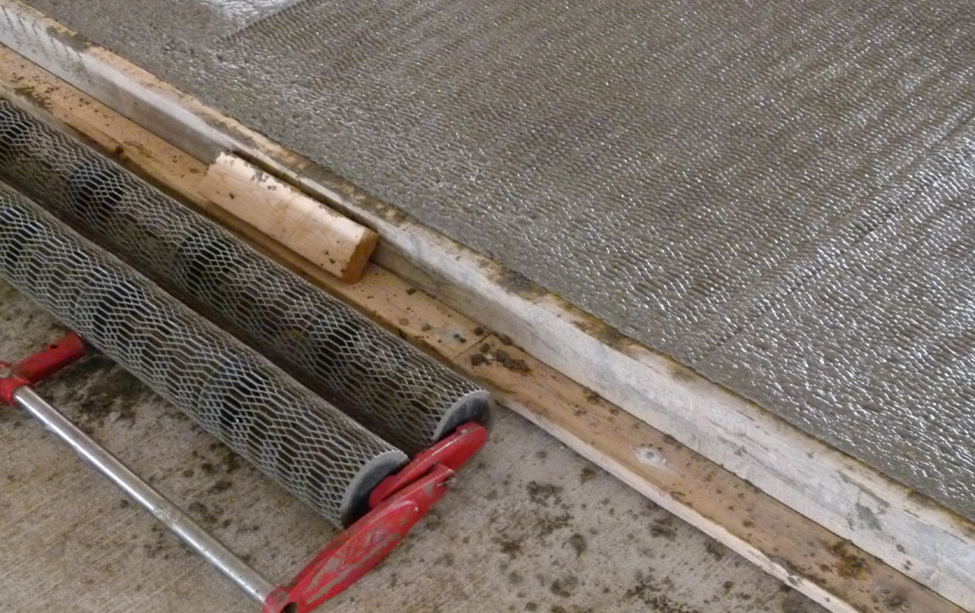
When concrete is first poured and levelled with a bull-float, it is glossy. It dries to a matte finish before hardening. When you see the matte finish, tap your fingers on the concrete. If you leave fingerprints and your fingers stay dry, this is the right time to use the roller to produce a textured surface.
Broom finish
Use a stiff broom to produce a “broom” finish by brushing the surface of the concrete while it is moist.
Grooved floors
Cows will still slip, even on a floor with a good textured finish. Barn floors are usually grooved to reduce cow slippage and fall. Grooving the floor provides edges for the cow to catch her hooves in to keep her from slipping too far and falling. Different groove patterns are used in dairy barns with the most common ones being longitudinal and diamond grooves.
Longitudinal grooves
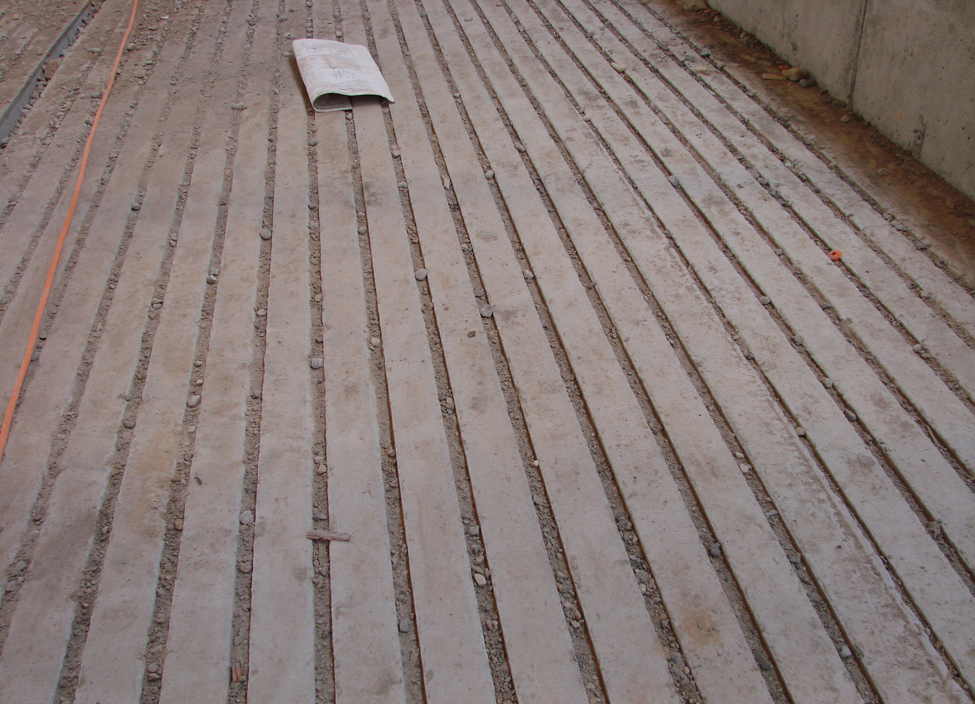
Make grooves run parallel to the feed manager, 2 cm wide × 1.25 cm deep, spaced 8.25 cm on centre, (¾ in. wide × ½ in. deep, spaced 3 ¼ in. on centre) (Figure 2).
Diamond pattern
Make the grooves in a diagonal pattern, 1.25 cm wide × 1–1.25 cm deep, spaced 10–15 cm apart (½ in. wide × ⅜–½ in. deep, spaced 4–6 in. apart) (Figure 3).
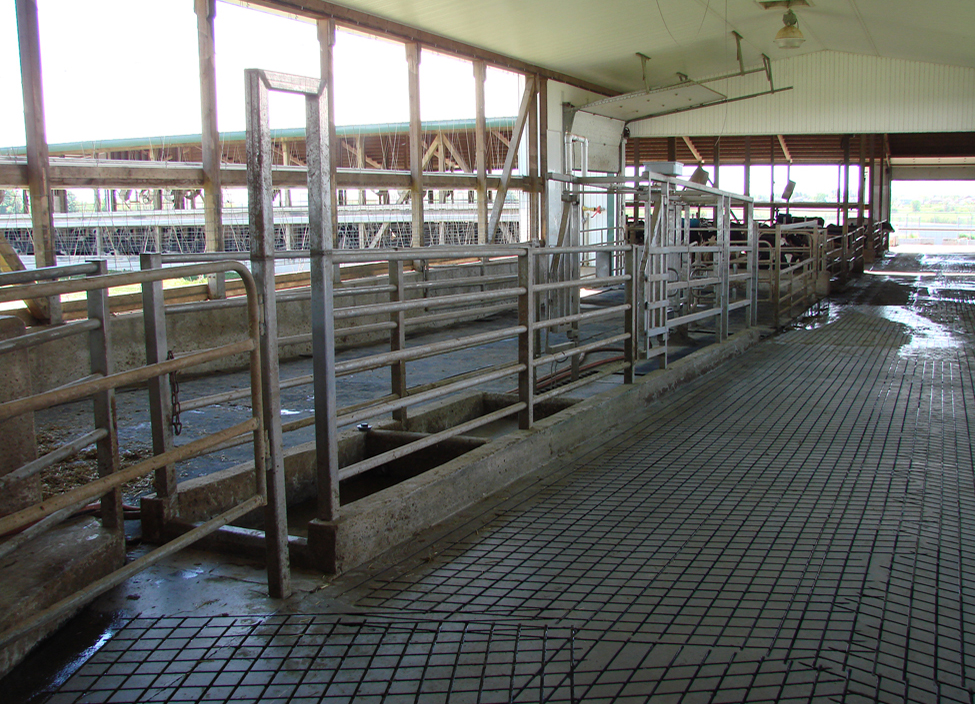
Longitudinal grooves are easier to form, but in areas where cows must make sharp turns, such as crossovers, add grooves at an angle to create a diamond pattern to provide extra traction for the cow when she turns (Figure 3).
Forming grooves
Wet concrete
Forming grooves in wet concrete is an art. If they are formed when the concrete is too wet, the grooves will not hold their shape. If the concrete becomes too dry, it will be difficult to form the grooves and the surface finish may be harmed. Be careful to maintain a flat surface when grooving. Grooving when the concrete is wet displaces concrete and it is important the surface does not become curved between grooves.
Once the concrete is cured, it may be necessary to remove the initial roughness of freshly poured concrete floors that have been wet-grooved. One method is to drag several concrete blocks behind an all-terrain vehicle until the sharp edges are worn off the concrete. Another method is to use a steel scraper on the surface. Either method will remove sharp edges and help age the floor surface, reducing the chance of causing sore feet.
Cured concrete
Cutting grooves in cured concrete is recommended as opposed to forming grooves in wet concrete. It is easier and more efficient to cut grooves after the concrete has cured for at least 7 days but should be completed in a maximum of a 2-day period. This helps to get a more consistent result across the floor. Waiting longer makes the concrete harder and slows the cutting process.
Surface treatment
Cows may experience problems if they walk on concrete before it has finished curing. High surface alkalinity may irritate the skin of the feet, causing pain and possibly making cattle more susceptible to foot infections. To avoid this problem, allow the concrete to cure properly for 28 days. After this time, the concrete is almost totally cured. Hydration, the chemical reaction that takes place during curing, will have slowed down. Wash off the concrete and reintroduce the cattle to the area with little or no effect to their feet. If cows have to walk on the concrete before 28 days, allow it to cure for at least 7 days, then wash it with a solution of 40 parts water to 1-part muriatic acid. The acid will neutralize the alkalinity of the floor. Wash the floor thoroughly with water to remove the residue.
Existing floors
Maintenance
Manure removal equipment, such as alley scrapers, will polish concrete floors. In a free-stall barn, use a rubber tire scraper or add a piece of durable rubber to the bottom of the scraper blade to protect the floor finish.
Refurbish worn floors
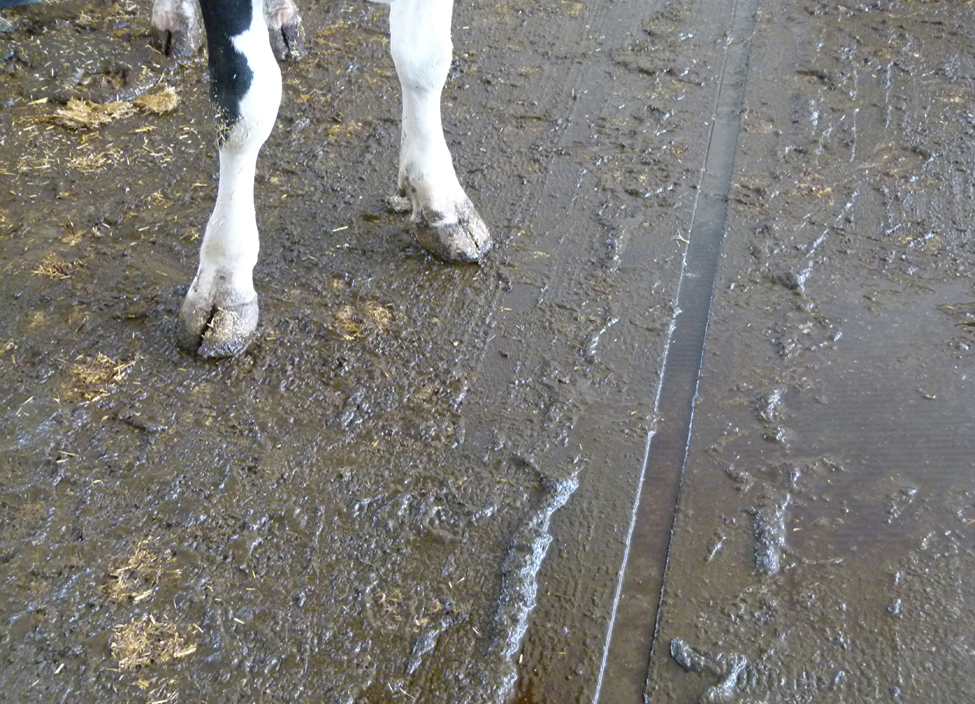
Concrete floors can become too smooth from repeated scraping for manure removal. Improve traction on slippery floors by cutting grooves into the floor in a diagonal pattern similar to the recommendation for a new floor. Another method is to grind or mill small grooves into the entire surface to improve traction (Figure 4).
Sand bedding
Cows “kick” sand out of the stalls into the alleyways when getting up and down in free stalls bedded with sand. The sand that ends up in the alley improves cow traction on the floor. An alley that does not have stalls exiting into it won’t have the same amount of sand on them, making them more slippery. These alleys may need new grooves or other options such as rubber surfaces to improve traction.
Rubber surfaces
Rubber or similar products are increasingly being used on alley floors to provide a softer surface than concrete for the cow to stand on. Cows show a definite preference for standing or walking on rubber surfaces. It is important to use a material that is durable but not so hard that it is slippery. Make sure the material is fastened down properly so that manure removal equipment will not catch on it.
Hooves will not wear the same on rubber floors as on concrete floors. Cows may require more frequent foot trimming on a rubber floor.
Hoof management
It is important to consider the condition of the cows’ hooves before they are moved to a new barn. Do not trim cows’ feet before moving them to a facility with new concrete floors. Their feet will be too tender and injuries can occur. If feet need trimming, make sure there is adequate time for them to toughen up before moving to the new concrete floor.
Summary
Floor finishes are important for cow comfort and safe movement. Alley floors must be strong and durable, while providing good traction for cows. Use surface texture and grooving on concrete floors to provide the traction necessary to keep cows from slipping and injuring themselves. To improve traction, groove or mill the surfaces of floors that are too slippery from repeated cleaning. Cows move more confidently on floors that have better traction.
Resources
- The Dairyland Initiative. Flooring. University of Wisconsin. Madison, WI.
- Progressive Dairy. Designing Concrete Floors for Dairy Facilities to Reduce Lameness Incidences. David W. Kammel and Karl Burgi, 2023.
Author credits
This fact sheet was updated by Rajan Niraula, P. Eng., engineering specialist, livestock structure and equipment, dairy and beef, Ministry of Agriculture, Food and Agribusiness (OMAFA) and Steve Beadle, P. Eng., engineering specialist livestock structure and equipment, swine and sheep, OMAFA. It was originally written by Harold K. House, P. Eng., engineer, dairy and beef housing and equipment, Ministry of Agriculture, Food and Rural Affairs.