

Fortifying Ontario’s Economy: Critical minerals
Read our vision for protecting Ontario, strengthening economic sovereignty and securing global leadership in critical minerals.
Minister’s message: Ontario is the world’s reliable partner
Ontario’s prosperity and economic sovereignty will be defined by the choices we make today.
Ontario has made a choice to move with speed, to reaffirm our commitment to the rule of law, democratic values, and ethical resources. This is our value proposition, as our province emerges as an island of stability — the world’s reliable partner — in a sea of turmoil.
Critical minerals have become the foundation of economic strength and national security. They power the technologies that drive modern life — from advanced manufacturing and electric vehicles to hospitals, data centres, artificial intelligence, and defence systems. As demand surges and supply chains grow more fragile, the jurisdictions that can deliver secure, responsible, and reliable supply will shape the global economy for decades to come.
Ontario faces a clear choice: rely on unstable global supply chains, or act decisively to secure our own economic destiny. We are choosing to lead.
Ontario is unapologetically advancing a bold agenda: accelerating approvals, enhancing regulatory certainty, investing in domestic processing, and moving forward on generational projects like the Ring of Fire. Our government has been seized with unlocking the world’s largest multi-commodity undiscovered developments on earth with abundant minerals and rare earths that will help unleash $22 billion in GDP and 70,000 jobs. After a generation of talk, it is Premier Ford and our government that will build the roads, the transmission lines, and mines that will bolster Canadian self-reliance as our country is under attack.
We are home to some of the most diverse and abundant critical mineral deposits in the world including nickel, lithium, cobalt, graphite, copper, platinum group elements, and rare earth elements. We have a century-long mining legacy, a highly skilled workforce, world-class environmental standards, access to clean and reliable electricity, and a financial sector that helps raise capital for projects across the globe. At a time of rising geopolitical uncertainty and increasing protectionism, Ontario can protect its own economic future while standing as a trusted supplier to Canada, democratic G7 allies, and the world.
But leadership does not happen by accident. It requires focus and decisive action. Protecting Ontario means reducing reliance on unstable or untrusted sources. It means building resilient, end-to-end supply chains here at home. It means capturing more processing, manufacturing, and innovation in our province — creating good jobs, driving investment, and delivering long-term prosperity, particularly in Northern Ontario.
Ontario faces a clear choice: rely on unstable global supply chains, or act decisively to secure our own economic destiny. We are choosing to lead. We have a responsibility to secure the materials that will power the industries of tomorrow. If we act with focus and determination, Ontario will not only compete — we will lead.
By acting now, we will strengthen our economic security, reinforce our sovereignty, and position Ontario as a global leader in the responsible development of critical minerals — ensuring that when the world needs these essential materials, it looks to Ontario first.
Under Premier Ford’s leadership, this is our plan to protect Ontario’s economy, anchor critical mineral supply chains at home, and ensure our province remains a trusted G7 partner and a global leader in responsible resource development for decades to come.
Unapologetic champions of Canadian workers and minerals
Every major growth sector depends on critical minerals. From clean energy to advanced manufacturing, healthcare and defense, none progress without the workers, and the resources found in Ontario. Global demand for critical minerals is expected to double by 2030, yet supply chains remain dangerously concentrated, vulnerable to disruption, price shocks, and geopolitical leverage. This is no longer just an economic issue. It is an issue of sovereignty, security, and resilience.
Ontario already plays a vital role in North American and global supply chains. Our high-quality critical minerals support manufacturing, clean energy, and defence industries. As countries move to diversify supply away from unstable or untrusted sources, Ontario’s ability to produce and process critical minerals responsibly has never mattered more.
Since 2022, Ontario has acted decisively:
- launching its first Critical Minerals Strategy
- modernizing mining regulations
- streamlined approvals
- invested in domestic processing
- advanced the Ring of Fire in partnership with First Nations
This marked shift — from fragmented, project‑by‑project development to a coordinated, long‑term, whole of government approach focused on supply chain resilience, value creation, and responsible growth. Now, the landscape has changed again. Ontario must move further and faster.
This renewed vision sets the course for the next phase of action: unapologetically protecting Ontario’s economy, strengthening national sovereignty, creating good-paying jobs, and positioning Ontario as a trusted leader among Group of Seven partners in responsible critical mineral development.
When the world needs secure, ethical supply — it should look to Ontario, and to the Canadian workers who make it possible.
Why critical minerals matter now
The backbone of modern life
Critical minerals are not niche commodities. They are embedded in everyday life:
- your smartphone and computer contain nickel, cobalt, copper, and platinum group elements (PGEs).
- electric vehicles and charging systems contain nickel, cobalt, graphite, copper, and lithium.
- MRI machines and surgical equipment use rare earth elements, nickel, cobalt, and titanium.
- our electricity grid and battery storage use copper, nickel, graphite, and cobalt.
- aerospace and defense technologies use nickel, rare earth elements, titanium, cesium, and beryllium.
A mineral is considered “critical” when it is essential, difficult to substitute, and exposed to supply risk. In Ontario, critical minerals are defined by their importance to economic growth, energy systems, advanced manufacturing, health care, and national defence — particularly where secure and reliable supply is essential.
Many are mined in one region and refined in another — often concentrated in only a few countries, creating vulnerability. Where State owned enterprises, like those controlled by China, ignore market signals, like price, and dominate refining and processing capacity, their predatory practices of market intervention, stockpiling, and export restrictions expose vulnerability of our supply chains to a single supplier. The G7 countries are now treating critical minerals as core components to economic and national security strategy. Supply chain diversification is accelerating. Trusted partners are in demand and Ontario is one of them.
Ontario’s critical minerals list
| Mineral | Common uses |
|---|---|
| Aluminum | Advanced manufacturing, automotive, aerospace |
| Antimony | Metal products and fire-retardant material |
| Barite | Weighting agent, drilling fluids and X-ray shielding |
| Beryllium | Aerospace, industrial and medical technologies |
| Bismuth | Pharmaceuticals and metallurgy |
| Cesium | Atomic clocks and drilling fluids |
| Chromite | Stainless steel and alloys |
| Cobalt | Rechargeable batteries and superalloys |
| Copper | Electronics, plumbing and antimicrobial applications |
| Fluorspar | Chemical, cement, steel and glass production |
| Gallium | LEDs and integrated circuits |
| Germanium | Fibre optics |
| Graphite | Lubricants, batteries, and fuel cells |
| Indium | Fusible alloys, solders, electronics, LCD and thin-film application |
| High-purity iron | Steel production |
| Lithium | Rechargeable lithium-ion batteries, lubricant, glass and ceramics |
| Magnesium | Manufacturing, agricultural and industrial applications |
| Manganese | Steelmaking and batteries |
| Molybdenum | High-temperature superalloys |
| Nickel | Stainless steel and rechargeable batteries |
| Niobium | Electrolytic capacitators and high-tech alloys |
| Phosphate | Fertilizer |
| Platinum Group Elements (PGEs) | Catalysts, catalytic converters and alloys |
| Rare Earth Elements (REEs) | Electronics, catalysts and magnets |
| Scandium | Aerospace alloys and fuel cells |
| Selenium | Rubber compounding, steel alloying and selenium rectifiers |
| Tantalum | Alloys and electrical capacitators |
| Tellurium | Photovoltaic solar cells and high-tech alloys |
| Tin | Alloys, coatings and construction material |
| Titanium | Aerospace alloys |
| Tungsten | Abrasives, alloys and electronics |
| Uranium | Nuclear fuel and life-saving medical isotopes |
| Vanadium | Aerospace alloys and redox-flow batteries |
| Zinc | Anti-corrosion agent in batteries and alloys |
| Zirconium | Fibre-optics, ceramics and abrasives |
Geopolitical dynamics and Ontario’s role
This urgency is driven in large part by the scale of dominance held by China across the global critical mineral supply chain:
- China is responsible for roughly 60–70% of global rare earth mining and over 85% of processing capacity, giving it an outsized role in materials essential for electronics, weapons systems, and clean technologies.
- China controls more than 70% of global lithium-ion battery manufacturing, anchoring the downstream value chain that powers electric vehicles and grid storage.
- China refines approximately 65% of the world’s lithium, 70% of cobalt, and over 90% of battery-grade graphite, despite often mining far less of the raw material itself — a sign that the strategic advantage lies in processing and value-added manufacturing.
- China produces nearly all spherical graphite used in EV anodes and dominates midstream chemical conversion, where raw minerals are transformed into usable industrial inputs.
This concentration creates a structural vulnerability for Western economies: even when minerals are mined in allied jurisdictions, they are frequently sent to China for processing before returning as finished materials. Control over refining and manufacturing — not just extraction — translates directly into geopolitical leverage. At the same time, rising U.S. tariffs and trade actions have injected new uncertainty into global markets. These measures strain integrated North American supply chains, increase costs for producers, and destabilize industries that depend on reliable access to critical inputs.
Global supply gaps, price volatility, and the energy transition
Long development timelines, high capital costs, infrastructure gaps, and complex permitting processes have constrained new production — creating supply shortages and sharp price volatility that ripple across manufacturers, consumers, and governments.
This imbalance is already translating into volatility:
- prices for key battery minerals have experienced dramatic boom-and-bust cycles, with lithium prices rising several hundred percent between 2020 and 2022 before correcting sharply — creating uncertainty for mining companies, manufacturers and investors.
- nickel markets saw extreme short-term price spikes that forced trading halts, exposing how thin and fragile supply can be in the face of disruption.
- manufacturers increasingly report that mineral availability — not technology — is becoming the gating factor for scaling EVs, energy storage, and electrified industry.
The energy transition is therefore not just a technology shift; it is a materials transformation. Clean energy systems are significantly more mineral-intensive than fossil-fuel systems, requiring vast upfront inputs of mined and processed resources to build out infrastructure that will last for decades.
The jurisdictions that can responsibly produce and process these materials will shape the next industrial era. Those that cannot, will depend on others. For Ontario, inaction would mean greater exposure to global instability and deeper reliance on concentrated or untrusted suppliers. Acting decisively strengthens economic sovereignty, reinforces allied security, and secures long-term prosperity for communities across the province.
Ontario’s strategic advantage
Ontario enters this moment from a position of strength — one built deliberately over the past several years through sustained policy reform, targeted investment, and a renewed commitment to treating mining as a strategic, province‑building industry.
Ontario possesses one of the richest and most diverse concentrations of critical minerals in the world, but our strategic advantage in mining goes far beyond geology. We operate on one of the world’s cleanest and most reliable electricity grids, enabling mineral production at scale. Our strong labour protections and highly skilled workforce ensure projects are built and operated safely, fairly, and productively. Our rigorous environmental standards demand responsible development, backed by transparent regulatory oversight and the rule of law. Underpinning it all is a culture of accountability, democratic governance, and respect for Indigenous partnership. The result is a mining jurisdiction defined not just by what we produce — but by how we produce it: ethically, sustainably, and reliably.
Critical minerals deposits with defined resources
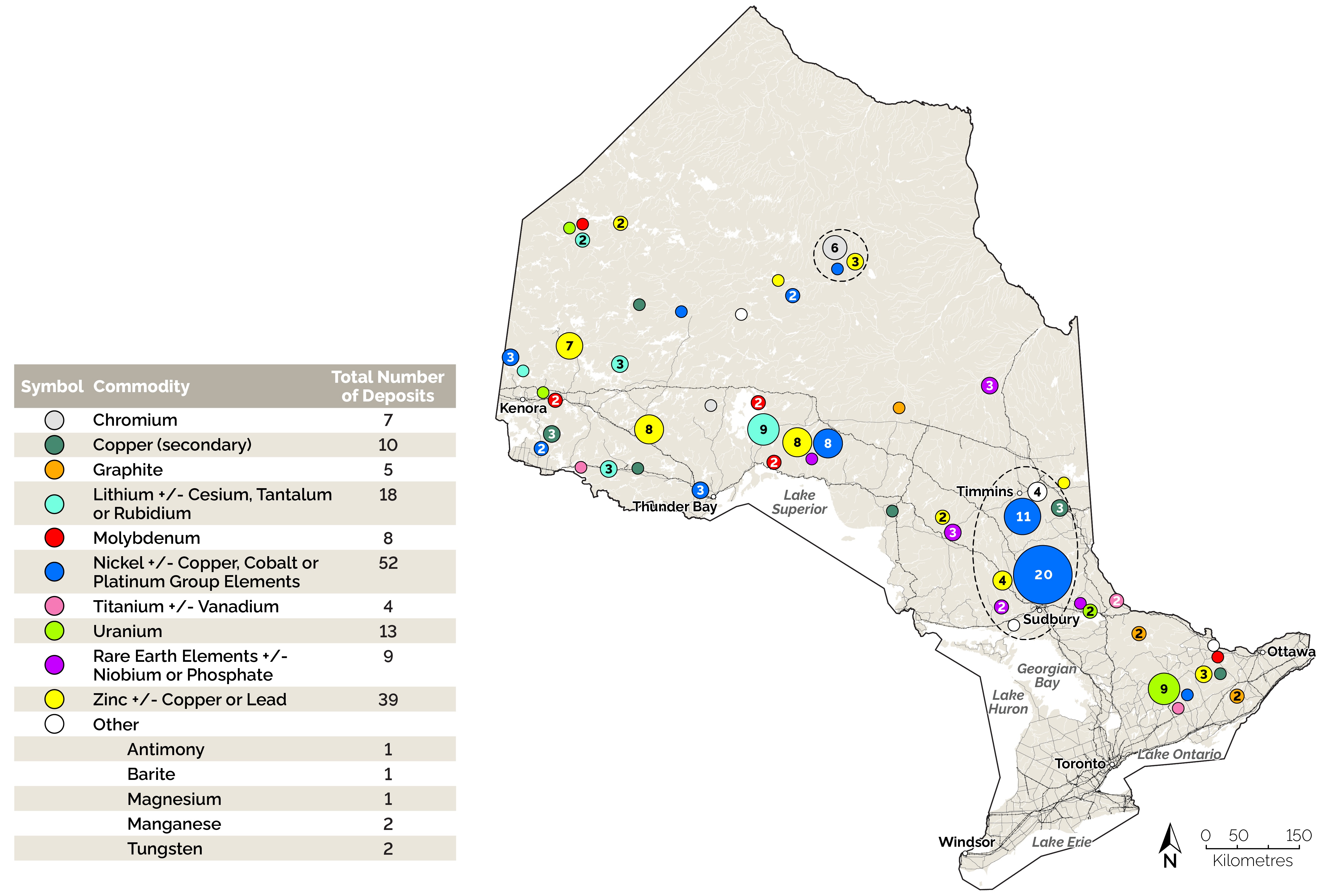
This map shows the number of critical mineral deposits with defined resources in Ontario. Defined resources are locations where there is a concentration of minerals in or on the Earth’s crust that has reasonable prospects for economic extraction in the future. The size of the dots is proportional to the number of deposits in an area, not indicative of tonnage or grade.
Source of Data: Resident Geologist Program’s ‘Deposits Not Being Mined’ table: Ontario Mineral Inventory
| Commodity | Total number of deposits |
|---|---|
| Chromium | 7 |
| Copper (secondary) | 10 |
| Graphite | 5 |
| Lithium +/- Cesium, Tantalum or Rubidium | 18 |
| Molybdenum | 8 |
| Nickel +/- Copper, Cobalt or Platinum Group Elements | 52 |
| Titanium +/- Vanadium | 4 |
| Uranium | 13 |
| Rare Earth Elements +/- Niobium or Phosphate | 9 |
| Zinc +/- Copper or Lead | 39 |
| Antimony | 1 |
| Barite | 1 |
| Magnesium | 1 |
| Manganese | 2 |
| Tungsten | 2 |
Graphite
Ontario hosts several, high-quality graphite deposits including the high-grade Albany graphite deposit near Hearst and the large tonnage Kearney and Bisset Creek deposits in Southern Ontario.
Lithium
Northwestern Ontario hosts several significant lithium projects including Frontier Lithium’s high-grade, large tonnage PAK deposit north of Red Lake. These deposits often contain other critical minerals such as cesium, tantalum and rubidium.
Rare Earth Elements
Ontario hosts several, emerging deposits of Rare Earth Elements often containing niobium, including the Martison Lake deposit near Hearst and the Prairie Lake deposit near Marathon.
Ring of Fire
Globally significant mineral resources of high-grade chromium, nickel, copper, platinum group elements, cobalt and zinc, and globally significant potential for titanium, vanadium, scandium and iron.
Sudbury and Timmins
In addition to the world class production of ultra-pure nickel, copper, platinum group elements and cobalt, the Sudbury and Timmins area host significant future development potential. This includes Canada Nickel’s Crawford deposit near Timmins and KGHM’s Victoria project in Sudbury, which is currently under construction.
These resources may be NI 43-101-JORC compliant as defined by modern standards/methods or historical estimates which as less reliable. Please note that individual resources are not necessarily economically viable for extraction; they simply represent the estimated quantity of a given commodity present in the ground.
A mining powerhouse
Ontario is a national leader in mining — and a cornerstone of Canada’s critical minerals strength. Today, Ontario is home to more than 37 active metal mines, supporting over 28,000 direct, good-paying mining jobs and an additional 47,000 supply and service jobs across engineering, equipment manufacturing, construction, environmental services, and technology. Together, the sector supports roughly 75,000 jobs province-wide, forming one of Ontario’s most significant resource-based employment clusters.
Looking ahead, the opportunity grows. The Ontario Vehicle Innovation Network projects that the mining sector will require more than 3,300 additional workers by 2040 to meet rising demand driven by electrification, advanced manufacturing, and battery supply chains. That represents sustained hiring over the next 14 years — creating a strong pipeline for long-term, skilled careers in trades, engineering, geoscience, heavy equipment operation, environmental management, and emerging mining technologies.
These are high-quality, good-paying jobs that provide stability, benefits, and pathways for advancement. They anchor families and sustain communities across the province — particularly in Northern Ontario — where mining remains a foundational economic driver. As critical mineral development accelerates, employment is expected to expand not only at mine sites, but across processing, refining, manufacturing, and innovation activities linked to Ontario’s growing end-to-end supply chains.
Ontario also consistently attracts the largest share of mineral exploration investment in Canada. In 2024, there were 212 critical minerals exploration projects reporting activity in the province. This leadership in exploration fuels the next generation of discoveries — including nickel, lithium, copper, cobalt, and rare earth elements essential to the clean economy and global energy transition. From this position of strength, Ontario must continue to drive investment-attraction and exploration spending for the long-term health of the mining sector.
In short, mining in Ontario is not a sunset industry — it is a growth sector. With strong fundamentals, rising global demand, and a clear workforce pipeline, the sector is positioned to deliver sustainable, long-term careers while reinforcing Ontario’s role as a reliable supplier in global critical mineral markets.
Production and global impact
Ontario produces a significant share of Canada’s nickel and copper, along with substantial platinum group elements. In 2024, the province’s mining production exceeded $13 billion, with critical minerals exported to the United States, Europe, and Asia.
Nickel remains a cornerstone of Ontario’s exports, supporting manufacturing supply chains and allied security interests. Ontario is also emerging as a major player in the global lithium market, with reserves and development projects that position Canada as a potential top five supplier for North American demand.
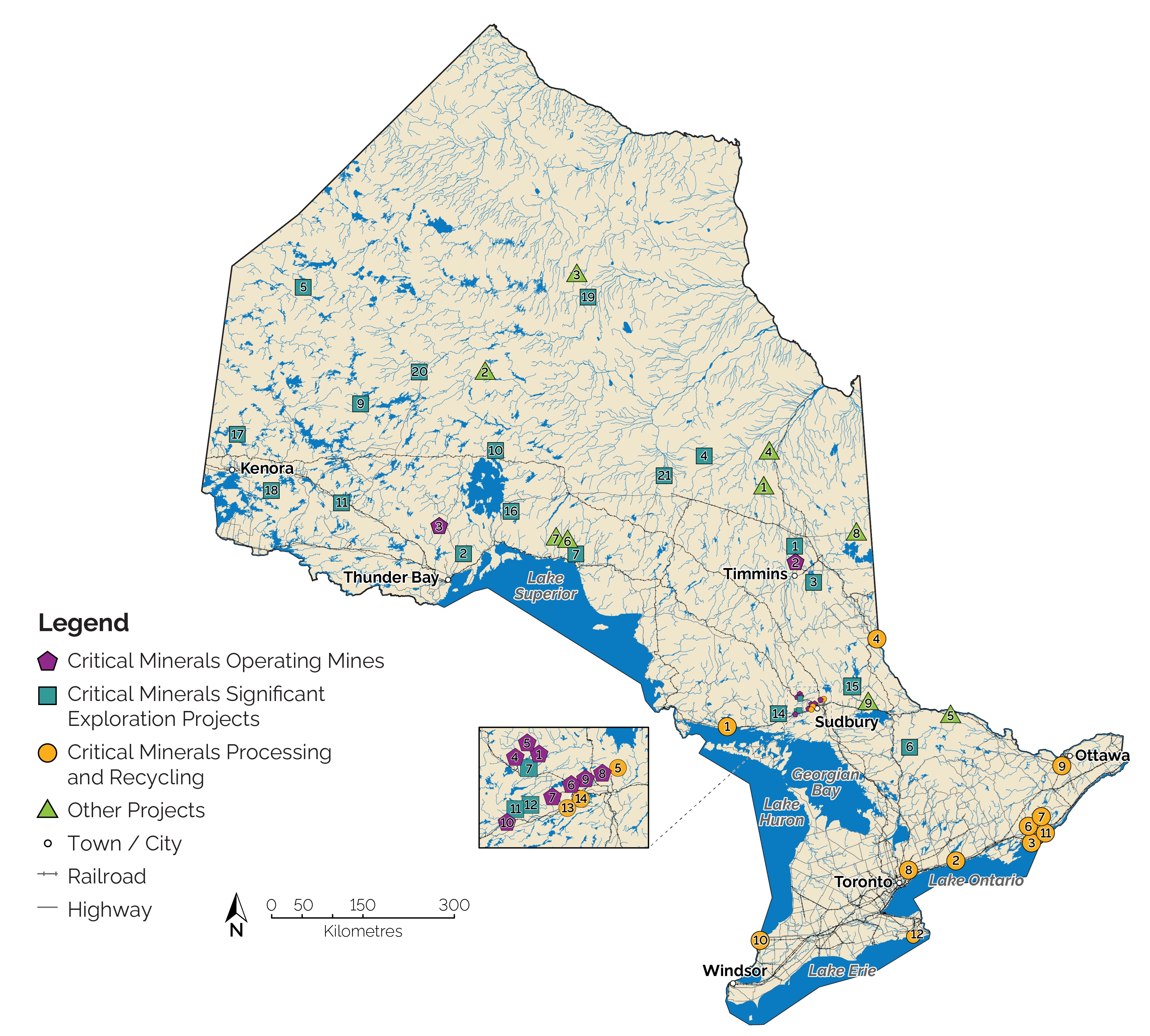
| Company | Project | Commodity |
|---|---|---|
| Glencore PLC — Glencore Canada Corp. | Fraser Mine | Nickel, Copper, PGE, Cobalt |
| Glencore PLC — Glencore Canada Corp. | Kidd Creek Mine | Copper, Zinc, Silver |
| Impala Platinum Holdings Ltd. — Impala Canada | Lac des Iles Mine | PGE |
| Magna Mining Inc. | McCreedy West Mine | Nickel, Copper, PGE, Cobalt |
| Vale S.A. — Vale Canada Ltd. | Coleman Mine | Nickel, Copper, PGE, Cobalt |
| Vale S.A. — Vale Canada Ltd. | Copper Cliff Complex | Nickel, Copper, PGE, Cobalt |
| Vale S.A. — Vale Canada Ltd. | Creighton Mine | Nickel, Copper, PGE, Cobalt |
| Vale S.A. — Vale Canada Ltd. | Garson Mine | Nickel, Copper, PGE, Cobalt |
| Vale S.A. — Vale Canada Ltd. | Stobie Mine | Nickel, Copper, PGE, Cobalt |
| Vale S.A. — Vale Canada Ltd. | Totten Mine | Nickel, Copper, PGE, Cobalt |
| Company | Project | Commodity |
|---|---|---|
| Cameco Corporation | Blind River Refinery | Uranium |
| Cameco Corporation | Port Hope Conversion Facility | Uranium |
| Cyclic Materials Inc. | Rare Earth Magnet Recycling | Recycling and reuse |
| Electra Battery Materials Corp. | First Cobalt Refinery | Cobalt, Sulfate, Nickel Sulfate |
| Glencore PLC — Glencore Canada Corp. | Sudbury Smelter | Nickel, Copper, PGE, Cobalt |
| Kingston Process Metallurgy Inc. | KPM Kingston Facilities | R&D for critical minerals processing, recycling and reuse |
| Li-Cycle Holdings Corp. | Ontario spoke facility for lithium battery resource recovery | Recycling and reuse |
| Li-Metal Corp. | Markham lithium processing facility | Lithium processing and anode production |
| Masterloy Products Company | Ottawa Plant | Ferrovanadium, Ferromolybdenum |
| TODA Advanced Materials Inc. | TODA Sarnia Facility | Metal Hydroxide Materials |
| Ucore Rare Metals Inc. | RapidSXTM Commercialization and Demonstration Facility | REE processing |
| Vale S.A. — Vale Canada Ltd. | Port Colborne Refinery | Nickel, Cobalt |
| Vale S.A. — Vale Canada Ltd. | Copper Cliff Nickel Refinery | Nickel, Cobalt, PGE |
| Vale S.A. — Vale Canada Ltd. | Copper Cliff Smelter | Nickel, Copper, PGE |
| Company | Project | Commodity |
|---|---|---|
| Canada Nickel Company Inc. | Crawford Nickel Sulphide Project | Nickel, Iron, Chromium, Cobalt, PGE |
| Clean Air Metals Inc. | Escape Lake | Copper, Nickel, Platinum Metals |
| EV Nickel Inc. | Shaw Dome | Nickel |
| Fox River Resources Corp. | Martison Phosphate Project | Phosphate |
| Frontier Lithium Inc. | PAK Lithium Project | Lithium |
| G6 Energy Corp. | Kearney Mine | Graphite |
| Generation Mining Ltd. | Marathon Project | PGE, Copper |
| Glencore PLC — Glencore Canada Corp. | Onaping Depth Project | Nickel, Copper, PGE, Cobalt |
| Green Technology Metals Ltd. | Root Project | Lithium |
| Green Technology Metals Ltd. | Seymour Lithium Project | Lithium |
| International Lithium Corp. | Raleigh Lake Project | Lithium |
| KGHM Polska Miedž S.A. — KGHM International Ltd. | Victoria Project | Nickel, Copper, PGE, Cobalt |
| Magna Mining Inc. | Crean Hill Mine | Nickel, Copper, PGE, Cobalt |
| Magna Mining Inc. | Shakespeare Project | Nickel, Copper, PGE, Cobalt |
| New Age Metals Inc. | River Valley Project | PGE |
| Rock Tech Lithium Inc. | Georgia Lake Project | Lithium |
| Separation Rapids Ltd. (SCR-Sibelco NV and Avalon Advanced Materials Inc.) | Separation Rapids Project | Lithium |
| Tartisan Nickel Corp. | Kenbridge Nickel Project | Nickel, Copper, Cobalt |
| Wyloo | Eagle’s Nest Project | Nickel, Copper, PGE |
| XXIX Metal Corp. | Thierry Copper Project | Nickel, Copper |
| Zentek Ltd. | Albany Graphite Project | Graphite
|
| Company | Project | Commodity |
|---|---|---|
| Argyle Resources Corp. | Clay-Howells Property | Rare Earth Elements |
| Critical One Energy Inc. | Howells Lake | Antimony, Gold |
| Juno Corp. | Vespa | Scandium, Titanium, Vandium |
| Neotech Metals Corp. | Hecla-Kilmer | Niobium, Rare Earth Elements |
| Northern Graphite Corp. | Bisset Creek Property | Graphite |
| Nuinsco Resources Ltd. | Prairie Lake | Niobium, Phosphate, Rare Earth Elements |
| Plato Gold Corp. | Good Hope Niobium | Niobium, Phosphate, Rare Earth Elements |
| Power Metals Corp. | Case Lake | Cesium, Tantalum, Lithium |
| Volta Metals Ltd. | Springer-Lavergne Rare Earth Project | Rare Earth Elements |
Restoring confidence
Since 2018, Ontario has taken a fundamentally different approach to the mining sector. Where the previous government ushered in regulatory uncertainty, lengthy and duplicative approvals, and the lack of fortitude to defend Ontario’s miners and sustainable resource development, our government has moved decisively to restore confidence, reduce risk, and position mining — particularly critical minerals — as central to the province’s economic future.
This shift reflects a clear principle: protecting Ontario means enabling responsible development, creating good jobs, and ensuring the province can compete and win in a more volatile global economy.
Building a competitive and predictable mining environment
Over the past several years, Ontario has repositioned mining as a strategic economic priority and a cornerstone of future growth by:
- re‑establishing mining as a priority sector within its broader economic and industrial strategy
- launching its first Critical Minerals Strategy in 2022
- passing legislation like the Building More Mines Act to advance the Ring of Fire through partnerships with Marten Falls and Webequie First Nations
- invested in world-class public geoscience to reduce exploration risk and attract capital investment
- modernized regulatory frameworks to improve clarity, coordination, and predictability
- expanded domestic processing and value‑added capacity to capture more benefits at home
The result: Ontario is now recognized as a jurisdiction where responsible mining projects move forward with certainty, while maintaining high environmental, safety, and consultation standards.
A coordinated strategy
The 2022–2027 Critical Minerals Strategy marked a turning point. For the first time, Ontario adopted a coordinated, long‑term plan to connect mineral development in the North with advanced manufacturing in the South, building an integrated, end-to-end critical minerals ecosystem.
The strategy focused on:
- expanding geoscience and exploration to reduce risk and unlock new deposits
- growing domestic processing and supply chains so minerals are refined in Ontario
- improving regulatory efficiency while maintaining strong environmental standards
- investing in innovation, research, and development
- advancing economic partnerships with Indigenous communities
- growing a skilled workforce to meet rising demand
This foundation positioned Ontario to compete globally in the clean technology sector but does not reflect the current reality. Ontario must broaden our strategy to include minerals needed for national defense, securing advanced manufacturing, and ensuring that Ontario is never reliant on foreign sources of critical minerals.
One Project, One Process
In 2025, Ontario introduced “One Project, One Process” — a whole of government approval model designed to replace fragmented and duplicative reviews. The framework reduces overlap across ministries and reflects a more coordinated, predictable approvals system that supports timely investment while upholding environmental protection and Indigenous rights. To date, three projects have been designated including:
- Frontier Lithium’s PAK Project
- Canada Nickel Company’s Crawford Nickel Project
- Kinross Gold Corporation’s Great Bear Project
Building More Mines Act, 2023
The Building More Mines Act, 2023 modernized Ontario’s Mining Act to improve efficiency, and predictability.
Key reforms streamlined closure planning, through a certification‑based approach, reduced administrative burden for low‑risk changes, clarified decision‑making authority, and introduced phased financial assurance aligned with project timelines. These reforms reduced uncertainty for proponents while maintaining strong environmental oversight and consultation obligations.
Together with “One Project, One Process,” these reforms signal that Ontario is serious about enabling responsible development.
Recovering more value from existing resources
Ontario is also unlocking value from materials once left behind.
Through its Recovery of Minerals framework, the province enables responsible extraction of critical minerals from legacy mine tailings using advanced technologies.
This approach accelerates timelines, supports innovation, strengthens sustainability outcomes, and increases supply of materials such as lithium, cobalt, rare earth elements, and platinum — all while maintaining rigorous health, safety, and environmental protections.
Made-in-Canada: Scaling domestic processing capacity
Mining alone is not enough.
Ontario launched the $500 million Critical Minerals Processing Fund to build refining and processing capacity at home — ensuring minerals like nickel, lithium, graphite, cobalt, and copper are processed in Ontario, not exported for value-added elsewhere.
This strengthens supply chain resilience, supports manufacturing competitiveness, protects workers from global disruptions, and helps end the historic “rip and ship” model.
Advancing the Ring of Fire
Unlocking the Ring of Fire requires one foundational commitment: infrastructure first.
Since 2018, Ontario has shifted the region from long-standing potential toward tangible progress by prioritizing the core infrastructure needed to enable development and attract private investment. The focus is on building the essential transportation and energy corridors that make advanced exploration and eventual production viable at scale.
Proposed all-season road networks are central to this effort. These roads will provide dependable, year-round access to remote mineral deposits, replacing costly fly-in logistics and seasonal winter roads with permanent infrastructure capable of supporting drilling programs, equipment mobilization, and sustained exploration activity. Reliable access dramatically lowers operating costs, shortens project timelines, and allows companies to move from early-stage assessment to advanced exploration with confidence.
At the same time, planning is underway to extend transmission infrastructure into the region, connecting future operations to Ontario’s clean, reliable electricity grid. Access to stable power is a prerequisite for modern mining — enabling electrified operations, reducing reliance on diesel generation, and ensuring projects can scale efficiently while meeting high environmental standards.
By leading with roads, transmission, and coordinated regional planning, Ontario is reducing project risk, improving regulatory certainty, and creating the physical backbone required to unlock private-sector capital. Infrastructure is what allows geoscience to turn into drilling, drilling into feasibility, and feasibility into construction.
Through sustained infrastructure leadership, Ontario is creating the conditions for companies to advance exploration now — and positioning the region to become a globally significant, secure source of critical minerals in the years ahead.
From risk to readiness
Ontario’s advantage today is not accidental. Since 2018 the government has made a number of strategic changes to drive growth in its mining and metals sectors. Including:
- reducing government review time for permitting timelines by at least 50 per cent through its “One Project, One Process” framework
- delivering a more predictable, stable regulatory environment
- investing in world-class geoscience and exploration through the Ontario Geological Survey and provincial investment
- our highly skilled workforce
- energy expansions including new transmission infrastructure to the region
The province was recently crowned the lowest-risk mining jurisdiction in Mining IQ’s World Risks Insights out of 120 jurisdictions. This success is the result of sustained, deliberate action to move the province from a high‑risk jurisdiction for mining investment to one that is investment‑ready, strategically aligned, and globally competitive.
Positioned to lead
Ontario is moving forward in globally significant regions such as the Ring of Fire, Timmins, Sudbury, and Thunder Bay while scaling domestic processing capacity for nickel, lithium, graphite, cobalt, and rare earth elements.
But the world has changed since 2022. Demand for critical minerals is no longer driven by clean technology alone. Electric vehicles and renewable energy remain essential — but today’s surge is also powered by artificial intelligence, data centres, advanced manufacturing, aerospace, and national defence. Ontario needs an updated strategy that reflects that reality.
It will take a broader, more strategic view of the critical minerals landscape — ensuring supply chains support not only clean growth, but defence readiness, digital infrastructure, and the computing power required to make Ontario an energy and industrial powerhouse. Together, these actions will position Ontario not just to compete — but to protect itself.
By anchoring resilient, end-to-end value chains at home, reducing exposure to global risk, and strengthening ties with trusted allies, Ontario will reinforce its role as a secure and reliable G7 supplier in a rapidly changing world.
Ontario’s vision for critical minerals
Ontario’s vision is straightforward and ambitious: Unlock our critical mineral abundance to protect economic security, strengthen sovereignty, and lead as a trusted G7 partner.
Critical minerals are not just commodities. They are strategic assets. Ontario will develop them with purpose — to anchor resilient supply chains, power advanced industries, and secure long-term prosperity.
This vision is grounded in five principles:
- Protecting Ontario — strengthen economic sovereignty, reduce exposure to global shocks, and ensure Ontarians are never left vulnerable to unstable or untrusted supply.
- Lead among allies — be a reliable, ethical supplier of the minerals essential to defence, advanced manufacturing, clean technology, and digital infrastructure.
- Capture more value at home — process, refine, innovate, and manufacture in Ontario — creating good jobs and lasting economic growth across the province.
- Advance Indigenous partnership — build early, meaningful, and mutually beneficial partnerships that support reconciliation, equity participation, and shared prosperity.
- Enable responsible development — maintain high environmental, safety, and social standards while ensuring projects move forward with clarity and predictability.
This vision is not about chasing a single technology or market cycle. It is about building a durable, end-to-end system that secures Ontario’s interests for decades.
When the world uses Ontario’s minerals, it will know they come from a stable, responsible, and world-class jurisdiction — ready to power the future.
Ontario’s strategic priorities for a new critical minerals strategy
To deliver on this vision, Ontario will focus on eight priorities:
Plan for growth
Ontario must plan for growth across the entire critical minerals value chain — not project by project, but system-wide. Mining, processing, power, infrastructure, workforce training, and Indigenous partnerships must move in sync so projects can advance from discovery to production faster and with greater certainty to attract capital to drive responsible growth. A mineral deposit alone does not create prosperity. An aligned, investment-ready ecosystem does.
By planning proactively, Ontario will cut timelines, reduce risk, strengthen Northern communities, and ensure it is ready to meet rising global demand — not scrambling to catch up, but built to lead.
Build future‑ready workforce
Protecting Ontario’s economic future starts with people.
Critical minerals development — from mining and processing to advanced manufacturing — depends on a highly skilled workforce: tradespeople, engineers, geoscientists, technicians, and technology specialists. Ontario will explore ways to expand education, training, and on-the-job learning pathways to ensure workers are ready for the mines, processing facilities, and manufacturing plants of tomorrow. A predictable and reliable talent pool allows for greater business planning, ensuring that mining companies can be confident their projects will succeed and uphold their global standing as the safest, most efficient operations in the world.
The goal is clear: create good-paying, long-term careers for Ontarians — and build the talent pipeline that keeps Ontario competitive for decades to come.
Infrastructure and enabling conditions
Unlocking Ontario’s mineral wealth requires enabling infrastructure to be in place before growth arrives. Transportation corridors, reliable and affordable energy, broadband connectivity, housing, and community services — particularly in Northern Ontario — must be planned and built in coordination with development.
By taking a long-term, integrated approach, Ontario will support responsible resource development while strengthening communities and ensuring growth is sustainable, not strained.
Regulatory certainty and faster delivery
A competitive Ontario requires clear, predictable, and timely regulatory processes. Ontario will continue to streamline approvals from exploration to production — cutting duplication, improving sequencing, and helping projects move forward efficiently.
At the same time, the province will uphold strong environmental protections, respect the Duty to Consult, and ensure regulations keep pace with rapidly growing global demand for critical minerals.
Supporting exploration and finding the mines of tomorrow
Ontario’s long‑term competitiveness begins with discovery. The province will strengthen early‑stage exploration and geoscience to unlock the next generation of mineral deposits, while aiming to keep areas of significant mineral potential remain open for claim registration, exploration, and development. By reducing risk and attracting private capital, Ontario will remain a top destination for mining investment and innovation, ensuring tomorrow’s mines are discovered today.
Advancing Indigenous partnerships
Indigenous partnership is foundational to Ontario’s critical minerals future. Ontario will prioritize early, meaningful, and equity‑based partnerships that support Indigenous communities as owners, partners, and beneficiaries across the critical minerals value chain — advancing reconciliation and shared prosperity.
Securing investment and resilient supply chains
Ontario will scale up innovation, attract global capital, and anchor critical mineral supply chains at home.
By expanding domestic processing, supporting value-added manufacturing, and reducing reliance on unstable or untrusted suppliers, Ontario will capture more economic value — and protect its industries from global disruption.
Global leadership and allied supply chains
Ontario will deepen cooperation with the other jurisdictions and other trusted partners to build secure North American and allied supply chains.
As demand intensifies, Ontario will reinforce its role as a reliable, responsible supplier — strengthening economic security, boosting competitiveness, and keeping control of its economic future firmly at home.
The moment to act
Global competition for critical minerals is no longer emerging — it is accelerating.
Major economies are racing to secure supply. Strategic stockpiles are expanding. Processing capacity is being reshored. Public funding is flowing at historic levels. Critical minerals have moved from commodity markets to the centre of economic and national security strategy. Demand is rising — driven by electrification, artificial intelligence, advanced manufacturing, defence modernization, and the global energy transition.
Supply remains constrained — limited by long development timelines, capital intensity, infrastructure gaps, and concentrated refining capacity. If Ontario does not seize this moment, others will. Investment will flow elsewhere. Processing capacity will be built elsewhere. Supply chains will be anchored elsewhere.
By acting now, Ontario will:
- protect its economic sovereignty — reducing reliance on unstable or untrusted suppliers. Anchoring resilient, end-to-end value chains at home. Shielding Ontario workers and industries from geopolitical shocks and trade disruption.
- create good, long-term jobs — generating high-quality, good-paying employment opportunities in mining, processing, construction, engineering, manufacturing, and technology — particularly in Northern Ontario — with careers that span generations.
- capture more value at home — moving beyond extraction to refining, advanced materials, battery components, and next-generation manufacturing. Ending the historic “rip and ship” model and ensuring more wealth stays in Ontario communities.
- strengthen Indigenous partnerships — advancing early, meaningful, and equity-based partnerships that create shared prosperity, long-term revenue streams, and economic self-determination.
- secure its role as a trusted allied supplier — positioning Ontario as a reliable partner to Canada, the United States, and other G7 economies seeking ethical, transparent, and secure sources of supply.
Ontario is uniquely positioned to lead the next era of critical mineral development. The province has the resources — one of the most diverse critical mineral endowments in the world, with abundant nickel, lithium, cobalt, graphite, and rare earth elements that underpin clean energy, advanced manufacturing, and defence technologies. These are the materials that will define which economies thrive in the energy transition and which supply chains remain resilient.
Ontario also has the workforce. From skilled tradespeople and engineers to geoscientists, innovators, and manufacturers, generations of experience have built a mining sector capable of moving projects from exploration to production at scale. This human capital is complemented by a century-long legacy of responsible resource development, creating expertise that few jurisdictions can match.
The province has the standards. Rigorous environmental protections, strong regulatory oversight, and a commitment to sustainable development ensure that growth is responsible, resilient, and accountable. Beyond regulations, Ontario offers the stability and infrastructure that underpin long-term investment: clean and reliable electricity, world-class public geoscience, political certainty, and proximity to North America’s major manufacturing hubs. These factors make Ontario a uniquely predictable and capable partner for companies and allies looking to secure critical minerals.
The foundation is built. Roads, transmission lines, regulatory modernization, and streamlined approvals have already created the framework necessary to move exploration projects forward and attract investment. Ontario’s minerals, workforce, and infrastructure together form a competitive advantage that is rare on a global scale.
Now, Ontario will lead. Critical minerals are the building blocks of the future economy — the inputs that determine which jurisdictions power advanced manufacturing, secure supply chains, and shape the industrial landscape of tomorrow. Ontario will not simply watch that future unfold. The province will supply it — responsibly, securely, and competitively, in partnership with trusted allies — ensuring that Canadian workers, communities, and industries benefit for generations to come.