

Labour market report, December 2025
Employment in Ontario was little changed in December. Get the details in this report.
Quick facts
In December 2025:
- There were 13.8 million people in Ontario aged 15 years or older:
- 9.0 million (65.3%) were in the labour force. The labour force increased by 64,400 (0.7%) in December compared to November.
- 8.3 million (60.2%) were employed, little changed (12,700, or 0.2%) from November.
- Ontario's unemployment rate increased to 7.9% in December from 7.3% in November and 705,500 people were unemployed, up by 51,700 (7.9%) from November.
Important note
This report is based on the Labour Force Survey (LFS), a household survey carried out by Statistics Canada. December’s LFS results cover labour market conditions during the week of December 7 to 13.
Note: LFS data reflect initial tariffs on exports to the United States including goods not compliant with the Canada-United States-Mexico agreement (CUSMA) (March 4), steel and aluminum (March 12), automobiles (April 3), auto parts (May 3), copper (August 1), and softwood lumber and wood products (October 14).
Employment was little changed in December
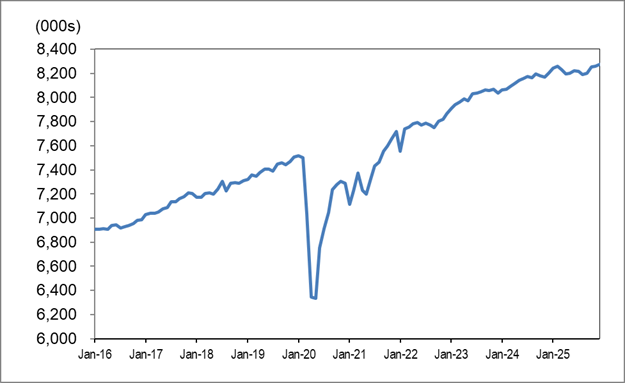
Employment in Ontario was little changed (12,700 or 0.2%) in December, similar to November (6,100 or 0.1%). A total of 8,273,100 people were employed in Ontario in December.
Employment in Canada was little changed by 8,200 (0.0%) in December, after little change in November (53,600 or 0.3%). A total of 21,143,700 people were employed in Canada in December.
Chart 1 shows employment in Ontario from January 2016 to December 2025.
Source: Statistics Canada, Labour Force Survey, Table 14-10-0287-01, (seasonally adjusted data).
On an annual basis, employment in Ontario increased by 80,900 (1.0%) in 2025, following increases of 140,000 (1.7%) in 2024 and 242,000 (3.1%) in 2023.
Full-time vs. part-time
Full-time employment increased by 35,500 (0.5%) in December, while part-time employment decreased by −22,800 (−1.5%).
Employment change by sex and age
Employment for men increased by 6,600 (0.2%) in December, after increasing by 12,600 (0.3%) in November. Total male employment was 4,378,100 in December. Employment for women increased by 6,200 (0.2%) in December, after decreasing by 6,500 (−0.2%) in November. Total female employment was 3,895,100 in December.
Youth (aged 15 to 24) employment increased by 14,700 (1.4%) in December for a total of 1,071,600, after increasing by 7,600 (0.7%) in November. Employment for people aged 25 to 54 decreased by 14,000 (−0.3%) in December to 5,453,100, after decreasing by 17,400 (−0.3%) in November. Employment for those aged 55 and older increased by 12,100 (0.7%) in December to 1,748,500, after increasing by 15,900 (0.9%) in November.
Employment change by industry
Ontario’s largest industry groups by employment in December were wholesale and retail trade (1,152,600 or 13.9% of total employment), health care and social assistance (1,038,800 or 12.6%), professional, scientific and technical services (913,800 or 11.0%) and manufacturing (830,600 or 10.0%).
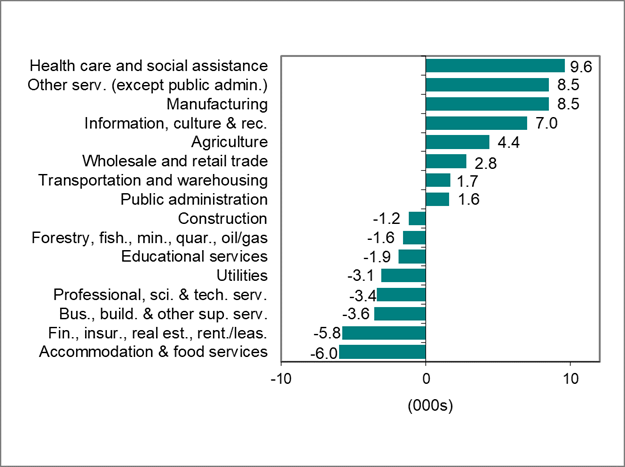
Notable job gains in December included health care and social assistance (9,600 or 0.9%), other services, except public administration (8,500 or 2.9%) and manufacturing (8,500 or 1.0%).
Accommodation and food services (−6,000 or −1.4%) , finance, insurance, real estate rental and leasing (−5,800 or −0.8%) and business, building and other support services (−3,600 or −1.3%) led job losses in December.
On an annual basis, employment increased in ten of the sixteen major industry groups in 2025, led by information, culture and recreation (26,700 or 8.2%), wholesale and retail trade (25,200 or 2.2%), accommodation and food services (18,700 or 4.4%) and health care and social assistance (14,700 or 1.5%).
On an annual basis, employment decreased in six of the sixteen major industry groups in 2025. Notable employment losses occurred in business, building and other support services (−12,200 or −4.2%), manufacturing (−8,400 or −1.0%) and agriculture (−6,400 or −8.9%).
Chart 2 shows industries by employment change in Ontario, November 2025 to December 2025.
Source: Statistics Canada, Labour Force Survey, Table 14-10-0287-01, (seasonally adjusted data).
Employment change by occupation
Ontario’s largest occupational groups by employment in December were sales and service (1,706,200 or 20.7% of total employment), business, finance and administration (1,362,800 or 16.5%), trades, transport and equipment operators (1,091,900 or 13.3%) and occupations in education, law and social, community and government services (980,200 or 11.9%).
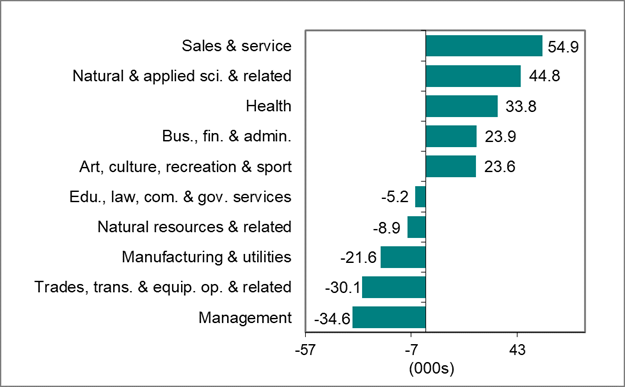
Five of the ten major occupational groups in Ontario had net annual employment gains between 2024 and 2025. Sales and service occupations (54,900 or 3.3%) led job gains, followed by natural and applied sciences and related occupations (44,800 or 5.5%) and health occupations (33,800 or 5.7%).
Annual employment losses were recorded in management occupations (−34,600 or −3.9%), trades, transport and equipment operators and related occupations (−30,100 or −2.6%) and occupations in manufacturing and utilities (−21,600 or −5.5%).
Chart 3 shows occupations by annual employment change in Ontario, 2024 to 2025.
Source: Statistics Canada, Labour Force Survey, Table 14-10-0421-01, (data unadjusted for seasonality).
Employment change in urban centres
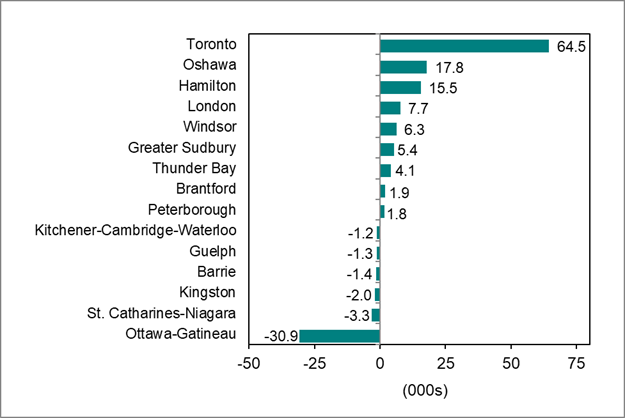
In December 2025, employment in nine of the sixteen Ontario Census Metropolitan Areas (CMAs) was above their December 2024 levels, led by Toronto (64,500 or 1.7%) and followed by Oshawa (17,800 or 7.4%), and Hamilton (15,500 or 3.6%).
Notable employment losses in December were recorded in Ottawa-Gatineau (−30,900 or −3.5%), St. Catharines-Niagara (−3,300 or −1.4%) and Kingston (−2,000 or −2.1%).
On an annual basis, employment increased in thirteen of the sixteen CMAs in 2025, led by Toronto (67,200 or 1.8%), Hamilton (8,900 or 2.1%), Kitchener-Cambridge-Waterloo (7,700 or 2.0%), and Oshawa (7,400 or 3.1%).
On an annual basis, employment decreased in three of the sixteen CMAs in 2025. Notable employment losses occurred in Ottawa-Gatineau (−6,900 or −0.8%), Guelph (−5,500 or −5.3%) and Barrie (−2,100 or −1.6%).
Chart 4 shows employment change for Ontario Census Metropolitan Areas (CMAs) from December 2024 to December 2025.
Alt text description: Bar graph for chart 4 shows employment change by Ontario Census Metropolitan Area.
Source: Statistics Canada, Labour Force Survey, Table 14-10-0459-01, (seasonally adjusted data three-month moving average to reduce volatility caused by small sample size).
Note: Belleville-Quinte West was excluded from this table. Following the full integration of the 2025 LFS sample design in September 2025, enhancements to the calibration of survey weights may have introduced a level shift for some estimates in this community. Use caution when comparing estimates for this community before and after September 2025.
Unemployment rate increased to 7.9%
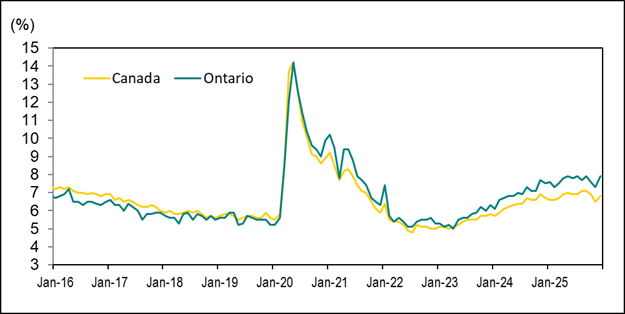
Ontario’s unemployment rate increased to 7.9% in December from 7.3% in November. The provincial unemployment rate has increased significantly since falling to a near-record low in April 2023 (5.0%).
The Canadian unemployment rate increased to 6.8% in December from 6.5% in November. The national unemployment rate has increased significantly since March 2023 (5.0%).
Chart 5 shows unemployment rates, Ontario and Canada, January 2016 to December 2025.
Source: Statistics Canada, Labour Force Survey, Table 14-10-0287-01, (seasonally adjusted data).
Ontario’s annual unemployment rate was 7.7% in 2025, above the annual rate of 7.0% in 2024 and well above the annual rate of 5.6% in 2023.
Unemployment rate by sex, age, visible minority status, immigrant status and Indigenous group
The unemployment rate for women increased to 8.0% in December from 7.4% in November. The rate for men increased to 7.8% in December from 7.3% in November.
For youth aged 15 to 24, the unemployment rate increased to 15.6% in December from 15.3% in November. The unemployment rate for individuals aged 25 to 54 increased to 7.0% in December from 6.3% in November. The unemployment rate for those aged 55 and older increased to 5.3% in December from 5.1% in November.
In Ontario, the unemployment rate among population groups designated as visible minorities was estimated at 8.5% in December compared to a 5.9% rate for those who are not visible minorities and did not identify as Indigenous (data are three-month moving averages and are not adjusted for seasonality).
The unemployment rate for landed immigrants was 7.4% in December compared to a 6.5% rate for the Canadian-born population in Ontario. The unemployment rate for landed immigrants includes the rates for very recent immigrants (i.e., immigrants who landed less than 5 years earlier) (10.5%), recent immigrants (i.e., immigrants who landed more than 5 to 10 years earlier) (8.7%) and established immigrants (i.e., immigrants who landed more than 10 years earlier) (6.3%) (data are three-month moving averages and are not adjusted for seasonality).
In Ontario, the unemployment rate for the Indigenous population was estimated at 11.0% in December compared to a 7.0% rate for the non-Indigenous population. The unemployment rate for the Indigenous population includes the rates for First Nations people living off reserve (10.0%) and individuals who identify as Métis (12.3%) (data are three-month moving averages and are not adjusted for seasonality).
Unemployment rate by urban centre
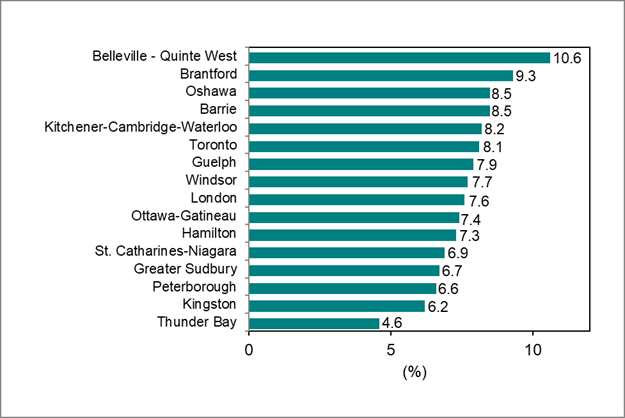
In December, the average unemployment rate increased from November in nine of the sixteen Ontario Census Metropolitan Areas (CMAs). The largest increases were seen in Belleville – Quinte West (8.8% in November to 10.6% in December), Kingston (5.6% to 6.2%), Peterborough (6.0% to 6.6%) and London (7.0% to 7.6%).
Five CMAs had average unemployment rates that decreased in December, led by Guelph (8.3% in November to 7.9% in December), Windsor (8.1% to 7.7%) and Toronto (8.4%% to 8.1%) .
The average unemployment rate was unchanged in Ottawa-Gatineau (7.4%) and Hamilton (7.3%) in December.
Chart 6 shows the average unemployment rate for Ontario Census Metropolitan Areas (CMAs) in December 2025.
Source: Statistics Canada, Labour Force Survey, Table 14-10-0459-01, (seasonally adjusted data three-month moving average to reduce volatility caused by small sample size).
Long-term unemployment
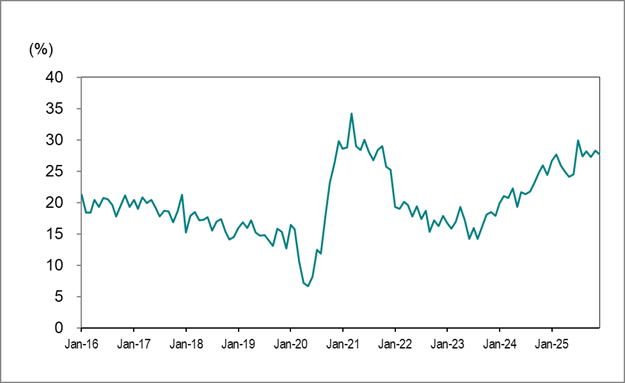
In December, an estimated 195,200 Ontarians or 27.7% of all unemployed people were unemployed for 27 weeks or longer (long-term unemployed). This compared to 180,000 Ontarians or 28.3% of all unemployed people in November and 162,800 or 24.4% of all unemployed people a year earlier in December 2024.
On an annual basis, the proportion of all unemployed people who were in long-term unemployment was 27.1% in 2025. This was well above the percentages in 2024 (22.4%) and 2023 (16.7%).
The average time in unemployment was 24.9 weeks in December, below the average in November (28.3 weeks) and above the average in December 2024 (24.6 weeks).
On an annual basis, the average time in unemployment was 24.9 weeks in 2025, above the averages in 2024 (20.9 weeks) and 2023 (17.6 weeks).
Chart 7 shows Ontario’s long-term unemployment (27 weeks or more) as a percentage of total unemployment, January 2016 to December 2025.
Source: Statistics Canada, Labour Force Survey, Table 14-10-0342-01, (seasonally adjusted data).
Average hourly wages by sex, age and industry
Important note
Average hourly wage rates are reported without adjusting for the rate of inflation.
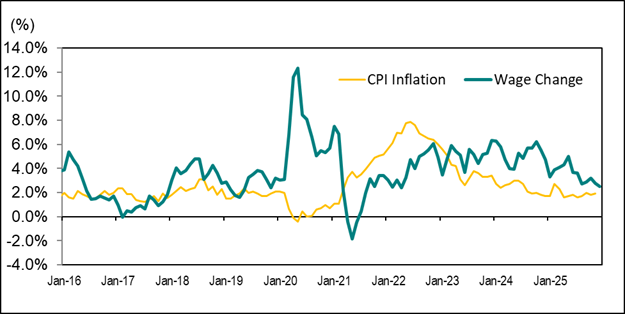
The average hourly wage rate in Ontario for employees was $38.32 in December, above the average rate across Canada ($37.06). Ontario’s average hourly wage rate in December rose by 2.5% on a year-over-year basis (by $0.93 from $37.39 in December 2024) which was below the 2.8% increase from November.
December’s wage growth (2.5%) was above the growth seen in the Ontario Consumer Price Index (CPI) as of November (1.9%). The CPI is a measure of inflation that represents changes in prices for goods and services as experienced by consumers.
Chart 8 shows the year-over-year percentage change in Ontario’s average hourly wage rate and the Ontario Consumer Price Index (CPI), January 2016 to December 2025.
Source: Statistics Canada, Labour Force Survey, Table 14-10-0063-01 (data unadjusted for seasonality); Statistics Canada, Consumer Price Index, Table 18-10-0004-01 (data unadjusted for seasonality).
The average hourly wage rate was $36.16 for women in December, increasing by 3.7% ($1.30) from $34.39 in December 2024. For men, the average hourly wage rate was $40.41, an increase of 1.5% ($0.61) from $39.80 a year earlier.
For youth aged 15 to 24, the average hourly wage rate was $22.53 in December, an increase of 2.1% ($0.47) from the hourly wage rate in December 2024. The average hourly wage rate for individuals aged 25 to 54 rose to $40.98 in December, up 2.9% ($1.15) from $39.83 a year earlier. The average hourly wage rate for those aged 55 and older increased by 1.7% ($0.66) to $40.51 in December from $39.85 a year earlier.
In December, the industries with the largest increases in average hourly wage rates compared to a year earlier were:
- Finance, insurance, real estate, rental and leasing: +7.1% ($3.26) to $49.06
- Forestry, fishing, mining, quarrying, oil and gas: +6.2% ($0.32) to $48.01
- Business, building and other support services: +11.0% ($3.04) to $30.68
Only four industries experienced a decrease in their average hourly wage rate in December compared to a year earlier:
- Agriculture: −16.6% (−$0.33) to $23.78
- Transportation and warehousing: −6.2% (−$0.44) to $32.43
- Information, culture and recreation: −3.7% (−$1.36) to $35.79
- Other services (except public administration): −0.58% ($-0.19) to $32.64
Changes in average hourly wages by industry are the result of multiple factors, including wage growth and shifts in the composition of employment by job tenure and occupation.
Download data
Source: Statistics Canada, Labour Force Survey
December 2025 Labour Market Report:
- CSV, Chart 1, employment in Ontario from January 2016 to December 2025, 1 Kb
- CSV, Chart 2, industries with highest and lowest employment change in Ontario, November 2025 to December 2025, 2 Kb
- CSV, Chart 3, annual employment change for occupations in Ontario from 2024 to 2025, 2 Kb
- CSV, Chart 4, employment change for Ontario Census Metropolitan Areas (CMAs) from December 2024 to December 2025, 2 Kb
- CSV, Chart 5, unemployment rates, Ontario and Canada, January 2016 to December 2025, 2 Kb
- CSV, Chart 6, average unemployment rates for Ontario Census Metropolitan Areas (CMAs), December 2025, 2 Kb
- CSV, Chart 7, Ontario’s long-term unemployed (27 weeks or more) as a percentage of total unemployment, January 2016 to December 2025, 2 Kb
- CSV, Chart 8, year-over-year percentage change in Ontario’s average hourly wage rate and the Ontario Consumer Price Index (CPI), January 2016 to December 2025, 2 Kb