

Monitoring and testing for chronic wasting disease
Learn about how you can report sick cervids (members of the deer family) and how hunters can get their harvested deer tested.
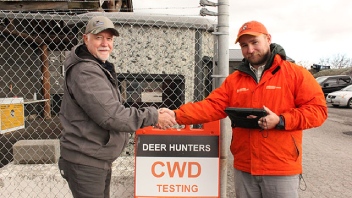
Overview
Once established in the wild, chronic wasting disease (CWD) is nearly impossible to control or eliminate. If CWD enters Ontario, early detection will be critical for a rapid and effective response.
Our surveillance program includes:
- annual targeted surveillance of high-risk areas of the province by testing samples from:
- hunter harvested cervids
- people who’ve registered to keep a cervid carcass
- dead cervids such as roadkill
- opportunistic sampling of high-risk cervids (for example, animals that showed signs of illness and escaped captive cervids) throughout the year and across the province
- mandatory testing of all farmed cervids at slaughter
Since 2002, we have tested over 16,500 samples from wild cervids and CWD has not been detected. We must remain vigilant because of the risks posed from its continued spread across North America.
Report a sick or dead wild deer, moose, elk or caribou
To report these signs in a wild cervid (member of the deer family):
- use our online reporting tool
- email CWD@ontario.ca
- call our Wildlife Health Information Line at
1-888-574-6656
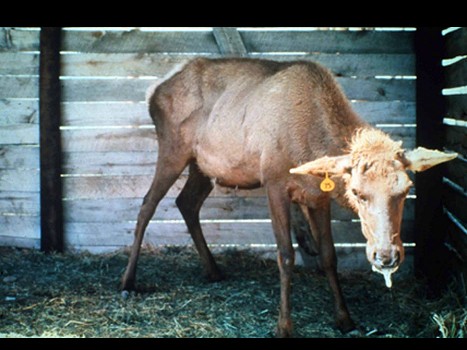
When reporting sick or dead cervids, include:
- your name and contact information
- the date you saw the animal
- the location the animal was seen
- the signs of illness or unusual behaviour you observed
- if the animal was alive or dead
- photos or video and submit them to CWD@ontario.ca
Testing for CWD
There are currently no approved tests (such as a blood test) that can definitively diagnose CWD in a live animal. The tissue that must be tested (such as brain and lymph nodes) can only be obtained from an animal after it is dead.
Ontario’s hunters are a key partner in our efforts to monitor for CWD. Learn how to get your deer tested.
Annual targeted surveillance
Each year, we identify priority areas for surveillance using a risk model, expert input and information from other jurisdictions. Ontario’s risk model is based on known risk factors linked to the spread of CWD, including:
- proximity to neighbouring outbreaks
- deer and elk population density
- presence of cervid farms
- prior sampling effort
- winter deer feeding areas
- winter severity
Each year during the deer hunting season, we collect samples from these surveillance areas. Hunters within a surveillance area can have their harvested deer tested free of charge. Hunters are the primary source of samples and are critical to Ontario’s efforts to detect CWD.
Note: Fawns under 1 year of age are not tested because CWD is less likely to be detected in young animals.
For more information on CWD monitoring or to submit a sample from one of the CWD surveillance areas:
- call our Wildlife Health Information Line at
1-888-574-6656 - email CWD@ontario.ca
How to get your deer tested
The options for submitting samples in a surveillance area, include:
- ministry wildlife technicians
- freezer depots
- participating taxidermists
- participating butchers
Ministry wildlife technicians
During portions of the firearm hunts, our wildlife technicians travel throughout the surveillance areas visiting hunters and hunt camps to request samples from harvested deer. The technicians ask the hunter’s permission to remove a small amount of tissue from the base of the skull of the deer for analysis. The deer is then returned to the hunter.
Sampling does not prevent hunters from consuming the meat or, in most cases, having the head mounted. Learn more about safe handling, chronic wasting disease and human health.
Ministry freezer depots
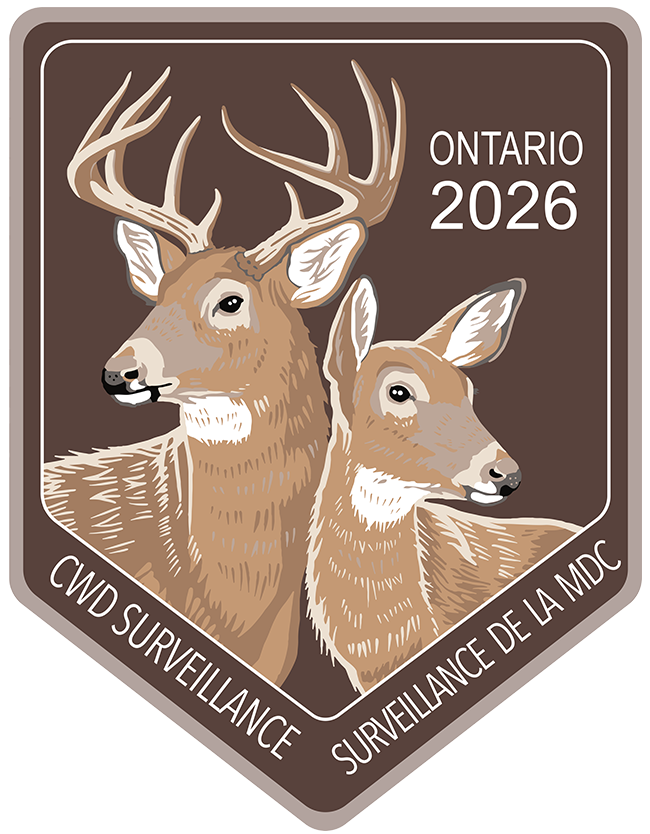
Successful hunters in surveillance areas can take the heads of yearling or older deer they harvest and deposit them in one of the ministry freezer depots. Freezer depots have bags to place deer heads into, along with tags that must be filled out with required information and attached to the bag. Hunters who submit a sample at a ministry freezer are provided with a participation crest and a sample ID card.
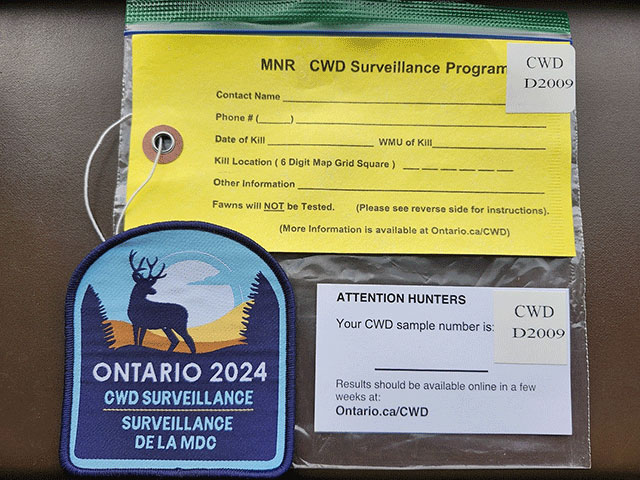
When submitting heads, hunters:
- must provide the date and general location of the harvest using the map provided at the depot — without this information the sample will not be tested
- should make deposits as soon as possible, preferably within 48 hours of harvest or freeze the head until it can be dropped off
- should remove the antlers before submission
- may remove the skull cap if most of the brain, including all the brain stem, remains in the head
If you harvest a deer within one of the surveillance areas that you would like to have sampled, but you are unable to submit it at a freezer location, contact CWD@ontario.ca or
Test results will be posted to the test results table.
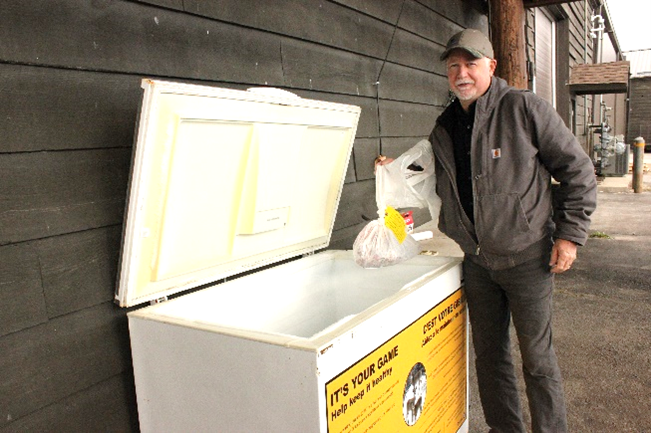
Earn your crest
The first 500 hunters in each surveillance area who provide a sample from a deer taken in a surveillance area will receive a participation crest.
Freezer depot locations
In 2026, we will conduct targeted chronic wasting disease monitoring in 2 Ontario regions:
- Southern Ontario in Wildlife Management Units (WMUs): 79C, 79D, 87C, 87D, 87E, 88, 89A, 89B and 90A
- Eastern Ontario in WMUs: 63B, 64A, 66A, 67 and 69B
Check the freezer depot tables for a list of drop-off locations in each region.
2026 sampling area, Southern Ontario
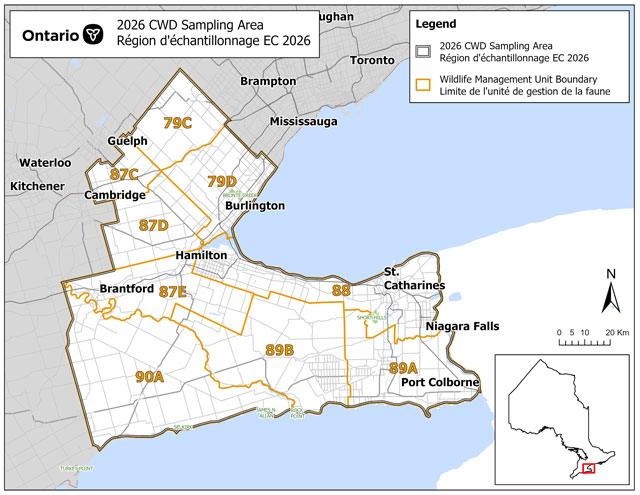
Southern Ontario freezer depots
Additional depots may be added. Check back for regular updates.
| Name | Address | Phone | Hours |
|---|---|---|---|
| Shooter’s Choice | 631 Colby Drive, Waterloo |
| |
| White Tanning | 5153 Eramosa, Erin Townline Rockwood |
| |
| Triggers & Bows | 340 Bishopsgate Road, RR2 Burford |
| |
| Erie Tracker Outfitters | 111 Killaly Street West Port Colborne |
|
2026 sampling area, Eastern Ontario
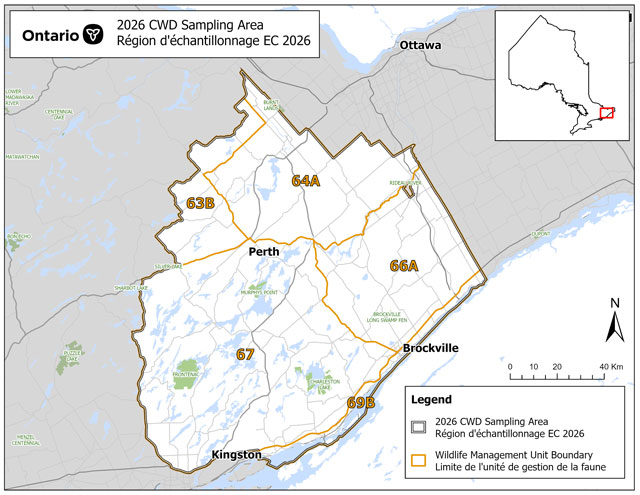
Eastern Ontario freezer depots
Additional depots may be added. Check back for regular updates.
| Name | Address | Phone | Hours |
|---|---|---|---|
| Norris’s Bait and Tackle | 8872 County Road 42 Westport |
| |
| Al’s Corner Store | 4812 Highway 17 West Arnprior |
| |
| Big Rideau Tackle | 158 Lombard Street Highway 15 Smith Falls |
| |
| Wildlife Control Supplies Canada | 7000 County Road 18 Spencerville |
| |
| South Frontenac Rental Center | 4567 Road 38 Harrowsmith |
| |
| Timeless Pursuit Hunting Company | 232 King Street West Prescott |
| |
| Wings Live Bait and Tackle Ltd. | 413 Lyndhurst Road Leeds and the Thousand Islands |
|
Test results
Testing for 2026 is under way and should be complete by the end of February 2026. Results will be posted as they become available. CWD was not detected in any samples we have tested.
Explanation of results
- CWD not detected
- CWD was not detected in the sample
- Sample not tested
- It was not possible to test this sample or the sample was from outside of the surveillance area
For more information on the ministry surveillance program or to receive copies of the previous year’s report, contact us.