

Tree-of-heaven
Learn about the tree-of-heaven and how you can help prevent the introduction and spread of this invasive species.
What Ontario is doing
To prevent the introduction and further spread of this invasive plant, Ontario has regulated the tree-of-heaven (Ailanthus altissima) as a restricted invasive species under the Invasive Species Act, 2015.
Learn about the Invasive Species Act and regulations.
Background
The tree-of-heaven is a tall deciduous tree (meaning it drops its leaves) native to China and Taiwan. Known for its rapid growth and hardiness, it's often found in urban areas, along roadsides or in disturbed soils.
The tree-of-heaven was introduced to North America in the late 1700s as an ornamental plant, and later was used for urban landscaping. Its prolific seeding and root suckering has allowed it to spread aggressively and outcompete native vegetation.
Tree-of-heaven is also a primary host for the spotted lanternfly (Lycorma delicatula), an invasive pest that's harmful to agriculture and forestry due to its ability to feed on a wide range of fruit, ornamental and woody trees. The tree's association with the spotted lanternfly has heightened the importance of controlling its spread, as reducing the number of host trees can help limit the spotted lanternfly's proliferation.
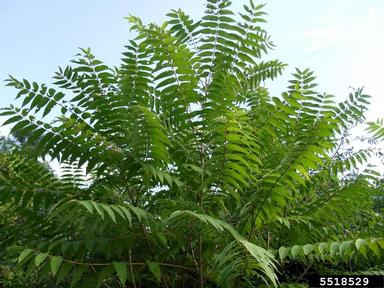
Credit: Richard Gardner, Bugwood.org
Range
Originally from China and Taiwan, the tree-of-heaven has now established itself throughout much of North America, particularly in the United States.
Since its first introduction to Europe in the 1750s, it now occurs on every continent apart from Antarctica.
It has been reported in British Columbia, Quebec and Ontario. In Ontario, it occurs in Southern and Southeastern Ontario.
View an up-to-date distribution map of tree-of-heaven in North America.
Impacts of tree-of-heaven
Tree-of-heaven's fast-growing nature allows it to outcompete native species for light, nutrients and space. It produces certain chemicals, which inhibit the growth of other plants, contributing to its ability to dominate and take over invaded ecosystems. This aggressive spread can lead to decreased biodiversity and disrupt native ecosystems. Its aggressive roots can also damage pavement and building foundations.
How to identify tree-of-heaven
The tree-of-heaven is a tall, deciduous tree that can grow up to 25 metres tall and 2 metres in diameter. It has smooth, pale grey bark and its leaves grow in pairs across the stem. The tree also has clusters of small, yellowish-green flowers, which develop into winged samaras (a type of fruit containing seeds for germination).
The tree-of-heaven can also be identified by the foul-smelling odour that the leaves and twigs emit when crushed giving it the nickname “stinky sumac”.
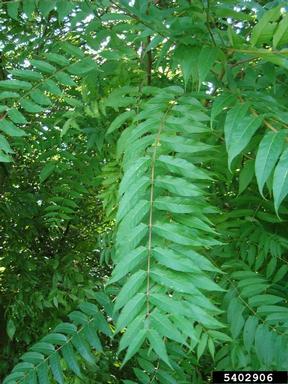
Credit: Annemarie Smith, ODNR Division of Forestry, Bugwood.org
Key identification features
The tree-of-heaven can be mistaken for native sumac, ash or walnut trees. It can be distinguished by its distinctive foul odor, and leaflets that have smooth (as opposed to toothed) margins except for one or two lobes near the base of the leaflets.
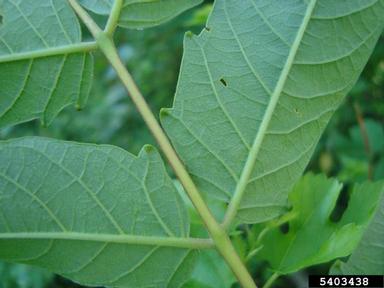
Credit: Richard Gardner, Bugwood.org
What you need to know
Learn how to identify the tree-of-heaven and how to prevent the introduction or spread of this plant in local ecosystems.
It is illegal to:
- possess or transport tree-of-heaven in a provincial park or conservation reserve
- bring tree-of-heaven into Ontario
- deposit, release or propagate tree-of-heaven including planting it or any other actions which may encourage its spread or growth
- buy, sell, lease or trade tree-of-heaven in Ontario
Educate others about the risks associated with this invasive plant, particularly its role as the primary host species for the spotted lanternfly and how they can help prevent its spread.
Reporting illegal activity
If you have any information about the illegal importation, distribution or sale of the tree-of-heaven, report it immediately to either:
- the ministry at
1-877-847-7667 , toll-free anytime - Crime Stoppers anonymously at
1-800-222-TIPS (8477) (8477 (8477))
If you’ve seen tree-of-heaven or another invasive species in the wild, please:
- contact the toll free Invading Species Hotline at
1-800-563-7711 - visit EDDMapS
- search for the ‘Invasive Species in Ontario’ project on iNaturalist.org to report a sighting