

Alert: Loading limitations of utility service covers
Learn about suggested precautions when conducting construction work over underground utility vaults under sidewalks and other non-roadway areas.
The incident
In Ontario, a worker died and another worker was critically injured while operating a mobile elevated work platform (EWP) over a utility service cover that was on top of a telephone company cable vault embedded in concrete below a public sidewalk. The utility service cover broke under the weight of the equipment, destabilizing the elevated platform and causing it to tip over.
Hazard
This Alert is intended to increase awareness about the safety requirements under the Occupational Health and Safety Act (OHSA) and the Construction Projects Regulation (O. Reg. 213/91). It is intended to help employers be aware of the potential hazards associated with utility service covers installed on public rights of way which may not be strong enough to support personnel, vehicles and heavy mobile equipment, such as mobile elevated work platforms.
Utility service covers allow for access to various utilities and may be located in areas where loads from personnel, vehicles, and heavy mobile equipment such as elevated work platforms and cranes may be applied to them.
Utility covers must meet the minimum load rating of a work platform as defined in section 134 of O. Reg. 213/91 when they are located on a project and accessible by workers. This is a minimum requirement.
The utility service cover must also be capable of withstanding additional loads imparted by vehicles and other equipment. These loads can include the wheel loads from equipment, such as mobile elevated work platforms, and outrigger loads from cranes which may impart significant forces on utility covers. It is the duty of the employer to ensure that in such cases, the utility service cover is adequate to withstands all these loads.
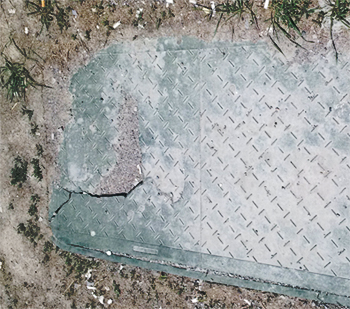
Utility service cover that has been damaged.
Protective Measures
Contractors using mobile elevated work platforms on a project should be aware of all ground hazards that may affect the stability of the equipment including the strength limitations of grade level utility service covers in the work area. The following precautions are best practices that should be taken to prevent workers from being exposed to the dangers associated with working on a surface that cannot support the load applied to it:
- Inspect utility service covers in the work area and ensure they are capable of supporting all loads, or that they are adequately covered with a covering capable of supporting all loads expected to be applied to them, including loads from mobile equipment or machinery.
- Refer to the equipment/machinery operator’s manual to determine the weight of the equipment/machinery and corresponding accessories or attachments. Be sure that they do not exceed the design load limitations of any utility covers in the work area.
- If the utility cover can't support the load consider ways to mitigate the risk, for example, by operating the equipment/machinery along a path that avoids the area with the utility cover. This prevents the cover from being subjected to the equipment/machinery's weight.
- If avoiding the utility cover isn't feasible, implement an engineered control, like covering the utility cover with a heavy steel plate designed to withstand the applied loads.
Elevated work platforms and employer duties under the Occupational Health and Safety Act and the Construction Projects Regulation
Under the Occupational Health and Safety Act (OHSA) employers have a duty to provide information, instruction and supervision to a worker to protect their health and safety, and to acquaint a worker or person in authority over a worker with any hazard in the work. This includes identifying hazards that could affect the stability of an elevated work platform (EWP) before work starts and providing instruction on measures to be taken to address those hazards and perform the work safely. [OHSA 25(2)(a) and 25(2)(d)]. There are additional general duties for employers, supervisors and workers.
In addition to the general employer responsibilities outlined under OHSA, there are prescribed requirements for elevated work platforms under the Construction Projects Regulation O. Reg. 213/91 that must be complied with.
Under the construction regulation O. Reg. 213/91, employers must ensure that:
- The existing utility covers located in the work area are capable of supporting loads they may be subjected to by the work activities taking place and, if necessary, replace an existing utility cover with one of sufficient strength. Alternatively, the utility cover may itself be covered with a material capable of supporting the load without failure [ O. Reg. 213/91 subsection 31(3)].
- Before the EWP is used for the first time, provide oral, written, and hands-on instruction in the specific class of machine a worker will operate. The instruction would include the dangers of ground/surface conditions that would affect the stability of the EWP and how to operate the EWP in a manner so as not to affect its stability [O. Reg. 213/91 sections 147 and 148].
- In addition to the specific training requirements outlined for EWPs, subsection 93(3) of the construction regulation also requires equipment, such as EWPs, to be used in accordance with the manufacturer’s operating manual. EWP operating manuals include information on the types of surfaces the equipment should not be operated on and require the user/operator to survey the ground / surface conditions of the equipment’s intended path to identify conditions that would pose a hazard to the stability of the EWP.
- If the view of the operator of the EWP’s intended path is obstructed, then the operator of the EWP shall be assisted by a signaller [O. Reg. 213/91 104(3) 1.]. The employer must provide the signaller with adequate oral training and written instructions to ensure they are competent to safely act as a signaller on the project [O. Reg. 213/91 106(1) and (1.5)]. Provision of a signaller would be determined by site specific conditions at the job and should be assessed daily.
For more information
Find more information and guidance resources about the safe use of elevated work platforms on construction projects and applicable health and safety requirements under the Occupational Health and Safety Act and the Construction Projects Regulation O. Reg 213/91 at the links below.
- Achieve compliance on construction sites: access to and egress from a work area | ontario.ca
- Infrastructure Health and Safety Association
- Ministry of Labour, Immigration, Training and Skills Development Health & Safety Contact Centre
- Canadian General Standards Board
- Canadian Standards Association
This resource does not replace the Occupational Health and Safety Act (OHSA) and its regulations and should not be used as or considered legal advice. Health and safety inspectors apply and enforce these laws based on the facts they find in the workplace.