

Euthanizing sheep and goats on farm
Learn when and how to euthanize sheep and goats humanely, and how to dispose of deadstock properly.
Overview
You may need to euthanize an animal if it severely injured, sick or affected by a disaster such as a fire. On-farm euthanasia is a practical and humane way to relieve an animal's pain and suffering, if it is unfit to travel or to prevent drug residues from entering the food supply. Whenever possible, consult a veterinarian before deciding to euthanize an animal. In some cases, such as a broken leg with exposed bone, immediate euthanasia may be required.
Use the following considerations to help decide whether treatment or slaughter are appropriate alternatives to euthanasia:
Consider treatment if the animal:
- is likely to recover
- is in pain or distress that can be lessened with treatment
- can access feed and water
Consider slaughter if the animal:
- has cleared drug withdrawal times
- fit for humane transported
Consider euthanasia if the animal:
- if the animal is unlikely to recover
- is in pain or distress that will not be lessened with treatment
- can’t access feed and water
- is not fit for slaughter
Contact a veterinarian if the animal:
- shows clinical signs you don’t recognize
- shows signs of a reportable disease
- requires an assessment, treatment or euthanasia
Euthanasia methods
Euthanasia should minimize fear and anxiety in the animal. You have an ethical and moral responsibility to provide a humane death without causing additional pain or suffering.
There are 3 appropriate methods for humane on-farm euthanasia:
- injection by a veterinarian
- captive bolt followed by bleed-out
- gunshot
Each method has advantages and disadvantages as outlined in Table 1. If you choose the captive bolt pistol or gunshot method, take precautions to prevent injury to yourself and others.
When choosing a method, consider:
- human safety
- animal welfare
- required skills
- costs
- other considerations
Death must always be confirmed, regardless of which method is used.
| Method | Safety | Animal welfare rating | Skills required | Cost | Other considerations |
|---|---|---|---|---|---|
| Injection by a veterinarian | Restrain the animal. | Excellent. | Proper technique for intravenous injection. | Veterinary fee. | Can only be administered by licenced veterinarian. |
| Penetrating captive bolt — penetration of the skull and brain by captive bolt, followed by bleed-out by cutting all the main arteries and veins in the neck | Restrain the animal. Be cautious of falling or thrashing animals. | Good. Correct cartridge strength, target site and penetration angle on animal is essential. | Correct and safe use of captive bolt pistol. Correct and safe use of sharp knife. | Low — after purchase of captive bolt pistol. | Results in some body movement. Results in large volume of blood that requires proper disposal. |
| Gunshot — penetration of the skull and brain by bullet | Restrain the animal. Be cautious of falling or thrashing animals. Be extremely cautious about bullet ricochet. | Good. Correct size of firearm and ammunition, and correct target site and penetration angle on animal is essential. | Correct and safe use of firearm. | Low — after purchase of firearm. | Results in some body movement and blood. Requires firearm acquisition certificate. Local by-laws may prohibit the use of firearms. |
Using a captive bolt or firearm
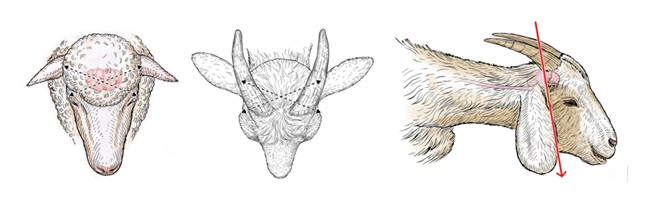
An experienced person can produce rapid unconsciousness in an animal by using a penetrating type captive bolt or a firearm. The shot must be aimed at the correct target site and angle for the species and age of animal. The same anatomical targets and angles are used for both methods (refer to Figure 1 and 2).
Target site and angle
For sheep and goats without heavy horns, aim at the intersection of 2 imaginary lines drawn from the outside corner of the eye to the base of the opposite ear (refer to Figure 1). The shot must be directed towards the back of the throat.
For sheep and goats with large horns, aim at the midpoint on an imaginary line between the back of the ears. Direct the shot towards the mouth (refer to Figure 2).
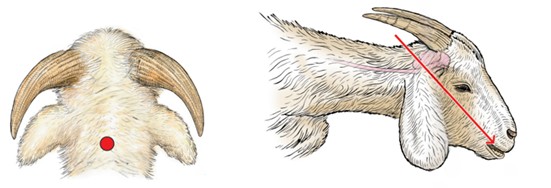
Graphics adapted from the AVMA Guidelines for the Humane Slaughter of Animals, 2016 and 2020 editions.
Steps for using a captive bolt
- Make sure the animal is securely restrained.
- Use the appropriate cartridge strength for the animal (refer to the manufacturer's manual).
- Place the captive bolt pistol firmly against the animal's head on the target site, and shoot.
- Be careful to avoid injury from thrashing limbs when the animal collapses.
- After stunning, cut the carotid arteries and jugular veins in the neck with a sharp knife to bleed-out the animal. These arteries and veins are on both sides of the throat.
Learn more about captive bolt stunning of livestock.
Gunshot
- Make sure the animal is securely restrained.
- Shoot outdoors when possible.
- Have a backstop (such as an earth berm or manure pile) to stop the bullet if you miss or it over-penetrates.
- Use a firearm and ammunition that are appropriate for the animal’s size, age and type. The ammunition used to euthanize an animal must be powerful enough to make the animal immediately unconscious and to penetrate the head deeply enough to destroy the areas of the brain that control breathing and circulation.
- Hold the firearm 5 to 25 cm (2 to 10 in.) from the target site. Do not place the firearm muzzle directly against the animal's skull.
- Be careful to avoid injury from thrashing limbs when the animal collapses.
Learn more about the humane killing of livestock using firearms.
Confirming death
You must confirm the animal's death immediately after euthanasia. A standing animal should collapse right away. Muscles may involuntarily contract for up to 20 seconds, followed by uncoordinated movements before the muscles completely relax.
Check for breathing, heartbeat and blinking (corneal reflex). There should be none. The eyes should be fixed and dilated. To check blinking, touch the surface of the eye. Any eye movement or blinking shows sustained or recovering brain activity. If there are signs of life, repeat the euthanasia method or use an alternate procedure.
Disposing of mortalities
Proper disposal of livestock mortalities is critical in preventing environmental contamination and the spread of disease. In Ontario, disposal is regulated under the Nutrient Management Act, 2002, O. Reg. 106/09.
Producers must dispose of on-farm mortalities within 48 hours in a safe and environmentally friendly manner. When euthanizing an animal, choose a location where you can access and dispose of the animal quickly.
Approved disposal methods include:
- using a licensed collector
- on-farm burial
- on-farm incineration
- on-farm composting
- on-farm disposal vessel
- delivery to an approved anaerobic digester
- delivery to an approved waste disposal site
- delivery to a licensed disposal facility under the Food Safety and Quality Act, 2001
- delivery to a licensed veterinarian for purposes of a postmortem
For further details on disposal methods review Deadstock disposal options on-farm.
Conclusion
Human safety and animal welfare must come before economic considerations when deciding if, how and when to euthanize an animal.
Euthanasia is an unpleasant but necessary part of animal husbandry. Careful planning and training can reduce stress and prevent the unnecessary suffering of animals. Talk to your veterinarian about euthanasia options and develop an action plan. Update it annually as part of your flock or herd health program.
Disclaimer
The Ministry of Agriculture, Food and Agribusiness (OMAFA) does not recommend any specific method described on this page. Producers should choose which method is appropriate for their individual circumstances.
Possession and use of firearms are governed by federal legislation. Producers should ensure compliance with all legislative requirements and ensure adequate safety precautions are used. OMAFA is not liable for injuries or damages resulting from the use of the above methods.