

Invasive Wild Pig Sightings: 2024 Annual Report
Read our 2024 annual report for information on invasive wild pig sightings in Ontario.
Overview
This annual report summarizes wild pig sightings and associated site visits in Ontario between January 1 and December 31, 2024.
Reporting Changes
The Ministry of Natural Resources (MNR) has changed the annual reporting period and how wild pig sightings are summarized to align with the recently released Canadian Invasive Wild Pig Report. Sightings are now summarized by calendar year (January 1 to December 31) rather than by fiscal year (April 1 to March 31), as used in previous annual sighting reports. As a result of this change, this summary for 2024 includes some data previously reported in the 2023 annual report. Also, summaries are now based on the date the wild pig was sighted rather than the date the sighting was reported. Therefore, yearly summary numbers may change over time as more reports come in, since reports are not always received in the same year pigs are sighted.
While evidence suggests that wild pig populations are not established in Ontario, research shows that a proactive approach to managing this invasive species is most successful. Therefore, the MNR continues to collect and follow up on wild pig sightings in the province.
Reports and follow-up
The MNR receives reports of wild pigs from the public by email wildpigs@ontario.ca, phone line (
Prior research in the province revealed that wild pigs are not moving into Ontario from neighbouring jurisdictions; rather, most sightings originate from pigs that have escaped from captivity; current year data continues to support this observation.
Wild pig reports
Wild pig sightings are sorted into four categories: domesticated pigs, pot-bellied pigs, Eurasian wild boar, and unknown (when the pig type cannot be verified with a photo or is unclear).
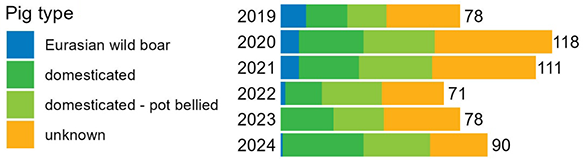
Sightings between January 1 and December 31, 2024, showed 28% of reports received were of unknown pig type, domesticated pigs made up 39% and pot-bellied pigs 32% of the total sightings while only 1% of sightings were of Eurasian wild boar (Figure 1). These pigs are often determined to be escapees from enclosures or containment.
Figure 1

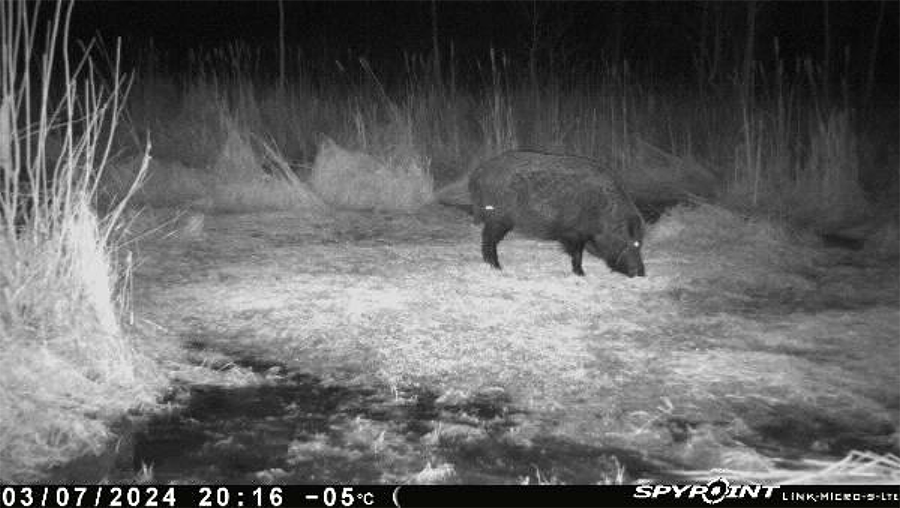
One sighting of Eurasian wild boar was confirmed during this period, resulting in the removal of 2 pigs from the wild in eastern Ontario. Eurasian wild boar sightings have declined since their phase out was initiated in Ontario in 2022 (Figure 2).
Figure 2
Most of the wild pigs reported have been lone animals (49%) or multiple animals with no young (38%), and some wild pigs were found dead, then reported (6%). Only 8% of the reports were in the highest risk category of multiple pigs with young (Figure 1), though none of these reports appeared to be established groups breeding in the wild.
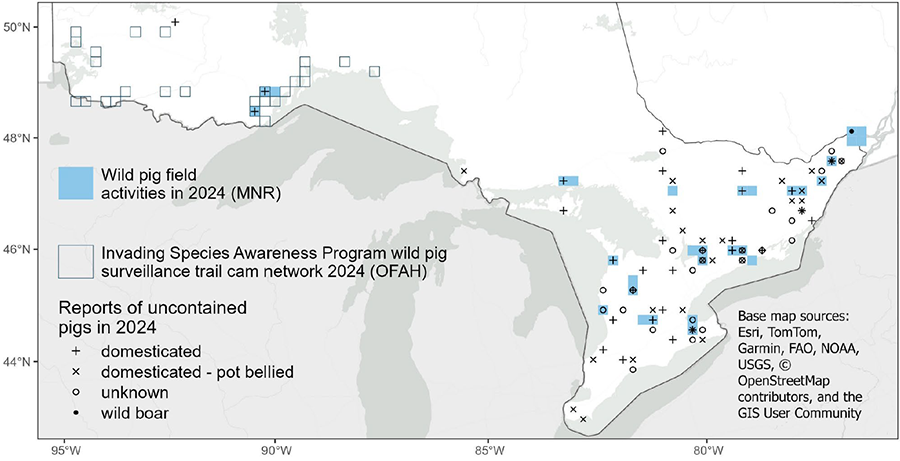
Between January 1 and December 31, 2024, site visits were conducted at 20 unique locations (Figure 3).
Figure 3
All high priority reports were followed up on in the field. In some cases, low priority reports were not investigated in the field. This occurred when the pigs reported were confirmed to be domestic or pot-bellied pigs and farms or owners were known to be nearby.in these cases, the probability of recapture by owners or further reports in populated areas was high, with no additional sightings of the pigs reported.
During site visits, MNR staff canvassed neighbourhoods and spoke with residents to gather additional information, such as number of pigs roaming freely, type of pigs, whether they caused damage, and the wild pigs’ locations.
This year, staff spoke with people at 40 properties, and left fact sheets and contact information at an additional 112 properties to facilitate the return or removal of the pigs. Where evidence was sufficient that wild pigs were present in the area, staff deployed trail cameras to help locate them.
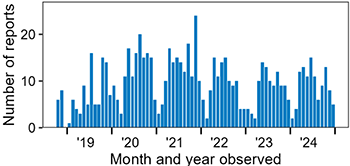
Between January 1 and December 31, 2024, the MNR received 90 unique moderate or high confidence wild pig sightings from the public, MNR staff, other agencies, internet, and media (Figure 2). Another 19 low confidence sightings were reported. Low confidence means that the individual reporting the sighting was not sure if what they saw or heard was a pig. Overall, 109 reports were submitted during the reporting period, averaging about 9 per month (Figure 4).
Figure 4
This past year, MNR staff removed 2 Eurasian wild boar, 1 domestic heritage breed pig and assisted with the recapture of 1 escaped domestic pig in southeastern Ontario. An additional 15 wild pigs connected with ministry investigations were known to be removed or recaptured by residents and other partners. Since 2020, the Ministry has removed 21 wild pigs and has assisted with trapping and the return of 10 wild pigs to captivity. A further estimated 205 wild pigs associated with Ministry investigations were reported to have been removed or recaptured by residents and other partners since 2020.
Pig escapes or releases
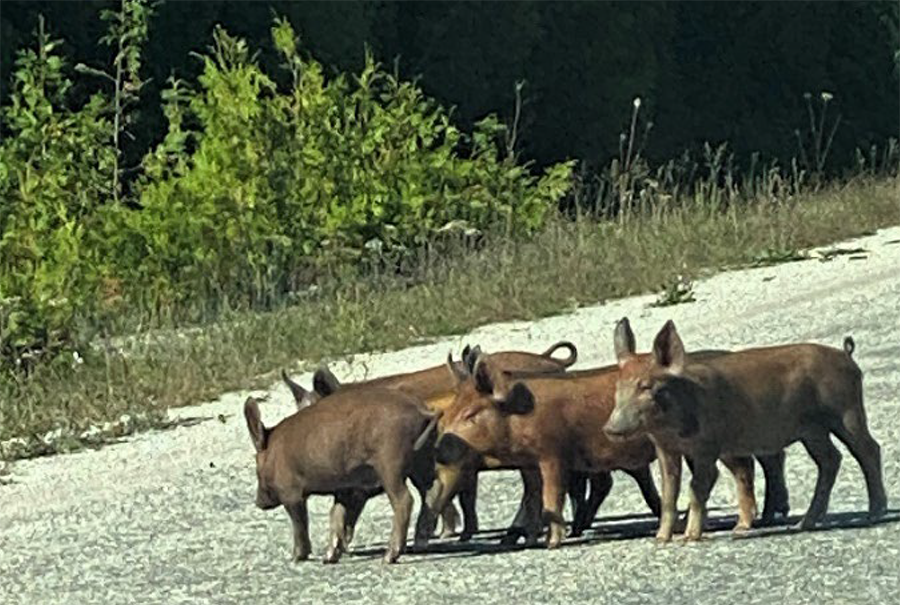
Escapees continue to make up most of the wild pig reports in the province. Most of these pigs returned to their enclosures or were recaptured by their owners.
Figure 5
Pigs are a restricted species under the Invasive Species Act, 2015 and prohibitions apply (for example, pig escapes must be reported by their owners to the Ministry and escaped pigs must be captured or killed as soon as possible). If you see a wild pig, speak with neighbours; ask if they have a pig that has escaped and find out if it has been reported or recaptured. For more resources, go to dealing with escaped livestock in your community and fencing best practices (PDF).
The Ontario Federation of Anglers and Hunters’ (OFAH) Wild Pig Surveillance Program.
The MNR collaborates with OFAH on wild pig surveillance in Ontario. Through OFAHs Invading Species Awareness Program, 50 trail cameras were deployed in northwestern Ontario in 2024; no wild pigs were detected.
Public and outreach
The ministry continues to engage with the public to raise awareness of the threats of invasive wild pigs. Program staff from the Science and Research Branch attended two events in 2024: the Toronto Sportsman Show and the International Plowing Match in Linsday, Ontario.
Eurasian wild boar and their hybrids
Eurasian wild boar and their hybrids have characteristics that make them more likely to survive and successfully reproduce in the wild; therefore, they are more likely to establish self-sustaining populations that could pose a substantial risk to ecosystems in our province.
As of January 1, 2024, it is illegal to import, possess, transport, propagate, lease, trade, buy, and sell live Eurasian wild boar and their hybrids. These prohibitions apply to everyone in the province. These prohibitions related to live Eurasian wild boar and their hybrids do not apply to domesticated pigs (for example, Sus scrofa domesticus), including commercial and heritage breeds of pigs or pot-bellied pigs.
Figure 6
Research and control of invasive wild pigs would not be possible without the many people who have reported their wild pig sightings. The Ministry thanks all contributors for their participation in our monitoring program.
Resources
For more information about wild pigs, including our approach on how to address them and current regulations, go to Invasive wild pigs in Ontario.
Have you seen a wild pig?
Report your sightings to wildpigs@ontario.ca or