

Our plan: more homes for more people at a price they can afford
We are working to make housing more affordable and speed up construction of the homes that families across Ontario urgently need.
Our plan includes:
- expanded HST relief for people buying new homes
- partnering with municipalities to build more homes
- reducing development costs so homes can be built faster and more affordably
- expanding access to supportive housing
in combined savings on new homes
available in HST relief for eligible buyers of new homes
in investments over 10 years for housing-enabling infrastructure projects
Saving home buyers up to $130,000 with HST relief
Ontario’s expanded Harmonized Sales Tax (HST) relief on new homes could save eligible buyers, including first-time home buyers, up to $130,000.
This builds on the Ontario HST rebate for first-time home buyers and expands the HST New Housing Rebate and New Residential Rental Property Rebate for one year.
How the HST relief works
Eligible buyers of new homes valued at $1 million or less can receive the full 13% HST relief while eligible buyers of new homes valued at more than $1 million can receive relief below the full 13% HST.
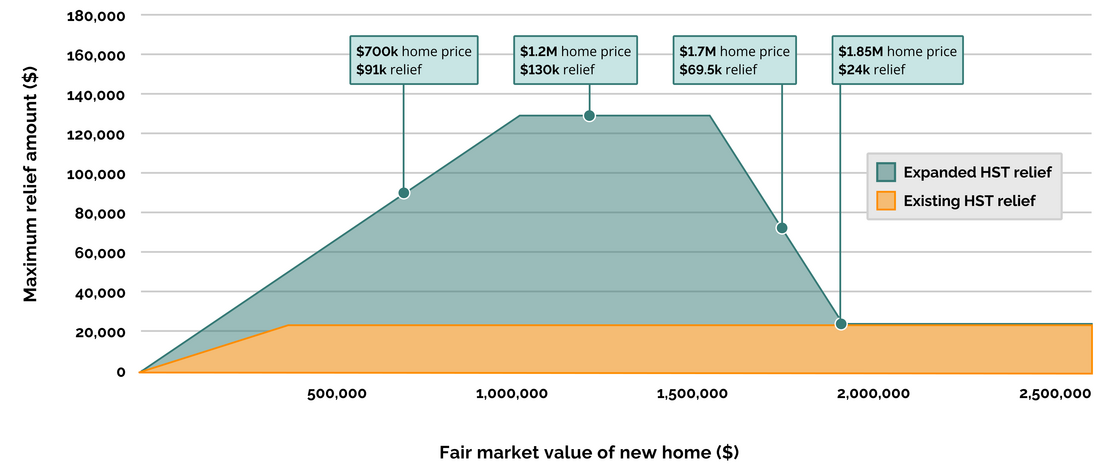
For example, if you’re buying a new home valued at:
- $500,000, you could qualify for the full 13% HST relief of $65,000
- $700,000, you could qualify for the full 13% HST relief of $91,000
- $1 million, you could qualify for the full 13% HST relief of $130,000
- $1.2 million, you could qualify for the maximum relief amount of $130,000
- $1.7 million, you could qualify for a reduced relief amount of approximately $69,400
- above $1.85 million, you could qualify for a maximum relief amount of $24,000
Chart: Maximum relief available under expanded HST relief
How to apply for HST relief
This relief is delivered through the Ontario Enhanced New Housing Rebate (ENHR) and Enhanced New Residential Rental Property Rebate (ENRRPR) administered by the Canada Revenue Agency (CRA), which provide relief on the 8 per cent provincial portion of HST. Through the Ontario New Home Affordability Payment (ONHAP), Ontario is providing additional top-up relief equivalent to up to the 5 per cent federal portion of HST for those who are eligible and receive an enhanced rebate.
Applications are now available for the Ontario ENHR. You can access the relevant forms on the GST/HST new housing rebate page.
Applications for the Ontario ENRRPR will be available soon.
The forms include consent to share contact, banking, and rebate information with Ontario, and no separate provincial application is required to apply for ONHAP.
Who is eligible
The relief is broadly available on eligible transactions involving new homes.
The Ontario ENHR and ENRRPR generally apply to the same types of housing and follow the same eligibility conditions as Ontario’s existing HST New Housing Rebate (NHR) and New Residential Rental Property Rebate (NRRPR), subject to some additional conditions.
Applicants must meet all eligibility requirements under the federally administered Ontario ENHR or ENRRPR and receive the rebate (including through a credit from a builder) to qualify for the ONHAP.
More detailed information on eligibility is available on the Enhancing Harmonized Sales Tax Relief on New Homes page.
Homes used as primary place of residence
As is the case with Ontario’s NHR, you may be eligible for the Ontario ENHR if you buy a new home from a builder or you build, or hire someone else to build, a home on land you own or lease. An eligible home generally includes a detached or semi-detached house, a condominium unit, a townhouse or a rowhouse purchased or built for use as your primary place of residence.
For additional information on the Ontario ENHR, guidance is available from the CRA at Ontario Temporary Enhanced New Housing Rebate: Situations that involve purchasing a home from a builder.
New homes purchased from a builder
For a new home purchased from a builder, the Ontario ENHR is generally available if:
- the agreement of purchase and sale for the home was entered into with the builder on or after April 1, 2026, and on or before March 31, 2027; and
- construction of the home begins on or before December 31, 2028, and the home is substantially completed on or before December 31, 2031.
Owner-built homes
For an owner-built home, the Ontario ENHR is generally available if construction of the home begins on or after April 1, 2026, and on or before March 31, 2027, and the home is substantially completed on or before December 31, 2029.
Long-term residential rental properties
As is the case with Ontario’s existing NRRPR, you may be eligible for the Ontario ENRRPR if you buy a new residential property from a builder or you build, or hire someone else to build, a residential property on land you own or lease to rent for long-term residential use by individuals as their primary place of residence.
Construction begins on or before March 31, 2026
In the case of construction that begins on or before March 31, 2026, the Ontario ENRRPR only applies to purchases of single-unit homes that are to be rented out to a long-term residential tenant.
An eligible single-unit home generally includes a detached or semi-detached house, a condominium unit, a townhouse or a rowhouse.
The Ontario ENRRPR is generally available if:
- the agreement of purchase and sale for the home was entered into with the builder on or after April 1, 2026, and on or before March 31, 2027; and
- construction of the home begins on or before March 31, 2026, and the home is substantially completed on or before December 31, 2029.
Construction begins on or after April 1, 2026
In the case of construction of a residential property that begins on or after April 1, 2026, the Ontario ENRRPR is generally available if construction of the residential property begins on or after April 1, 2026, and on or before March 31, 2027, and the residential property is substantially completed on or before December 31, 2029.
Limitations
To ensure that the Ontario ENHR and ENRRPR are only available as intended (for example, to agreements entered into on or after April 1, 2026), a series of rules apply to limit the availability of the Ontario ENHR and ENRRPR in certain circumstances.
Other Ontario HST rebates available
First-time home buyers
Ontario has also removed the full 8% provincial portion of the HST for first-time home buyers of new homes valued up to $1 million with an effective date of March 20, 2025. This mirrors the federal GST/HST first-time home buyers rebate.
The rebate generally applies to purchasers who entered into agreements of purchase and sale between March 20, 2025 and December 31, 2030, and where construction of the home begins on or before December 31, 2030 and is substantially completed on or before December 31, 2035.
Where someone is eligible for both the Ontario temporary enhanced rebate and the Ontario first-time home buyers’ rebate, they can claim either or both Ontario rebates. However, the total amount of all rebates for the 8% portion of the HST cannot exceed $80,000 or the amount of 8% provincial portion of the HST payable in respect of the transaction, whichever is less.
Purpose-built rental housing
Ontario has also removed the full 8% provincial portion of the HST on qualifying new purpose-built rental housing. This mirrors the federal GST/HST purpose-built rental housing rebate, and together, the provincial and federal actions remove the full 13% HST on qualifying projects.
The rebate generally applies to qualifying projects that begin construction between September 14, 2023 and December 31, 2030, and complete construction on or before December 31, 2035.
Lowering government fees and charges on Ontario homes
Municipal development charges are municipal fees levied by municipalities to fund municipal infrastructure. Over the years these costs have grown substantially in some municipalities, adding more than $100,000 to the cost of a new home in some instances.
Together with the federal government, we’re investing $8.8 billion over 10 years in infrastructure that supports new housing. A large portion of this will be allotted to support municipalities through development charge reductions. To be eligible for the funding, municipalities must reduce development charges by up to 50% to help get more homes built and lower the cost of new homes for Ontario homebuyers
We’re also making separate investments in housing-enabling infrastructure like sewers, roads and water treatment plants to support new neighbourhoods, along with advancing innovative water and wastewater models that reduce municipal reliance on development charges.
How this saves home buyers money
Municipal development charges can add significant costs to new homes. For example, in the City of Toronto, development charges cost home buyers nearly $140,000 for a semi-detached home. These costs are currently bundled into the purchase price and are not clearly outlined to buyers. By lowering development charges and requiring clearer disclosure of these fees in new home agreements, we are improving transparency and reducing upfront costs of new homes to make housing more attainable and affordable.
Building homes faster and increasing rental options
We’re taking steps to build more affordable homes across Ontario by lowering costs for builders and getting more shovels in the ground.
Making home ownership more affordable
To help more people buy a home, Ontario is lowering costs for builders who construct affordable homes people can own.
For new ownership homes that meet affordability requirements, we have provided exemptions from development charges. This makes it cheaper to build these homes and encourages builders to focus on options for families and first-time buyers, making homeownership more attainable.
Increasing rental housing
Ontario is also reducing the cost of building and operating rental housing to increase the supply of rental options and help keep rents more affordable.
For qualifying new purpose-built rental housing, we have:
- removed the full 8% provincial portion of the HST
- this can be combined with the federal government's rebate for the full 5% federal portion of the HST on purpose-built rental housing — together, these changes remove the full 13% HST
- allowed municipalities to reduce property taxes by up to 35%
- provided exemptions from development charges if units meet affordability requirements
- provided discounts for development charges on all rental units, with discounts of up to 25% for family-friendly units
By lowering taxes and development costs, Ontario is making it more affordable for builders to construct rental housing. This creates more affordable choices for renters.
Expanding access to supportive housing and preventing homelessness
Ontario is making significant investments to strengthen housing and support services to help prevent homelessness and improve housing stability for people across the province.
Through our Roadmap to Wellness, we are investing $3.8 billion over 10 years to close gaps in mental health and addictions care by expanding services, including supportive housing, and creating new programs across Ontario.
We also allocated over $1.7 billion in 2025–2026 to provide vulnerable Ontario residents with appropriate short- and long-term housing solutions.
Homelessness Prevention Program
We delivered $654 million through the Homelessness Prevention Program in 2025–2026 to provide funding for programs and services that deliver housing assistance, support services and supportive housing.
This program gives local service managers the flexibility to determine how to use the funding for programs and services that address and prevent homelessness in their communities, allowing communities to respond to their unique local needs.
Indigenous Supportive Housing Program
A further $41.5 million was allotted through the Indigenous Supportive Housing Program in 2025–2026. This program is delivered by two Indigenous Program Administrators and provides culturally appropriate housing assistance and support services to Indigenous people experiencing or at-risk of homelessness. This funding includes a $10 million ongoing dedicated stream of operating funding for mental health and addictions supports.
Working with the federal government to improve housing supports
Ontario and the federal government continue to work together to improve housing affordability and stability through the National Housing Strategy.
Three key programs are delivered by Ontario under the strategy:
- Canada-Ontario Community Housing Initiative: protects affordability for households in social housing, supports the repair and renewal of existing social housing supply and expands the supply of community housing over time
- Ontario Priorities Housing Initiative: provides funding to address local housing priorities, including affordability, repair and new construction
- Canada-Ontario Housing Benefit: provides an income-tested, portable housing benefit payment directly to eligible vulnerable households in housing need
In 2025–2026, approximately $608 million in combined provincial and federal funding was allocated to these initiatives to maintain and create more community housing and provide housing assistance and supports.
Learn more about supportive housing in Ontario.
Related
- Backgrounder: Eligibility for Ontario’s Expanded HST Relief on New Homes
- Housing in Ontario
- Building Ontario
- Ontario and the National Housing Strategy
- Ontario’s Third Action Plan under the National Housing Strategy (2025–2028)
Accessible chart description
A chart compares the expanded HST relief with existing relief based on the fair market value of a new home. The horizontal axis shows home prices, and the vertical axis shows maximum rebate amounts.
An orange area labeled “Expanded HST Relief” peaks at a maximum rebate of $130,000 for homes valued between $1 million and $1.5 million. It then decreases to a lesser rebate amount for homes valued over $1.5 million, until it hits a rebate amount of $24,000 for homes valued at $1.85 million and above.
A blue area labeled “Existing Relief” stays flat at $24,000 for all homes above $400,000, showing the lower rebate level without expansion.
Key data points depicted on the chart:
- $700,000 home price: $91,000 in relief
- $1.2 million home price: $130,000 in relief
- $1.7 million home price: $69,500 in relief
- $1.85 million home price and above: $24,000 in relief