

Ontario’s Primary Care Action Plan: October 2026 progress update
Learn about Ontario’s progress towards connecting every person in Ontario to primary care by 2029.
Summary
Ontario has made significant progress in the second year of its $3.4 billion Primary Care Action Plan, which has already attached more than 511,000 patients to a primary care provider.
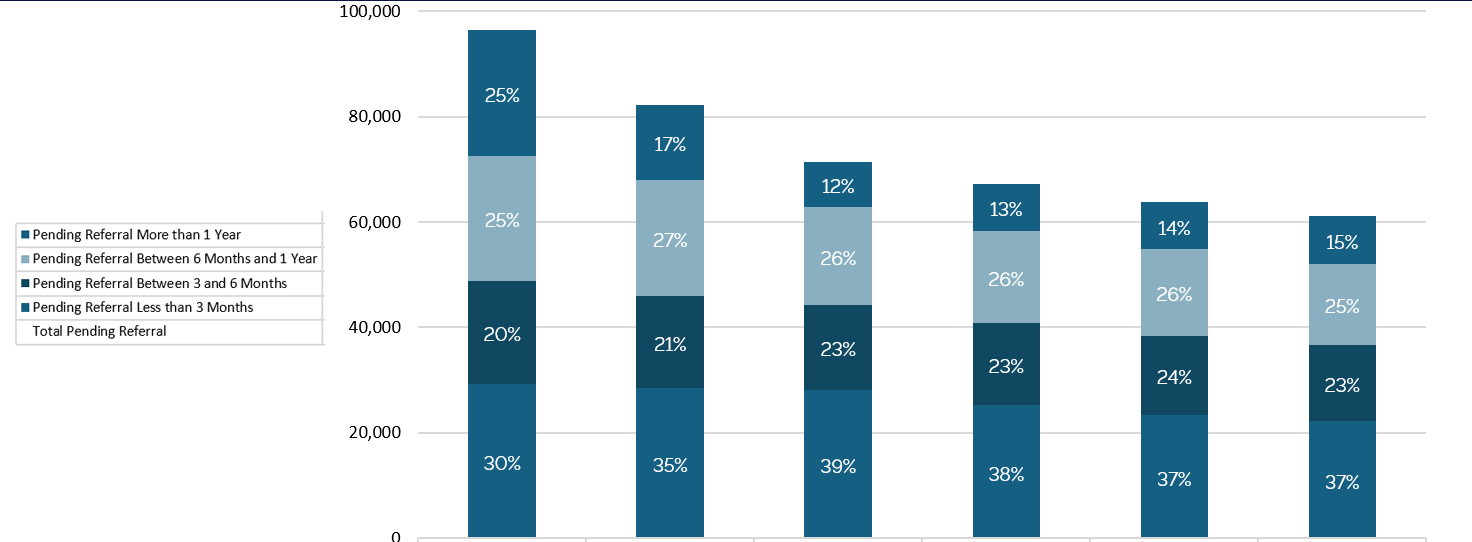
More than 470,000 patients have been cleared from the Health Care Connect waitlist since January 2025, and wait times are at their lowest levels in over a decade.
The province continues to exceed its initial targets and is on track to connect every person in Ontario to a primary care provider by 2029.
Timeline: Primary Care Action Plan
- February 2024: Ontario announced the first expansion of primary care teams in more than a decade, investing more than $110 million that connected over 610,000 people to primary care, exceeding its target of 328,000.
- December 2024: Based on the success of recent primary care team expansion, Ontario established the Primary Care Action Team (PCAT), led by Dr. Jane Philpott, with a mandate to connect every Ontarian to primary care by 2029.
- January 2025: The government launched the Primary Care Action Plan, with the goal of attaching everyone in Ontario to a publicly funded family doctor or primary care team by 2029. This plan is supported by an initial historic $2.1 billion provincial investment, which builds on the government’s February 2024 investment of $110 million.
- April 2025: Supported by a $235 million investment, the government launched the 2025–26 call for proposals to connect 300,000 more people to a primary care provider. Seventy-five proposals representing over 130 new and expanded primary care teams were successful.
- September 2025: Supported by a $250 million investment, the government launched the 2026–27 call for proposals that will connect 500,000 more people to a primary care provider. One hundred twenty-four proposals representing over 190 new and expanded primary care teams were successful.
- March 2026: Through the 2026 Ontario Budget, the government invested an additional $325 million annually in the Primary Care Action Plan, increasing the four-year investment to $3.4 billion.
- September 2026: Supported by a $250 million investment, government launched the 2027–28 call for proposals to create and expand approximately 78 primary care teams that will connect 600,000 more people to primary care. The 2027–28 call for proposals will close on November 20, 2026.
Overview: Ontario’s Primary Care Action Plan
Mandate: Connect everyone in Ontario to a family doctor or primary care team by 2029.
Connecting you to a primary care team
- Create and expand approximately 300 primary care teams. These teams bring together health professionals — such as doctors, nurses, social workers, and dietitians — to provide coordinated, comprehensive care.
- Invest more than $235 million in 2025–26 to establish and expand approximately 130 additional primary care teams across the province, attaching 300,000 more people to primary care as a first step toward connecting everyone in the province to primary care.
- In June 2025, Ontario became the first Canadian jurisdiction to pass legislation identifying primary care as the foundation of the health system and outlining what people can expect when accessing care.
- Provide regular public updates on progress and performance in achieving the Primary Care Action Team’s mandate.
Making primary care more connected and convenient
- Modernize Health Care Connect to improve the user and provider experience, with the goal of establishing a wait time target of no more than 12 months.
- Connect everyone on the Health Care Connect waitlist (as of Jan 1, 2025) to primary care by summer 2026.
- Enhance digital tools for providers and patients, improving patient navigation, reducing administrative burden and improving the referral process.
- Leverage Health811 to view online health records, book an appointment with their primary care provider, and discover care options.
- Set regular performance indicators of primary care teams.
Supporting primary care providers
- Introduce targeted strategies to recruit and retain the workforce needed to support primary care providers and teams, including family doctors, nurse practitioners and other allied health professionals.
- Address administrative burden with digital tools, targeted recruitment and retention strategies for northern and rural communities and ensure all of Ontario’s highly qualified health-care professionals can work to their full scope of practice.
- Add and expand community-based primary care teaching clinics in collaboration with academic institutions and other partners. These clinics train family doctors and other professionals — such as nurse practitioners, physician assistants, and registered nurses — by combining patient care with hands-on learning.
Closing the gap
- According to the Canadian Institute for Health Information, Ontario leads the country with access to a regular health-care provider.
- To support the Primary Care Action Team’s mandate, the Ministry of Health worked with INSPIRE-PHC, a network of primary care researchers, to develop an updated methodology for determining how many patients are attached to primary care.
- The Primary Care Action Plan was intended to close the gap for the remaining approximately two million Ontarians who want to connect to primary care, achieving the goal of connecting every person in Ontario to primary care.
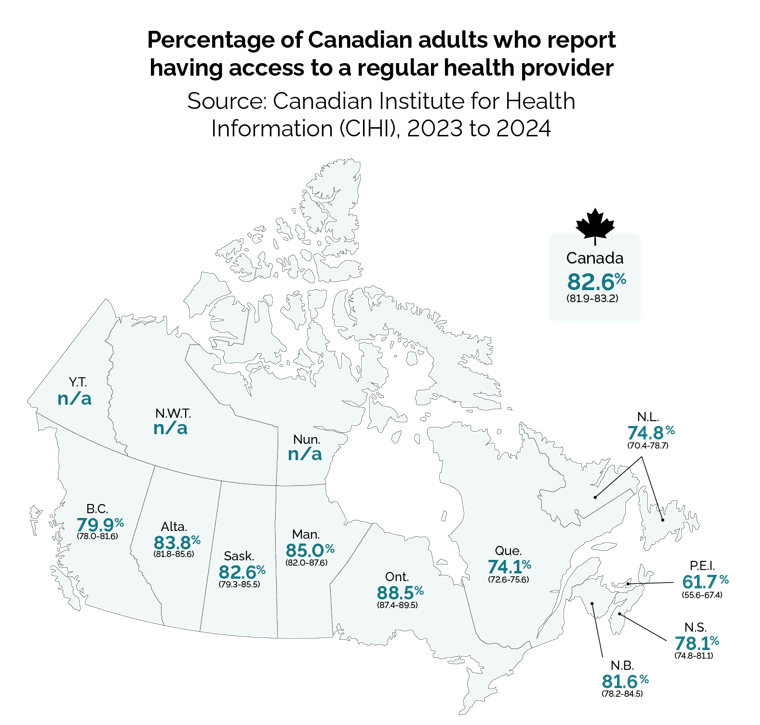
Connecting everyone by 2029
Multiple strategies are being used to attach every person in Ontario to primary care, including but not limited to:
- Funding of approximately 300 new and expanded interprofessional primary care teams
- Connecting people who register with Health Care Connect
- Impact of the 2024–28 Physician Services Agreement
- Negotiated agreement between the Ministry of Health and the Ontario Medical Association, improving attachment to primary care and helping to retain and attract new doctors.
- This includes modernizing the Family Health Organization (FHO) model with the goal of enhancing access to ongoing, comprehensive primary care.
- Existing programs, such as Practice Ready Ontario and the Learn and Stay Grant continue to support the primary care workforce
Progress to date: More than half a million Ontarians attached to primary care
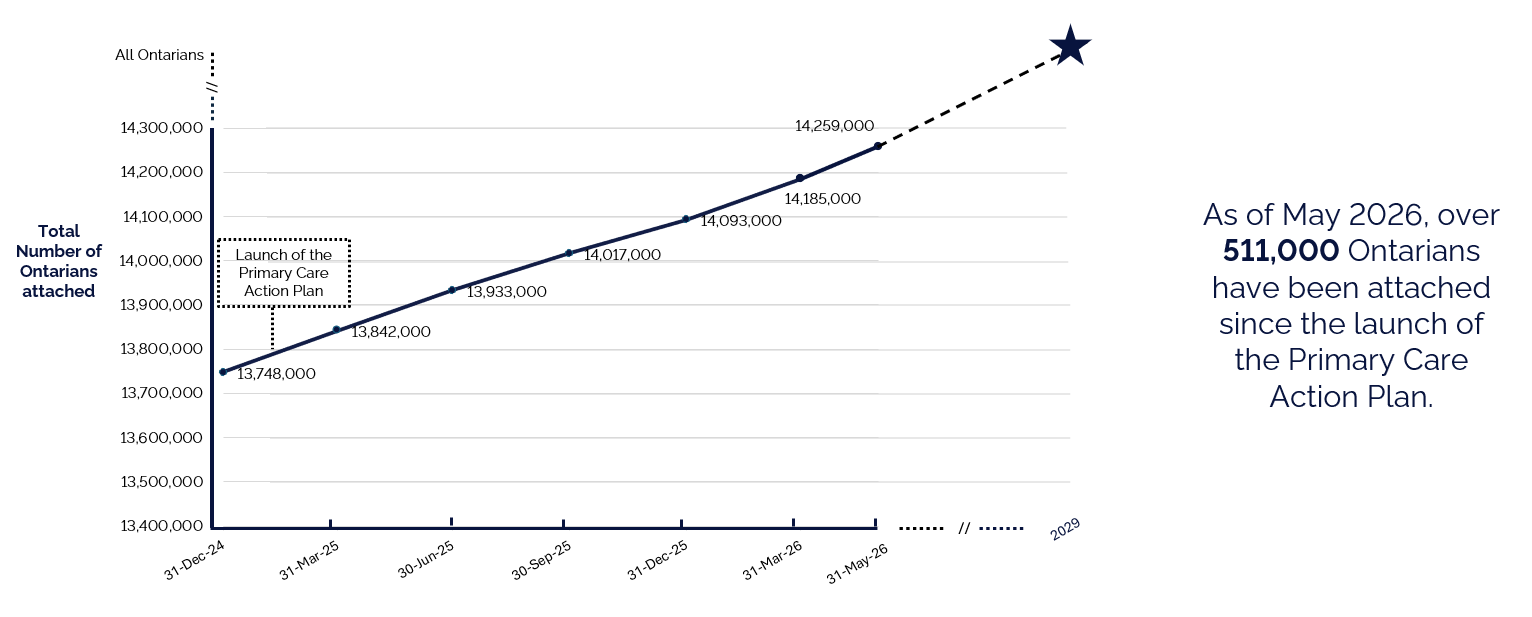
Attachment estimates are approximately one quarter behind due to data availability. The May 2026 number is an interim estimate.
Progress to date: Ontario on track to meet or exceed its primary care attachment targets
| Jan to Mar 2025 | Apr to Jun 2025 | Jul to Sep 2025 | Sep to Dec 2025 | Jan to Mar 2026 | Apr & May 2026 | New attachments | |
|---|---|---|---|---|---|---|---|
| Net new attachments per quarter | 94,000 | 91,000 | 84,000 | 76,000 | 92,000 | 74,000 | 511,000 |
| Total population attached | 13,842,000 | 13,933,000 | 14,017,000 | 14,093,000 | 14,185,000 | 14,259,000 |
Attachment estimates are approximately one quarter behind due to data availability. The May 2026 number is an interim estimate.
Progress to date: Lowering wait times for Health Care Connect
In addition to the more than 470,000 people cleared from the Health Care Connect waitlist since January 2025, provincial wait times are at their lowest levels in over a decade. As of October 1, 2026, 85 per cent of individuals pending referral have been waiting less than one year.
| May 1, 2026 | June 1, 2026 | July 1, 2026 | Aug 1, 2026 | Sept 1, 2026 | Oct 1, 2026 | |
|---|---|---|---|---|---|---|
| More than 1 year | 23,839 | 14,352 | 8,452 | 8,894 | 8,838 | 8,964 |
| Between 6 months and 1 year | 23,626 | 21,891 | 18,659 | 17,503 | 16,490 | 15,472 |
| Between 3 and 6 months | 19,575 | 17,594 | 16,122 | 15,523 | 15,025 | 14,324 |
| Less than 3 months | 29,310 | 28,437 | 28,137 | 25,277 | 23,382 | 22,320 |
| Total | 96,350 | 82,274 | 71,370 | 67,197 | 63,735 | 61,080 |
Strengthening Ontario’s primary care workforce
Registered nursing primary care upskilling
Investing $4.5 million to help over 1,400 registered nurses gain skills and experience in primary care. To date, 120 registered nurses have completed the program, with an additional 670 RNs completing the program by Spring 2027.
Nurse practitioner education seat expansion
Investing $8.5 million to add up to 170 new nurse practitioner seats. 12 nurse practitioners began training in January 2026, and up to 60 to begin training in Fall 2026.
Physician assistant education seat expansion
$16 million for up to 150 new physician assistant seats starting in 2026/27. 48 physician assistants to begin training in Fall 2026.
Primary care teaching clinics
Ontario has committed $300 million to support 18 primary care teaching clinics. Two of these clinics have already opened in Brampton to support TMU’s new medical school.
Practice Ready Ontario
Program supporting internationally-trained physicians to become licensed in Ontario more quickly. To date, over 120 physicians have begun practicing in rural or northern communities, including over 25 physicians in 2026–27 to date.
Learn and Stay Grant
In September 2026 opened applications to help more than 2,000 Ontario medical students studying to become comprehensive family doctors and practice in the province.
Impact of primary care teams across the province
City of Lakes Family Health Team — Sudbury
- Expanded Family Health Team
- $542,300 in funding
- Target of ~1,250 by July 2026
- Over 2,200 patients attached as of August 31, 2026
Anishnawbe Mushkiki Incorporated — Thunder Bay
- Expanded Indigenous Primary Health Care Organization
- $734,400 in funding
- Target of ~1,000 patients attached by July 2026
- Over 1,400 patients attached as of August 31, 2026
Grand Bend Community Health Centre — Grand Bend
- Expanded Community Health Centre
- $858,000 in funding
- Target of ~1,895 patients attached by July 2026
- Over 2,000 patients attached as of August 31, 2026
Pinecrest Queensway Community Health Centre (South Nepean CHC Satellite Site) — Ottawa
- Expanded Community Health Centre
- $1,147,200 in funding
- Target of ~2,175 patients attached by July 2026
- Over 3,000 patients attached as of July 31, 2026
Southlake Academic Family Health Team — Newmarket
- Expanded Family Health Team
- $848,500 in funding
- Target of ~2,410 patients attached by July 2026
- Over 3,400 patients attached as of July 1, 2026
Access Alliance Multicultural Health and Community Services — Toronto
- Expanded Community Health Centre
- $873,400 in funding
- Target of ~1,988 patients attached by July 2026
- Over 2,500 patients attached as of July 31, 2026
Next steps: 2027–28 Call for Proposals for new and expanded primary care teams
The 2027–28 Call for Proposals will fund approximately 78 new or expanded teams to attach 600,000 more people. The 2027–28 Call for Proposals launched on September 29, 2026, and will close on November 20, 2026.
| FY 25/26 ✔ | FY 26/27 ✔ | FY 27/28 | FY 28/29 | Total | |
|---|---|---|---|---|---|
| New people attached | 300,000 | +500,000 | +600,000 | +600,000 | 2,000,000 |
| New and expanded primary care teams | 75 proposals 130+ teams | 124 proposals 190+ teams | +78 | +78 | 305 |
Next steps
- 2026–27 Primary Care Team Expansion: Teams funded through 2026–27 call for proposals attaching 500,000 patients in the months ahead.
- 2027–28 Primary Care Team Expansion: Deadline for submissions is 5:00 p.m. on November 20, 2026.
- Primary Care Teaching Clinics: Ministry to continue working with medical schools on their planning, including the finalization of their interprofessional primary care team partnerships to support teaching and the delivery of primary care services, with clinics beginning to open as early as 2027–28.