

Information for notaries public in Ontario
Learn about your role and responsibilities as a notary public.
Overview
A notary public is a person who has the power to witness or certify, and attest, the execution of a document and certify and attest a true copy of a document. A notary public also has all the powers of a commissioner for taking affidavits.
This information is a resource to assist notaries in carrying out their duties. This information is not legal advice. The Ministry of the Attorney General does not provide legal advice or opinions to notaries public. If you have a question about how this information applies to your circumstances, please consult a lawyer.
Responsibilities of a notary public
Notaries are governed by the Notaries Act. Section 3 of the Notaries Act, states that a notary public may, subject to any restrictions set out in their appointment:
- witness or certify, and attest, the execution of a document
- certify and attest a true copy of a document
- exercise the powers of a commissioner for taking affidavits in Ontario
- exercise any other powers and perform any other functions specified by the regulations made under the Act
Difference between a notary public and a commissioner for taking affidavits
A commissioner for taking affidavits may administer oaths and can take affidavits, declarations and affirmations. An affidavit is a written statement confirmed to be true by oath or affirmation, often used as evidence in court. An oath, declaration or affirmation is a solemn pledge with legal consequences that can be made before a notary or commissioner.
Commissioners are governed by the Commissioners for Taking Affidavits Act. To learn more about a commissioner’s role and responsibilities or how to administer oaths and take affidavits, declarations and affirmations, please refer to the guide for newly appointed commissioners for taking affidavits in Ontario.
People holding specific offices, such as lawyers and paralegals, are automatically designated as commissioners by virtue of office. You can find a complete list of commissioners by virtue of office here. Unlike commissioners, there are no notaries by virtue of office. To become a notary public in Ontario, you must apply and be appointed.
Types of notary appointments
There are 2 types of notary appointments:
- a lawyer or paralegal appointment
- a non-lawyer and non-paralegal appointment
Lawyer and paralegal notary appointments
Lawyers and paralegals are not notaries by right and must still apply to be appointed as a notary public. If you are a lawyer or paralegal licensed with the Law Society of Ontario (LSO) and would like to be appointed as a notary public, you can learn how to apply to be a notary public.
Once appointed, a lawyer or paralegal holds a lifetime notary appointment as long as they remain licensed with the LSO and their licence is neither suspended nor in abeyance.
Suspended appointment
Subsection 7(1) of the Notaries Act sets out the circumstances under which a lawyer’s or paralegal’s notary appointment is suspended, and they are prohibited from performing notarial duties until such time as their licence is no longer under suspension or in abeyance, or they are relicensed under the Law Society Act.
Non-lawyer and non-paralegal notary appointments
If you are not a lawyer or a paralegal and would like to be appointed as a notary public, you can review the eligibility requirements and learn how to apply to be a notary public.
The Ministry of the Attorney General appoints non-lawyer and non-paralegal notaries for a term of 10 years and may impose restrictions or limitations on what the individual may notarize. For example, notarial services must only be provided for the purposes of the business or organization with which they are affiliated and appointed on behalf of. Non-lawyer and non-paralegal notaries are not permitted to provide notary services outside their limitations or for personal use.
These requests for appointments are subject to the ministry’s review, assessment and approval.
Notarizing documents
To notarize a document, you must adhere to the legal requirements set out in the Notaries Act.
Notarizing in person
In accordance with the Notaries Act, a notary must be physically present with the person requiring notarization when notarizing the documents. Remote notarization is not permitted under the Notaries Act. Documents notarized remotely will not be authenticated or apostilled by Ontario’s Official Documents Services.
Offences and revocation
The Notaries Act outlines the consequences of a conviction of an offence as a notary public.
A notary public who exercises any power, performs any function, or acts in any way that is not authorized by the Notaries Act or the regulations under it, may be found guilty of an offence. When convicted, they may be liable to a fine of up to $2,000. Further, under subsection 7(2) of the Act, the Attorney General may revoke the appointment of a notary public on his or her conviction for an offence, or for any other conduct that, in the Attorney General’s opinion, renders the person unfit to hold the office of notary public.
If you have evidence of a notary committing an unlawful act, you may report the matter to your local police service. If the notary is a lawyer or paralegal, you may also file a complaint with the LSO.
Notary seal (and stamp for non-lawyers/non-paralegals)
When you are appointed as a notary public, you:
- are recognized by the Ontario government as an Ontario notary public
- will receive a notice of approval and a Specimen of Notarial Signature and Seal form to complete from Ontario’s Official Documents Services
If you are a lawyer or paralegal notary, you will notarize documents using your:
- signature
- embossed notarial seal
If you are a non-lawyer and non-paralegal notary, you will notarize documents using your:
- signature
- embossed notarial seal
- stamp imprint
Delays to authenticate notarized documents
Delays can sometimes occur in the Official Documents Services’ ability to authenticate notarized documents submitted to them from lawyers or paralegals for various reasons, including commonalities in names or because a paralegal has become a lawyer and there may be a need to determine at which capacity the licensee notarized the document. As a helpful practice, paralegals and lawyers can write in or identify their Law Society number on the document under their seal or signature to more easily identify themselves.
How to get your embossed notarial seal
After you receive notice of your notary appointment, you must order your embossed notarial seal from a seal company. The embossed notarial seal must:
- match the name set out on the notice of approval you receive
- show Notary Public and Ontario
Example of notarial seal

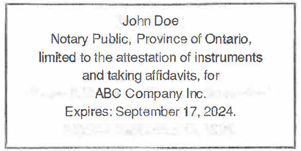
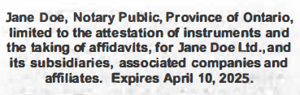
How to get a stamp imprint
For non-lawyers and non-paralegal notaries, in addition to your embossed notarial seal, you must purchase a stamp from an office supply store. You can find the approved wording of your stamp on the Notice of Approval document that you received from the Ontario Ministry of the Attorney General.
You cannot make any handwritten changes to your stamp.
You must obtain a new stamp after every reappointment to reflect the new expiry date. Contact the Legal Appointments Office to request changes to your stamp or for any questions regarding your stamp.
Examples of a stamp imprint
Submit your signature, seal (and stamp for non-lawyers/non-paralegals) to the government
Official Documents Services will send you a Specimen of Notarial Signature and Seal form to complete so the government has your signature, seal (and stamp for non-lawyers/non-paralegals) on file to authenticate any documents you notarize.
Failing to return this form may result in the Ontario government’s inability to authenticate your notarized documents and/or issue an apostille for the documents.
Notarial standards and considerations when notarizing documents
When acting as a notary public, notaries should uphold a high standard of skill and care in the work that they perform to establish trust and respect from the public.
Notary public duties
As a notary public, your duties include:
- verifying documents and certifying signatures as true and genuine
- ensuring the signatory is present in person
- reviewing a valid piece of government-issued photo identification
- understanding that a document that is notarized adds a layer of verification to prevent fraud and identity theft
- understanding that you may be held accountable for improperly notarizing a document, including through potential charges for offences under the Notaries Act
Notaries must comply with the Notaries Act, and its applicable regulations, and any other relevant laws, directives, policies or guidelines.
Limitations for non-lawyer and non-paralegal notaries
If you are a notary public and you are not a lawyer or paralegal, your ability to notarize documents is limited to notarizing a document which directly relates to your employment, business and/or organization, as set out in your notice of approval. Notarizing outside of your limitations is prohibited.
Obligations as a lawyer or paralegal
If you are a notary public and a LSO licensed lawyer or paralegal, you have an obligation to act in accordance with the LSO’s Rules of Professional Conduct or the Paralegal Rules of Conduct, as the case may be. This includes the duty to discharge all responsibilities to clients, tribunals, the public and other members of the profession honourably and with integrity. You should refrain from providing legal advice unless you are retained to do so and it is appropriate under the circumstances.
At times, authorities have identified instances of notarization involving frivolous and vexatious issues, such as:
- freeman on the land matters
- fake "diploma mills"
- instances of notarization on forgeries
- fraud
- other criminal activity
Notaries should not
Notaries should not:
- mislead or attempt to mislead anyone in the discharge of their duties and responsibilities
- notarize or participate in the preparation or delivery of any document that, on its face, the notary is aware, or should be aware, is:
- incomplete
- misleading
- deceptive
- suspicious
- frivolous
- vexatious
- fraudulent
Notaries may question the client on the validity of each document, especially when certifying or attesting a true copy of a document. Notaries should only notarize documents if they are comfortable doing so, as they may be held accountable for improperly notarizing a document.
Contact
For questions related to non-lawyer and non-paralegal notary appointments, please contact:
Ministry of the Attorney General
Legal Appointments Office
77 Wellesley St W, BOX 720
Toronto ON M7A 1N3
Tel: 416-326-4064 Fax: 416-326-4065 - appointments@ontario.ca
For questions related to lawyer and paralegal notary appointments or document authentication by the government, please contact:
Ministry of Public and Business Service Delivery and Procurement
Official Documents Services
777 Bay Street, lower level
Toronto, Ontario
M7A 2J8
Tel: 416-325-8416 Fax: 416-325-8434 - official.documents@ontario.ca
The Ministry of the Attorney General and the Ministry of Public and Business Service Delivery and Procurement cannot provide legal advice or opinions and cannot comment or advise on particular notarizing needs and situations.