

Invasive Wild Pig Sightings: 2025 Annual Report
Read our 2025 annual report for information on invasive wild pig sightings in Ontario.
Overview
The Ministry of Natural Resources (MNR) collects wild pig sightings reported across Ontario, investigates likely sightings and works to remove wild pigs from the landscape. While evidence suggests that wild pig populations are not established in Ontario, it does show ongoing escapes of pigs from domestic sources which could result in feral populations establishing.
Research in other jurisdictions has shown that preventing wild pigs from becoming established is more effective than trying to manage them once established. MNR research published in 2021 found that the most likely source of wild pigs in Ontario is from captive sources rather than migration from neighbouring jurisdictions. In 2025, escapees continue to make up all of the wild pig reports in the province.
Pigs as invasive species
Wild pigs are one of the most invasive terrestrial mammals worldwide. In Ontario, pigs are a restricted invasive species under the Invasive Species Act, 2015. Certain prohibitions apply, including requirements for owners to notify MNR of pig escapes.
Escaped pigs must be captured or killed as soon as possible. Live Eurasian wild boar and their hybrids are prohibited in the province. The public are encouraged to report any wild pigs, or signs of wild pigs to MNR’s wild pig program by email (wildpigs@ontario.ca), or phone
Investigations
MNR prioritizes sightings for investigation using multiple factors, including:
- confidence of the reporter that they observed a wild pig
- type of pig observed (for example, Eurasian wild boar vs a pet pot-bellied pig)
- visual evidence (for example, photo evidence)
- number of reports in an area
- number of animals reported
- if animals were seen with young
- length of time animals were known to have been on the landscape
- degree of risk of pigs breeding in the wild, or being a threat to property, livestock or human safety
Where priority cases are identified, MNR conducts in-person investigations and follows up remotely with municipalities, local businesses and residents or uses a combination of these methods.
Where evidence that wild pigs were present in an area is found, staff set up remote cameras to locate them, monitor with drones and set up live traps to capture them.
2025 results
Between January 1 and December 31, 2025, MNR received 64 reports of wild pigs on the landscape from the public, MNR staff, other agencies, the internet and media. Of the 64 total reports, 55 were unique; that is, separate incidents involving pigs outside of an enclosure. Of the unique sightings, 40 were likely pigs and 16 were low confidence sightings, the latter are sightings where the individual was not confident what they saw or heard was a pig. Overall, MNR received fewer moderate and high confidence reports of wild pigs on the landscape than in the previous 6 years (average: 90 calls per year between 2019 and 2024, Figure 1).
Staff followed up on reported sightings with:
- in-person investigations at 12 properties
- interviewed residents at 17 properties to gather information about escaped pigs
- left program information at another 23 addresses
Figure 1
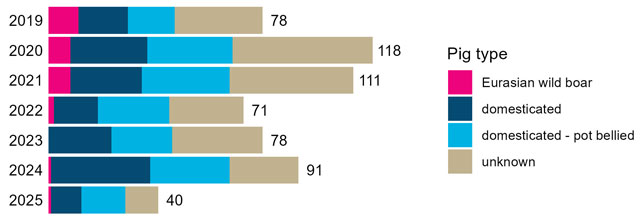
Wild pig sightings are sorted into 4 categories:
- domesticated pigs
- pot-bellied pigs
- Eurasian wild boar
- unknown (when the pig type cannot be verified with a photo or is unclear)
In 2025, the types of pigs identified in sighting reports were split between:
- unknown (30%)
- domesticated (28%)
- pot-bellied pigs (40%)
- sightings were of Eurasian wild boar (2%; Figure 2a)
These pigs were all determined to be escapees from enclosures or other forms of containment. Most of the wild pigs reported were identified as:
- lone animals (45%)
- multiple animals with no young (32%)
- some were found dead (22%; Figure 2b)
No sightings were reported of pigs with young, and none of these reports appeared to be established groups breeding in the wild.
One sighting of multiple escaped Eurasian wild boar was confirmed during this period, resulting in the removal of 8 animals from the landscape.
Figure 2

Wild pig mapping
Figure 3
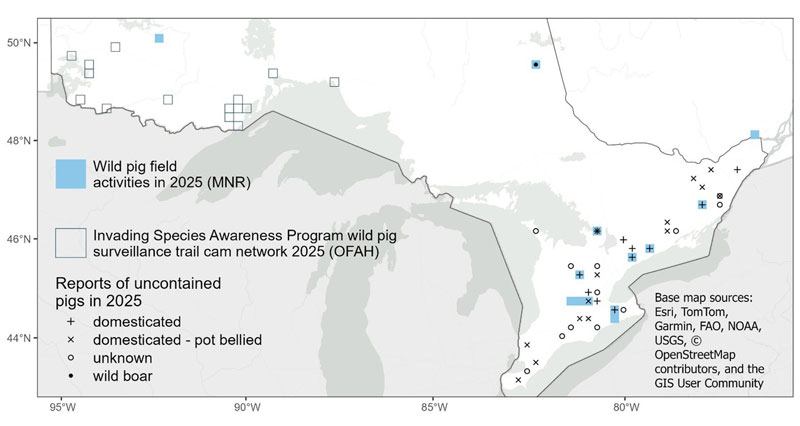
Ontario continues to collaborate and submit wild pig data to the Canadian Invasive Wild Pig Report and national map (PDF). Mapping includes both annual operations and sightings defined as “resolved” which includes dead or removed wild pigs, pets or livestock that have been returned to captivity.
In some cases, the investigated locations do not appear to overlap with a sighting which can occur for a variety of reasons including the reporting year, the sighting was another species, the investigation area and size shifted as the team learns more or it reflects proactive monitoring.
Ontario Federation of Anglers and Hunters’ (OFAH) wild pig surveillance program.
MNR collaborates with OFAH on wild pig surveillance in Ontario. Through OFAH’s Invading Species Awareness Program, 30 trail cameras were deployed in Northwestern Ontario in 2025 where lower human density means less opportunities for public observations and reports of wild pigs. No wild pigs were detected (Figure 3).
Public and outreach
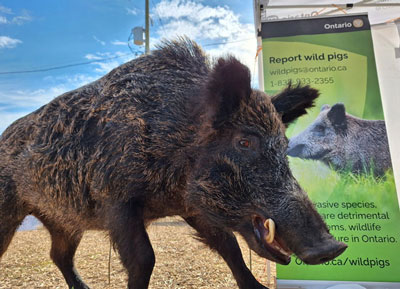
MNR engages the public to raise awareness of the threats of invasive wild pigs. Generally, outreach is done in person, on our website, on social media and by responding to questions directly from the public, stakeholders and media. In 2025, staff continued to respond to direct questions and engage with residents during investigations and at the International Plowing Match in Grassie, Ontario (Figure 4). However, lower media coverage and public outreach of wild pig topics may be responsible for fewer wild pig sightings reports. More comprehensive outreach in 2026 could help the team clarify if the lack of reports is linked to the phase out of boar, or a lack of public education and outreach in 2025. The amount of outreach has been shown to correlate with number of wild pig sightings in Ontario.
Figure 4
Conclusion
There continues to be no evidence of established wild pig populations in Ontario. However, there is an ongoing risk from escapes from domestic sources. MNR will continue to conduct surveillance and respond to cases of pigs on the landscape to prevent the establishment of breeding populations in Ontario and the economic, agricultural and biodiversity impacts that they would pose.
Research and control of invasive wild pigs would not be possible without the many people who have reported their wild pig sightings. Thanks to all contributors for their participation in our surveillance program.
For more information about wild pigs, including our approach on how to address them and current regulations, visit Invasive wild pigs in Ontario.