

Published plans and annual reports 2025–2026: Ministry of Transportation
Ministry overview
Ministry of transportation mandate
Be a leader in moving people and goods safely, efficiently, and sustainably across Ontario so that all people and businesses can easily access the places, opportunities, and services that help them thrive.
Ministry contribution to government priority outcomes
Every Ontarian is impacted by transportation, as people and businesses across the province rely on a safe and reliable transportation network. Ontario has the largest transportation system in Canada, including the most public roads, registered vehicles, licensed drivers, and the largest railway network in the country.
The Ministry of Transportation (the ministry) supports economic growth by making investments that create jobs, accelerate the building of infrastructure, support housing, and facilitate the safe and efficient movement of people and goods. Through supporting and collaborating with other ministries, the ministry delivers safe, integrated, efficient, user–focused, equitable, and future–ready mobility services for the people and businesses of Ontario.
Core commitments and key deliverables
1. Ensuring that Ontario’s transportation network is safe.
- Making improvements to address critical rehabilitation needs on major highways and bridges, including Highway 401 through Toronto.
- Implementing various regulatory, policy, and legislative initiatives—such as the Safer Roads Community Act, 2024—to improve road safety by tackling the top causes of collisions, including those involving large commercial vehicles and impaired driving.
- Developing and implementing a Pothole Prevention Program to support smaller municipalities with road maintenance and help improve road conditions while promoting good asset management practices and high–quality roadwork.
- Increasing enforcement capacity to improve road safety outcomes and enable 24–hour operations at key commercial vehicle inspection facility locations.
- Continuing to provide airport services in remote northern Ontario communities (primarily First Nations communities), traveler information services to the public, and reliable ferry services across the province.
2. Ontario is working toward achieving an integrated, multi–modal, and efficient transportation network and providing seamless connections.
- Investing nearly $30 billion over the next 10 years to support the planning and construction of highway projects across the province, and approximately $61 billion to develop the next generation of transit infrastructure across Ontario. This includes:
- Advancing work on key highway projects such as the Bradford Bypass, Highway 413, the Queen Elizabeth Way (QEW) Garden City Skyway Bridge Twinning, Highway 3 between Essex and Leamington, and Highway 11/17.
- Launching the Highway 401 Tunnel Feasibility and Congestion Relief Study to explore options for infrastructure capacity improvements and complementary congestion mitigation strategies on Highway 401 in the Greater Toronto Area (GTA).
- As part of the New Deals with the City of Toronto and Ottawa, advancing work to upload key highway assets in these regions, subject to third party due diligence, to ensure the long term sustainability of these un–tolled highways.
- Advancing implementation of provincial transit projects, including the Ontario Line, Scarborough Subway Extension, Eglinton Crosstown West Extension, Yonge North Subway Extension, Hazel McCallion Line (including extension to Brampton), and Hamilton Light Rail Transit (LRT).
- Continuing to progress on expanding passenger rail service, including two way, all day GO service to core segments of the rail network, advancing feasibility studies for GO 2.0 to build on existing investments in the GO Transit network, and bringing back the Northlander passenger rail service.
- Developing a comprehensive Ontario wide long term transportation plan that builds existing regional plans to develop focused solutions to strengthen supply chains, make it easier to travel within the province, invest in future ready infrastructure, and increase safe and affordable access to jobs and services.
3. Providing a transportation system that is user focused and equitable by collaborating with delivery partners to enhance the user journey and offer convenient, easily accessible, customer focused transportation and government services.
- Modernizing the delivery of driver examination services (DES) and improving oversight of commercial driver training and driver training services such as Beginner Driver Education (BDE) and the Driver Certification Program (DCP).
- Modernizing the transportation network by increasing speed limits to 110 km/h on select provincial highways.
- Continuing to implement the One Fare program, which removes double fares across the Greater Golden Horseshoe (GGH) region, and working with municipal partners towards more convenient and affordable transit through improved fare and service integration.
- Implementing Ontario’s first–ever Marine Transportation Strategy, which sets out actions to support Ontario’s 10–year vision for building a strong and sustainable marine sector and implementing a new Ontario Shipbuilding Grant Program.
- Providing funding through the Ontario Transit Investment Fund, which delivers local and intercommunity transportation projects in unserved and underserved areas in Ontario, particularly in rural areas.
4. Being future–ready and ensuring that Ontario’s transportation system is resilient, sustainable, and meets the needs of today and the future.
- Continuing to deliver the Electric Vehicle (EV) ChargeON Program to support the deployment of public EV charging stations throughout Ontario.
- Expanding the Connecting Links program to maintain municipal assets that are critical links in the provincial highway network.
- Continuing to support emerging vehicle technology by administering the Automated Vehicle (AV) Pilot to allow the testing of passenger and commercial AVs on Ontario’s roads under strict conditions.
Ministry programs
Integrated Policy and Planning Program develops transportation policies and plans to improve mobility and access to goods and services for people and businesses in Ontario, and build a future–ready transportation system that includes emerging technologies. It is responsible for identifying the long–term, strategic interests of the province with respect to Ontario's transportation system for all modes. The program also works to advance Ontario's strategic transportation objectives with other provincial ministries and government agencies, the federal government, other provinces and territories, municipalities, and Indigenous communities. This includes integrating Indigenous relations and environmental policy into transportation initiatives.
Transit Program oversees the design, delivery, and decision–making of the province’s investments in public transit. The program is responsible for the development and implementation of strategies and funding programs that support safe, efficient, equitable, sustainable, and future–ready public transit systems across the province. The program also provides oversight of the delivery of transit capital projects as well as the design and execution of strategies for the planning, funding, and delivery of provincial and municipal transit projects across Ontario.
Transportation Infrastructure Management Program is responsible for infrastructure investment, asset management, design, engineering, capital delivery activities related to provincial infrastructure (highways, ferries, remote airports, etc.), and working with relevant provincial agencies, such as Infrastructure Ontario. The program helps ensure provincial transportation infrastructure projects, including highway and bridge rehabilitation activities and new expansion projects, are planned and delivered to safely, efficiently, sustainably, and equitably move people and goods to support a globally competitive economy and high quality of life.
Operations Program oversees the operations and maintenance of the provincial highway network and related transportation services to protect and maximize the effectiveness of public investments in highway infrastructure. The program also provides airport services in remote northern Ontario communities (primarily First Nations communities), traveller information services to the motoring public, and supports ferry services across the province. Additionally, the program provides funding for roads in many First Nations communities, and funding for the design, construction, renewal, rehabilitation, and projects related to municipal roads, including those designated as Connecting Links to the provincial highway network.
Transportation Safety Program advances and supports safety and mobility in Ontario through the development of safety policies and programs, setting standards and requirements, and delivering services, education, oversight, and compliance to promote safety in a multi–modal transportation system. The program leads and actively participates in developing, promoting, and evaluating transportation safety initiatives and best practices. The program works with many partners, including law enforcement agencies, safety organizations, the medical community, academic researchers, and the insurance industry to reduce collisions, fatalities, and injuries on all provincial roads.
Commercial Transportation Safety and Enforcement Program advances and supports transportation safety for Ontarians through the development of commercial transportation safety programs, on–road enforcement, carrier compliance monitoring, and oversight of towing and vehicle storage and Ontario’s vehicle inspection program.
Oversight and Agency Governance Program provides oversight and accountability for the ministry’s provincial transportation agencies–Metrolinx, Owen Sound Transportation Company (OSTC), and Ontario Northland Transportation Commission (ONTC)–to strengthen alignment with government priorities. It also serves as a centre of excellence, executes best practices related to third-party contracting and service management, and supports stewardship of taxpayer funds.
Ministry Administration Program provides leadership and advice, legal counsel, communications, and specialized, cost–effective, value–added business support services to help the ministry achieve its overall goals. The program provides strategic support, expertise, and advice in the areas of corporate finance, strategic human resources, and business supports, and oversees the Ontario Public Service’s fleet vehicle program.
2025-26 Strategic plan
Delivery of key transit projects and programs
The ministry will continue to work with agencies and partners to deliver on Ontario’s historic investment in the next generation of transit infrastructure to encourage greater transit use.
| Indicator | Target |
|---|---|
| Total Ontario Transit Ridership | 773 million (2026) Increasing transit ridership over the long term |
Programs that contribute to the Key Performance Indicator (KPI) result
- Transit Program
- Oversight and Agency Governance Program
- Integrated Policy and Planning Program
Measurement of performance against target will be based on ridership data sourced from the Canadian Urban Transit Association (CUTA)’s Transit Fact Book.
Key Programs and Initiatives include:
- Continuing implementation of the GO Rail Expansion program, including SmartTrack stations, which will transform core segments of the GO rail network to provide electrified, two–way, all–day service, as well as working to increase and extend service to Kitchener, Niagara, Milton, and Bowmanville.
- Advancing construction of core components of provincial transit projects, including the Ontario Line, the Scarborough Subway Extension, the Eglinton Crosstown West Extension, Yonge North Subway Extension, and the Hamilton Light Rail Transit (LRT).
- Ensuring the safe transition of the Eglinton Crosstown LRT and the Finch West LRT from construction completion through advanced testing and commissioning so that both lines are brought into revenue service, as well as continuing construction on the Hazel McCallion Line, and planning and design for future Hazel McCallion Line extension(s).
- Continuing to work collaboratively with all municipal partners towards more convenient and affordable transit across the GGH region through improved fare and service integration, including implementation of the One Fare Program.
- Advancing the return of the Northlander passenger rail service, providing people with a safe, reliable, and convenient travel option in northeastern Ontario.
- Providing funding through the Ontario Transit Investment Fund to support the start–up and growth of transit services across Ontario, particularly in rural areas.
Highway, road, and bridge infrastructure and operations
MTO will continue to deliver on its commitment to build, expand, and improve the provincial highway network in order to reduce gridlock and support economic development.
| Indicator | Target value and date |
|---|---|
| Percentage of Provincial Bridges in Good Condition (BCI) | > 85% (2025) |
| Percentage of Provincial Highway Pavements in Good Condition (PCI) | > 67% (2025) |
Programs that contribute to the KPI results
- Transportation infrastructure management program
- Operations program
- Integrated policy and planning program
The Pavement Condition Indicator (PCI) and Bridge Condition Index (BCI) provides a snapshot of current pavement and bridge conditions at a point in time. It is used for predicting future conditions and rehabilitation needs. The condition categories are not an indicator of safety status of assets — the ministry is committed to ensuring the safety of all its assets regardless of condition. In addition, the ministry is continuing to refine performance measurement approaches for the province's highway expansion program.
Key Programs and Initiatives include:
- Enhancing support for municipal roadway infrastructure through key initiatives such as an expanded Connecting Links program, funding for projects of provincial interest such as an interchange at Banwell Road and E.C. Row Expressway in Windsor, and the design and implementation of a municipal Pothole Prevention Program.
- Continuing to maintain the province’s highway network to allow for safe and efficient movement of goods and people, while also delivering on the province’s ambitious highway infrastructure expansion program.
Southern Ontario
- Advancing rehabilitation and replacement work on targeted bridges including:
- Highway 400/Dunlop Street in Barrie,
- Choate Road and Ganaraska River bridges on Highway 401 in Port Hope,
- Woodroffe and Maitland Road bridges and the bridge over the Rideau Canal on Highway 417 in Ottawa, and
- Pavement and bridges on Highway 401 from Whites Road to Neilson Road westbound express and collectors, Pickering, and Toronto.
- Advancing work on key highway expansion projects including:
- Moving forward with early works for Highway 413, and early works construction and procurement for Bradford Bypass, Garden City Skyway etc.
- Commencing detail design of Barnsdale Road interchange on Highway 416 in Ottawa, continuing construction to widen Highway 3 from Essex to Leamington, and advancing work to support the new Highway 7 from Kitchener to Guelph, including replacement of the Frederick Street Bridge in Kitchener.
- Making improvements to the Highway 401 and Highway 4 Interchange in London and moving forward with procurement for the construction of the Talbotville bypass in Elgin County, to enhance access to the new electric battery plant in St. Thomas.
- Conducting third-party due diligence work for the Gardiner Expressway and Don Valley Parkway, as part of the Toronto New Deal, that will include an assessment of highways, financial and legal reviews, and corridor management controls.
- Conducting third–party due diligence work for Ottawa Road 174, as part of the New Deal agreement with the City of Ottawa, which includes provisions for a three–stage detailed plan to explore and assess considerations related to provincial ownership of Ottawa Road 174, which is currently under way.
Northern Ontario
- Expanding Highway 11/17 from two to four lanes between Thunder Bay and Nipigon, including from east of Highway 587 for 14.4 kilometres and from west of Highway 582 to Coughlin Road for 8.3 kilometres. These two projects are part of a larger series of projects to widen over 100 kilometres of the highway between Thunder Bay and Nipigon.
- Replacing the Little Current Swing Bridge on Highway 6 in the Town of Northeastern Manitoulin and the Islands. The planning, preliminary design and Environmental Assessment have been completed, and the project is proceeding with the next steps — property acquisition, right–of way designation and detail design.
- Supporting renewed partnerships with Animbiigoo Zaagi’igan Anishinaabek, Aroland First Nation, Ginoogaming First Nation and Long Lake #58 First Nation to build and improve highway infrastructure that will help connect more First Nation communities to the province’s highway network. This work includes maintenance and upgrades to Highway 584 and Highway 11, with work continuing this construction season.
- Resurfacing of a section of Highway 69 from Highway 400 northerly to north of Highway 7182 for 19.6 kilometres, and rehabilitation of Shawanaga River Bridge.
Improve and maintain transportation safety
A key priority for MTO is to keep Ontario’s transportation network safe and ensure that the province’s transportation system remains among the safest in the world.
| Indicator | Target value and date |
|---|---|
| Fatalities per 10,000 Licensed Drivers | < 0.60 (2025) |
Programs that contribute to the KPI results
- Transportation safety program
- Commercial transportation safety and enforcement program
- Operations program
- Oversight and agency governance program
- Transportation infrastructure management program
- Integrated policy and planning program
Measurement of performance against target value will be based on data from the Ontario Road Safety report. Based on preliminary data as of 2023 (last available year of jurisdictional data), Ontario continues to be a leader in road safety.
Key Programs and Initiatives include:
- Continuing to implement initiatives to improve road safety by tackling the top causes of collisions and the factors that increase collision severity, including speeding, impaired driving, and the involvement of large commercial vehicles.
- Continuing oversight of the newly implemented Towing and Storage Safety and Enforcement Act (TSSEA), including registration and renewal of operators and drivers, educating and monitoring the towing sector, and interventions for violators.
- This includes continued engagement with stakeholders to develop new regulations that enhance efficiency and predictability for businesses and customers, improve compliance oversight, and update the maximum rates scheme for towing and storage under the TSSEA
- Continuing to engage with the rail sector and participate in industry standards development committees, research groups, and other fora to enhance provincial rail safety. These efforts also include ongoing work with Transport Canada and Metrolinx to support rail safety and compliance with Inspection Service Agreements.
- Undertaking an assessment of the driver examination services program to determine the future contracting model for the delivery of the program.
Planning for a multi-modal and sustainable transportation system in Ontario
The ministry is committed to developing integrated, evidence–based transportation plans, policies, and programs to enable access and mobility options that make life easier for people and businesses. This priority supports the outcomes of improving and expanding public transportation systems across Ontario and increasing per capita use of transit as a result.
Key Programs and Initiatives include:
- Continuing to plan for a future–ready, sustainable, and equitable transportation system through innovative, long–range transportation planning frameworks.
- This includes developing a new provincial transportation plan, continuing with transportation planning in southwestern and eastern Ontario by the end of 2025 and 2026, respectively, and ongoing implementation of Connecting the GGH. The ministry will also update Connecting the North with a 2051 horizon, incorporating input from the Northern Ontario Transportation Task Force.
- Launching a feasibility study to explore options for constructing a new vehicle and transit tunnel expressway under Highway 401, focusing on a section from west of Mississauga to east of Scarborough.
- This study will assess the potential for building a tunnel expressway and consider other options such as adding elevated highways, modifying the length and number of lanes, and updating interchange designs.
- The study will also identify and evaluate complementary congestion mitigation strategies to relieve traffic congestion and improve infrastructure effectiveness.
- Continuing implementation of the EV ChargeON Program to increase the number of public EV charging stations throughout Ontario at community and government sites.
- Launching a study to better understand the opportunities to improve air access to the Niagara Region. The study will be supported through engagement with air carriers, Transport Canada, other federal agencies, and municipalities and will assess opportunities and demand for air travel to Niagara Region, as well as examine how existing infrastructure, including airports, can be used to address transportation needs and encourage tourism and economic growth.
- Continuing to advance implementation of The Future of the Great Lakes Economy: Ontario’s Marine Transportation Strategy — the Province’s 10–year vision for building a strong and sustainable marine sector.
- This includes implementation of a new Ontario Shipbuilding Grant Program provide non-repayable grants to Ontario shipbuilders for projects that support the shipbuilding industry’s competitiveness, business growth and long–term capacity.
Advanced burden reduction and digital transformation in ministry programs and services
The ministry is prioritizing the modernization, digitization, and continuous improvement of ministry programs and services so that it can better leverage its data and ensure it places the people it serves at the centre of its work. The ministry’s work in this area supports government–wide efforts to deliver best–in–class, user–centric, and secure digital solutions.
Key Programs and Initiatives include:
- Continuing with the implementation of a multi–phased transformation of the way the ministry and its partners deliver driver- and vehicle–related services to Ontarians. The overall objective of the program is to make it easier for Ontarians and businesses to access ministry services by embracing a digital–first, and client-centred approach.
- Supporting a new digital platform, DriveON, to modernize and enhance integrity by reducing opportunities for fraud and streamlining the province’s vehicle safety and emissions inspections processes. DriveON has replaced the paper–based Motor Vehicle Inspection Station (MVIS) program, which ended on March 31, 2025.
Table 1: Ministry planned expenditures 2025–2026
| Item | Amount ($M ) |
|---|---|
| Operating | 3,639.2 |
| Capital | 4,189.4 |
| Total | 7,828.6 |
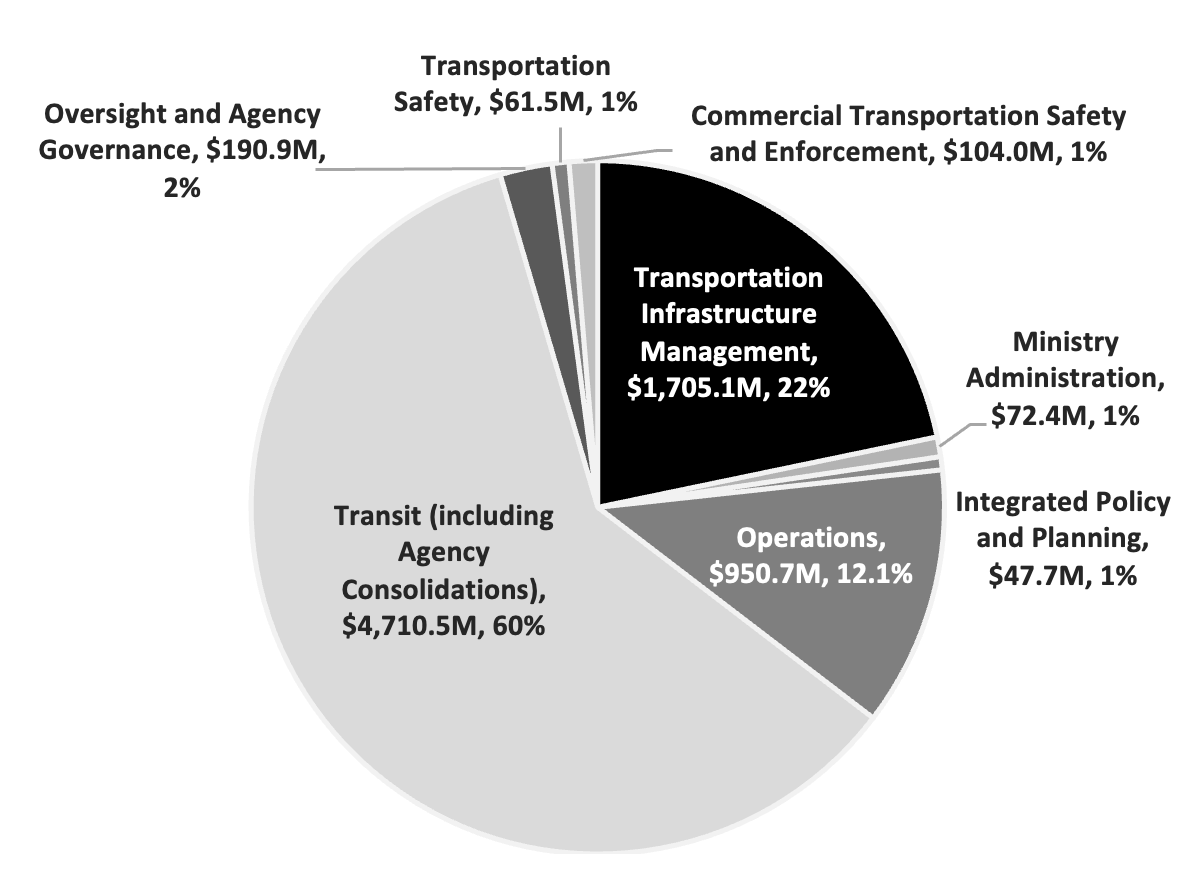
Note: Graph excludes adjustments for General Real Estate Portfolio (GREP) ($9.1M) and Ontario Infrastructure and Lands Corporation (IO) ($5.2M).
Transit (including Agency Consolidations): $4,710.6M
Transportation Infrastructure Management: $1,705.1M
Operations: $950.7M
Oversight and Agency Governance: $191.0M
Commercial Transportation Safety and Enforcement: $90.0M
Transportation Safety: $75.5M
Ministry Administration: $72.4M
Integrated Policy and Planning: $47.7M
Detailed financial information
Table 2: Combined Operating and Capital Summary by Vote
| Vote/Program | Estimates 2025–2026 $ | Change from Estimates 2024–2025 $ | % | Estimates 2024–2025 $ | Interim 2024–2025 $ | Actuals 2023–2024 $ |
|---|---|---|---|---|---|---|
| Ministry Administration Program | 55,604,000 | 13,386,000 | 31.7 | 42,218,000 | 53,250,200 | 49,330,492 |
| Transit | 1,060,136,800 | 51,477,300 | 5.1 | 1,008,659,500 | 1,511,956,200 | 1,613,005,256 |
| Transportation Safety | 65,505,900 | 14,684,800 | 28.9 | 50,821,100 | 86,138,300 | 54,793,751 |
| Transportation Infrastructure Management | 75,663,600 | 19,370,600 | 34.4 | 56,293,000 | 52,416,300 | 39,551,536 |
| Integrated Policy and Planning | 42,707,300 | 14,521,700 | 51.5 | 28,185,600 | 29,403,900 | 27,527,156 |
| Operations | 789,260,100 | 137,298,500 | 21.1 | 651,961,600 | 765,413,300 | 722,935,805 |
| Oversight and Agency Governance | 190,148,400 | 58,961,300 | 44.9 | 131,187,100 | 188,608,100 | 174,176,674 |
| Commercial Transportation Safety and Enforcement | 75,637,900 | 17,396,000 | 29.9 | 58,241,900 | 65,805,800 | 52,174,093 |
| Total Operating Expense to be Voted | 2,354,664,000 | 327,096,200 | 16.1 | 2,027,567,800 | 2,752,992,100 | 2,733,494,763 |
| Statutory Appropriations | 377,003,392 | 33,287,600 | 9.7 | 343,715,792 | 360,470,692 | 374,945,248 |
| Ministry Total Operating Expense | 2,731,667,392 | 360,383,800 | 15.2 | 2,371,283,592 | 3,113,462,792 | 3,108,440,011 |
| Consolidation Adjustment — Metrolinx | 791,853,500 | 78,456,800 | 11.0 | 713,396,700 | 716,457,200 | 806,380,085 |
| Consolidation Adjustment — Ontario Northland Transportation Commission | 129,937,700 | 8,174,300 | 6.7 | 121,763,400 | 117,683,900 | 133,417,174 |
| Consolidation Adjustment — Ontario Infrastructure and Lands Corporation | (5,206,100) | N/A | 0.0 | (5,206,100) | (5,206,100) | (1,460,293) |
| Consolidation Adjustment — General Real Estate Portfolio | (9,103,600) | 288,200 | (3.1) | (9,391,800) | (9,201,200) | (11,240,127) |
| Consolidation Adjustment — Other | N/A | N/A | N/A | N/A | - | 289,350 |
| Consolidation Adjustment — Centre for Addiction and Mental Health | N/A | N/A | N/A | N/A | - | (56,300) |
| Consolidation Adjustment — Hospitals | N/A | N/A | N/A | N/A | - | (135,941) |
| Other Adjustments — Bill 124 | N/A | N/A | N/A | N/A | - | (6,022,686) |
| Total Including Consolidation & Other Adjustments | 3,639,148,892 | 447,303,100 | 14.0 | 3,191,845,792 | 3,933,196,592 | 4,029,611,273 |
| Vote/Program | Estimates 2025–2026 $ | Change from Estimates 2024–2025 $ | % | Estimates 2024–2025 $ | Interim 2024–2025 $ | Actuals 2023–2024 $ |
|---|---|---|---|---|---|---|
| Ministry Administration Program | 1,000 | N/A | 0.0 | 1,000 | 1,000 | N/A |
| Transit | 1,000 | N/A | N/A | 1,000 | 1,000 | N/A |
| Transportation Safety | 1,000 | N/A | 0.0 | 1,000 | 1,000 | N/A |
| Transportation Infrastructure Management | 1,000 | N/A | 0.0 | 1,000 | 1,000 | N/A |
| Integrated Policy and Planning | 1,000 | N/A | 0.0 | 1,000 | 1,000 | N/A |
| Operations | 1,000 | N/A | 0.0 | 1,000 | 1,000 | N/A |
| Oversight and Agency Governance | 1,000 | N/A | 0.0 | 1,000 | 1,000 | N/A |
| Commercial Transportation Safety and Enforcement | 1,000 | 1,000 | N/A | N/A | N/A | N/A |
| Total Operating Assets to be Voted | 8,000 | 1,000 | 14.3 | 7,000 | 7,000 | N/A |
| Ministry Total Operating Assets | 8,000 | 1,000 | 14.3 | 7,000 | 7,000 | N/A |
| Total Including Consolidation & Other Adjustments | 8,000 | 1,000 | 14.3 | 7,000 | 7,000 | N/A |
| Vote/Program | Estimates 2025–2026 $ | Change from Estimates 2024–2025 $ | % | Estimates 2024–2025 $ | Interim 2024–2025 $ | Actuals 2023–2024 $ |
|---|---|---|---|---|---|---|
| Ministry Administration Program | 1,000 | N/A | 0.0 | 1,000 | 1,000 | N/A |
| Transit | 9,277,446,400 | (451,356,700) | (4.6) | 9,728,803,100 | 8,785,529,500 | 7,293,145,049 |
| Transportation Safety | 1,000 | N/A | 0.0 | 1,000 | 1,000 | 3,042,717 |
| Transportation Infrastructure Management | 184,439,500 | 16,700,000 | 10.0 | 167,739,500 | 178,636,500 | 209,683,358 |
| Integrated Policy and Planning | 5,000,000 | 5,000,000 | N/A | N/A | N/A | N/A |
| Operations | 161,460,000 | 95,940,000 | 146.4 | 65,520,000 | 100,098,700 | 50,388,956 |
| Oversight and Agency Governance | 1,000 | N/A | 0.0 | 1,000 | 1,000 | N/A |
| Commercial Transportation Safety and Enforcement | 1,000 | N/A | 0.0 | 1,000 | 1,000 | N/A |
| Total Capital Expense to be Voted | 9,628,349,900 | (333,716,700) | (3.3) | 9,962,066,600 | 9,064,268,700 | 7,556,260,080 |
| Statutory Appropriations | 1,486,496,400 | 137,998,500 | 10.2 | 1,348,497,900 | 1,342,256,500 | 1,335,050,728 |
| Ministry Total Capital Expense | 11,114,846,300 | (195,718,200) | (1.7) | 11,310,564,500 | 10,406,525,200 | 8,891,310,808 |
| Consolidation Adjustment — Metrolinx | (6,631,877,800) | 600,351,700 | (8.3) | (7,232,229,500) | (6,584,629,500) | (5,453,126,984) |
| Consolidation Adjustment — Ontario Northland Transportation Commission | (293,526,000) | (53,704,100) | 22.4 | (239,821,900) | (170,272,800) | (108,408,663) |
| Other Adjustment — Asset Retirement Obligation Revaluation | N/A | N/A | N/A | N/A | N/A | (638,718) |
| Total Including Consolidation & Other Adjustments | 4,189,442,500 | 350,929,400 | 9.1 | 3,838,513,100 | 3,651,622,900 | 3,329,136,443 |
| Vote/Program | Estimates 2025–2026 $ | Change from Estimates 2024–2025 $ | % | Estimates 2024–2025 $ | Interim 2024–2025 $ | Actuals 2023–2024 $ |
|---|---|---|---|---|---|---|
| Ministry Administration Program | 46,451,800 | 22,769,000 | 96.1 | 23,682,800 | 27,841,400 | 22,636,084 |
| Transit | 1,000 | N/A | N/A | 1,000 | 1,000 | N/A |
| Transportation Safety | 84,396,900 | 11,703,200 | 16.1 | 72,693,700 | 51,210,900 | 35,159,069 |
| Transportation Infrastructure Management | 3,408,973,700 | 277,970,500 | 8.9 | 3,131,003,200 | 2,544,506,400 | 2,212,071,111 |
| Operations | 1,000 | N/A | 0.0 | 1,000 | 1,000 | N/A |
| Oversight and Agency Governance | 1,000 | N/A | 0.0 | 1,000 | 1,000 | N/A |
| Commercial Transportation Safety and Enforcement | 1,000 | N/A | 0.0 | 1,000 | 1,000 | 8,718,676 |
| Total Capital Assets to be Voted | 3,539,826,400 | 312,442,700 | 9.7 | 3,227,383,700 | 2,623,562,700 | 2,278,584,940 |
| Ministry Total Capital Assets | 3,539,826,400 | 312,442,700 | 9.7 | 3,227,383,700 | 2,623,562,700 | 2,278,584,940 |
| Total Including Consolidation & Other Adjustments | 3,539,826,400 | 312,442,700 | 9.7 | 3,227,383,700 | 2,623,562,700 | 2,278,584,940 |
| Ministry Total Operating and Capital Including Consolidation and Other Adjustments (not including Assets) | 7,828,591,392 | 798,232,500 | 11.4 | 7,030,358,892 | 7,584,819,492 | 7,358,747,716 |
| Historic Trend Analysis Data | Actuals 2022-2023 $ | Actuals 2023–2024 $ | Estimates 2024–2025 $ | Estimates 2025–2026 $ |
|---|---|---|---|---|
| Ministry Total Operating and Capital Including Consolidation and Other Adjustments (not including Assets) | 6,559,489,271 | 7,358,747,716 | 7,030,358,892 | 7,828,591,392 |
| Percent change (%) | N/A | 12.2% | -4.5% | 11.4% |
The increase from 2024–25 to 2025–26 is mainly due to right-sizing of ministry budgets to account for increased costs due to recent inflationary pressures e.g. for highway maintenance, and updated project milestones.
For additional financial information, see:
Agencies, Boards and Commissions (ABCs)
| Name of Agencies, Boards and Commissions | 2026-2026 Estimates | 2024-2025 Interim Actuals | 2023–2024 Actuals |
|---|---|---|---|
| Ontario Northland Transportation Commission, operating subsidy | 108,725,500 | 94,163,900 | 59,582,375 |
| Ontario Northland Transportation Commission, capital | 335,109,400 | 201,904,200 | 102,675,795 |
| Owen Sound Transportation Company, operating subsidy | 9,357,400 | 9,577,000 | 5,907,097 |
| Owen Sound Transportation Company, capital | 13,960,000 | 1,928,500 | 11,505,195 |
| Metrolinx, operating subsidy | 916,917,300 | 1,350,696,000 | 1,221,041,938 |
| Metrolinx, capital | 8,166,209,000 | 7,967,286,000 | 6,580,035,232 |
Metrolinx
Metrolinx was created in 2006 with a mandate to provide leadership on the coordination, planning, financing, development, and implementation of an integrated transit network in the GGH. The agency is responsible for the operation of the GO Transit system, the PRESTO fare card payment system, the Union–Pearson (UP) Express, as well as the planning and construction of a number of rapid transit, subway, and heavy rail projects throughout the region. Metrolinx also acts on behalf of municipalities as a central procurement agency for local transit system vehicles, equipment, technologies, and related supplies and services.
Ontario Northland Transportation Commission
The Ontario Northland Transportation Commission (ONTC)’s mandate is to provide efficient, affordable, safe, and reliable transportation services in Northern Ontario. Current business lines include: the Polar Bear Express (PBX) passenger rail service between Cochrane and Moosonee, and the Cochrane Station Inn; motor coach services, including bus parcel express, throughout Northern Ontario connecting to Toronto, Ottawa, Thunder Bay, and Winnipeg, Manitoba; rail freight services from North Bay to Hearst across the northeast Highway 11 corridor, with a rail line extending into Quebec; and rail remanufacturing and repair services. ONTC is also advancing work to bring back passenger rail service in Northeastern Ontario.
Owen Sound Transportation Company, Limited
The Owen Sound Transportation Company (OSTC) is a non-share capital corporation. OSTC is mandated to provide safe, efficient, and reliable ferry transportation in the Province of Ontario i.e., OSTC owns the MS Chi–Cheemaun, which serves the ports of Tobermory and South Baymouth on the southeastern edge of Manitoulin Island. OSTC is also responsible for the Moose Factory Island Service, as OSTC owns the MV Niska 1, which serves Moosonee and Moose Factory Island on the Moose River in Northern Ontario. OSTC subcontracts the operation of the ferry to Complex RE Limited Partnership.
Additionally, OSTC provides vessel management services for the ministry for three vessels — the M.V. Pelee Islander, the M.V. Pelee Islander II, and the M.V. Jiimaan — to operate the Pelee Island Transportation Service. OSTC also administers a contractor–operated daily air service between the Ontario mainland and Pelee Island during the winter months when the ferry service is not in operation.
Ministry organization chart
June 2025
- Deputy Minister — Doug Jones
- Executive Advisor, Deputy Minister’s Office — Alessya D’Anna
- Director, Communications — Marc Hudon
- ADM, Oversight and Agency Governance Division — Melissa Djurakov
- Director, Metrolinx Agency and Oversight — Mike McRae
- Director, Strategic Partner Management — Ganesh Kashyap (Acting)
- Director, Contract Design and Implementation — Ben Sopel (Acting)
- ADM, Transit Division — James Pearce (Acting)
- Director, Transit Capital and Operations — Jillian Soule (Acting)
- Director, Transit Programs — Nathania Ho
- Director, Transit Strategy and Implementation — Ewa Downarowicz
- ADM, Integrated Policy and Planning Division — Tamara Gilbert
- Director, System Planning — Gurpreet Sidhu (Acting)
- Director, System Optimization Policy — Alena Grunwald
- Director, Transportation Policy — Katie De Palma
- Director, Indigenous Relations Environmental Policy — Dawn Irish (Acting)
- Director, Cabinet, Regulatory, Intergovernmental and Strategic Policy — Beth O’Connor
- ADM, Transportation Infrastructure Management Division — Eric Doidge
- Director, Asset Management — Michelle Pasqua
- Director, Highway Transfer Secretariat — Megan Chochla (Acting)
- Director, Northern Infrastructure and Partnerships — Gary Weiss
- Chief Engineer — Alain Beaulieu
- Director, Major Infrastructure Projects — Malvika Rudra
- Director, Capital Program Delivery — Michelle McGrath
- Director, Design and Engineering — Becca Lane
- Director, Standards and Contracts — Bruce Cane
- ADM, Transportation Safety Division — Felix Fung
- Director, Safety Program Development — Amanda Doobay
- Director, Driver and Vehicle Services — Dianne Oliphant
- Director, Digital Services Delivery — Marc Faubert
- Director, Special Projects — Greg Malczewski (Acting)
- ADM, Operations Division — Jasan Boparai
- Director, North Operations — Herb Villneff
- Director, East Operations — Franca Sacchetti
- Director, Central Operations — Logan Purdy (Acting)
- Director, Transportation User Services — Colin Simons
- Director, Highway Operations Management — Jason Ranger
- Director, West Operations — Geoffrey Gladdy
- Manager, Stakeholder Coordination and Integration — Kyle Clemens (Acting)
- CAO / ADM, Corporate Services Division — Virginia McKimm
- Director, Strategic HR — Andrea Morley (Acting)
- Director, Finance — Vrinda Vaidyanathan
- Director, Business Support Services — Sejal Jain (Acting)
- Director, Organizational Effectiveness — Shireen Mohammed (Acting)
- Director, Business Services Transformation — Shaleena Kitchlu (Acting)
- Manager, French Language Services Land and Resources Cluster — Sonia Melerowicz
- ADM, Commercial Transportation Safety and Enforcement — Brenda Augerman-Audette (Acting)
- Director, Commercial Inspection and Enforcement — Sean McGowan
- Director, Commercial Safety and Compliance — Jennifer Elliott
- Director, Driver Training and Compliance Oversight — BJ Alvey
- Legal Services — Donald Bennett (Acting)
- Internal Audit Services — Vince Conti
Annual report
2024–25 Results
Delivery of key transit projects and programs
Advancing transit infrastructure projects to improve connections across communities
- In September 2024, the province, with the City of Toronto and York Region, executed the Subway Program Agreements in Principle (AIP), marking a major milestone in transit expansion by outlining a comprehensive framework for planning, funding, operating, and maintaining provincial subway projects, including the Eglinton Crosstown West Extension, Ontario Line, Scarborough Subway Extension, and Yonge North Subway Extension.
- Eglinton Crosstown West Extension: Tunneling on the project has continued to advance, with tunneling for the east tunnel between Jane and Mount Dennis stations commencing in February 2025. Construction on the elevated guideway between Scarlett Road and Jane Street began in March 2025. Procurement is also underway for the Stations, Rail, and Systems (SRS) package of works, which is the final component of the Eglinton Crosstown West Extension. The Request for Proposals (RFP) for the SRS package was released in September 2024.
- Ontario Line: Construction is underway on all segments of the Ontario Line. Both Progressive Design–Build packages for northern sections are progressing through the design phase. Excavation work has commenced at some stations in the southern alignment, including at King–Bathurst, Corktown, Moss Park, and Queen–Spadina, in advance of tunneling. Tunnel boring machines that will be used on the Ontario Line are undergoing testing in Germany.
- Scarborough Subway Extension: Construction is underway across the line. The construction contract for the Stations, Rail, and Systems (SRS) package of works was awarded in February 2025 to Scarborough Transit Connect. Tunneling and related works as part of the Advance Tunnel Contract are also underway.
- Yonge North Subway Extension: In March 2025, the RFP for the Advance Tunnel Contract closed. The contract award for tunneling works is expected later in 2025. Early upgrades at Finch Station, which include improvements made to the electrical system that powers the rails, are now complete. Procurement planning for the other components of the Yonge North Subway Extension continues to advance.
- Hamilton Light Rail Transit (LRT): Throughout 2024–25, progress has been made on the Hamilton LRT project. Enabling works, including public utility relocations, are underway. Metrolinx launched a request for qualifications (RFQ) in November 2024 for advancing delivery of civil works that includes roads, structures, and bridges along the 14–kilometre route. The RFP is scheduled to be released in spring 2025.
- Eglinton Crosstown LRT and Finch LRT: Major construction is complete. Metrolinx continues to focus on safety and operational readiness testing, training, and certification of the projects.
- Hazel McCallion Line: Guideway and track construction has continued along the route, including track installation and stop platforms. The platform at Port Credit station is nearing completion and all girders have been installed for the elevated guideway spanning Highway 403.
Building more frequent and connected GO transit services
- The ministry and Metrolinx are continuing to expand and deliver better GO Transit services to make it easier and faster for people to get to where they need:
- Construction began in May 2024 on the new pedestrian tunnel connecting the Bloor GO/UP Express Station and the Toronto Transit Commission (TTC)’s Dundas West Station. This connection will encourage travellers to choose to combine GO Transit or UP Express trips with the TTC subway, streetcar, or bus services, and support the growth of a more interconnected regional rapid transit network.
- Throughout 2024–25, Metrolinx continued construction of the new Confederation GO station. This new station will support a more integrated transit network for Hamilton, providing better connections to existing local transit and GO bus services, while facilitating future increased GO rail service opportunities to Toronto and Niagara Falls.
- Metrolinx has continued to deliver improvements at Union Station as part of the transformational Union Station Enhancement Project, which will improve customer experience and connections and support GO service increases planned as part of the GO Rail Expansion program.
- Metrolinx continues to advance infrastructure improvements along the Kitchener GO Line to enable two–way, all–day service, including a new train platform at Guelph Central Station and new passing and storage tracks along the corridor.
Bringing back the northlander
- The ministry continues to work with the Ontario Northland Transportation Commission (ONTC) to reinstate the Northlander passenger rail service between Timmins and Toronto, with a rail connection to Cochrane.
- Construction of track and station improvements is currently underway. The Province has purchased three new trainsets for the reinstated service.
- The province is moving forward to implement next steps, including detailed design and engineering, environmental assessment, Indigenous and municipal consultation.
Improvements to PRESTO fare payment system
- On February 26, 2024, the province launched the One Fare program that allows riders to pay only once as they transfer for free between the TTC and participating transit systems in the Greater Toronto Area, including GO Transit. One Fare makes cross–boundary travel more affordable and convenient for transit riders.
- Metrolinx continued to implement the PRESTO fare payment system across the Greater Toronto Hamilton Area (GTHA) and in Ottawa to make it easier for Ontarians to access transit services. Throughout 2023–24, Metrolinx completed delivery of contactless credit card and Interac debit payment to all transit agencies in the GTHA, including the TTC. In addition, Metrolinx also delivered PRESTO in Google Wallet and launched its application in Apple Wallet on July 16, 2024, where a virtual PRESTO card can be loaded into the digital platform.
Supporting municipal transit systems to improve services and support expansion
- The province’s 2024–25 Gas Tax Program committed over $380 million in funding to 106 municipalities to support and grow their transit systems.
- The Public Transit stream of the Investing in Canada Infrastructure Program is providing $7.3 billion in provincial funding and $8.3 billion in federal funding to support over 400 transit capital projects across Ontario.
- Through the New Deal for Toronto, the Province is providing $300 million in one–time funding for subway and transit safety, recovery, and sustainability on the TTC network.
Ministry key performance indicators
| Indicator | Baseline value and date | Trend value and date | Target |
|---|---|---|---|
| Total Ontario Transit Ridership | 687 million (2002) pre-pandemic 584 million (2022) | 756 million (2023) | 773 million (2026) Increasing transit ridership over the long term |
Source of data is the Canadian Urban Transit Association’s Transit Fact Books. Note there is a lag in data availability; 2025 data will not be available until 2027.
Programs that contribute to the KPI results
- Transit program
- Oversight and agency governance program
- Integrated policy and planning program
Program–level trends
Municipal transit ridership
In 2023 (the most recent year with a full dataset), total Ontario transit ridership continued to recover from the declines that resulted from the COVID–19 pandemic, according to data provided by the Canadian Urban Transit Association (CUTA). While total ridership in Ontario increased to 756 million rides in 2023, representing an increase of 172 million rides or approximately 30% over 2022 ridership, it was still only 80% of the 2019 pre–pandemic level. This trend indicates that while progress has been made towards full recovery, overall, transit systems have not yet fully recovered their pre-pandemic ridership levels. Note, 2024–25 data not yet available.
Ridership recovery has varied across Ontario with some larger municipal transit systems already exceeding their pre–pandemic ridership levels while others have progressed at a slower pace. The ministry will continue to work with municipal transit systems to collect ridership data to gain insights into Ontario's municipal transit networks.
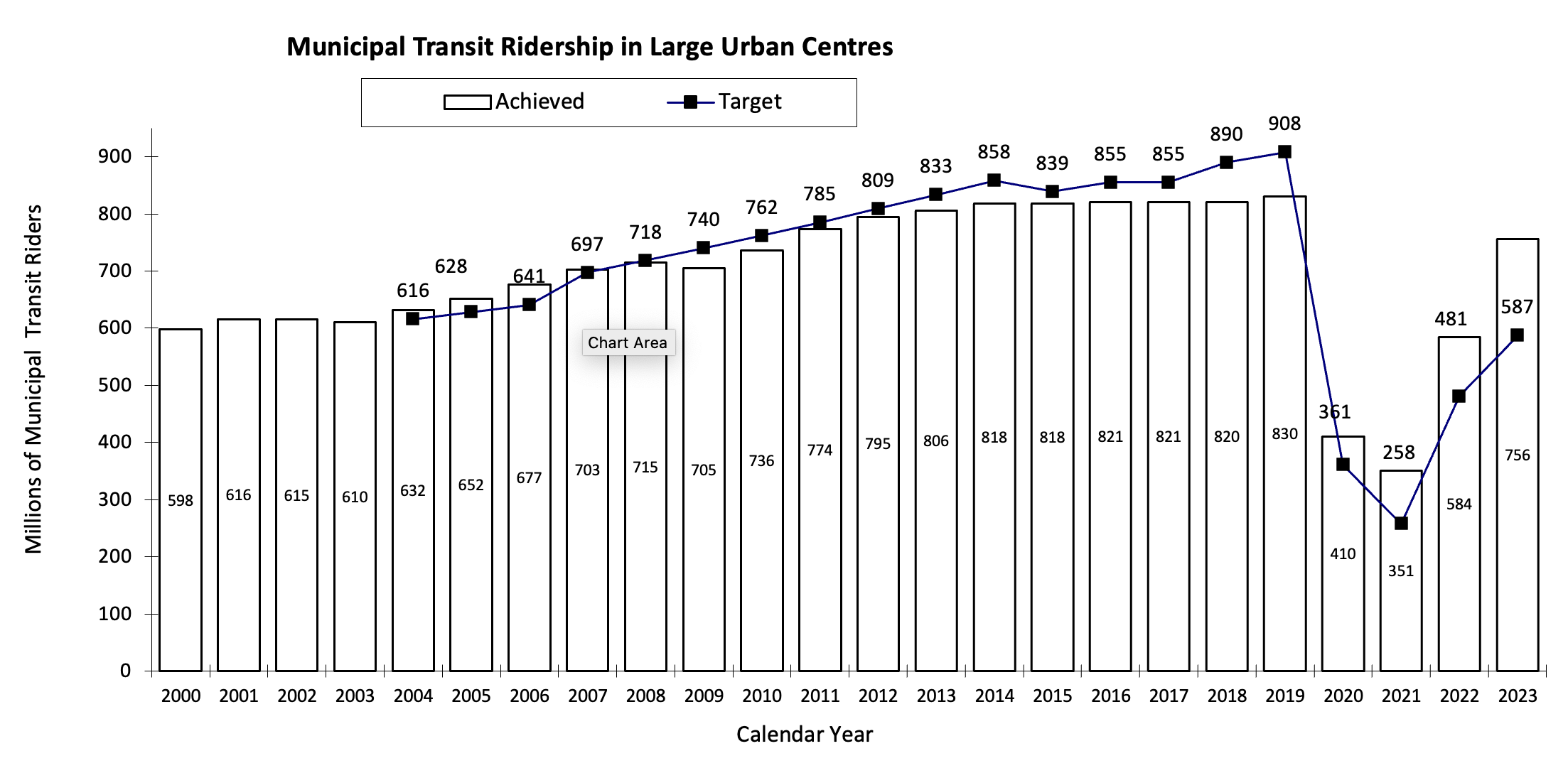
| Calendar year | Achieved (millions of municipal transit riders) | Target (millions of municipal transit riders) |
|---|---|---|
| 2000 | 598 | N/A |
| 2001 | 616 | N/A |
| 2002 | 615 | N/A |
| 2003 | 610 | N/A |
| 2004 | 632 | 616 |
| 2005 | 652 | 628 |
| 2006 | 677 | 641 |
| 2007 | 703 | 697 |
| 2008 | 715 | 718 |
| 2009 | 705 | 740 |
| 2010 | 736 | 762 |
| 2011 | 774 | 785 |
| 2012 | 795 | 809 |
| 2013 | 806 | 833 |
| 2014 | 818 | 858 |
| 2015 | 818 | 839 |
| 2016 | 821 | 855 |
| 2017 | 821 | 855 |
| 2018 | 820 | 890 |
| 2019 | 830 | 908 |
| 2020 | 410 | 361 |
| 2021 | 351 | 258 |
| 2022 | 584 | 481 |
| 2023 | 756 | 587 |
Metrolinx transit ridership
Metrolinx transit ridership (on GO trains, GO buses, and the UP Express) continues to recover from the declines that resulted from the COVID–19 pandemic. Ridership in 2024–25 was 71.9 million. This is an increase from 2023–24 when ridership was 59 million but below the pre–pandemic ridership of 76.3 million. The ministry and Metrolinx continue to take actions to grow GO Transit ridership by making investments in service improvements across the core network to bring two–way, all–day GO Transit service with faster trains, more stations, and better connections.
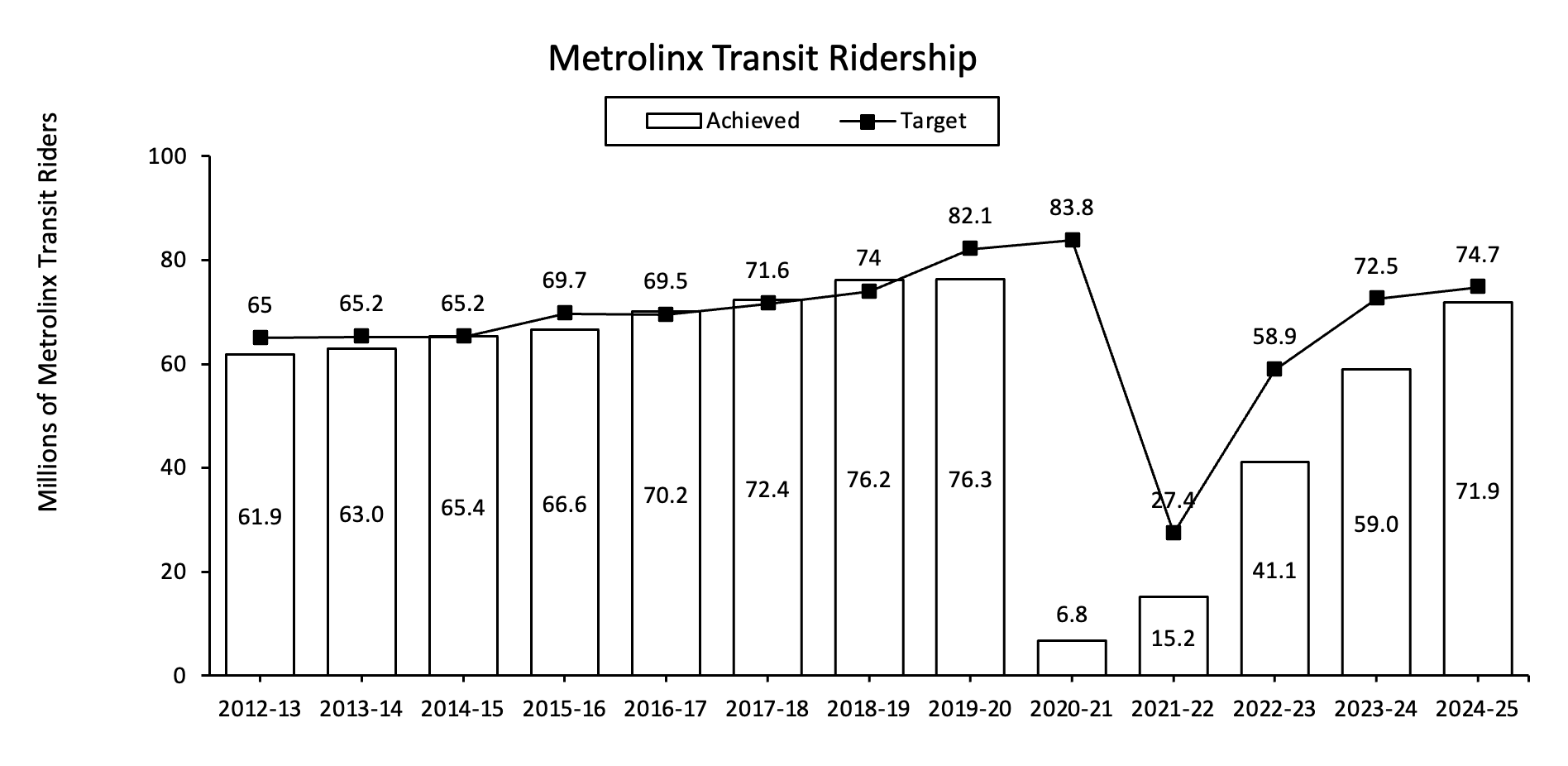
| Calendar year | Achieved (millions of Metrolinx transit riders) | Target (millions of Metrolinx transit riders) |
|---|---|---|
| 2012–2013 | 61.9 | 65 |
| 2013–2014 | 63 | 65.2 |
| 2014–2015 | 65.4 | 65.2 |
| 2015–2016 | 66.6 | 69.7 |
| 2016–2017 | 70.2 | 69.5 |
| 2017–2018 | 72.4 | 71.6 |
| 2018–2019 | 76.2 | 74 |
| 2019–2020 | 76.3 | 82.1 |
| 2020–2021 | 6.8 | 83.8 |
| 2021–2022 | 15.2 | 27.4 |
| 2022–2023 | 41.1 | 58.9 |
| 2023–2024 | 59 | 72.5 |
| 2024–2025 | 71.9 | 74.7 |
Note: Historical figures for 2012–13 through 2014–15 show GO Transit ridership only. With the launch of the UP Express service in June 2015, historical figures and targets from 2015–16 onwards have been adjusted to reflect the new Metrolinx transit ridership figures, which include both GO Transit and UP Express services.
Metrolinx on–time performance
On–time performance is defined as within five minutes of scheduled arrival time for GO rail trips, within 15 minutes of scheduled arrival time for GO bus trips, and within five minutes of targeted journey time for the UP Express. Note, data not yet available for 2024–25.
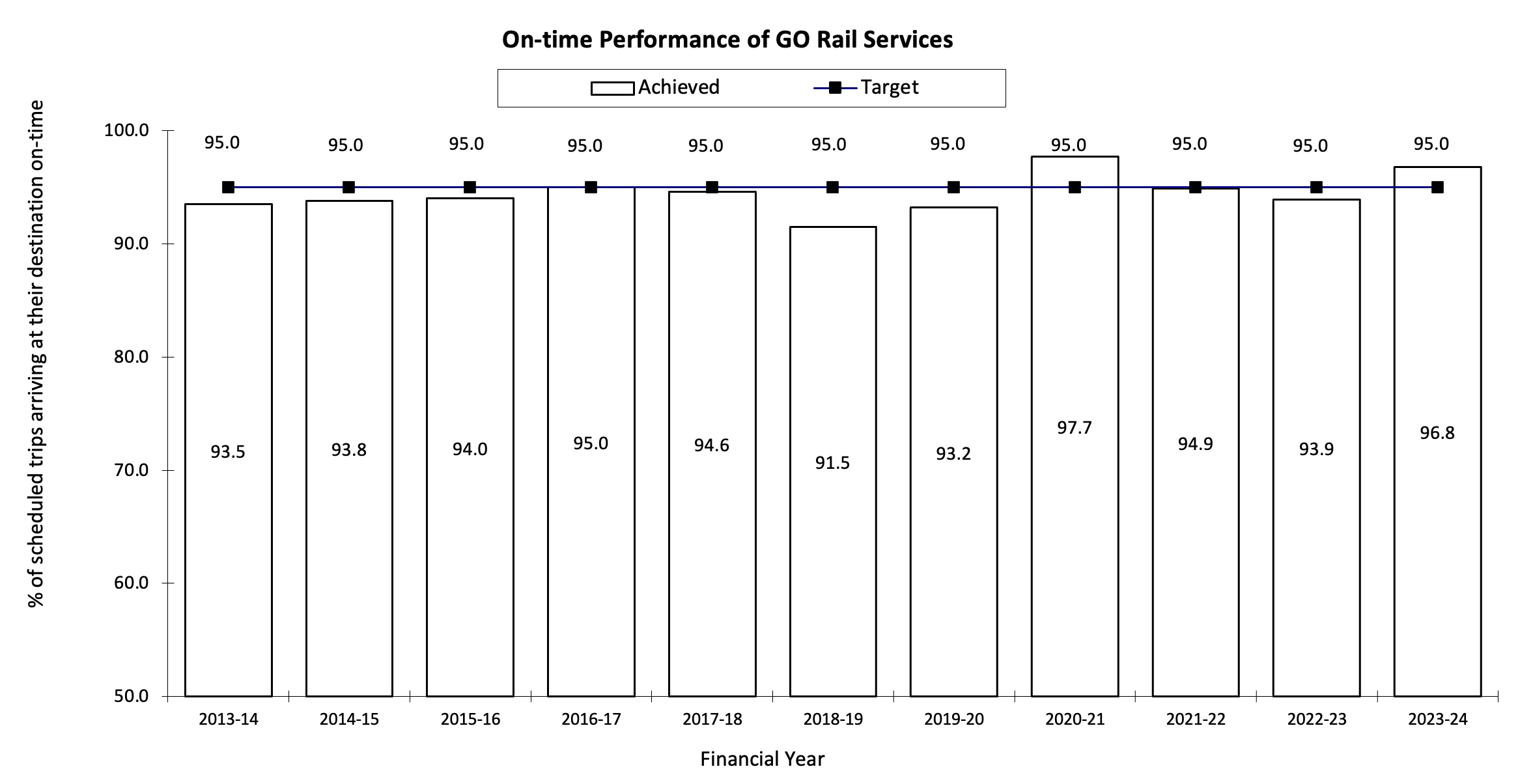
| Year | 2013–2014 | 2014–2015 | 2015–2016 | 2016–2017 | 2017–2018 | 2018–2019 | 2019–2020 | 2020–2021 | 2021–2022 | 2022–2023 | 2023–2024 |
|---|---|---|---|---|---|---|---|---|---|---|---|
| Achieved (%) | 93.5 | 93.8 | 94.0 | 95.0 | 94.6 | 91.5 | 93.2 | 97.7 | 94.9 | 93.9 | 96.8 |
| Target (%) | 95.0 | 95.0 | 95.0 | 95.0 | 95.0 | 95.0 | 95.0 | 95.0 | 95.0 | 95.0 | 95.0 |
Note: Data not available for 2018–19 and 2019–20 for GO Bus and UP Express below.
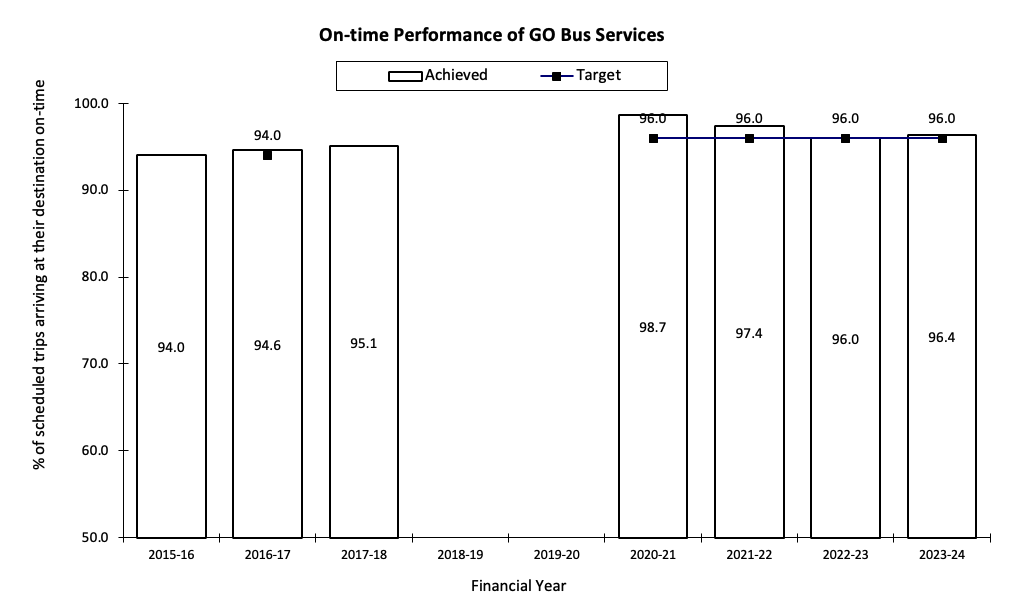
| Year | 2015–2016 | 2016–2017 | 2017–2018 | 2018–2019 | 2019–2020 | 2020–2021 | 2021–2022 | 2022–2023 | 2023–2024 |
|---|---|---|---|---|---|---|---|---|---|
| Achieved (%) | 94.0 | 94.6 | 95.1 | N/A | N/A | 98.7 | 97.4 | 96.0 | 96.4 |
| Target (%) | N/A | 94.0 | N/A | N/A | N/A | 96.0 | 96.0 | 96.0 | 96.0 |
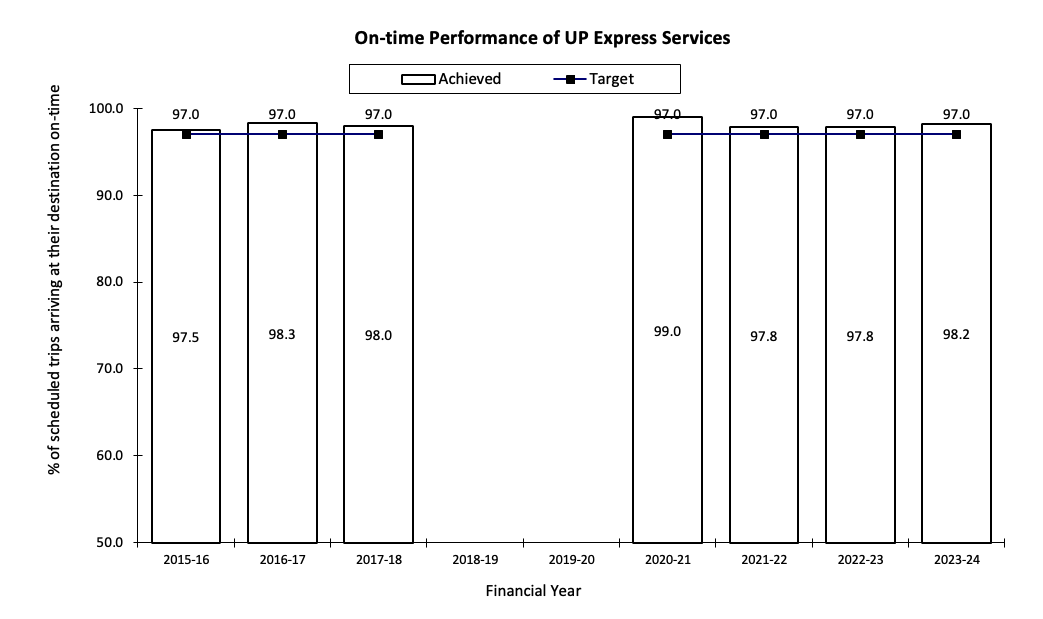
| Year | 2015–2016 | 2016–2017 | 2017–2018 | 2018–2019 | 2019–2020 | 2020–2021 | 2021–2022 | 2022–2023 | 2023–2024 |
|---|---|---|---|---|---|---|---|---|---|
| Achieved (%) | 97.5 | 98.3 | 98.0 | N/A | N/A | 99.0 | 97.8 | 97.8 | 98.2 |
| Target (%) | 97.0 | 97.0 | 97.0 | N/A | N/A | 97.0 | 97.0 | 97.0 | 97.0 |
Note: There indicators are not a province–wide measure and only reflects Metrolinx’s transit services (GO Rail, GO Bus, and the UP Express).
Related link:
ONTC Ridership
ONTC’s bus and passenger rail ridership made a gradual recovery to pre–pandemic levels throughout 2023–24. Motor Coach ridership levels in 2023–24 increased by 12% over 2022–23 while Polar Bear Express ridership levels were up 14% in 2023–24 over the previous year. Note, data not yet available for 2024–25.
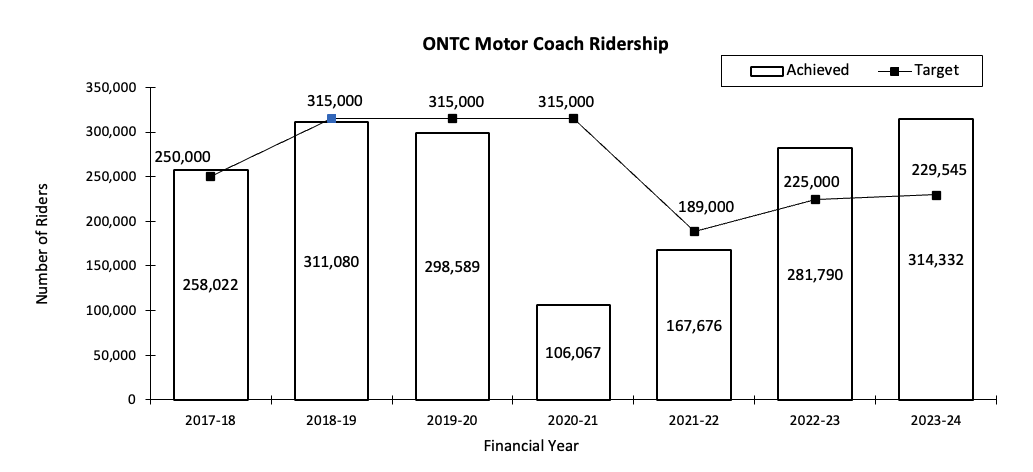
| Year | 2017–2018 | 2018–2019 | 2019–2020 | 2020–2021 | 2021–2022 | 2022–2023 | 2023–2024 |
|---|---|---|---|---|---|---|---|
| Achieved | 258,022 | 311,080 | 298,589 | 106,067 | 167,676 | 281,790 | 314,332 |
| Target | 250,000 | 315,000 | 315,000 | 315,000 | 189,000 | 225,000 | 229,545 |
Related link:
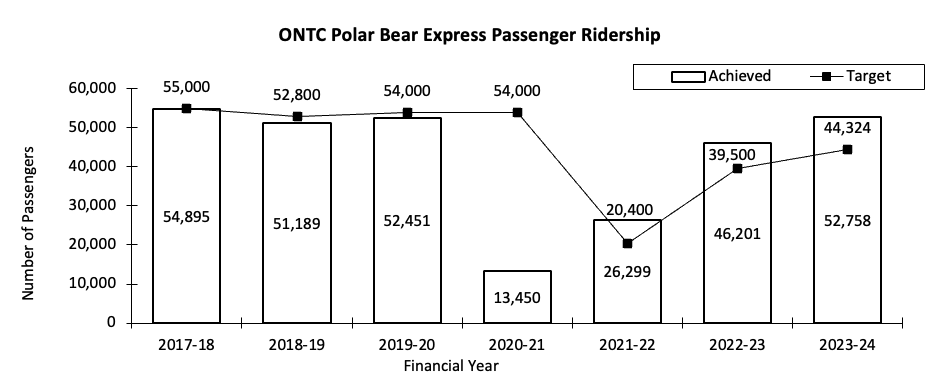
| Year | 2017–2018 | 2018–2019 | 2019–2020 | 2020–2021 | 2021–2022 | 2022–2023 | 2023–2024 |
|---|---|---|---|---|---|---|---|
| Achieved | 54,895 | 51,189 | 52,451 | 13,450 | 26,299 | 46,201 | 52,758 |
| Target | 55,000 | 52,800 | 54,000 | 54,000 | 20,400 | 39,500 | 44,324 |
Related link:
ONTC defines on–time performance as within 15 minutes of scheduled arrival time for both motor coach and rail trips.
The on–time performance of the ONTC motor coach services for 2023–24 was 69%, which is less than the target and a decrease of 5% from the previous year as a result of increased passenger volumes and vehicle traffic on roads and highways. Note, 2024–25 data not yet available.
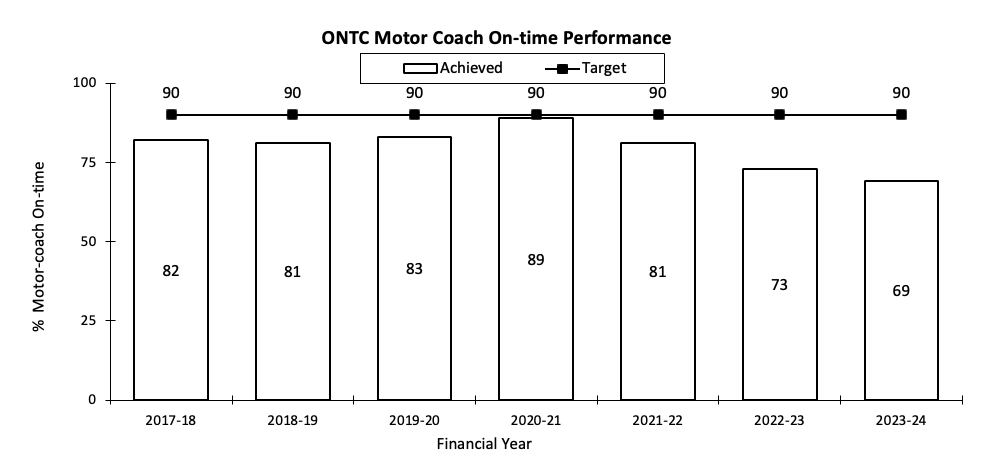
| Year | 2017–2018 | 2018–2019 | 2019–2020 | 2020–2021 | 2021–2022 | 2022–2023 | 2023–2024 |
|---|---|---|---|---|---|---|---|
| Achieved | 82 | 81 | 83 | 89 | 81 | 73 | 69 |
| Target | 90 | 90 | 90 | 90 | 90 | 90 | 90 |
Related link:
On–time performance for the Polar Bear Express in 2023–24 was 93%, a 1% decrease from the year before. Note, 2024–25 data not yet available.
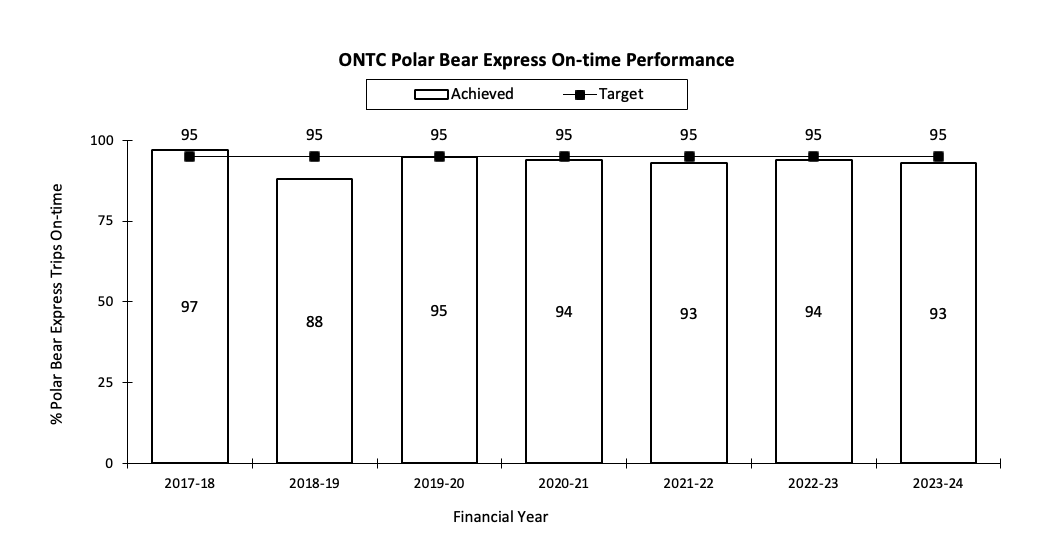
| Year | 2017–2018 | 2018–2019 | 2019–2020 | 2020–2021 | 2021–2022 | 2022–2023 | 2023–2024 |
|---|---|---|---|---|---|---|---|
| Achieved | 97 | 88 | 95 | 94 | 93 | 94 | 93 |
| Target | 95 | 95 | 95 | 95 | 95 | 95 | 95 |
Related link:
Highway, road, and bridge infrastructure and operations
Supporting municipal economic development and fiscal sustainability
- In 2024–25, the ministry provided $30 million in funding through the Connecting Links Program to help municipalities across Ontario repair roads and bridges that connect to provincial highways and international borders. For 2024–25, the ministry selected 21 projects for funding across the province.
- In addition, the ministry is providing up to $73.8 million for the Timmins Connecting Link to reconstruct an approximately 21.4‐kilometre stretch of Highway 101, which is one of the longest connecting links in Ontario and used by about 25,000 vehicles per day.
Toronto new deal
- On November 27, 2023, the Government of Ontario and City of Toronto reached an agreement for the Province to provide the City with up to $1.2 billion in provincial operating supports over three years and significant capital relief, including uploading both the Gardiner Expressway and the Don Valley Parkway to the Province, subject to third–party due diligence.
- In the interim period, the City of Toronto retains ownership and all maintenance and state-of-good-repair responsibilities over the highways. Operations and capital improvements are being funded by the province.
- To support these maintenance and rehabilitation efforts, in March 2024, the Province and the City of Toronto executed a two–year Transfer Payment Agreement (TPA) for up to $358.7 million for the Gardiner Expressway and Don Valley Parkway.
- In July 2024, the Province announced additional funding of up to $73 million to help accelerate construction on the Gardiner Expressway by at least one year.
Ottawa new deal
- On March 28, 2024, the Government of Ontario announced a new deal with the City of Ottawa that recognizes and invests in the City’s unique needs.
- The agreement includes up to $197 million over three years in provincial operating supports and up to $346 million over 10 years in provincial capital supports.
- The agreement with Ottawa includes provisions for a three–stage detailed plan to explore and assess considerations related to provincial ownership of Ottawa Road 174, which is currently under way.
- In the interim period, the Province will provide funding to Ottawa to support the rehabilitation and maintenance of Ottawa Road 174.
- As part of this support, in January 2025, the Province and City of Ottawa executed a three–year Transfer Payment Agreement (TPA) for up to $56 million to support maintenance and rehabilitation of Ottawa Road 174.
Investing in highways, roads, and bridges to improve the reliability and connectivity of the highway network
- The ministry continued to deliver on its investments to improve highway trade corridors and supply chain fluidity, manage congestion, and support a high quality of life for Ontario, by allocating $3.9 billion in 2024–25 to repair and expand provincial highways and bridges.
- In 2024–25, MTO built 53 lane–kilometres of new or expanded highway and five new bridges, while repairing 1,345 lane–kilometres of highway and 102 bridges.
- The ministry advertised and tendered $995.7 million worth of maintenance work to maintain the province’s highway network in the summer and winter.
- The ministry is currently implementing the largest expansion of rest areas in its history. As of March 2025, four new sites have been constructed and 10 sites rehabilitated.
- The ministry conducted 3,883 maintenance audits, encompassing both completed and ongoing audits, along with ~88,000 maintenance site visits.
As part of the province’s efforts to build, expand, and improve the provincial highway network, the ministry advanced several key highway projects in 2024–25:
Southern Ontario
- Made significant progress on the Highway 413 project, including continuing critical engineering work, establishing a process to streamline the assessment of environmental impacts, and advancing preliminary design to better connect Halton, Peel, and York Regions.
- Advanced the Bradford Bypass project by awarding the contract for design as well as advertising, awarding a Construction Manager assignment for the West section of the corridor, and completing the construction of the Simcoe County Road 4/Yonge Street bridge.
- Released a Request for Proposal (RFP) for a Highway 401 Tunnel Feasibility and Congestion Relief Study to determine the feasibility of infrastructure capacity improvements and congestion mitigation measures to improve transportation efficiency on Highway 401 in the GTA.
- Opened Highway 404 High Occupancy Vehicle (HOV) lanes from Highway 407 Express Toll Route (ETR) to Stouffville Road, York Region.
- Completed the full superstructure replacement of the Bay of Quinte Skyway bridge between Tyendinaga Mohawk Territory and Prince Edward County. This was a five–year project, successfully completed in the summer of 2024.
- Completed the series of 10 rapid bridge replacements on Highway 417 in Ottawa, as part of the Mid–Town Bridges project.
- Advanced the construction of the new Highway 7 between Kitchener and Guelph with the award of a contract to replace the Frederick Street bridge in Kitchener.
Northern Ontario
Note: Funding for the construction and contract administration services for northern highways is provided through the Ministry of Northern Economic Development and Growth.
- Completed the four laning of Highway 17 from the Manitoba border easterly to west of Highway 673, west of Kenora.
- Completed several rehabilitation projects on Highway 584 north of Geraldton and Highway 11 between Jellicoe and Highway 584.
- Completed the resurfacing of section of Highway 631 from south of Hornepayne northerly to Nagagamisis Narrows Bridge and construction of new paved shoulders for 31.7 kilometres. This project also included the replacement of Nagagamisis Lake Narrows Bridge and Hornepayne Creek Culvert, and the rehabilitation of Shekak River Bridge and West Beaton River Bridge.
- Rehabilitated a section of Highway 144 from north of Highway 560 northerly to Highway 661, for 22.1 kilometres.
- Resurfaced a section of Highway 129 from Highway 17 to Highway 554, for 29.9 kilometres.
Ministry key performance indicators
| Indicator | Baseline value and date | Trend value and date | Target value and date |
|---|---|---|---|
| Percentage of Bridges in good condition | 68% — 2004 | 87% — 2024 | > 85% — 2025 |
| Percentage of highway pavements in good condition | 59% — 2004 | 77% — 2024 | > 67% — 2025 |
Bridge and highway pavement conditions are categorized based on the need for repair, rehabilitation, or replacement based on the asset management life cycle. The condition results do not reflect the safety status of these assets.
Programs that contribute to the KPI results
- Transportation infrastructure management program
- Operations program
- Integrated policy and planning program
Program level measures
| Infrastructure | Measurement | Southern Ontario | Northern Ontario | Total |
|---|---|---|---|---|
| Pavement Rehabilitation | Lane-km | 715 | 630 | 1,345 |
| Bridge Rehabilitation/Reconstruction | Structures | 85 | 17 | 102 |
| New Highway | Lane-km | 24 | 29 | 53 |
| New Bridges Built | Structures | 5 | 0 | 5 |
Improve and maintain transportation safety
Maintaining ontario’s highways and improving safety and efficiency
- The ministry continues to transition provincial highway maintenance contract renewals to models that have more prescriptive requirements, optimize winter maintenance routes and equipment requirements, and ensure contractors are following the ministry’s best practices and method–based standards.
- The ministry is a recognized leader in implementing new technologies to support winter road maintenance and ensure the right amount of salt is distributed on the road at the right time. This is supported through an expanded network of 192 Road Weather Information System (RWIS) stations (176 Regular stations and 16 Mini RWIS sites) that provide timely road and weather data.
- In 2024, the ministry conducted approximately $3.2 million worth of work to treat phragmites, an invasive plant species, along highway corridors to improve drainage and sightlines, and minimize damage to highway infrastructure.
Promoting safer roads through legislation and regulation
- On November 19, 2024, the Safer Roads and Communities Act, 2024 (SRCA) received Royal Assent. This legislation is aimed at improving safety and protecting families and communities by targeting road users who engage in reckless behaviour, including impaired driving and stunt driving, as well as those convicted of auto theft. The SRCA also included measures to improve safety for e-bike users and enhance enforcement of commercial vehicle safety.
- Created regulation that, effective July 1, 2025, a Class D licence will no longer be required for recreational vehicles (RVs) over 11,000 kg. Instead, drivers must complete the new Recreational Vehicle Learning Module (RVLM) and obtain either a RV endorsement for Class G (11,000–14,000 kg) or a Class D RV-restricted licence (over 14,000 kg).
- The ministry has implemented new policies and procedures designed to help reduce vehicle fraud, which strengthen numerous identification and document requirements for registering or updating the ownership of a vehicle and make it harder for bad actors and criminals to defraud people by registering stolen vehicles in Ontario.
- The ministry has established a new provincial offence under the Highway Traffic Act (HTA) for intentionally or knowingly providing a false Vehicle Identification Number (VIN) for a vehicle transaction with the Ministry of Transportation. This new offence will have the highest penalty for VIN-related fraud in Canada and will provide law enforcement with additional tools to combat these unlawful activities.
- Following changes to the Highway Traffic Act in February 2024, the ministry, in partnership with the Ministry of Public and Business Service Delivery and Procurement, developed a new licence plate renewal process for eligible vehicles. Automated renewals for drivers in good standing (i.e., with no outstanding fines or tickets) began in summer 2024, saving vehicle owners more than 900,000 hours each year to renew their vehicle registration.
Implementing towing sector reform
- The ministry implemented policy changes under the Towing and Storage Safety and Enforcement Act (TSSEA) on July 1, 2024, making certification mandatory for all tow truck drivers. As of July 1, 2024, all tow truck drivers in Ontario must be certified and any new applicants must complete mandatory training requirements prior to receiving their certificate.
- The TSSEA’s educational period ended on July 1, 2024, at which point the ministry commenced interventions, such as sending advisory or warning letters and suspending or cancelling certificates, with approximately 1,400 interventions occurring in 2024–25.
- As of March 2025, there are approximately 1,500 tow operators, 8,000 drivers, and 2,000 vehicle storage operators certified in Ontario.
- MTO continued engagement with stakeholders, including municipalities, law enforcement, and tow and vehicle storage operators, to support towing sector oversight and program development.
Ministry key performance indicators
| Indicator | Baseline value and date | Preliminary trend value and date | Target value and date |
|---|---|---|---|
| Fatalities per 10,000 licensed drivers | 1.04 (2002) | 0.55 (2024) | < 0.60 (2025) |
Data sourced from the Ontario Road Safety annual report. Results for a given calendar year are usually not available until after the following year due to time required for data collection and confirmation from law enforcement entities.
Programs that contribute to the KPI results
- Transportation safety program
- Commercial transportation safety and enforcement program
- Operations program
- Oversight and agency governance program
- Transportation infrastructure management program
- Integrated policy and planning program
Ontario recorded a preliminary fatality rate of 0.57 fatalities per 10,000 licensed drivers in 2023 and continued to maintain the lowest motor vehicle collision fatality rate in North America (based on the most recent available jurisdictional data). Preliminary data for 2024 shows a similar rate for this key performance indicator, at 0.55 fatalities per 10,000 drivers. Fatalities have fallen for more than a decade due in part to public education campaigns, road safety improvement programs, and effective enforcement.
Program-level measure
The ministry’s highway winter maintenance is a continuous operation: equipment usage and material placement are active 24/7 during and following a winter storm event until the bare pavement performance target has been achieved to ensure safe and efficient operations of the province’s highway system.
| Indicator | Baseline value and date | Trend value and date | Target value and date |
|---|---|---|---|
| Winter Storm Clearance (to bare pavement) | 95% (2003) | 98% (2024) | > 90% (2025) |
Bare pavement is when 95 per cent of the driving surface (edge line to edge line) is free of snow, slush, and/or ice.
Programs that contribute to the KPI results
- Transportation safety program
- Operations program
For winter highway maintenance in the province, the ministry has established an annual performance target of 90% to achieve bare pavement within specified timeframes. Over the past 10 years, the province has met or exceeded this standard. The 90% target takes into consideration factors beyond the care and control of the maintenance contractors, including but not limited to the severity of the winter season, intensity of storms, local geography and weather conditions, temperature ranges, and traffic volumes, all of which affect the successful achievement of the target. For 2024–25, the ministry is on target to meet or exceed the performance target of 90%.
Planning for a multi–modal, equitable, and sustainable transportation system in Ontario
Preparing for the future through long–range transportation planning
- Transportation planning is a core activity of the ministry and is used to assess current demand and identify future transportation needs for all modes in support of an efficient, safe, equitable, sustainable, and integrated transportation system in Ontario.
- Greater Golden Horseshoe (GGH): collaborated across the OPS and with Metrolinx to implement Connecting the GGH, including updates to the Provincial Planning Statement, 2024, and ongoing work to update Metrolinx’s regional transportation plan to conform with the 2051 transit vision set by the province.
- Eastern Ontario and Southwestern Ontario: completed milestones on long–range transportation planning studies for each region, including identification of infrastructure, service, and policy options to be evaluated for inclusion in final transportation plans, and engagement with Indigenous communities, stakeholders, and the public to seek input on key milestones of the planning work. The southwestern study is targeting completion in 2025, and the eastern study in 2026.
- Northern Ontario: continued work to assess the recommendations of the Northern Ontario Transportation Task Force with work under way in the ministry and potential inclusion in a final plan for the region.
- The ministry continued to advance implementation of The Future of the Great Lakes Economy: Ontario’s Marine Transportation Strategy, which was released in October 2023. A key milestone of the Strategy’s implementation was the establishment of the Ontario Marine Partnerships and Development Office. Publicly launched in October 2024, the Office has a dedicated role in overseeing the implementation of the Strategy and helping to foster stronger collaboration among stakeholders, partners, and the government.
- The province completed the recalibration of the Greater Golden Horseshoe Model (GGHM). The GGHM is a strategic multi–modal regional travel forecasting tool that plays an important role in the transportation planning process. It helps governments understand how people and goods move around a region and informs the impacts of future changes to the transportation system. The project has entered the final phases of testing and will be in use in 2025.
- The ministry continues to monitor the intercommunity bus sector. With sector deregulation in 2021, statutory reporting requirements for operators were transferred to the ministry from the former Ontario Highway Transport Board and new annual reporting requirements were established. Following consultation with the sector in May 2024, the ministry launched the third annual sector survey in September 2024. While service gaps remain in many northern and rural communities, many new private operators have entered the market and service levels are recovering towards pre-pandemic levels.
Improving agency oversight and governance
- Increased integration of agency goals with government priorities by ensuring business plans and annual reports detail linkages between agencies’ work and government priorities.
- Led the analysis and planning review of the service delivery model for the driver examination services program including:
- Comprehensive user research to better understand client needs in designing services to reduce barriers faced by specific populations.
- Completion of demographic and demand analysis of the driver examination services program to evaluate the service network to support future delivery.
- Managed the current contract for driver examination service delivery operating 56 DriveTest Centres, 23 Commercial Vehicle test centres, and 36 part–time locations throughout the province. This includes oversight of customer service delivery, adherence to key performance indicators, and ensuring service availability and continuity.
- 1.34 million knowledge tests and 1.18 million road tests were administered, with over 99% of road tests delivered within the 42–day wait time standard.
- Oversaw the production and delivery of approximately 9.63 million driver’s licence cards, Ontario Photo Cards, Driver Instructor Licence cards, and health cards to Ontarians.
Improving connections with rural communities
- To improve connections with rural communities and promote a higher quality of life for all Ontarians, the ministry has been upgrading ferry services for Wolfe Island and Amherst Island. This includes working with local municipalities to launch new electric vessels and ongoing work to improve related dock infrastructure.
Strengthening relationships with indigenous peoples
- Ontario is working closely with Indigenous communities in the Kenora area to deliver the twinning of the Trans–Canada Highway from the Manitoba border to the City of Kenora. The ministry, with support from the Ministry of Labour, Immigration, Training and Skills Development (MLITSD), is working to build capacity and skills among Indigenous communities in the area, and to provide economic development opportunities while respecting Indigenous customs and traditions.
- In 2024–25, nine projects led by Indigenous communities and organizations across the province were funded through the Indigenous Transportation Initiatives Fund. These projects focused on local transportation services, such as providing more than 200 students with accessible and free daily inter–campus transportation, and upgrades to roads and biking trails.
- The ministry also increased driver examination service delivery to Indigenous peoples through an expansion of the existing program for remote and fly–in communities.
Advancing burden reduction and digital transformation
Highway corridor management system (HCMS)
- The ministry is continuing to modernize the Highway Corridor Management System (HCMS) as a convenient 24/7 online application system that allows construction companies, developers, municipalities, utility companies, conservation authorities, and the public to submit and track permit applications (e.g., building and land use, encroachment, entrance, sign), land development reviews, and general inquiries.
- In 2024–25, the HCMS processed over 10,000 submissions, including permits, development applications, and inquiry requests, with about 6,000 permits successfully issued.
- The HCMS will further alleviate the burden on applicants by reducing the application processing time by up to 10% and providing a single point of contact with the ministry for Highway Corridor Management permits and land development reviews.
Reducing burden and making it easier for average ontarians to access services
- As part of the Ontario Truck Inspection Station Automation Project, six Truck Inspection Stations (TIS) were equipped with Smart Roadside technology that is designed to screen commercial motor vehicles for defects, saving compliant operators time and money.
Table 3: Ministry Interim Actual Expenditures 2024–25
| Item | Ministry Interim Actual Expenditures 2024–2025 |
|---|---|
| Operating | $3,933.2 million |
| Other Capital | $3,651.6 million |
| Total Transportation | $7,584.8 million |
| Staff Strength (As of March 31, 2025) | 3,653 |
Link:
Footnotes
- footnote[1] Back to paragraph Estimates, Interim Actuals and Actuals for prior fiscal years are re-stated to reflect any changes in ministry organization and/or program structure. Interim actuals reflect the numbers presented in the 2025 Ontario Budget.
- footnote[2] Back to paragraph Estimates and Actuals for prior fiscal years are re-stated to reflect any changes in ministry organization and/or program structure.
- footnote[3] Back to paragraph Lane-km is defined as the length of each lane within the contract limits added together (e.g., 10 kilometres of a four-lane highway = 40 lane-km).
- footnote[4] Back to paragraph Interim actuals reflect the numbers presented in the 2025 Ontario Budget.
- footnote[5] Back to paragraph Ontario Public Service Full–Time Equivalent positions. Staff Strength is inclusive of Information Technology functions. Staff allocations related to this transfer to the Ministry of Public and Business Service Delivery and Procurement became effective as of April 1st, 2025.