

Rail line relocation for Highway 69 expansion
Learn about the proposal to relocate a portion of the Canadian National Railway Company’s rail line to support widening Highway 69.
Overview
As part of the work for the future widening of Highway 69 from 2 to 4 lanes between Parry Sound and Sudbury, the Canadian National Railway Company (CN) is proposing to relocate a portion of the existing rail line within the Township of Mowat and the Municipality of Killarney. The relocation is required to support the future Highway 69 interchange at Highway 522.
Rail line relocation proposal
The proposed relocation includes relocating 1.5 miles (2.4 kilometres) of track to the south of the existing alignment from Mile 204.1 to Mile 205.6 of CN’s Bala subdivision.
The proposed location has been selected for its proximity to CN’s existing rail corridor and is in a remote area with very few residences.
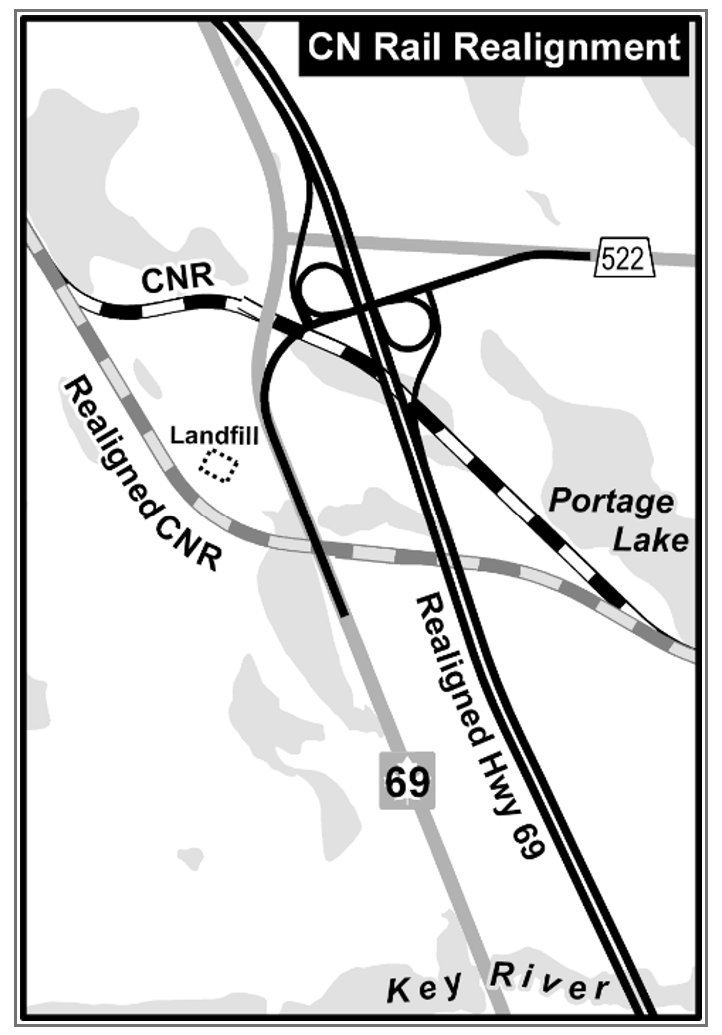
A map showing the proposed rail realignment alongside the realigned Highway 69.
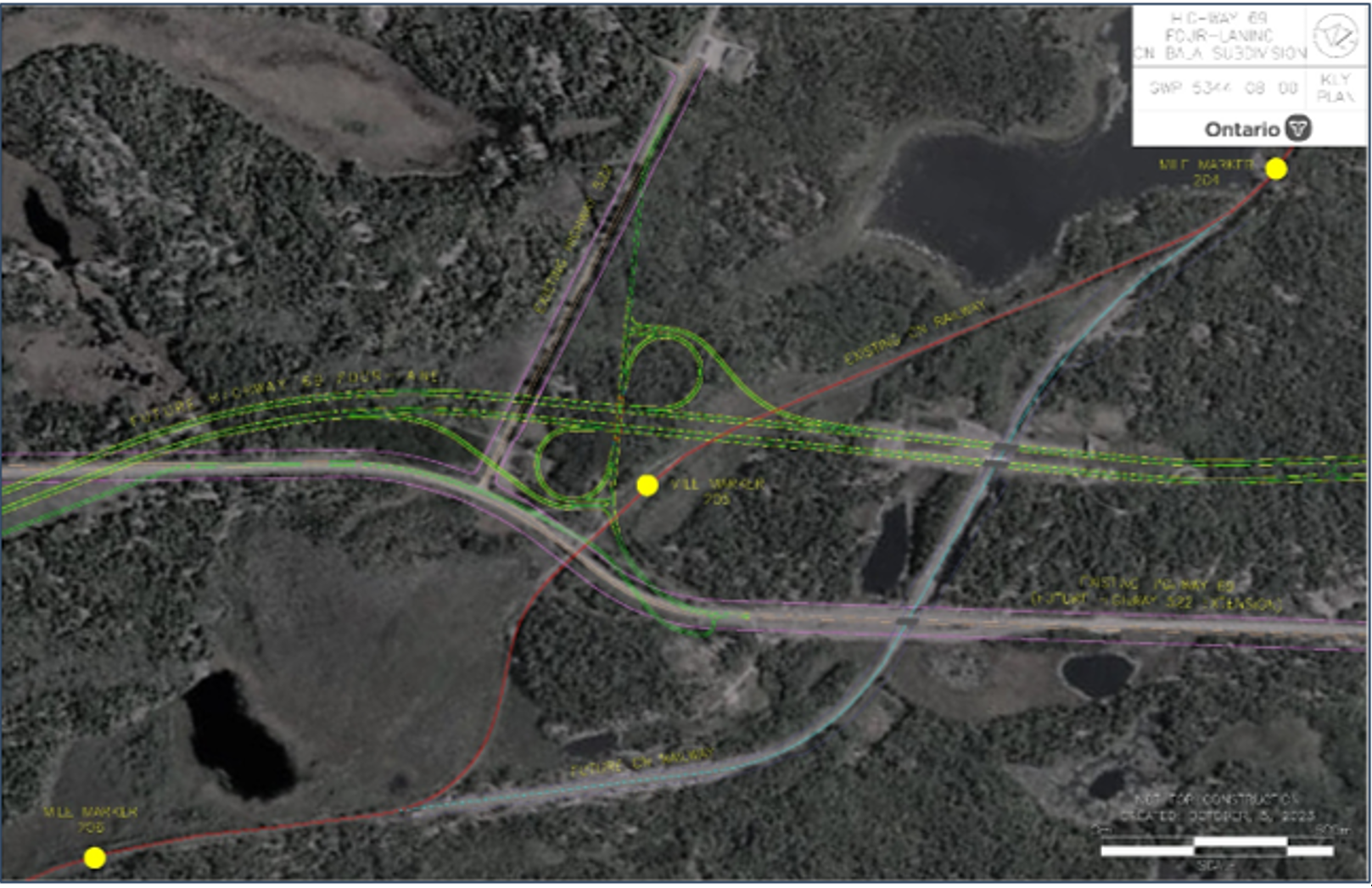
Map description: A detailed map showing the proposed rail realignment alongside the realigned Highway 69.
The railway relocation work includes:
- grading to ballast level, laying of new tracks and installation of signals
- tie-in or connection of the existing track to the new relocated track
- transfer of rail operations to the new corridor
- the existing rail alignment will be decommissioned and removed once the relocation is completed
- installation of fencing and access gates for site security and to prevent trespassing to the rail corridor
Proposed construction schedule
An application will be submitted by CN to the Canadian Transportation Authority (CTA) for an order authorizing the relocation of the proposed rail line between Mile 204.1 and 205.6 of CN’s Bala Subdivision. Once the application is approved by the CTA and other applicable federal regulators, the relocation work will begin.
Construction of the rail realignment is expected to take about 18 months.
| Phase | Description | Expected start date | Expected completion date |
|---|---|---|---|
| 1 | Drainage improvements | Fall 2026 | Spring 2027 |
| 2 | Grading to sub-ballast level, including remaining rock blasting works | Fall 2026 | Spring 2027 |
| 3 | Laying of new tracks | Spring 2027 | Summer 2027 |
| 4 | Installing signals, IT and fibre infrastructure | Spring 2027 | Summer 2027 |
| 5 | Connecting the existing track to the new track and transferring the rail operations to the new corridor | Fall 2027 | Fall 2027 |
| 6 | Decommissioning and removing the existing rail alignment | Fall 2027 | Winter 2028 |
Public engagement
Drop-in sessions were held on March 10, 2026 and the materials are available upon request.
Contact Us
For questions or comments about proposed rail realignment, contact CN Public Inquiries:
- 1-888-888-5909
- contact@cn.ca
For questions or comments about the Highway 69 widening project, contact the Ministry of Transportation.
Potential impacts and mitigation
- There are no anticipated changes to operations and services for CN.
- The work will be taking place outside of the current Highway 69 right-of-way. No impact or disruptions to traffic are excepted, aside from the movement of construction vehicles in and out of the construction zone.
- Excavated and excess materials will be transported offsite to designated soil disposal sites.
- Some blasting is required and the selected contractor will perform work in accordance with OPSS 120 and MECP Publication NPC-119.
- Impacts to wildlife are expected to be minor as there will be limited vegetation removal for construction.
- Measures to reduce impacts to nearby vegetation and species include:
- Silt fencing will be installed prior to turtle hibernation period, along the length of the proposed rail embankment adjacent to the marsh communities near one of the culverts, on both the north and south side of the embankment. This will also aim to prevent turtle travel into the work site, including species-at-risk turtles.
- No activity will take place within the known species-at-risk turtle habitat in the marshes outside of isolated areas of the culvert from September 1 to May 31 to protect potential hibernating turtles.
- Tree clearing will not take place during the bat maternity period from May 1 through August 31.
- If required, tree removals will occur outside of the breeding bird window from September 1 to April 7 to avoid impacting nesting birds. If clearing during this window cannot be avoided, a nest search must be conducted by an avian specialist 48 hours before clearing.
- The proposed track relocation intersects several existing culverts that will require remediation, replacement and new installation. Three of the culverts to be replaced are on watercourses with indirect fish habitat and one is on a watercourse with direct fish habitat. Flow conditions will be maintained for the indirect habitat and the culvert replacement in direct habitat will retain the existing footprint, therefore avoiding fish habitat loss.
- No Harmful Alteration, Disruption or Destruction (HADD) of fish habitat is anticipated. The project will be submitted to Fisheries and Oceans Canada (DFO) for review to obtain a Letter of Advice and confirm that a Fisheries Act authorization is not required.
- Measures to reduce impacts to fish and fish habitat include the following:
- Work area isolation measures will follow DFO’s Standard: In-water site isolation to ensure that measures to protect fish and fish habitat are implemented during construction. This will be applied when there is flowing water present during construction.
- In-water and near water construction may only occur during July 16 to March 14 of any given year (no in-water work is permitted from March 15 to July 15).
- Erosion and Sediment Control (ESC) measures will be implemented prior to and maintained during the construction phases, to prevent entry of sediment into the water. ESC measures will be inspected on a regular basis. All damaged ESC measures will be repaired and/or replaced within 24 hours of the inspection.
- A Stage 1-2 Archaeology Assessment (2011) report was previously completed for the rail relocation and filed with the Ministry of Citizenship and Multiculturalism (MCM). This assessment discovered no features and no further actions were required.
- In the event of the discovery of archaeological resources or human remains or burials, MCM, the OPP, Registrar of the Ministry of Government Services Cemeteries Regulations Unit and Indigenous Communities will be notified and work in the area shall stop.
- During construction, best practices will be followed to minimize temporary construction noise and dust generation, such as limiting idling of equipment, maintaining equipment in good operating condition and blasting will be done in accordance with OPSS 120.
- Railway construction works may occur 24/7, but the majority of rail construction work will be completed during daylight hours where possible.