

Spotted lanternfly prevention practices for grape producers
Learn how to identify and prevent the spread of Spotted lanternfly in vineyards.
Introduction
Spotted lanternfly (Lycorma delicatula, SLF) is an invasive planthopper that threatens Ontario’s agricultural sector. The pest was accidentally introduced to the United States (US) from its native range in China and has since spread to multiple states in the mid-Atlantic, including those bordering Ontario.
Due to the proximity of the pest and the numerous pathways for entry, the risk of introduction to Canada is considered very high.
To help mitigate against the spread, the Canadian Food Inspection Agency (CFIA) added SLF to their list of regulated pests in 2018.
Risk to vineyards and wineries
SLF attacks a diverse range of agricultural crops and landscape plants. Grapevines (Vitis spp.) are one of the preferred season-long hosts.
The highest-risk period occurs during the late summer and fall, when adults move from senescing hosts in surrounding areas into vineyards.
Feeding
Feeding involves ingestion of large volumes of phloem sap, which provides the energy, nitrogen and proteins necessary for survival, development to sexual maturity and egg-laying. Prolonged feeding by adults can weaken the vine, leading to:
- loss of winter hardiness
- reduced or no return bloom
- crop and vine death
High numbers have also been correlated with a reduced yield and fruit quality the following year.
SLF produce sugary “honeydew” that drips from plants when they are feeding. This sticky substance promotes the growth of black sooty mould and attracts wasps and bees. If there are hosts of SLF near tasting rooms, this may be a nuisance to clients.
Spread
Spotted lanternflies can disperse to new areas through both natural means and human-assisted transport. Long distance spread is typically associated with people inadvertently moving overwintering egg masses.
Adults and nymphs are known to hitchhike on vehicles (cars, trucks, trains), cargo and other items. The CFIA's directive Spotted lanternfly (Lycorma delicatula) – Domestic and import phytosanitary requirements highlights nursery stock and hardwood lumber with bark (including firewood) as key pathways for spread to new areas. If SLF is detected in Canada, these commodities will be subject to phytosanitary measures and specific phytosanitary documentation requirements to ensure materials are pest-free prior to domestic movement. The requirement of pest free status is not limited to nursery stock and hardwood lumber with bark. All things moving out of a regulated area to an unregulated area must be free from all life stages of SLF. Although only nursery stock and hardwood lumber with bark will require additional CFIA oversight and SLF specific documentation, everyone else — including members of the public and those involved in the broader agricultural sector — must also take steps to ensure they are not spreading SLF.
Grape growers must be vigilant when it comes to limiting the spread of SLF. Harvest coincides with periods of adult movement and egg-laying, and grapevines are a preferred late summer and fall host. Adults in the vineyard may end up being harvested with grapes, or they might fly into bins or hitchhike on equipment. Eggs might also be laid on or inside harvest bins. These may be difficult to detect, and as a result, there is a risk of inadvertently moving SLF from the vineyard to other areas.
SLF will lay their eggs on almost any flat surface, including host plants and non-plant material. The following should be considered as potential pathways for movement when assessing on-farm risk:
- Vineyard prunings or winery waste.
- Packing materials, such as wood crates or boxes.
- Trellising materials including wooden and metal vineyard posts and rolls of wire.
- Bundles of bird netting.
- Vehicles and farm equipment (such as sprayers, harvesters, mowers, hedgers).
- Bins.
- All plants and plant parts, both live and dead. For example, all debris associated with pruning vines or landscape trees must be checked for SLF egg masses before moving off your farm.
- Outdoor household articles, including recreational vehicles, lawn tractors and mowers, mower decks, grills, grill and furniture covers, tarps, mobile homes, tile stone, deck boards, mobile fire pits, any associated equipment and trucks or vehicles not stored indoors.
- Grapevine nursery stock.
- Any other article or means of conveyance which presents a risk for spreading any life stage of SLF due to its proximity to an infested area.
Winery managers must also be aware of possible introductions through materials moving from or through quarantine areas. Visiting clients may also carry hitchhiking SLF on vehicles.
For information on all other pathways and products, including both reporting requirements and risk mitigation measures (such as removal of all life stages) for moving regulated articles out of an SLF regulated area, visit the Canadian Food Inspection Agency’s website.
Prevention
Preventing introduction is the most critical step you can take to help protect your business. The most common way for SLF to spread to new geographic areas is via egg masses, making it critically important to inspect all supplies and associated vehicles when they arrive at and before they leave your operation. Movement of adults, especially mated females, presents an additional risk for introduction and potential establishment. To lower the risk of introducing SLF, you should:
- work with suppliers to determine if they are in an area with established SLF populations
- check the distribution map for SLF in the US (the same will apply once SLF is established in Canada)
- ask about your suppliers’ management and inspection programs, including what steps they use to exclude SLF in shipment staging and loading areas (periods of high risk for moving egg masses are late September through early May, and July to December for adults)
- train staff and workers to identify SLF life stages and to understand its seasonal biology and host use
- isolate goods coming from known infested areas in a designated holding area prior to storage or use at your operation
- inspect all incoming shipping vehicles, farm equipment and associated supplies including plants, pallets, crates, tarps, toolboxes and containers
- check vehicle wheel wells, truck beds and caps, and other recesses, such as grooves, small spaces, behind licence plates and under any protective wrapping (egg masses are often mistaken for splotches of mud — use a flashlight to improve visibility)
- where practical, establish visitor and supplier parking away from preferred landscape hosts, under tree lines and away from production areas
- contact the CFIA immediately if any suspected SLF life stage is detected
Best management practices
Best management practices (BMPs) have been developed by the Canadian Nursery Certification Institute (CNCI) to provide nursery farms guidance on preventing the entry of SLF to their farms through imports and incursions from infested areas. Many of these risk-reduction practices have application across agricultural production systems, including vineyards. If SLF is detected in Canada, these BMPs also outline practices that can prevent and manage the incursion of SLF from the outside environment.
Spotted lanternfly is a landscape-level community pest with many pathways for spread. Grape harvest represents a high risk for movement of SLF adults and egg masses within and between regulated areas. Adults may be present in vineyards from late mid-summer until they are killed by hard frosts in the fall. To limit the risk of spreading SLF to new areas, you should:
- apply an insecticide close to harvest to eliminate SLF present in the vineyard (multiple applications may be required to manage new SLF moving in from the landscape around vineyards, see lanternfly on the Crop Protection Hub for a list of products labeled on grapes for spotted lanternfly management)
- inspect and power-wash all vehicles and equipment if travelling between vineyards to remove any exposed nymphs or adults
- look for egg masses on bins, pallets, equipment and vehicles, keeping in mind these may be located on surfaces that are not easily accessible for inspection
- check clothing to make sure you are not transporting nymphs or adults
- if possible, use closed harvest bins to limit the possibility of SLF adult contamination (bins should be checked for egg masses prior to movement out of any regulated area and prior to storage)
Identification
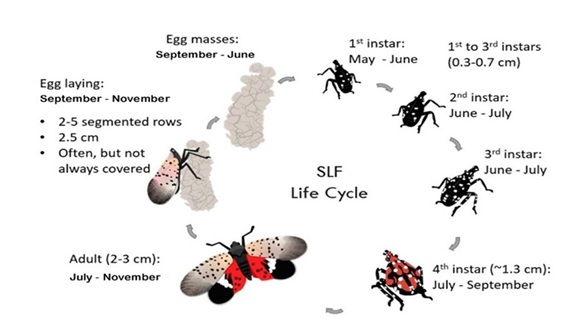
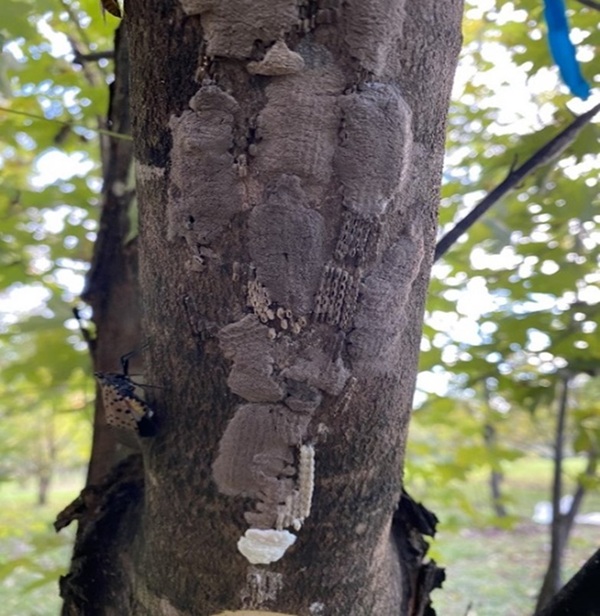
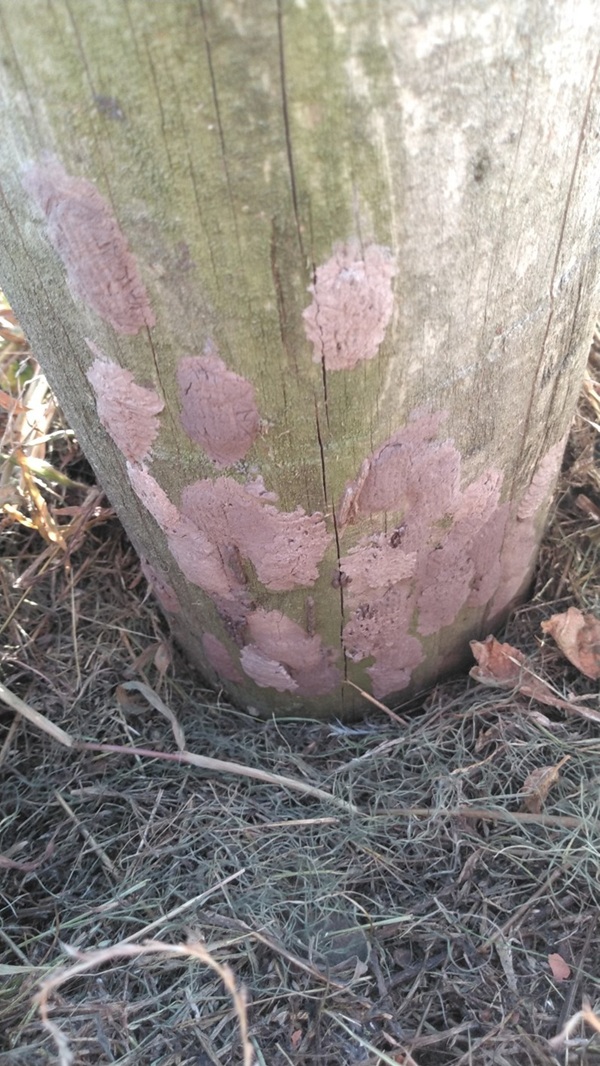
Spotted lanternfly has 1 generation per year and overwinters in the egg stage (Figure 1). In the fall, mated females lay rows of tan-coloured eggs, with 30 to 50 per mass. Eggs are covered by a protective white waxy coating that turns grey-brown, dries and cracks over time (Figure 2). They can be confused with mud splatters. Some egg masses may be partially covered, or they may be completely exposed. Eggs are cold tolerant and are expected to survive winters in southern Ontario.
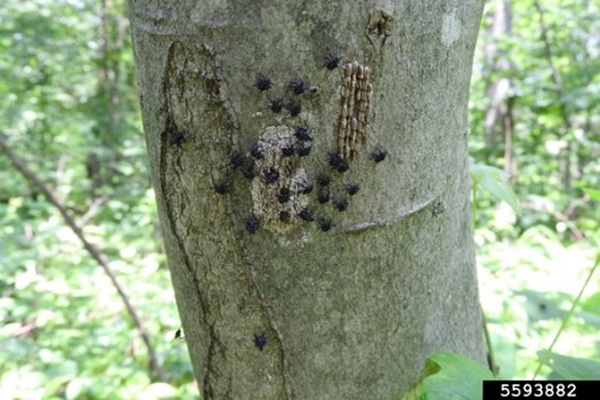
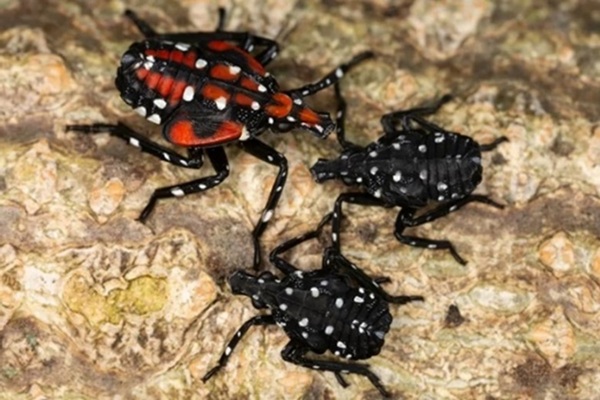
Nymphs hatch from eggs in the spring (Figure 3) and progress through four developmental stages known as instars. The first three instar stages are black with white spots and the fourth is bright red with white spots and black bands and approximately 13 to 15 millimetres (mm) in length (Figure 4). All nymphs are strong jumpers and are highly mobile. Nymphs and adults suck the phloem (sap) of plants with straw-like piercing-sucking mouthparts. Early instar nymphs have a broad host range and feed on young, tender shoots of perennial and annual plants. Fourth instar nymphs and adults typically restrict their feeding to woody tissues of grapevines, walnut, maple, birch, tree of heaven and other hardwood species.
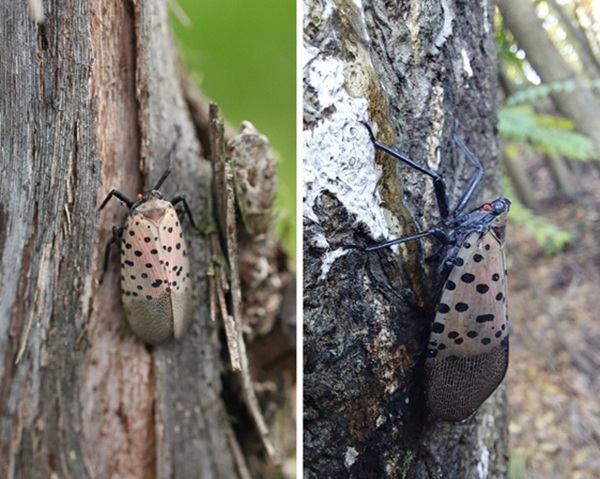
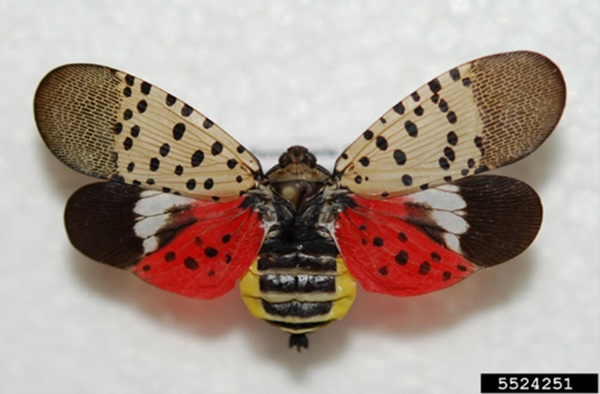
Adults are large, brightly coloured insects approximately 25 mm in length and 12 mm wide with wings folded at rest. The forewings have black spots on a light tan to grey background, with a dark net-like appearance at the tips (Figure 5). When the forewings are open, the exposed hindwings are bright red with spots at the base and black at the tip, separated by a white band (Figure 6). The abdomen is yellow with black bars. Bulbous red antennae on the side of the head are sometimes confused with eyes.
Based on observations in Pennsylvania, adults begin to appear mid-July and are active through November, until killed by a hard frost. Activity is not currently expected in December in southern Ontario, but there is a risk of adults being imported accidentally from more southern regions in the US. While adults are not considered strong flyers, local dispersal still occurs at a rate of several kilometres per year.
Seasonal host use and scouting
Spotted lanternfly has a large host range that includes agricultural crops, ornamental trees and shrubs, vines and garden perennials. Nymphs feed on the phloem (sap) from tender new growth of herbaceous plants, shrubs and trees and are constantly moving between hosts. Adults feed on the twigs, branches and trunks of woody plants. Preferred hosts change through the season as plants begin to lose their leaves and deteriorate in the late summer and fall (Table 1). Surveillance programs typically focus on common hosts for detection of SLF in the landscape. Many early detections of SLF populations have occurred on tree of heaven, a preferred host through the growing season.
| Host | Nymphs — May | Nymphs — June | Nymphs — July | Adults — August | Adults — September | Adults — October |
|---|---|---|---|---|---|---|
| Rose (wild, cultivated) | Yes | Yes | No | No | No | No |
| Perennials | Yes | Yes | No | No | No | No |
| Grape (wild, cultivated) | Yes | Yes | Yes | Yes | Yes | Yes |
| Tree-of-heaven | Yes | Yes | Yes | Yes | Yes | Yes |
| Black walnut, butternut | No | Yes | Yes | Yes | Yes | Yes |
| River birch | No | No | Yes | Yes | Yes | Yes |
| Willow | No | No | Yes | Yes | Yes | Yes |
| Sumac | No | No | Yes | Yes | Yes | Yes |
| Red/silver maple | Yes | No | No | No | No | No |
Include scouting for SLF as part of your integrated pest management (IPM) program; this is especially important in vineyards, as these are at direct risk from crop injury or indirectly from CFIA regulatory actions, respectively. If SLF has been detected in the area, scouting and monitoring common hosts in hedgerows and woodlots surrounding vineyards can help to identify potential areas of high risk.
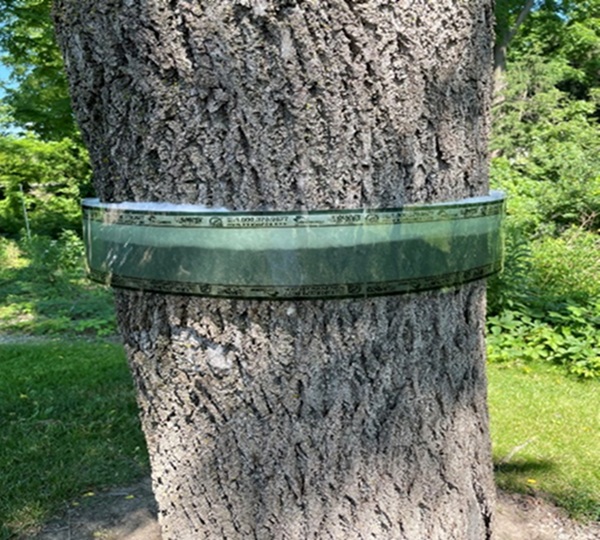
Monitoring is limited to visual surveys and passive trapping, as effective lures and trapping systems are still under development. BugBarrier Tree Band® (Figure 7) and other sticky trap-based tree banding have been used to support early detection and to help delimit populations in other jurisdictions. These passive traps intercept nymphs and adults as they move up and down trunks and vertical structures, so they need to be placed in areas where the pest is most likely to be present.
Although SLF feed on a large variety of crops, many of these are transitory, meaning feeding is usually of short duration and does not result in plant health decline. In contrast, grapevines are a highly preferred, season-long host. Vineyards are at high risk from SLF infestation and require additional scouting throughout the growing season. When scouting, consider the following:
- Grape producers should consider weekly monitoring for SLF as part of their IPM programs.
- Wineries should check incoming grapes and bins in the fall for SLF eggs, adults and fourth instars.
- Scouting vineyards in September and October is especially important, as this is when the adults move into the crop from surrounding wooded areas.
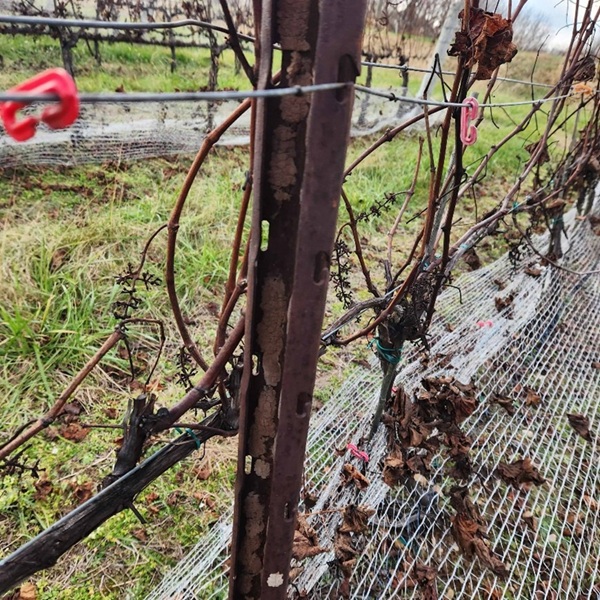
- Check for adults and their eggs on vineyard posts. Eggs are sometimes deposited on the lower portions of posts and may be covered by grass or other vegetation (Figures 8 and 9).
- Check preferred landscape hosts bordering your property/facility including tree of heaven, grapevines (wild and cultivated), black walnut, maples, birch and staghorn sumac.
- Adults favour and often aggregate on seemingly random “hot” landscape trees within a stand, potentially making SLF or symptoms of plant health decline easier to detect.
- Check light posts or other tall narrow structures around your operation. Adults are visually attracted to these and will use them to facilitate flight during the fall.
- Don’t limit your search to obvious places. Egg masses are often deposited in sheltered locations. Look on the underside of branches and loose bark.
- Females often lay their eggs on or near other egg masses, resulting in a clumped distribution on host plants or other surfaces.
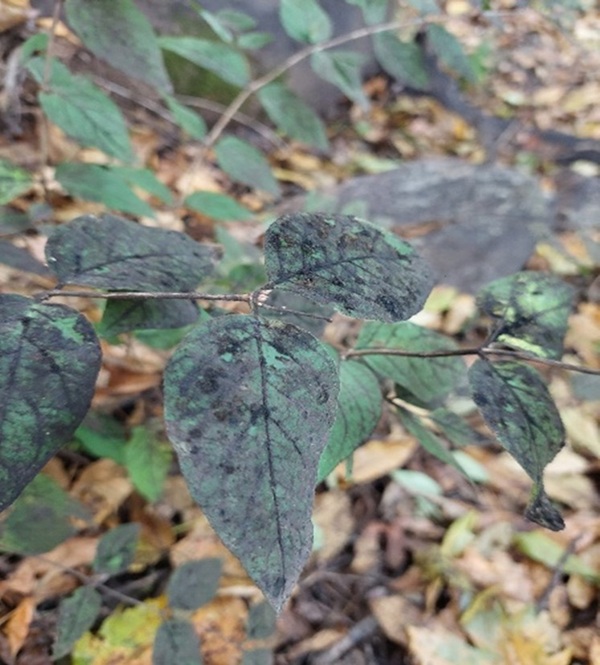
- Look for symptoms of SLF feeding including honeydew on foliage and on surfaces under plants, with associated buildup of black sooty mould fungus (Figure 10).
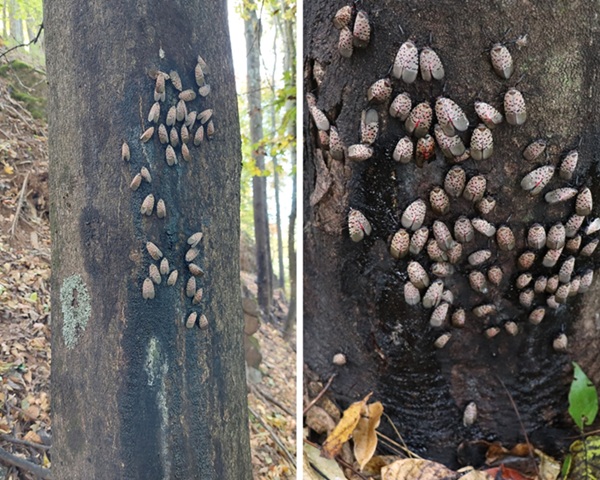
- Other symptoms include weeping trails of sap on tree trunks, the presence of a strong fermented odour or an increase in bee, ant and wasp activity (attracted to exposed sap and honeydew) (Figure 9).
- Sticky tree bands can be used at high-risk locations, such as in or near shipping and receiving areas. They can be placed on common host trees surrounding production areas or directly on support posts in vineyards.
- Contact the CFIA immediately if you detect SLF in any life stage.
Current management options
While SLF has not been found in Canada, integrated pest management (IPM) recommendations for limiting economic injury caused by the pest have been developed in other jurisdictions. PennState Extension has a video series discussing life stages, scouting, thresholds and control strategies for the grape and wine industry in eastern United States, and much of the information will be useful to Ontario producers. The following information is provided to help guide producers at immediate risk following detection of an established population in Ontario. If you believe you have found SLF, contact the CFIA immediately.
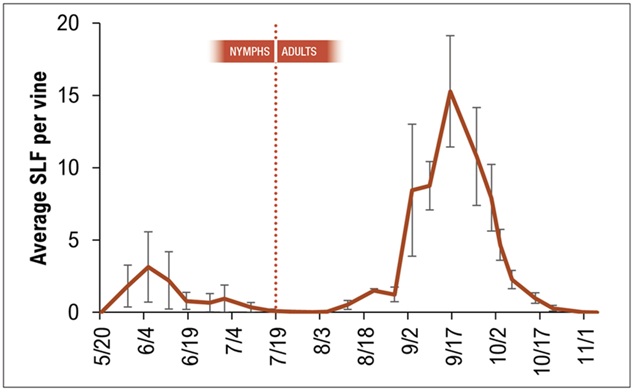
Grapevines are at risk from feeding injury caused by swarms of late instar nymphs and adults that typically invade the crop late in the season (Figure 12). Border sprays may be sufficient for managing incoming SLF, as numbers are often concentrated in plants along vineyard edges (first 20 m). The proximity of wooded areas bordering vineyards may facilitate movement of adults, as these often launch themselves from high points (trees, poles, other). Multiple insecticide applications are usually needed to manage successive waves of SLF moving into vineyards through the fall.
Action thresholds, or pest density at which control measures should be implemented to prevent it from reaching economic injury level, are still under development. If high numbers were present on vines in the summer or fall, evaluate bud viability before pruning because cold hardiness may be affected. Moderate to high levels of bud injury require differing pruning strategies, including increased bud retention to compensate for mortality or renewing trunks.
Fresh egg masses can be physically removed and destroyed by scraping them with a flat, rigid implement such as a credit card or putty knife. Apply sufficient pressure to completely crush the eggs, as those that remain intact may still hatch. Eggs may also be scraped directly into a small bag containing ethanol, rubbing alcohol, hand sanitizer or vinegar. Most egg masses laid in trees are found in the upper portion of the canopy (over 30 m), making them difficult to reach. Except where required to meet phytosanitary or market requirements, management of egg masses in vineyards and other commercial crops is not a common practice in other jurisdictions. Mechanical removal is labour intensive and while horticultural oils are effective for smothering eggs, thorough coverage is required on vines and trellis posts. Early instar nymphs that hatch from eggs laid in the crop the previous fall seldom cause economic injury and are usually killed by insecticides used for other pests.
If SLF is established in a vineyard (eggs laid the previous season), low populations of nymphs can be tolerated. Unlike adults, nymphs do not reinfest vineyards, so typically only one application of insecticide is necessary. For hot spots of dense populations of nymphs (i.e., >10 to 50 per vine), spot treatments may be needed. Young and/or stressed vines are at higher risk from feeding injury.
Recommendations for managing adults in the US include using insecticides with good residual activity and longer pre-harvest interval (PHI) in August and early September, then switching to products with strong knock-down and short PHI as harvest approaches. Adults will reinfest vineyards through the fall, requiring the use of insecticides with long residual activity (and long PHI) for sustained control. Research and field experience in the US indicate pyrethroids, some neonicotinoids (containing the active ingredients dinotefuran and thiamethoxam) and malathion can provide excellent control of adults. Commonly recommended pyrethroids with long residual activity, such as the active ingredients bifenthrin, beta-cyfluthrin and fenpropathrin, are not registered for use on grapes or other crops in Canada. Pyrethroids labelled for other pests of grapes in Canada are likely to provide knockdown, but they may have limited residual activity.
Grape harvest in infested areas represents a potentially high risk for movement of SLF adults and egg masses. Adults may be present in vineyards from late mid-summer until they are killed by hard frosts in the fall. To limit the risk of spreading SLF to new areas, you should:
- apply an insecticide close to harvest to eliminate SLF present in the vineyard
- make sure to inspect and power-wash all equipment if travelling between vineyards
- check clothing to make sure you are not transporting nymphs or adults
- if possible, use closed harvest bins to limit the possibility of SLF adult contamination
- use back-pack style vacuums to remove adults
Several commercial insecticides are fully labelled in Canada for suppression or control of SLF nymphs and adults in vineyards. As of May 2026 the following insecticides can be used on grapes in Canada:
- Kopa Insecticidal Soap is registered for suppression of SLF nymphs in tree fruit, grapes, ornamental and shade trees, and outdoor flowering, foliage and bedding plants.
- Sivanto Prime (flupyradifurone, group 4D) is registered for suppression of SLF (nymphs, adults) on pome fruits, stone fruits and grapes.
Get more information and updates on the Pesticide Regulatory Directorate
Training and customer outreach
Late instar nymphs and adults are large, brightly coloured insects that are relatively easy to identify. Take advantage of their dramatic appearance to:
- provide all employees with training on how to identify different SLF life stages
- raise awareness among retailers, customers and the public who visit your operation through signage and resources on SLF
Download a poster from OMAFA (PDF)
Wineries and other popular tourist destinations in agricultural areas are at high risk for introduction from infested regions, especially in the fall when adults are active and females are laying eggs. Remind visitors to check their vehicles for SLF, especially those coming from infested areas.
Visit the Invasive Species Centre website for information on their free SLF Training Program. Ontario Certified Crop Advisor Association (CCA) and/or ISA Continuing Education Units are available for those completing the training.
Reporting
SLF has not been detected in the Canadian landscape, but there have been observations made in multiple provinces including Ontario. The CFIA uses the following terms to describe observations of SLF in Canada:
- Sighting: Reports of spotted lanternfly in Canada that the CFIA is aware of, including those made on public reporting sites (for example, iNaturalist Canada, Facebook). Sightings are not confirmed by the CFIA.
- Interception: Live spotted lanternfly, confirmed by the CFIA, in contained situations (for example, warehouse) with no evidence of release to the Canadian environment; and/or dead spotted lanternfly, confirmed by the CFIA.
- Detection: Live spotted lanternfly, confirmed by the CFIA, in the Canadian environment.
- Established population: Evidence of a reproducing population in the Canadian environment, confirmed by the CFIA.
The CFIA requires an actual specimen to confirm. For updated information on observations of SLF in Canada, see the CFIA website. Early detection of SLF is critical to support response efforts and to slow the spread in Canada once found. If you think you have found SLF:
- Take a picture, collect a sample (if possible) or destroy, and contact the CFIA immediately through their contact page.
- For photographs, a clear image of the specimen is needed for species confirmation.
- If collecting samples, place eggs, nymphs or adults into a sealed container or plastic bag containing alcohol or vinegar to kill them. Eggs can be scraped into the container or bag with a knife or credit card. Do not transport live specimens.
- Information including precise location (GPS coordinates if possible), date and items/plant on which the specimens were found should be included in your submission. Consider flagging or marking the area the sample was collected from to make it easier to identify when revisiting the area.
- Isolate and contain any infested plant material or equipment immediately to limit potential escape of active life stages (nymphs, adults).
- Where possible, consider the use of registered pest control products to help reduce spread of active life stages (nymphs, adults). Eggs can be scraped off surfaces and crushed and/or placed into alcohol/vinegar to kill them.
Accessible description of Figure 1
Figure 1. Seasonal biology of spotted lanternfly in Pennsylvania. Source: Invasive Species Centre.
Spotted Lanternfly life cycle
- 1st instar: May – June
- 2nd instar: June – July
- 3rd instar: June – July
- 1st to 3rd instars (0.3 to 0.7 cm)
- 4th instar (approximately 1.3 cm): July – September
- Adult (2 to 3 cm): July – November
- Egg laying: September – November
- 2–5 segmented rows
- 2.5 cm
- Often, but not always covered
- Egg masses: September – June