

Training requirements
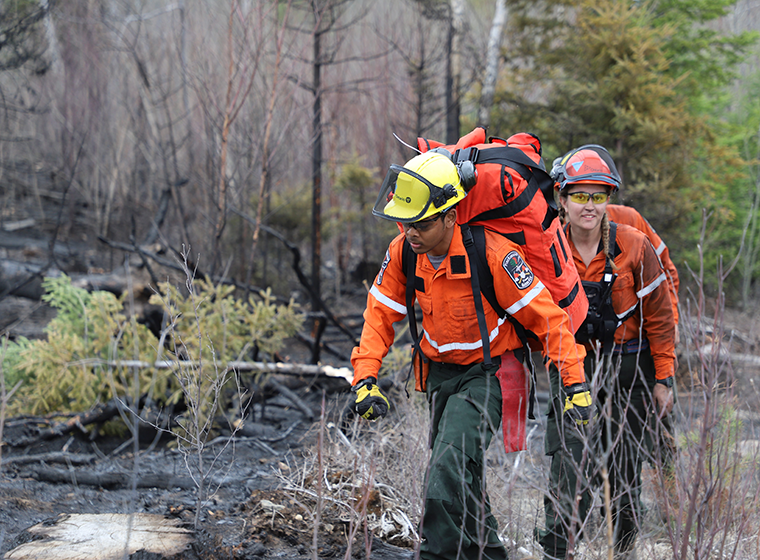
Applicants without previous wildland fire experience must get SP100 certification from one of our accredited agencies and colleges or directly from Aviation, Forest Fires and Emergency Services (AFFES). Learn more about training requirements.
Overview
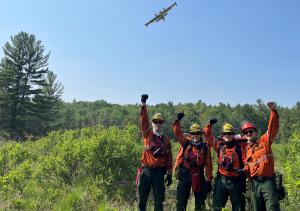
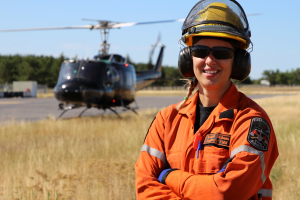
FireRangers are part of highly trained specialized teams that help protect Ontario’s forests and communities from the risks of wildland fires. FireRangers make a big difference in our wildland fire response by slowing down the spread of fires and providing wildland fire prevention education in communities across the province.
Read about the recent impact of wildland fires in Ontario:
Working as a FireRanger is a career of choice if you:
- want to protect Ontario’s natural resources
- enjoy working outdoors
- are eager to engage with the public on forest safety and fire prevention
- seek a physically rewarding and ever changing day-to-day
Choosing to be a FireRanger is a rewarding, active and physically demanding opportunity.
FireRangers build wildland fire response skills through in-depth and specialized training to achieve expertise at the Type 1 level, preparing you for all aspects of wildland firefighting.
About the career
FireRangers work throughout Ontario’s fire season, with start dates ranging from March to May. End dates can be flexible to accommodate your schedule and may extend past the legislated fire season of April 1 to October 31.
Earn $27.36 to $38.69 per hour at one of 17 locations in Northern Ontario.
We embrace diversity, teamwork, innovation and continuous learning.
What you’ll do
As a FireRanger, you will be involved in Type 1 wildland firefighter operations, including:
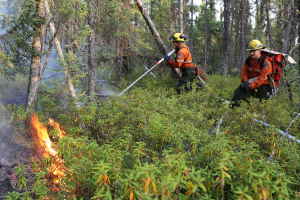
- initial attack — a rapid response by the first firefighting resources to contain and suppress a wildland fire, preventing its spread
- sustained attack — continued efforts to bring the fire under control after the initial response
- mop-up — ensuring the fire is completely extinguished and the area is secure
FireRangers are also involved in:
- fire prevention — educating the public on wildland fire prevention techniques
- equipment maintenance — keeping all firefighting tools and gear in top shape
- training — continuously enhancing skills to be prepared for any challenge
- resource management projects — undertaking preventive measures like clearing brush or trees to prevent future fire risks
What to expect
Your future
Not only will you receive specialized training, you’ll also gain additional qualifications to help you develop and grow within the wildland fire program.
Safety
Safety is our priority. We will ensure you are equipped and well-prepared for challenges faced on the job.
Worksites
Worksites can vary across the province of Ontario. You will often be outdoors in different environments and weather conditions.
Health and fitness
Every Fire Management Headquarter has fitness equipment and an hour is set aside each day for health and fitness training.
FireRanger stories
Roles and salary
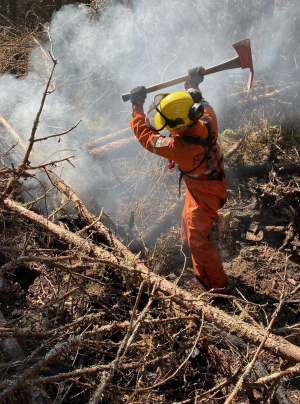
New FireRangers start in the role of a wildland firefighter 2.
As you gain experience and complete your training, you will find opportunities to grow within the team to the role of senior wildland firefighter and lead wildland firefighter.
Wildland firefighter 2, senior wildland firefighter and lead wildland firefighter roles require:
- teamwork
- resilience
- adaptability in changing environments
- long working hours in different weather conditions
- extended periods away from home
Wildland firefighter 2
Job term: April to September
Salary: $27.36 to $30.48
Qualifications:
- SP100 Wildland Firefighter Training course from a ministry accredited organization or AFFES
- Standard First Aid certification
- WFX-FIT physical performance standard testing
Senior wildland firefighter
Job term: April to September
Salary: $29.16 to $32.43
Qualifications:
- SP200 Wildland Firefighter Training course
- Standard First Aid certification
- WFX-FIT physical performance standard testing
Lead wildland firefighter
Job Term: March to October
Salary: $33.71 to $38.69
Qualifications:
- SP300 Wildland Firefighter Training course
- Standard First Aid certification
- WFX-FIT physical performance standard testing
The lead wildland firefighter role requires group leadership skills to provide training and guidance to a wildland firefighting crew.
Eligibility
Applicants
To be eligible, you must meet all the following criteria:
- 18 years or older
- proficient in English
- legally entitled to work in Canada (with a valid Social Insurance Number)
- minimum class G2 driver’s licence or equivalent
Training requirements
You can apply to become a FireRanger before registering for or completing the required training.
These training programs are provided by private contractors. We strongly advise that you enroll in this training early to secure your spot with the accredited training organization.
Successfully completing training and certificates does not guarantee that you will be hired.
SP100 Wildland Firefighter Training
Applicants without previous wildland fire experience must get SP100 certification from either an accredited agency or college or directly from AFFES.
Certifications from non-accredited organizations will not be recognized. You will not be eligible for positions that require SP100 certification.
The SP100 certification is a 40-hour course that focuses on safety and prepares you for the entry-level wildland firefighter (wildland firefighter 2) job in Ontario.
The course is offered by private training agencies and Ontario colleges. Review the list of accredited organizations.
You will learn to handle equipment such as:
- power pumps
- suppression hand tools
- communication devices
- camping gear
Learn more about the SP100 course.

WFX-FIT fitness assessment
The Canadian Physical Performance Exchange Standard for Type 1 Wildland Fire Fighters (WFX-FIT) is a yearly fitness assessment that Canadian Wildland Firefighters must pass.
It ensures you are physically prepared for the demands of the job.
Learn more about WFX-FIT testing.
Learn how to prepare for the WFX-FIT.

Standard first aid
Standard First Aid, Cardiopulmonary Resuscitation for Adults (CPR-A), and Automated External Defibrillator (AED) training is a 2-day certification course.
It covers basic first aid techniques, CPR-A and the proper use of an AED.
Find a list of approved first aid training providers.
Work locations
Before applying, review the work locations. Select only those you can travel to and work in.
You must be able to physically report to the identified work location — alternate or remote work is not an option for these positions.
Northeast Region locations
Northwest Region locations
How to apply
Apply by completing and submitting the online Ontario FireRanger employment application on any computer or mobile device.
Applications have closed for the 2026 season and will reopen for the 2027 season in November 2026.
First time applicants
You must provide:
- contact information — name, address, telephone number and email address
- position — the FireRanger role you are interested in (wildland firefighter 2, senior wildland firefighter, lead wildland firefighter)
- work locations — your preferred work locations (your preferred location might not always be available)
- training — the status of your SP100, WFX-FIT and First Aid training (you do not have to complete this training before applying)
- work experience — information about your previous job experience
- driver's licence — the class of driver's licence you have
- additional qualifications — extra skills or qualifications you have
- educational background — information about your education
- additional or personal qualifications — relevant skills or attributes you have
- references — a person who can provide a recommendation or confirm your qualifications
Updating applications
Once you submit your application, you can make changes to it at any time. For example, you can update your application to change any personal information or to identify completion of training.
After you apply
Application review
Your FireRanger application is securely stored in a centralized system and is accessible to all Fire Management Headquarters.
Each headquarters reviews the applications and selects the most qualified candidates.
Interviews
Leading candidates are contacted for follow-up phone interviews. You will have a chance to ask questions during your interview.
Reference checks
We may call your references to learn more about you.
Job offer
We will notify successful candidates by phone. In this step, we will:
- discuss the details of the role
- answer any remaining questions you may have
- determine your start date
- follow up with an offer letter via email
If you are not selected
If you receive a follow-up interview but are not selected for a position, you may be selected for a supplementary firefighter list. If selected, you will receive additional training and be eligible for on-call work.
Alternatively, you may be qualified to apply as a Type 2 Wildland Firefighter with a private company.
We also offer other seasonal and temporary job opportunities.
Other seasonal and temporary jobs
Join our team committed to managing wildland fires across Ontario through seasonal and temporary roles, including:
- data entry / clerical
- radio operations
- general labours
- warehouse labourer
- hose plant labourer
- drivers
- maintenance mechanics
How to apply for seasonal and temporary jobs
To get started, select the seasonal and temporary job application form button to access the online application form.
Choose:
- new: if you are applying for the first time
- update: to modify an existing application
You must provide the following:
- contact information: name, address, telephone number and email address
- positions: select which roles you are interested in
- work locations: your preferred work locations (your preferred location might not always be available)
- work experience: information about your previous job experience
- driver's licence: the class of driver's licence you have
- additional qualifications: any extra skills or qualifications you have
- educational background: information about your education
- additional or personal qualifications: relevant skills or attributes you have
- references: a person who can provide a recommendation or confirm your qualifications
Applications have closed for the 2026 season.
After you apply
Once you submit your application, you can make changes to it at any time. For example, you can update your application to change any personal information or to identify completion of training.
Type 2 Wildland Firefighters
If you are not hired as an Ontario FireRanger, you may apply as a Type 2 Wildland Firefighter with a private company.
During periods of escalated fire activity, we may hire additional wildland firefighter crews and other support staff from these private companies.
Type 2 crews:
- conduct sustained attack and mop-up
- are hired as needed during the summer when fires are active
Type 2 contract companies
Type 2 contracts have been awarded for the 2025 fire season to the following private companies who hire and provide fire crews. Apply directly to each company.
Geraldton Community Forests Inc.
P.O. Box 400
Geraldton Ontario
P0T 1M0
Contact: Cory Nephin
Horizon North Camp and Catering Partnership
627 Squier Street
Thunder Bay, Ontario
P7B 4A7
Contact: Jennifer Morrison
Footnotes
- footnote[1] Back to paragraph Indicates the salary listed as per the OPSEU Collective Agreement