

Invasive Wild Pig Sightings: 2021–2022 Annual Report
Read our 2021–2022 annual report for information on invasive wild pig sightings in Ontario.
Overview
Wild pigs are not native to Ontario and have been coined ‘an ecological trainwreck’ because of the magnitude and extent of the damage they can cause to the natural environment and the agriculture industry.
In fall 2021, the province began implementing Ontario’s Strategy to Address the Threat of Invasive Wild Pigs, and introduced new regulations to prevent the establishment of invasive wild pigs in the province. A component of that strategy has been the incorporation of the wild pig pilot project to systematically track and action wild pig sightings in Ontario.
This third annual report summarizes wild pig sightings reported and site visits in Ontario between April 1, 2021 and March 31, 2022.
Figure 1
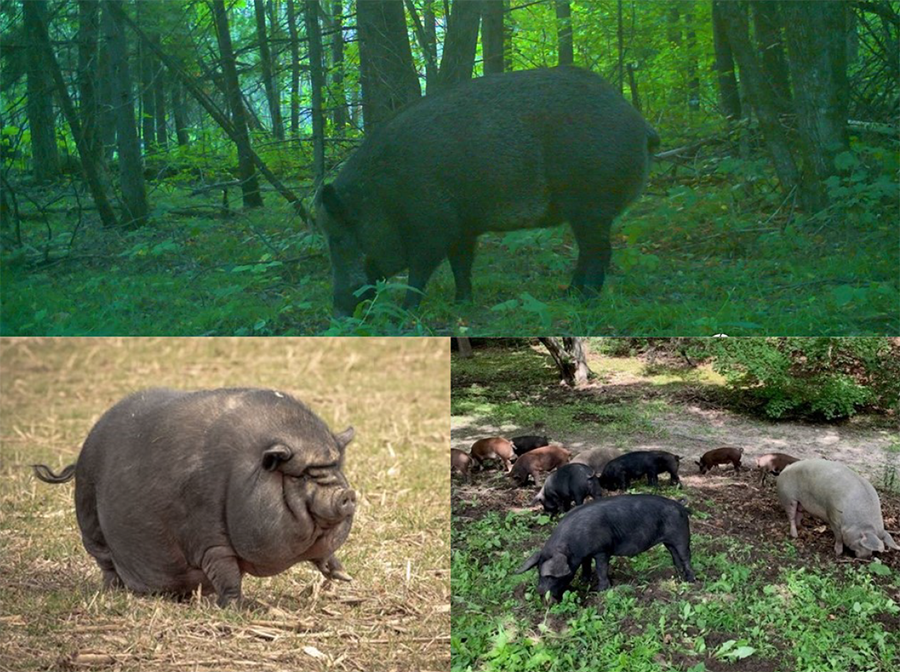
At this time, no evidence suggests that wild pigs are established — meaning self-sustaining and breeding — in Ontario. However, reports of wild pigs in Ontario continue to be submitted, indicating that without continued action wild pigs could become established. The least costly and most effective approach for managing wild pigs is to act early. As such, Ontario has set the proactive goal of preventing the establishment of invasive wild pigs in the province.
Reports and follow-up
Ontario-based research and on-site investigations have revealed that wild pigs reported in Ontario are originating from pigs escaping from captivity . Evidence does not suggest that wild pigs are invading from neighbouring jurisdictions.
The ministry receives reports of wild pigs from the public through the wild pigs email address (wildpigs@ontario.ca) and phone line (
Wild pig sightings are categorized into four categories:
- domesticated pigs
- pot-bellied pigs
- Eurasian wild boar
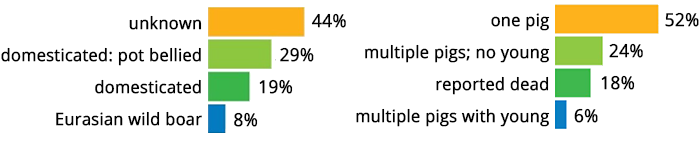
- unknown (Figure 2)
Close to half of the reports received during this period were of unknown pig type. The unknown category is due to the lack of evidence to definitively identify the species, for example, blurry photos or vague reports. Most of the pigs reported were:
- unknown (44%)
- pot-bellied (29%)
- domesticated (19%)
- Eurasion wild boar (8%)
These pigs are often determined to be escapees from enclosures or containment. Most of the wild pigs reported have been:
- lone animals (52%)
- animals with no young (24%)
- reported dead (18%)
- multiple pigs with young (6%)
Figure 2
Between April 1, 2021 and March 31, 2022 staff conducted site visits at 35 unique locations and were in the field about 77 days (Figure 3). During these site visits, staff canvassed neighbourhoods and spoke with residents to gather additional information, such as number of pigs roaming freely, type of pigs, whether they have caused any damage, and located the wild pigs. Priority locations for site visits were those where confidence in the sighting report was high and where pigs posed a greater risk of establishing a breeding population or posed a threat to property, livestock, or human safety.
Figure 3
Ontario Wild Pig Sightings and Field Investigations
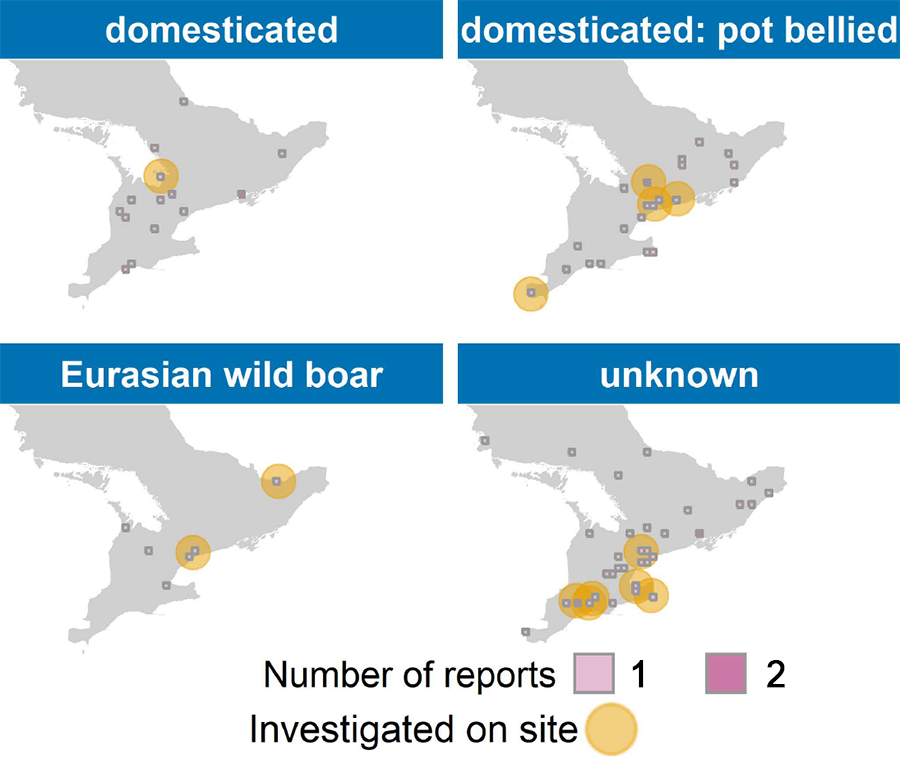
During these site visits, staff spoke with people at 419 properties, and left fact sheets and staff contact information at an additional 493 properties. Where evidence of wild pig presence was strong, staff deployed trail cameras to help with locating them. In 2021-22, 16 wild pigs (14 Eurasian wild boar and 2 domesticated pigs) from 2 locations were trapped and removed from the landscape using the whole sounder removal approach, which removes all animals in a group.
Pickering, Ontario
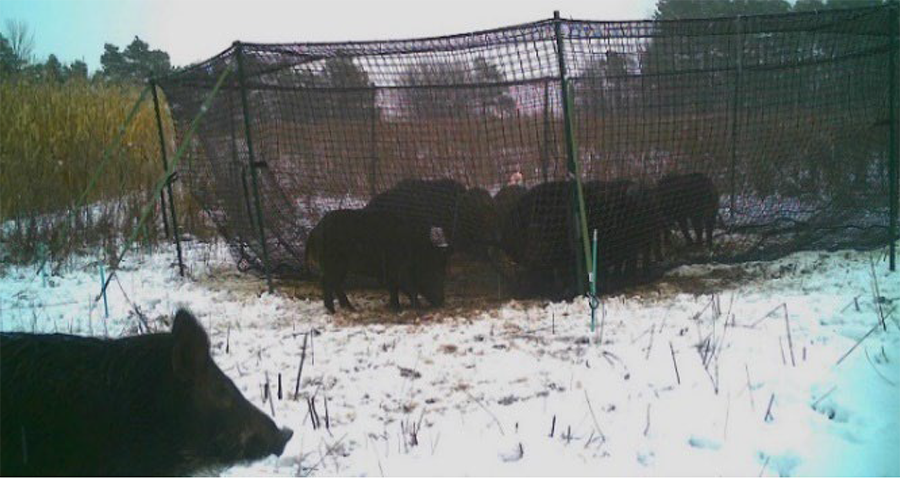
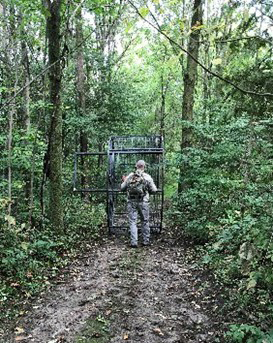
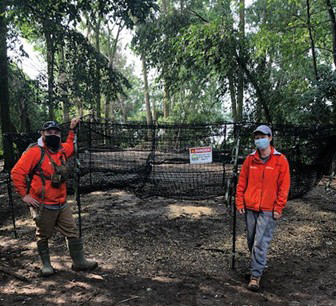
In November 2021, the ministry received reports of Eurasian wild boar roaming freely in rural north Pickering. These reports were quickly verified with videos, photos, and follow-up discussions with residents in the area. With strong community support and assistance, ministry staff determined how many pigs were present and what areas they were using. Technicians baited the wild pigs using peanuts, marshmallow fluff, jelly powder, and corn and successfully trapped and removed all 14 Eurasian wild boar from the landscape using the whole sounder removal approach (Figure 4). These pigs are not believed to have been from an established population, and their source is under investigation by the ministry’s Enforcement Branch.
Figure 4
Media and outreach
Local and national news reports about the large group of wild pigs in Pickering generated an increase in wild pig reports during November 2021 (Figure 5). This outcome is consistent with ministry research indicating that media coverage and outreach help to elicit public participation in reporting wild pig sightings.
Figure 5

Policy and new regulations
Ontario’s Strategy to Address the Threat of Invasive Wild Pigs was finalized in October 2021. The strategy outlines 4 objectives and supporting actions to prevent the establishment of invasive wild pigs in the province. Actions are varied, highlighting the need for clear communication, robust policy, Ontario-specific research and management, and strong collaboration among governments, agencies, and industry partners.
The ministry’s policy and regulatory approaches are grounded in Ontario-based research on wild pigs and research findings from other jurisdictions across North America.
Pig release
Many of the wild pigs that are investigated by ministry staff are determined to be owned pigs that have escaped from captivity. For example, a farmed domesticated pig that has found a hole in a fence or a pot-bellied pig that has strayed from its home. All pigs have the potential to cause damage to the natural environment, spread disease, and compete with native wildlife.
As of January 1, 2022, wild pigs are a restricted species under the Invasive Species Act, 2015. Under this legislation, pigs cannot be released into the natural environment. If a pig escapes, the owner is required to notify the ministry of the escape and capture or kill the pig as soon as possible.
Hunting
It is illegal to hunt wild pigs in Ontario. Research and management experiences from other jurisdictions indicate that hunting accelerates the spread of wild pigs. When exposed to hunting pressure, wild pigs flee into new areas and change their behaviour to avoid humans, making them more difficult to trap and remove from the landscape. The ministry traps and removes wild pigs using a whole sounder approach.
Landowners have the right to protect their property from damage caused by pigs, including for the purpose of maintaining biosecurity. Protection can include dispatching a wild pig with the provison to first consider that the pigs may be owned and are being sought for recapture by their owners. Landowners and agents acting on their behalf must comply with all relevant federal, provincial, and municipal legislation, such as trespass and licensing and discharge of firearms, and must notify the ministry that they have done so. This reporting is pertinent for ministry staff who are tracking and responding to wild pig sightings.
Eurasian wild boar and their hybrids
Eurasian wild boar and their hybrids are of particular concern as an invasive species.
These pigs were brought to Ontario in the 1980s as a novel farming opportunity and often raised in pasture. Research indicates that Eurasian wild boar and their hybrids have characteristics that make them more likely to survive in the wild and successfully reproduce. Eurasian wild boar and their hybrids present a substanial risk to Ontario’s natural environment and for the establishment of wild pig populations. As such, they are being phased-out of the province. In Ontario, it is illegal to import, possess, transport, propagate, lease, trade, buy, or sell Eurasian wild boar and their hybrids. Certain time-limited exceptions apply to people who owned Eurasian wild boar or their hybrids when these rules came into effect on January 1, 2022.
Ontario Federation of Anglers and Hunters’ Wild Pig Surveillance Program
The MNRF collaborates with OFAH on wild pig surveillance in Ontario. Staff with the OFAHs Invading Species Awareness Program assisted with wild pig surveillance in 2021 through education and organizing member citizen science. Ten trail cameras were deployed in Lanark County and 40 cameras were deployed in Parry Sound District and received more than 77,000 photos from member volunteers. All photos received are catalogued with non-personal identifiers and are examined for potential wild pig occurrences. No wild pigs were documented in the photos collected.
MNRF Reporting
Research and control of invasive wild pigs would not be possible without the many people who have reported their wild pig sightings. The ministry thanks everyone who reached out for their participation in our monitoring program.
For more information on wild pigs, including the strategy and new regulations, please visit Invasive wild pigs in Ontario.
Have you seen a wild pig?
Report your sightings to wildpigs@ontario.ca or
Resources
Read past annual reports on our website: Status of invasive wild pigs in Ontario.
Read peer reviewed articles about wild pigs in Ontario:
Koen, E.L. & Newton, E.J., Outreach increases detections of an invasive species in a crowdsourced monitoring program. April 2021. Biological Invasions 23(1).
Pollock, L.A., Newton, E.J., & Koen, E.L., Predicting the high-risk areas for African swine fever spread at the wild-domestic pig interface in Ontario. 2021. Preventative Veterinary Medicine (191).
Koen, E.L, Newton, E.J., and Ellington, E.H., Evaluating potential sources of invasive wild pigs in Ontario. 2021. Ecology and Evolution.
For additional support and guidance, go to Dealing with escaped livestock in your community.
For pig owners, ensure that your pigs are contained. For more information on best practices for keeping your livestock contained, fencing for outdoor pig production, and dealing with escaped livestock in your community, visit our website at Invasive wild pigs in Ontario.