

Long Combination Vehicle Program Conditions
Read the conditions for the Long Combination Vehicle (LCV) program.
Program overview and principles
Overview
- LCVs provide economic benefits to Ontario industry and consumers, reduce congestion, reduce consumption of fuel and related greenhouse gas (GHG) emissions and improve highway safety.
- The LCV program generally consists of "turnpike doubles" generally operating on the primary LCV network of "freeway-style" highways, to and from rest or emergency stops, and to and from approved origin or destination locations in close proximity to the primary network.
- The LCV program was initially developed cooperatively with Quebec to ensure the free movement of LCVs between the 2 jurisdictions. Since the LCV program’s inception, Ontario and Quebec have worked cooperatively with Nova Scotia and New Brunswick to allow the free movement of LCVs across the 4 jurisdictions.
- Participating carriers, drivers and vehicles are held to higher standards than other trucking operations to enhance highway safety. LCVs operate under carefully developed controls and are closely monitored.
- The LCV program is a private sector initiative that has been led by the Ontario Trucking Association (OTA) and Private Motor Truck Council of Canada (PMTC) since 2009. These associations have been responsible for identifying highways for inclusion in the primary LCV network, appropriate rest or emergency stop and turn-around ramp locations and undertaking all necessary engineering assessments or route modifications. Road authority consent must be obtained for any non-provincial routes.
- Since the LCV program’s inception, the OTA has been responsible for the LCV driver or instructor training program for Ontario operations, including overseeing the issuance of LCV driver and instructor certificates required for LCV operations in Ontario. The OTA also manages the collection of monthly LCV trip reports. No other organization may provide those services without first obtaining ministry approval.
- Participating carriers are responsible for issuance of LCV driver certificates after ascertaining the driver meets specified qualifications, training and experience.
- Participating carriers must enter into a memorandum of understanding (MOU) with MTO, signifying that the carrier accepts responsibilities as outlined in this document (Ontario LCV program conditions).
- MTO will issue permits to qualifying carriers for operation on the primary LCV network and specified off-network routes to approved origin or destination (O/D) locations.
- The Program currently allows 3 types of LCV configurations; an A-train comprised of two 12.2 to 16.2 m long trailers, a B-train comprised of a single 11.5 to 14.65 m lead trailer and a single 11.5 to 16.2 m second trailer and a Twin stinger-steer auto carrier comprised of 2 trailers up to 14.65 m. The allowable A-train, B-train and Stinger-steer configurations are designed to generally fit within the same turning space. At the present time, there is no allowance for the use of a B-train comprised of two 16.2 m long trailers.
Timing and scope
- Carriers are limited to 2 permits for their first calendar year in the Program. After a year, they may apply for additional permits. MTO reserves the right to deny additional permits.
Areas of operation
- Attachments to permits indicate:
- Approved primary LCV network of highways (generally controlled access, multi-lane, divided highways), turn-around ramps and approved rest or emergency stop locations along the primary highway routes. These routes and stops are generally available to all LCV permit holders.
- O/D certificates which indicate locations in close proximity to primary highways the named carrier is authorized to access.
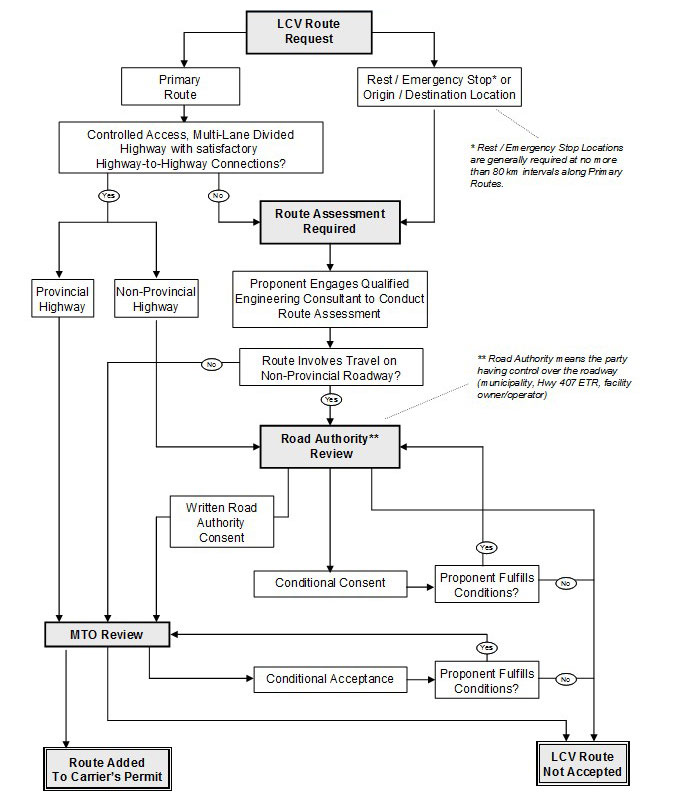
- An internal MTO LCV route review committee, made up of subject matter experts from the Transportation Safety and Transportation Infrastructure Management divisions, review all route requests. Routes involving non-provincial highways are also reviewed by the appropriate road authority (ies).
Notification of collisions, incidents or infractions
- Carrier must provide email notification to MTO and trucking association recipients immediately following any reportable collision. Email addresses are provided to participants.
- Within 10 business days of any reportable collision (as specified in s199 of the Highway Traffic Act), carrier must provide a copy of the accident report, carrier’s written explanation of the collision circumstances and a speed report related to the trip and the truck involved in the incident. Email, fax and mail addresses are provided to participants.
- Within 10 business days, carrier must provide notification and description of any non-reportable incident that disrupts traffic or damages property. Email and fax addresses are provided to participants.
- Carrier agrees that any information provided may be shared with police.
- Police and enforcement personnel are requested to notify MTO of any LCV infractions at: LCV.Monitoring@ontario.ca.
Ongoing evaluation process
- Participants agree to maintain a monthly record of each LCV trip. Each month’s data is to be submitted to the OTA electronically within 10 business days of the month’s end. The OTA will intake and compile the carrier data and forward a monthly LCV trip report to the MTO.
- MTO will treat all data from individual carriers as confidential, although aggregate results may be reported.
- Recorded trip information will include time and date of dispatch, origin, destination, commodity carried and distance.
- MTO will also track and evaluate any comments, issues and concerns raised by the public, media, other modes, shippers or others.
Operator qualifications
Carrier qualification
- Carriers with "Conditional" or "Unsatisfactory" carrier safety ratings may not operate LCVs in Ontario. Carriers with such ratings must immediately cease LCV operations.
- Carrier will maintain a minimum $5 million public liability insurance coverage.
- Carrier has at least 5 years of prior trucking experience.
- Carrier must identify one or more personnel as a primary LCV contact and notify MTO of any changes. Contact information and updates will include name, title, address, telephone, cell and email address.
- LCV carriers must meet requirements set out in Ontario’s Workplace Safety and Insurance Act.
- Carriers may be required to provide documentation to support these qualifications, including compliance with Ontario’s Workplace Safety and Insurance Act and Ontario’s Dangerous Goods Transportation Act.
Driver eligibility criteria
- Driver has a valid Class A driver’s licence with Z (air brake) endorsement, or equivalent from another jurisdiction.
- Driver has minimum of 5 years provable tractor-trailer driving experience.
- Ontario-licenced drivers have successfully completed Ontario LCV training as set out in the LCV Driver and Instructor Certification Manual.
- Drivers licenced in other jurisdictions hold valid certificates or license endorsements to operate LCVs in their home jurisdiction and meet all requirements set out in the LCV Driver and Instructor Certification Manual.
- Other than DIT, all drivers have at least 1,000 km experience driving LCVs.
- Copies of recent driver abstracts are provided for all driver registrations and renewals as set out in the LCV Driver and Instructor Certification Manual.
- Driver has no driving-related Criminal Code (Canada) convictions in previous 36 months, no more than 2 moving violation convictions of any kind in previous 12 months and no more than 3 moving violation convictions of any kind in previous 36 months based on a driver’s abstract dated no more than 30 days prior to application for the annual Ontario LCV driver certificate. Note: certain offences may immediately disqualify a driver from the program.
- Documentation to support eligibility must be retained for at least 2 years and provided to MTO upon request.
LCV driver certificate
- All LCV drivers must carry a valid Ontario LCV driver certificate in addition to a valid driver’s licence when operating LCVs on Ontario highways.
- The Ontario LCV driver certificate is valid only for the carrier named on the certificate.
- Ontario LCV driver certificates are valid for up to one year.
- Further requirements are as set out in the LCV Driver and Instructor Certification Manual.
LCV Driver-in-training (DIT) certificate
- Ontario drivers undertaking LCV training, and qualified LCV drivers from other jurisdictions lacking 1,000 km LCV driving experience, must carry a valid Ontario LCV Driver-in-training (DIT) certificate in addition to a valid driver’s license when operating LCVs on Ontario highways.
- The Ontario LCV DIT certificate is valid only for the carrier named on the certificate.
- The Ontario LCV DIT certificate is valid only if the driver is accompanied by an instructor holding a valid LCV instructor certificate plus a valid LCV driver certificate for the same carrier.
- Ontario LCV DIT certificates are valid for up to 30 days.
- All required qualifications and supporting documentation as well as training and testing requirements are as set out in the LCV Driver and Instructor Certification Manual.
LCV instructor
- LCV full instructors possess a valid LCV instructor certificate as well as a valid LCV driver certificate for the same carrier. Full instructors can deliver all aspects of driver training and evaluation, including classroom, yard and on-road.
- Restricted LCV instructors do not require an LCV driver certificate and are limited to delivering only the classroom portion of training.
- All instructors must have prior experience or certification training adults.
- Full instructors must have at least 10,000 km of provable LCV driving experience.
- Full instructors must complete at least 1,000 km of LCV driving in the 12 months prior to an LCV instructor certificate being issued.
- LCV instructor certificates are valid for the carrier named on the certificate and instructors may only deliver training to drivers issued a DIT certificate naming the same carrier.
- LCV instructor certificates are valid for up to 3 years.
- All required qualifications, documentation, training, and testing are as set out in the LCV Driver and Instructor Certification Manual.
Certificates
footnote P Drivers must possess valid Ontario LCV drivers or LCV DIT certificates when in charge of an LCV. Instructors must possess a valid Ontario LCV instructors certificate while accompanying Drivers-in-training. DIT Certificates are valid only for the carrier appearing on the certificate and must be presented upon demand request to a police officer or officer appointed to carry out the provisions of the Highway Traffic Act.footnote P Ontario LCV driver and DIT certificates will include a certificate number, issue and expiry dates, driver’s name, licence number and issuing province, driver’s signature, carrier’s name and registration number and name and signature of designated carrier representative.footnote P Ontario LCV instructor certificates will include a certificate number, issue and expiry dates, instructor’s name, licence number and issuing province, instructor’s signature and name and signature of designated association representative.- Upon request, carrier must provide MTO a list of drivers and Drivers-in-training holding valid LCV certificates. MTO may share this information with police.
- Upon request, carrier must provide MTO copies of documentation to support driver eligibility criteria, including copies of driver abstracts dated no more than one month prior to certificate issue date. MTO may share this information with police.
- Drivers and instructors may hold LCV certificates for more than one carrier.
- MTO reserves the right to require carriers or any other organizations to suspend, revoke, or deny LCV driver, DIT or instructor certificates.
LCV instructor or driver training, advisory and monitoring services
A ministry-approved service delivery provider, selected through a procurement process on a 5-year basis, will provide training, advisory and monitoring services as part of the Ontario LCV program. The service delivery provider must offer the following services at a minimum:
- management and intake of carriers into the LCV program
- information package provided to prospective carriers enquiring about the LCV program
- on-boarding services for carriers entering into the LCV program
- intake and compiling of carrier monthly LCV trip report data
- an Ontario LCV Driver and Instructor Certification Manual
- an online LCV driver or instructor certificate database with internet access portal for use by MTO and law enforcement agencies
- Ontario LCV driver or instructor training curricula
- monitoring and oversight of the Ontario LCV driver or instructor training regime
- verification of driver qualifications, as part of the database and information collection process
- issuance of Ontario LCV driver, DIT or instructor certificates
LCV routes
Primary LCV network
- The primary LCV network is the list of highways individually authorized for general LCV travel. The network will generally consist of controlled access, multi-lane, divided highways (often referred to as freeways, expressways and parkways) including ramps connecting one highway with another.
- Access or egress from the primary LCV network may only be made at authorized rest or emergency stop locations, truck inspection stations or authorized origin or destination locations.
- The primary LCV network also includes select turn-around ramps where LCVs can safely egress and access the highway to change direction, as needed.
- Highways will be considered for addition to the primary LCV network upon application from an interested proponent. Such applications must include evidence of acceptable rest or emergency along each route.
- Unless a specific concern is identified — controlled access, multi-lane, divided highways (or specified portions of such highways) and their connecting ramps may be added to the primary LCV network without engineering assessment.
- Other highways may be considered for the primary LCV network on an exception basis. An engineering assessment is required in all such cases.
- In cases where the proposed addition to the primary LCV network includes a municipal roadway, bridge authority or privately operated highway, written consent is required from a transportation official of the road authority acknowledging they do not object to LCV travel over the proposed route.
footnote P A copy of MTO’s most recent list of authorized highways forming the primary LCV network must be attached to each LCV permit.
Rest or emergency stops
- Rest or emergency stop locations are service centres, truck stops or other suitable locations in close proximity to the primary LCV network at which an LCV may safely stop or park in case of inclement weather, road closure, time restrictions, driver breaks or other disruption.
footnote P Other than in emergency situations, rest or emergency stop locations are not intended for assembly or disassembly of LCVs, although a rest or emergency stop location may also be designated as an origin or destination location for this purpose upon separate authorization.- Rest or emergency stops should generally be within 500 m of the primary LCV network (exceptions will be considered).
- Rest or emergency stops will be considered for additions to the primary LCV network upon application from an interested proponent. An engineering assessment must accompany the application for the entire route from the primary LCV network (including highway ramps, turning roadways, intersections and entranceways to the rest or emergency stop location).
- In cases where access to the stop involves travel on a municipal roadway or Highway 407 ramp, written consent is required from a transportation official of the municipality or Highway 407/ETR acknowledging they are aware of the engineering assessment and do not object to LCV travel over the proposed route.
- Written consent is also required from the facility operator or property owner (service centre, truck stop or other) that they will allow LCV access to their facility.
footnote P A copy of MTO’s most recent list of authorized rest or emergency stop locations must be attached to each LCV permit.
Origin or destination (O/D) locations
- LCV O/D locations are taken to mean truck terminals, shipper locations or LCV assembly or disassembly yards in close proximity to the primary route — generally within a 5 km radius of the interchange ramp terminus.
- O/D locations will be considered upon application from an interested proponent. An engineering assessment must accompany the application for each O/D location for the entire route from the primary LCV network (including highway ramps, all turning roadways, intersections and entranceways to the O/D location).
- If a portion of the route was previously approved or will be shared with another proponent, applicants may work together through the engineering consultant to defray costs.
- If the O/D is already approved for another carrier, additional carriers require a release from the party who undertook the previous engineering assessment.
- If access to the O/D location involves travel on a municipal roadway or Highway 407 ramp, written consent is required from a transportation official of the municipality and/or Highway 407/ETR acknowledging they are aware of the engineering assessment and do not object to LCV travel over the proposed route.
footnote P A copy of MTO’s most recent list of approved authorized O/D locations must be attached to each LCV permit.
Engineering assessment
- To be conducted by an engineering consultant qualified to assess highway design and traffic. (Consultant’s qualifications to be reviewed by MTO’s Transportation Infrastructure Management Division prior to undertaking the assessment. It is expected the consultant will have access to AutoTurn® or equivalent turn simulation software and will use pre-approved input variables.)
- Consultant to acquire recent and relevant (meaning "as constructed") images of the route. These may include design drawings (plans) or orthophotos of ramps, turns and intersections. A site visit is required to verify existing conditions. The consultant should also obtain posted speeds and relevant traffic information.
- The appropriate road authority (municipal, regional or provincial or other) or private owner should be contacted to determine whether there is proposed construction or maintenance work along the proposed LCV route. Proposed changes to existing roads within the planned LCV route shall be documented and evaluated to determine the implications to LCV operations.
- Consultant will overlay turning templates of LCVs on the route images using turn simulation software to determine if ramp, roadway, intersection and entranceway geometry can safely accommodate LCV travel without damage to roadway infrastructure or fixtures and without causing negative impact to traffic operation. Hard copy plots of the simulations shall be provided in the assessment documentation for review.
- Consultant will provide an operational and traffic safety impact analysis based on turning and weaving movements, storage and lane change space and traffic signal timing.
- The consultant’s report should also include a straightforward, standard form map of O/D location access and egress routes that can be printed and attached to the in-vehicle permit to guide drivers and help avoid off-route travel.
- Design vehicles and turning templates will be based on maximum allowable LCV axle spacings (worst case scenario) in combination with standard fifth-wheel and king-pin placements, steering lock angle and front and rear overhangs as specified in Appendix A. The assessment must indicate whether it applies to A-train or to B-train LCVs. As Stinger-Steer LCV combinations require less turning space, A-train or B-train assessments are also deemed acceptable for stinger-steer configurations.
- In the event an assessment specifies that it applies only to an A-train or B-train, the assessment may be expanded to apply to both combinations by submitting a letter from the original engineering consultant expressing that both combinations would be feasible and accepted. At the present time, there is no allowance for the use of a B-train comprised of two 16.2 m long trailers.
- It is expected that all wheels of the LCV will remain on the paved surface of any provincial highways or ramps. Any necessary LCV manoeuvre that does not comply with the Highway Traffic Act and/or CTA LCV driver training program manual must be documented and evaluated from an operational and safety perspective.
- For O/D locations only, consideration will be given to recommendations for time of day restrictions.
- Any modifications to the primary LCV network or other route infrastructure to accommodate LCVs are the responsibility of the proponent working in conjunction with the appropriate road authority or property owner.
- All documents will be scanned or converted to PDF files and submitted to MTO via email.
Acceptance process
- Applications for additions to the primary LCV network, rest or emergency stop locations and origin or destination locations shall be submitted to MTO on an approved form.
- An internal MTO LCV route review committee, made up of subject matter experts from the Transportation Safety and Transportation Infrastructure Management Divisions, review all route requests. Routes involving non-provincial highways are also reviewed by the appropriate road authority or authorities. (Other areas may be consulted as required.)
- Applications for new or additional routes or locations must be accompanied by any necessary engineering assessments as well as written consent from appropriate road authorities. Road authorities are taken to mean any party other than MTO having control over the roadway (municipality, Highway 407/ETR, bridge authority, facility owner or operator, and more).
- The committee may accept or reject request or may work with the applicant and/or road authority to address issues or to request further information or assessment.
- Upon accepting a route or location, the committee will authorize the MTO permit office to add the route or location to permit attachments. (Appendix D)
Truck inspection stations (TIS)
- A TIS does not qualify as a rest or emergency stop location for purposes of qualifying a highway for primary LCV network status.
LCV weights and dimensions
Allowable LCV types
footnote P A-train double consists of a 3-axle tractor, a tandem or tridem-axle lead semi-trailer, a tandem-axle converter dolly and a tandem or tridem-axle second semi-trailer. Both rear axles of tractor must be drive axles.footnote P B-train double consists of a 3-axle tractor, a tandem or tridem-axle lead semi-trailer and a tandem or tridem-axle second semi-trailer. Both rear axles of tractor must be drive axles.- B-trains comprised of two 16.2 m long trailers are not currently allowed in the program.
- Twin Stinger-Steer Auto Carriers consist of a 3-axle tractor, a triple-axle equipped lead semi-trailer where the rear-most axle is liftable, and a tandem-axle second trailer. Both rear axles of the tractor must be drive axles.
Allowable dimensions
footnote P Allowable dimensions for the A-train doubles, B-train doubles and Twin stinger-steers are as specified in appendices A, B and C respectively.footnote P Aerodynamic devices at rear of trailers are excluded from length measurements provided they are authorized by and meet all conditions of a separate vehicle or fleet permit or meet requirements specified in the Highway Traffic Act.
Allowable weights
footnote P Maximum tire, axle and gross weights for the A-train doubles, B-train doubles and Twin stinger-steers are as specified in appendices A, B and C respectively.- The allowable gross weight of any A-train or B-train LCV combination must not exceed 63,500 kg. The allowable gross weight of any Stinger-Steer LCV combination must not exceed 55,000 kg.
Special equipment requirements
Horsepower or steering
footnote P Tractor engine must have a rating of at least 425 horsepower.footnote P Steering axle must be capable of turning at least 40 degrees in either direction from straight ahead position.
Speed recording device
footnote P Tractor must be equipped with a functioning and accurate electronic on-board device that records speed, time and date at regular intervals not exceeding 5 minutes in length.- The speed recording device must be a GPS or similar tracking system and must display in a legible table, including rows and columns. Tachograph and tachograph charts are not acceptable speed recording devices within the program.
- Data from this device must be retained for at least 60 days and capable of producing a report indicating the vehicle’s speed at specified dates and times.
- Upon request, such reports must be provided to MTO who, in turn may share them with police. (Reports are not expected to be produced at roadside.)
Splash or spray controls
footnote P Each tandem or tridem axle unit must be equipped with anti-sail mud-flaps which are at least as wide as the tire treads, within 350 mm of the ground when the vehicle is standing empty and are either equipped with anti-sail brackets or plates or are rigidly designed to prevent rearward floatation at highway speeds.- Stinger-Steer Auto Carrier trailers are exempt from above mudflap requirement as the structure and body of the trailer encloses the wheels.
Hitch requirements
footnote P The lead trailer of an A-train must be equipped with a no-slack, snubber-type pintle hook equipped with a secondary locking device.- For any stinger-steer LCV combination, the tractor fifth wheel and the structure to which it is mounted must be rated for at least 100,000 lbs (45,360 kg) pulling capacity.
Brake system requirements
footnote P Tractors, trailers and dollies must be equipped with a functioning anti-lock braking system (ABS) compliant with CMVSS 121.footnote P Dollies, lead trailers and second trailers set up for towing must be equipped with a control line pilot (speed-up) valve.footnote P Dollies must be equipped with a supply line pressure protection valve.footnote P Any trailer retrofitted for towing must have brake timing tested and certified as complying with CMVSS 121.footnote P Tractors must be equipped with a functioning 465 litre per minute (16.5 cfm) or larger air compressor and air dryer(s) of sufficient capacity to prevent moisture accumulation in trailers.
Lighting requirements
footnote P The converter dolly must be equipped with functioning tail lights, brake lights, turn signals and 2 red reflectors in accordance with FMSCA – title 49cfr 393.11.footnote P Each trailer in the combination must have functioning side marker lights in accordance with CMVSS 108.
Rear signage requirements
footnote P A yellow-orange sign must be displayed on the rear of the second semi-trailer bearing a black illustration of an LCV and the word "LONG". (Refer to Appendix E).footnote P The sign must be at least 230 cm wide by 30 cm high and made of high-intensity retro-reflective material.footnote P The sign must be positioned so as to be clearly visible by following traffic, but does not obstruct licence plates, lights or other safety devices and removed or covered when not in use.
Electronic stability control
footnote P The tractor must be equipped with a functioning electronic stability control (ESC) system that, as a minimum, monitors steering angle, yaw and lateral acceleration and selectively applies the tractor and trailer brakes when necessary to maintain vehicle control.footnote P The lead trailer must not be equipped with a functioning independent roll stability system (RSS) unless it is also capable of automatically applying the downstream (dolly and second trailer) brakes.
Documentation
- Carrier must be prepared to provide documented proof of special equipment to MTO upon request.
Operational rules and restrictions
Specified routes
footnote P LCVs are restricted to approved routes as specified in permit attachments, including:- approved highways and turn-around ramps on the primary LCV network
- approved rest or emergency stop locations
- approved origin or destination locations
- Some routes and locations may not allow B-train type LCVs.
Detours
footnote P Off-route detours due to road closures or other reasons are not permitted, with the exception of a trailer pulling a converter dolly with no second trailer.
Speed restrictions
footnote P The LCV must not exceed 90 km/h.
Peak travel restrictions
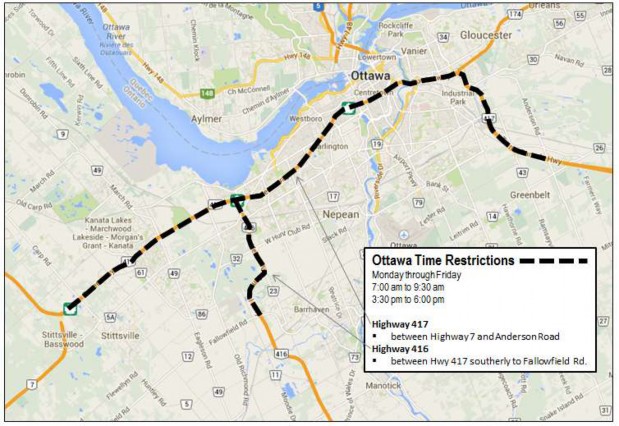
footnote P Ottawa travel restrictions apply Monday through Friday from 7:00 a.m. to 9:30 a.m. and from 3:30 p.m. to 6:00 p.m. as per Appendix F, with the exception of a trailer pulling a converter dolly with no second trailer.
Inclement weather, visibility or road conditions
footnote P With the exception of convertor dollies when there is no second trailer, LCVs must not operate if the roadway is: partly covered, covered or there is a road closure or reduced visibility (such as visibility is 500 m or less). These conditions align with the winter driving conditions posted and defined on the MTO's 511. Use the "Winter Driving - Road Conditions" selection in 511on.ca. Alternatively, a text version of the “Road Conditions” can be found under the "Text" tab of this website.footnote P If any of these conditions are encountered en route, the LCV must proceed to the nearest rest or emergency stop or point off the travelled portion of the highway considered to be sufficiently removed from traffic so as not to constitute a hazard, or as directed by a police officer or other officer designated under the HTA, with the exception of convertor dollies when there is no second trailer.
Cargo restrictions
footnote P LCVs must not carry any goods that require an emergency response assistance plan (ERAP).footnote P Tankers are prohibited from operating within the program.footnote P LCV carriers and drivers must employ federal and provincial mandated practices of transporting dangerous goods.- LCV carriers and drivers who transport dangerous goods must meet requirements set out in Ontario’s Dangerous Goods Transportation Act.
- LCV carriers and drivers may be required to provide documentation to support adherence to Ontario’s Dangerous Goods Transportation Act.
footnote P LCV must not carry livestock.
Safe operation
footnote P Where practical, driver is expected to travel in the right-most lane of the highway.footnote P Where practical, a space of at least 150 m (500 feet) is to be maintained between LCVs travelling on a highway.footnote P Driver must operate the LCV on approved routes in a fashion that does not cause damage to highway infrastructure, including interference with curbs, lights or other highway fixtures.footnote P Carrier is responsible for any damage to highway infrastructure.footnote P LCVs must report to any truck inspection station on the same basis as other commercial vehicles.
Dolly repositioning
footnote P For dolly repositioning purposes, the LCV may consist of a tractor, semi-trailer, and dolly with no second trailer.footnote P All LCV rules apply to this combination with the following exceptions:- 5(e) – dolly does not require functioning brakes
- 5(g) – no requirement for rear sign
- 6(b) – may travel on designated detour routes
- 6(e) – peak travel restrictions do not apply
- 6(g) – inclement weather restrictions do not apply
- Appendix A (Alternate configurations) – gross weight allowances are restricted
General permit conditions
Original permit
footnote P Permits may be transferred between qualifying vehicles operated by the same permit holder, providing that the tractors are registered to the same CVOR/NSC registration number specified on the permit.footnote P Permits are only valid when copies of MTO provided lists of approved highway routes, turn-around ramps, rest or emergency stops and origin or destination locations are attached to permit.footnote P Original permit (not a copy) must accompany the LCV and be produced on demand to a police officer or officer appointed to carry out the provisions of the Highway Traffic Act.footnote P Permit cannot be transferred to another carrier or combined with any other permit for width, height, length, or weight other than permits allowing aerodynamic devices at the rear of vehicles.
Permit may be revoked
footnote P MTO reserves the right to suspend one or more of a carrier’s permits or revoke a carrier’s LCV permit privileges or to cancel the LCV program at any time.footnote P Permit may be revoked or suspended for any breach of any condition, for non-compliance with the MoU or for non-compliance with the Highway Traffic Act.footnote P Permits automatically become null and void if a permit holder’s carrier safety record falls to "Conditional" or "Unsatisfactory".footnote P MTO reserves the right to withdraw approval or modify conditions related to any highway route, rest or emergency stop, or origin or destination location.
Appendix A: LCV A-train double
Description, dimensions and weights (ref. 4(b) (c))
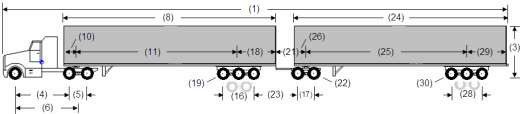
Combination description
The LCV A-train double consists of a tractor and 2 semi-trailers connected by a converter dolly. The front axle of the tractor is a single axle with single tires and the drive axle is a tandem axle. The lead semi-trailer has a tandem or tridem axle. The converter dolly has a tandem axle. The second semi-trailer has a tandem or tridem axle.
Alternative configurations
- This combination may be split with the tractor pulling one semi-trailer plus the dolly for purposes of repositioning the dolly. The combination must comply with all requirements of designated (SPIF) combination #1 in HTA Reg 413/05 except for dimension (1) "overall length". The allowable gross vehicle weight is that of the tractor-trailer without the dolly, plus 2,000 kg.
- Trailers may be equipped with additional "invisible" lift axles provided axles are not deployed.
| Vehicle | Ref | Feature | Dimensional limit (m) |
|---|---|---|---|
| Overall | (1) | Length of combination and load | Max. 40 |
| Overall | (2) | Width of vehicle and load | Max. 2.6 |
| Overall | (3) | Height of vehicle and load | Max. 4.15 |
| Tractor | (4) | Interaxle spacing | Min. 3.5 |
| Tractor | (5) | Tandem axle spread | 1.2 to 1.85 |
| Tractor | (6) | Wheelbase | Max. 6.2 |
| Lead semi-trailer | (8) | Length | 12.2 to 16.2 |
| Lead semi-trailer | (10) | Swing radius | Max. 2.0 |
| Lead semi-trailer | (11) | If length < 14.5 m:
|
|
| Lead semi-trailer | (11) | If length < 14.5 m:
|
|
| Lead semi-trailer | (11) | If length > 14.5 m:
|
|
| Lead semi-trailer | (11) | If length > 14.5 m:
|
|
| Lead semi-trailer | (16) | Tandem spread | 1.2 to 3.1 |
| Lead semi-trailer | (16) | Tridem spread | 2.4 to 3.7 |
| Lead semi-trailer | (18) | Hitch offset
|
|
| Lead semi-trailer | (18) | Hitch offset
|
|
| Lead semi-trailer | (19) | Track width
|
|
| Lead semi-trailer | (19) | Track width
|
|
| Lead semi-trailer | (19) | Track width
|
|
| Converter dolly | (17) | Tandem spread | 1.2 to 1.85 |
| Converter dolly | (21) | Drawbar length | Max. 3.0 |
| Converter dolly | (22) | Track width
|
|
| Converter dolly | (22) | Track width
|
|
| Converter dolly | (22) | Track width
|
|
| Converter dolly | (23) | Inter-vehicle unit distance | Min. 2.7 |
| Second semi-trailer | (24) | Length | 12.2 to 16.2 |
| Second semi-trailer | (25) | If length < 14.5 m:
|
|
| Second semi-trailer | (25) | If length < 14.5 m:
|
|
| Second semi-trailer | (25) | If length > 14.5 m:
|
|
| Second semi-trailer | (26) | Swing radius | Max. 2.0 |
| Second semi-trailer | (28) | Tandem spread | 1.2 to 3.1 |
| Second semi-trailer | (28) | Tridem spread | 2.4 to 3.7 |
| Second semi-trailer | (29) | Effective rear overhang | Max. 35% of Wheelbase |
| Second semi-trailer | (30) | Track width
|
|
| Second semi-trailer | (30) | Track width
|
|
| Second semi-trailer | (30) | Track width
|
|
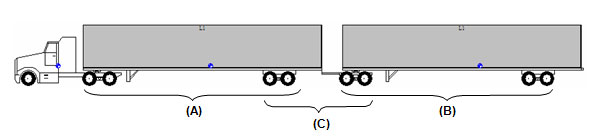
| Feature | Weight limit |
|---|---|
| Manufacturer’s weight ratings | Vehicle and its components shall not exceed rated capacity |
| Feature | Weight limit |
|---|---|
| Front (steering) axle | Max. 11 kg per mm (279 kg per inch) |
| Any other tire | Max. 10 kg per mm (254 kg per inch) |
| Feature | Weight limit |
|---|---|
| Front (steering) axle | Max. 7,700 kg (5,000 kg if no written GAWR verification) |
Tandem axle (drive, dolly or trailer):
|
|
Tandem axle (drive, dolly or trailer):
|
|
Tridem axle spread:
|
|
Tridem axle spread:
|
|
Tridem axle spread:
|
|
| Feature | Weight limit |
|---|---|
| Weight restriction #1 (A) > (B) | Sum of weights of drive axles plus lead trailer axles (A) must be greater than sum of weights of dolly axles plus second trailer axles (B). |
Weight restriction #2
| Sum of weights of rear axles of lead trailer plus dolly axles (C):
|
Weight restriction #2
| Sum of weights of rear axles of lead trailer plus dolly axles (C):
|
Weight restriction #2
| Sum of weights of rear axles of lead trailer plus dolly axles (C):
|
| Feature | Weight limit |
|---|---|
| Allowable Gross Vehicle Weight (AGVW) (lower of i, ii and iii) |
|
Appendix B: LCV B-train double
Description, dimensions and weights
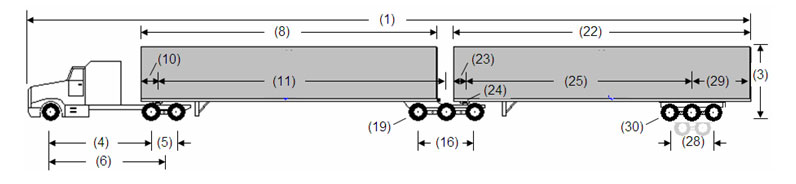
Combination description
The LCV B-train double consists of a tractor and 2 semi-trailers connected by a fifth wheel assembly whose lower half is mounted on the rear of the foremost semi-trailer. The front axle of the tractor is a single axle with single tires and the drive axle is a tandem axle. The lead semi-trailer has a tandem or tridem-axle and the second trailer has a tandem or tridem axle. The lead and second semi- trailer have a tandem or tridem axle.
Alternative configurations
- When the trailers are separated, the resulting tractor-trailer must comply with all requirements for SPIF #1 (i.e. the lead trailer may not be operated with bogie extended).
- Either trailer may be equipped with additional "invisible" lift axles provided axles are not deployed.
Dimensional limit chart (LCV B-train double)
| Vehicle | Ref | Feature | Dimensional limit (m) |
|---|---|---|---|
| Overall | (1) | Length of combination and load | Max. 40 |
| Overall | (2) | Width of vehicle and load | Max. 2.6 |
| Overall | (3) | Height of vehicle and load | Max. 4.15 |
| Tractor | (4) | Interaxle spacing | Min. 3.5 |
| Tractor | (5) | Tandem axle spread | 1.2 to 1.85 |
| Tractor | (6) | Wheelbase | Max. 6.2 |
| Lead semi-trailer | (8) | Length (excluding extended bogie) | 11.5 to 14.65 |
| Lead semi-trailer | (10) | Swing radius | Max. 2.0 |
| Lead semi-trailer | (11) | Wheelbase | Max. 13.5 |
| Lead semi-trailer | (16) | Tandem spread | 1.2 to 1.85 |
| Lead semi-trailer | (16) | Tridem spread | 2.4 to 3.7 |
| Lead semi-trailer | (19) | Track width
|
|
| Lead semi-trailer | (19) | Track width
|
|
| Lead semi-trailer | (19) | Track width
|
|
| Second semi-trailer | (22) | Length | 11.5 to 16.2 |
| Second semi-trailer | (23) | Swing radius | Max. 2.0 |
| Second semi-trailer | (24) | Kingpin behind rearmost axle of tridem | Max. 0.3 |
| Second semi-trailer | (25) | Wheelbase | Max. 11.5 |
| Second semi-trailer | (28) | Tandem spread | 1.2 to 1.85 |
| Second semi-trailer | (28) | Tridem spread | 2.4 to 3.7 |
| Second semi-trailer | (29) | Effective rear overhang | Max. 35% of Wheelbase |
| Second semi-trailer | (30) | Track width
|
|
| Second semi-trailer | (30) | Track width
|
|
| Second semi-trailer | (30) | Track width
|
|

Weight limit chart (LCV Turnpike B-train double)
| Feature | Weight limit |
|---|---|
| Manufacturer’s weight ratings | Vehicle and its components shall not exceed rated capacity |
| Feature | Weight limit |
|---|---|
| Front (steering) axle | Max. 11 kg per mm (279 kg per inch) |
| Any other tire | Max. 10 kg per mm (254 kg per inch) |
| Feature | Weight limit |
|---|---|
| Front (steering) axle | Max. 7,700 kg (5,000 kg if no written GAWR verification) |
Tandem axle (drive, dolly or trailer):
|
|
Tandem axle (drive, dolly or trailer):
|
|
Tridem axle spread:
|
|
Tridem axle spread:
|
|
Tridem axle spread:
|
|
| Feature | Weight limit |
|---|---|
| Weight restriction #1 (A) > (B) | Weight on drive axles (A) must exceed weight on second trailer axles (B). |
| Allowable Gross Vehicle Weight (AGVW) | AGVW = sum of the actual weight on the front axle plus the allowable weights of all other axles (none of which exceed any limits in this chart). AGVW shall not exceed 63,500 kg. |
Appendix C: LCV Twin Stinger-Steer Auto Carrier
Description, dimensions and weights
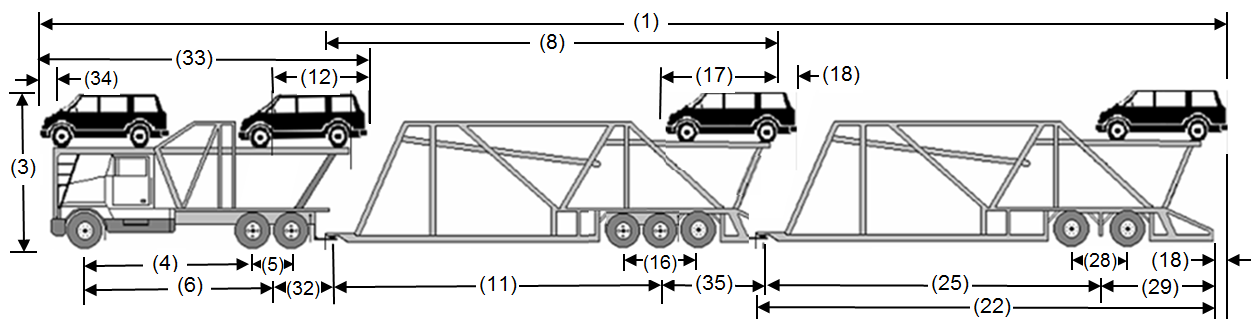
Combination description
The LCV Twin Stinger-Steer Auto Carrier consists of a tractor and 2 non-enclosed semi-trailers designed to carry vehicles. The fifth wheel assemblies are mounted on a drop frame located behind and below the centre of the rearmost axle of the tractor and the lead trailer. The front axle of the tractor is a single axle with single tires and the drive axle is a tandem axle. The lead semi-trailer has a triple axle unit with the rearmost axle liftable by use of manual controls located on the trailer. The axle is deployed at all times when operating as an LCV. The second trailer has a tandem axle.
Alternative configurations
When the trailers are separated and pulled individually behind the tractor, the resulting tractor-trailer must comply with all requirements for SPIF #14.
Dimensional limit chart (LCV Twin Stinger-Steer Auto Carrier)
| Vehicle | Ref | Feature | Dimensional limit (m) |
|---|---|---|---|
| Overall | (1) | Length of combination and load | Max. 40 |
| Overall | (2) | Width of vehicle and load | Max. 2.6 |
| Overall | (3) | Height of vehicle | Max. 4.15 |
| Overall | (4) | Height of vehicle and load | Max. 4.3 |
| Tractor | (4) | Interaxle spacing | Min. 3.5 |
| Tractor | (5) | Tandem axle spread | 1.2 to 1.85 |
| Tractor | (6) | Wheelbase | Not controlled |
| Tractor | (12) | Effective rear overhang | Max. 4.6 |
| Tractor | (32) | Hitch offset | Max. 1.9 |
| Tractor | (33) | Length | Max. 12.5 |
| Tractor | (34) | Front load overhang | Max. 1.0 |
| Lead semi-trailer | (8) | Length | Max. 14.65 |
| Lead semi-trailer | (11) | Wheelbase | 11.35 to 12.5 |
| Lead semi-trailer | (16) | Triple axle spread | 2.4 to 2.8 |
| Lead semi-trailer | (17) | Effective rear overhang of vehicle | Max. 4.0 or 42% (whichever is greater) |
| Lead semi-trailer | (18) | Rear load overhang | Max. 1.2 |
| Lead semi-trailer | (19) | Track width
|
|
| Lead semi-trailer | (19) | Track width
|
|
| Lead semi-trailer | (19) | Track width
|
|
| Lead semi-trailer | (35) | Hitch offset | Max. 2.4 |
| Second semi-trailer | (22) | Length | Max. 14.65 |
| Second semi-trailer | (25) | Wheelbase | 10.0 to 12.5 |
| Second semi-trailer | (28) | Tandem axle spread | 1.2 to 3.1 |
| Second semi-trailer | (29) | Effective rear overhang of vehicle | Max. 4.0 or 42% (whichever is greater) |
| Second semi-trailer | (18) | Rear load overhang | Max. 1.2 |
| Second semi-trailer | (30) | Track width
|
|
| Second semi-trailer | (30) | Track width
|
|
| Second semi-trailer | (30) | Track width
|
|
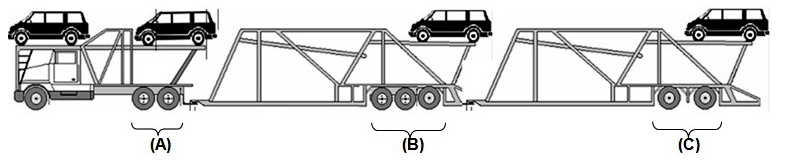
Weight limit chart (LCV Twin stinger-steer auto carrier)
| Feature | Weight limit |
|---|---|
| Manufacturer’s weight ratings | Vehicle and its components shall not exceed rated capacity |
| Feature | Weight limit |
|---|---|
| Front (steering) axle | Max. 11 kg per mm (279 kg per inch) |
| Any other tire | Max. 10 kg per mm (254 kg per inch) |
| Feature | Weight limit |
|---|---|
| Front (steering) axle | Max. 7,700 kg (5,000 kg if no written GAWR verification) |
| Tandem axle (drive or trailer) | Max. 18,000 kg |
| Triple axle | Max. 21,300 kg |
| Feature | Weight limit |
|---|---|
| Weight restriction #1 (A) > (C) | Weight on drive axles (A) must exceed weight on second trailer axles (C). |
| Weight restriction #2 (B) > (C) | Weight on lead trailer axles (B) must exceed weight on second trailer axles (C). |
| Feature | Weight limit |
|---|---|
| Allowable Gross Vehicle Weight (AGVW) | AGVW = sum of the actual weight on the front axle plus the allowable weights of all other axles (none of which exceed any limits in this chart). AGVW shall not exceed 55,000 kg. |
Appendix D: LCV route acceptance process
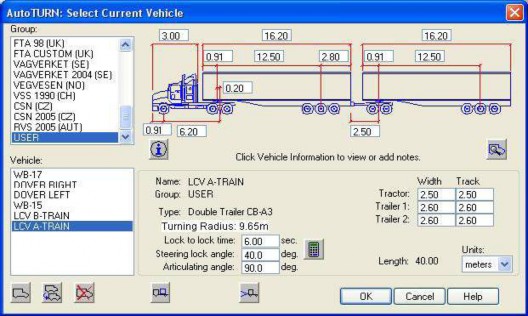
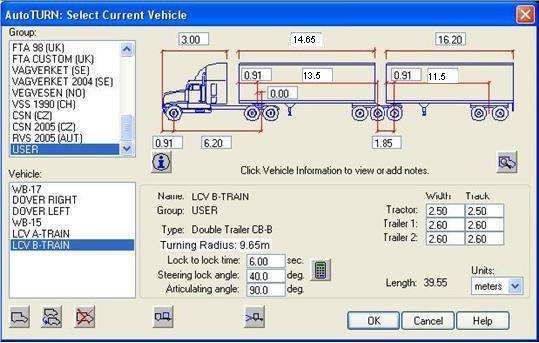
For purposes of any engineering assessment required in section 3, the following is acceptable input data for the computer simulated turning templates. For purposes of overlaying the design drawings with turning templates, a buffer of 0.5 m is required between the vehicle wheels and any curbs, fixtures, edge of the pavement, etc. As Twin stinger-steer LCV combinations require less turning space, A-train or B-train assessments are also deemed acceptable for stinger-steers.
A-train
B-train
Appendix E: Signage on rear of LCVs configuration
A LCV must have a pictogram based sign affixed to the rear of the second semitrailer which complies with the following specifications:

- Background of the sign: type III or superior yellow retroreflective sheeting complying with the standard specification for Retroreflective Sheeting for Traffic Control (D 4956) of the American Society for Testing and Materials
- Pictogram: black
- Lettering: black, Highway gothic, E-series modified, 50 mm high
- Position: at the rear of the last semitrailer mounted so that it is clearly visible by following drivers, and must not obstruct lights or other safety devices. The sign must be removed when not in use.
- Sign size: 30 cm by 230 to 245 cm
Appendix F: Ottawa Monday to Friday time of day restrictions
LCV Primary Highway Network – maps
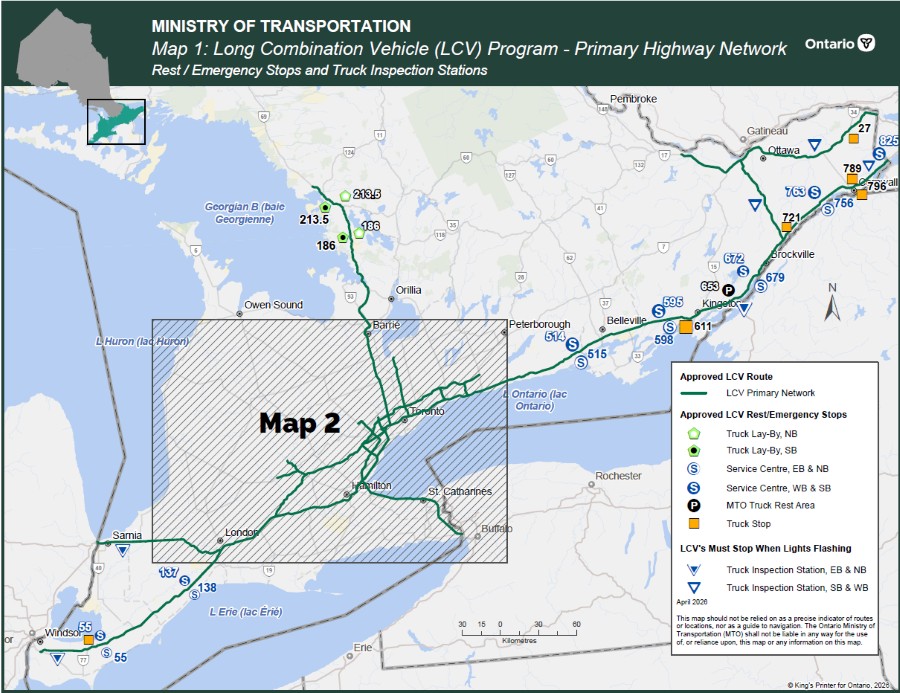
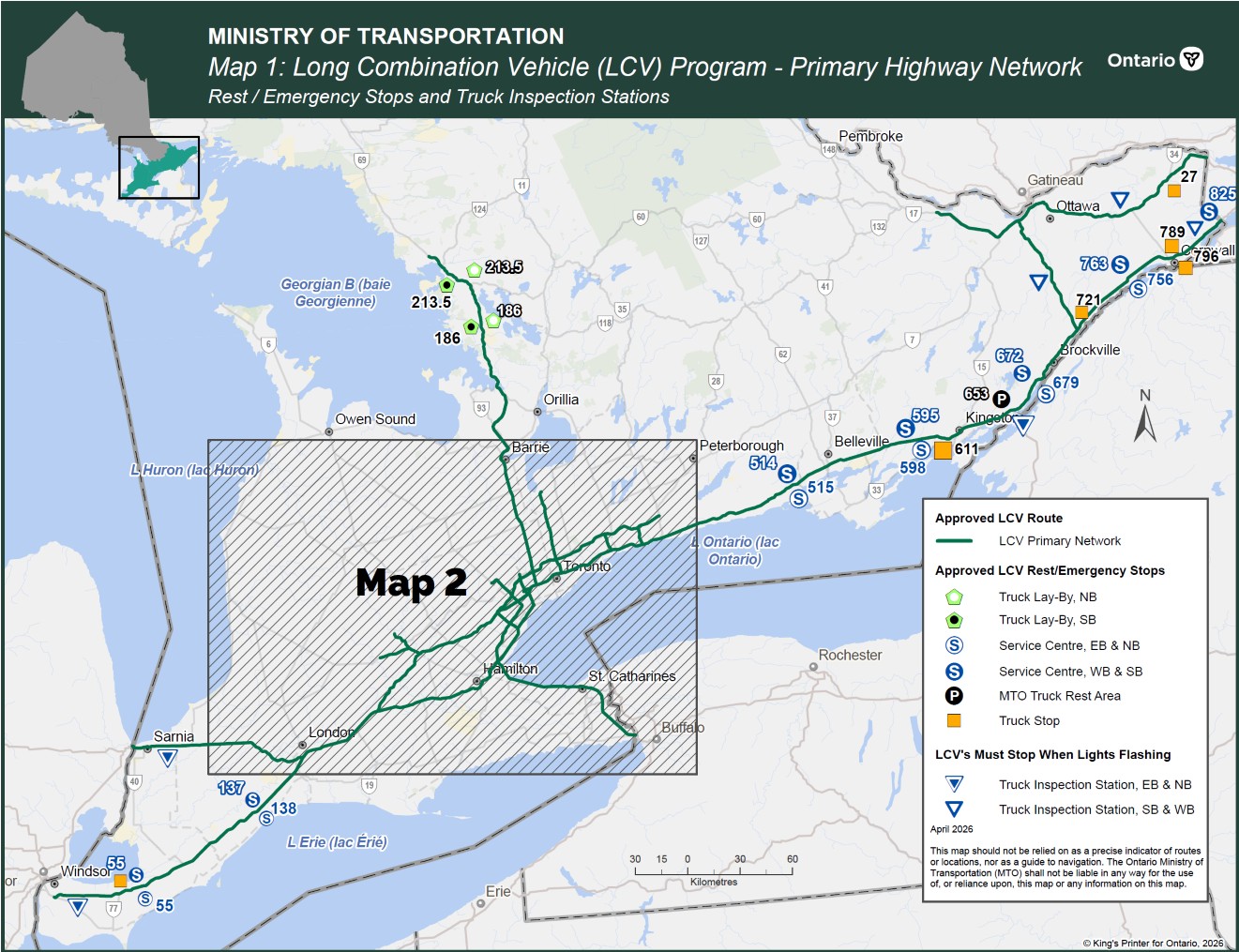
Map 1: Long Combination Vehicle (LCV) Program — Primary Highway Network. View a larger version of this map.
Map shows the approved LCV routes and stops in Southern Ontario including:
- highways
- turn-around ramps
- rest or emergency stops
- truck inspection stations
Map 2 (shaded area) of the Greater Toronto and Hamilton Area is available in greater detail on a separate map.
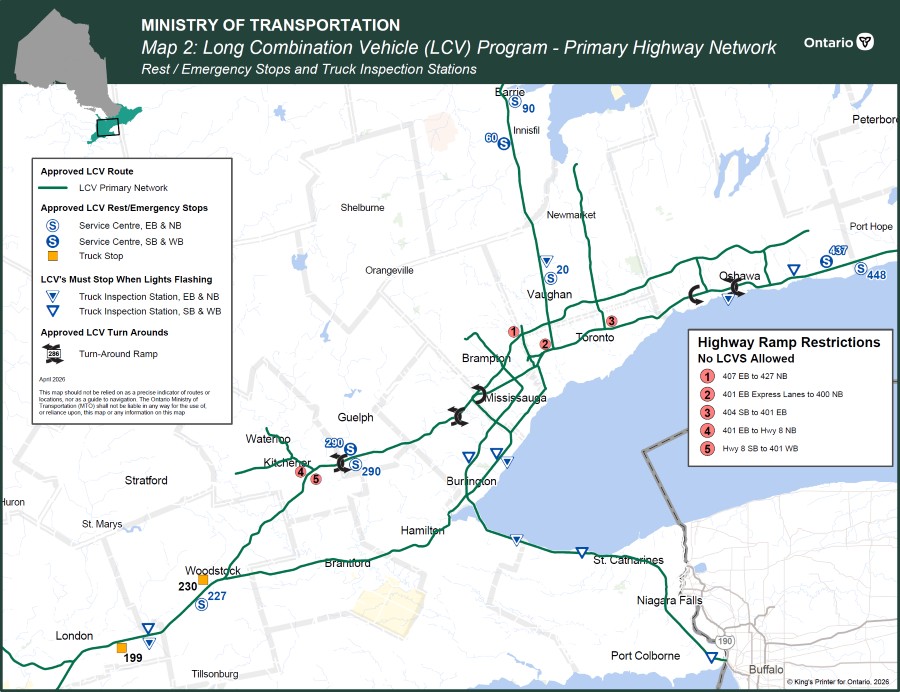
Map 2: Long Combination Vehicle (LCV) Program — primary highway network for the Greater Toronto and Hamilton Area. View a larger version of this map.
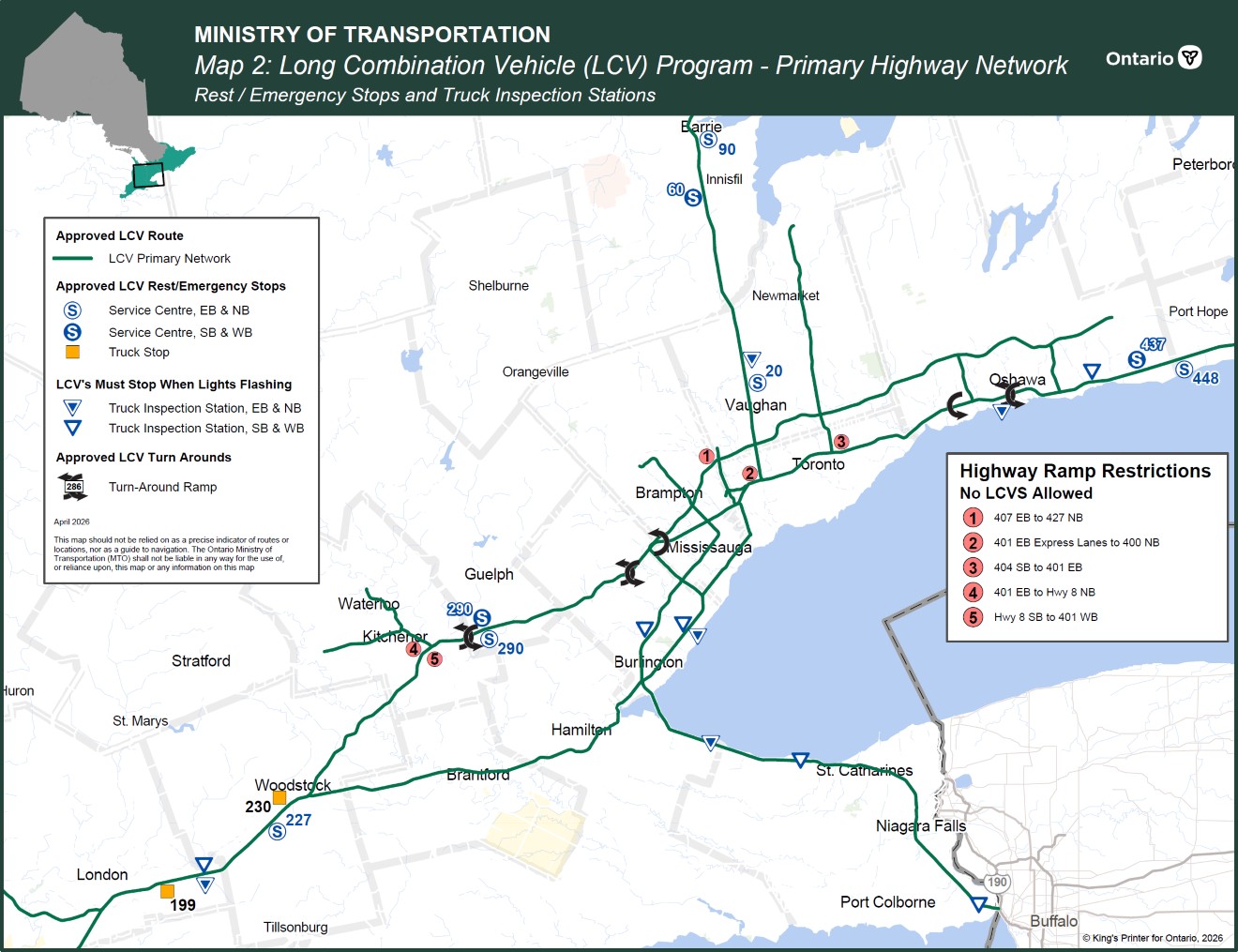
Map shows the approved LCV routes and stops in Southern Ontario including:
- highways
- rest or emergency stops
- truck inspection stations
- turn-around ramps
- highway ramp restrictions where no LCVs are allowed
Revisions since August 13, 2009
October 31, 2025
- removal of LCV program condition 6 (d) holiday restrictions
- updated Appendix E – LCV rear sign
May 10, 2021
- 2(a) addition of Ontario’s Workplace Safety and Insurance Act requirements
- 2(b), (c), (d), (e) – updated wording to reflect LCV Driver and Instructor Certification Manual.
- 6(h) – addition of Ontario’s Dangerous Goods Transportation Act requirements
- Appendices "D" and "E" removed
November 8, 2019
- 6(e) – removal of GTA time restrictions
- 6(h) – addition of permit conditions allowing the transportation of dangerous goods
January 23, 2017
- 1(a) – updated to reflect harmonization agreements with neighbouring jurisdictions, relationships with trucking associations, and updates to allowable LCV configurations
- 1(b) – removal of permit and carrier limits
- 1(d) – inclusion of requirement for speed report to be submitted with reportable collision information
- 2(b) – 2 (f) – updated requirement for Ontario LCV driver certificate.
- 2(g) – new provision regarding LCV training, advisory and monitoring services
- 3(d), 4(a) – 4(c), 5(c), 5(d) – inclusion of requirements regarding Twin Stinger-Steer LCV combinations
- 6(d) – inclusion of holiday restrictions on Canada Day
- Appendix A – updated to allow 12.2 m (40 foot) semitrailers
- Appendix C – added to reflect LCV Twin Stinger-Steer Auto Carrier description, dimensions and weights
March 1, 2015
- 1(b) – updated to reflect increase in number of permits available
- 2(b) – updated to reflect reciprocity with training in Quebec, Nova Scotia and New Brunswick
- 2(e) – updated to clarify that renewal workshops will be one day, not a half day
- 3(b) – condition added to permit conditions
- 4(a) – updated to include requirement that both tractor rear axles must be drive axles
- Appendix C – updated to reflect driver eligibility changes to 2(b)
November 19, 2014
- 6(d) – updated to include holiday restrictions in December, January and February
- 6(f) – time of year restriction removed
February 12, 2014
- 1(b) – updated to reflect increase in number of permits available
- 1(c) – updated to include turn-around ramps as area of operations
- 3(a) – updated to include turn-around ramps in approved LCV network
- 6(a) – updated to include turn-around ramps as specified routes
- 6(e) – Ottawa peak travel restrictions added
- 6(j) – dolly repositioning adjusted to include Ottawa travel restrictions
- 7(a) – updated to include turn-around ramps in list of MTO approved routes
February 5, 2013
- 1(a) – updated to reflect 2 types of permitted LCV configurations
- 1(b) – updated to reflect increase in number of permits available
- 1(e) – removed requirement to report probable alternate mode of transport
- 2(e) – added restricted instructor conditions
- 3(d) – updated engineering assessment requirements for including additional configurations to an assessment
- 4(a) – included B-train length not allowed in the program
- 5(b) – updated to require electronic on-board monitoring at regular intervals and holding of records for 60 days
- 5(c) – updated to clarify anti-sail mud-flap definition
- 5(e) – updated to remove brake requirement for converter dollies without a second trailer
- 6(e) – remove GTA travel restrictions for trailers pulling dollies without a second trailer
- 6(j) – added details on dolly repositioning conditions
- 7(a) – clarified transfer of permits between equipment held under the same CVOR/NSC
- Throughout – removed reference to OTA/QTA shared training and certificates
February 23, 2012
- 1(b) – timing and scope reflects allocation of permits
- 2(b) – note added regarding driver disqualification from LCV program
- 2(e) – Instructor eligibility requirements updated
- 2(f) – Certificate section updated to include MTO ability to require driver or driving-in-training certificates are denied
- 3(d) – engineering assessment requirements updated to include ability to introduce other combinations onto the route without a new assessment
- 5(b) – speed recording device requirements updated to require GPS or a similar electronic tracking system
- Appendix A – Dimensions updated for A-train to allow for wide tandem spread
- Appendix B – Dimensions updated in B-train input sample
February 3, 2011
- 1(b) – timing and scope reflects the increase in available permits
- 1(e) – updated trip reporting requirements (time of dispatch required)
- 5(f) – restriction on additional rear lighting is removed
- Appendix A, B – Track width modified to accommodate wide based single tires
For the formal governing document setting out the LCV program conditions, or any questions about the program, please email LCV.Monitoring@ontario.ca.
Footnotes
- footnote[P] Back to paragraph "P"- indicates that item is also a "Permit Condition" on the LCV permit. Also included as permit conditions are Appendices A and D.
- footnote[*] Back to paragraph Exclusions to width and length measurements are as specified in HTA s109. Measurements also exclude authorized aerodynamic devices at rear of trailers.