

Ontario’s Early Years and Child Care Annual Report 2025
Ontario’s Early Years and Child Care Annual Report 2025 describes the early years and child care system, key data and measures for child care and indicators under Ontario’s bilateral federal-provincial early learning and child care agreements with the federal government.
Introduction
Ontario recognizes the vital role that a strong and accessible child care and early years system plays in supporting families across the province. High-quality early years and child care is fundamental in children’s learning, development and well-being. We are committed to investing in this system to shape the future of our children and enhance the prosperity of our communities.
This report provides an annual snapshot and detailed year-over-year trends of Ontario’s child care sector that will help inform future plans and policy. In addition, the report supports Ontario's commitments to informing the public on progress made under federal-provincial early learning and child care agreements. Most of the data presented in this report were collected between April 2024 and March 2025.
In 2022, Ontario and Canada signed the Canada-wide Early Learning and Child Care (CWELCC) Agreement. The agreement prioritizes five key areas: lowering fees, increasing access, enhancing quality, supporting inclusion and strengthening data and reporting.
In 2024-25, Ontario continued collaborating with sector partners throughout the province, achieving significant milestones of implementing the CWELCC system:
- April 2024: the province held virtual consultations with sector partners, including child care providers, experts, Indigenous partners, official language minority communities and other interested parties, as an important step in finalizing its fiscal year 2024-2025 Action Plan. This phase of Ontario’s stakeholder consultations focused on the feedback shared in Winter 2023, CWELCC progress made to date and areas for further development in CWELCC implementation.
- June 2024: the province conducted a survey to gather feedback directly from parents and guardians across Ontario, receiving nearly 11,000 responses. Alongside consultations, these engagements were crucial for shaping the direction of the early years and child care system and represent a significant step towards finalizing the 2024-2025 CWELCC Action Plan.
- June 2024: the province completed the CWELCC Program Review with the federal government, which was an opportunity for Ontario and Canada to communicate progress and share information on the committed objectives under the CWELCC agreement, including a review of the targets, indicators and cost drivers.
- August 2024: the province announced a new, cost-based funding approach for CWELCC and released a Cost-Based Funding Guideline. Design of the new approach was heavily guided by extensive stakeholder engagement.
- January 2025: the new, cost-based funding approach took effect. Cost-Based Funding provides support for operating costs for licensees participating in CWELCC for the delivery of child care to children aged 0 to 5 years.
- January 2025: Ontario took the next step in lowering child care fees for families as part of the CWELCC system. Starting in January 2025, parent fees were capped at $22 per day for children under the age of six in CWELCC programs.
As of March 31, 2025, 5,556 (92%) licensed child care sites were enrolled in the CWELCC system, representing a total of 328,610 (92%) licensed child care spaces in centres and homes for children aged 0 to 5 years.
Across Ontario’s entire licensed child care system for children aged 0 to 12 years, growth continued in 2024–25, supporting more children and families. From March 31, 2024, to March 31, 2025:
- The number of centres increased by 2.6% from 5,836 to 5,989.
- The number of spaces grew by 16,070 from 516,455 to 532,525, with an increase in almost all age groups, including 3.8% for infants, 5.5% for toddlers, 4.8% for preschool, 2.3% for kindergarten and 1.8% for school age. The number of spaces for family age group decreased slightly by 1.1%.
footnote 1 - The number of home child care agencies increased by 2.0% from 151 to 154. These agencies oversee child care in 5,860 homes across the province.
footnote 2
To continue delivering high-quality, affordable child care and early years programs to families across the province, Ontario and Canada are investing $6.24 billion in early years and child care in 2025-26. This includes:
- Provincial investments of $1.68 billion to support the ongoing delivery of early years and child care services and EarlyON supports. This includes a general allocation for core service delivery of early years and child care programs.
- Investments of $4.56 billion from the federal government to support Ontario’s commitments under the CWELCC, Early Learning and Child Care (ELCC) and ELCC Infrastructure Fund agreements.
Over the same six-year period as the commitment of the CWELCC agreement, federal funding compliments and builds on the estimated $21.6 billion the province is investing in full-day kindergarten and the estimated $11.8 billion the province is investing in early years and child care (estimated total provincial investment of $33.4 billion). Ontario’s investment in early years and child care includes funding for fee subsidies and the Ontario Childcare Access and Relief from Expenses (CARE) tax credit which also directly supports lowering child care costs for eligible families.
In summary, Ontario’s early years and child care sector has showed strong growth and demonstrated significant achievements over the past year. These achievements could not be reached without the collaboration and leadership of our hardworking partners: our early years and child care workers, program operators, Indigenous partners, service system managers and the federal government.
Part 1: Overview of the early years and child care system
The province sets overall policy, legislation and regulations for the child care and early years sector, under the authority of the Child Care and Early Years Act, 2014, and licenses child care programs across the province. The province also conducts inspections and investigates complaints about licensed and unlicensed child care.
The province oversees and licenses two types of child care:
- child care centres
- home child care agencies that contract with home child care providers
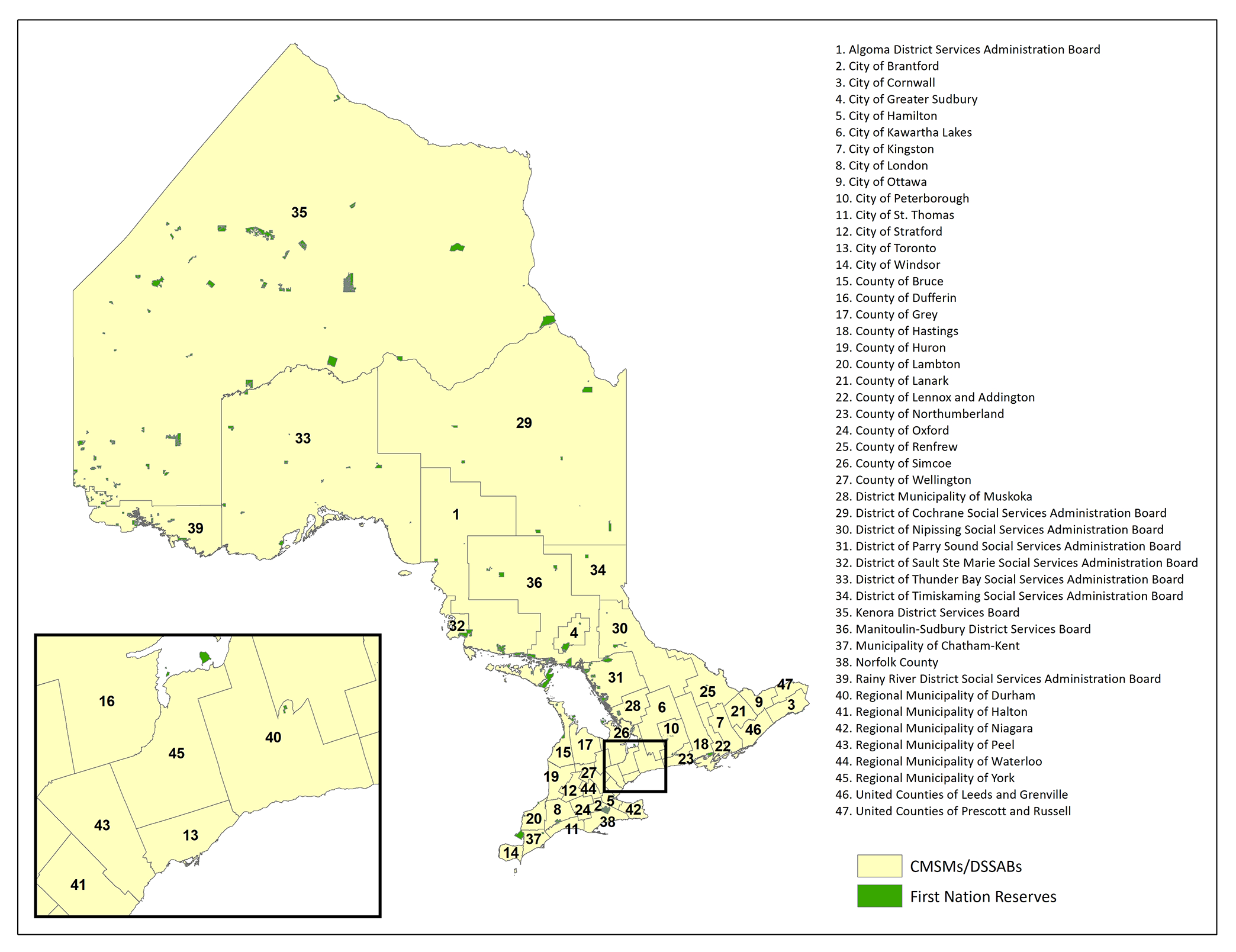
The provincial government provides funding to 47 local service system managers, known as Consolidated Municipal Service Managers (CMSMs) and District Social Services Administration Boards (DSSABs), to support licensed child care and child and family programs in the province (see Figure 1). These service system managers have the authority to determine funding priorities within their local systems, provided they comply with provincial legislation, policies and guidelines.
As of March 31, 2025, the province is funding 95 First Nations to support child care and/or child and family programs on-reserve, of which:
- 31 receive funding for child care only
- 22 receive funding for child and family programs only
- 42 receive funding for child care and child and family programs
Figure 1: Consolidated Municipal Service Managers and District Social Services Administration Boards in Ontario
Data sources: Ontario Ministry of Education and Statistics Canada.
Map of Ontario showing the locations of Consolidated Municipal Service Managers and District Social Services Administration Boards (CMSMs/DSSABs), which are as follows:
| Location name |
|---|
| Algoma District Services Administration Board |
| City of Brantford |
| City of Cornwall |
| City of Greater Sudbury |
| City of Hamilton |
| City of Kawartha Lakes |
| City of Kingston |
| City of London |
| City of Ottawa |
| City of Peterborough |
| City of St. Thomas |
| City of Stratford |
| City of Toronto |
| City of Windsor |
| County of Bruce |
| County of Dufferin |
| County of Grey |
| County of Hastings |
| County of Huron |
| County of Lambton |
| County of Lanark |
| County of Lennox and Addington |
| County of Northumberland |
| County of Oxford |
| County of Renfrew |
| County of Simcoe |
| County of Wellington |
| District Municipality of Muskoka |
| District of Cochrane Social Services Administration Board |
| District of Nipissing Social Services Administration Board |
| District of Parry Sound Social Services Administration Board |
| District of Sault Ste Marie Social Services Administration Board |
| District of Thunder Bay Social Services Administration Board |
| District of Timiskaming Social Services Administrations Board |
| Kenora District Services Board |
| Manitoulin-Sudbury District Services Board |
| Municipality of Chatham-Kent |
| Norfolk County |
| Rainy River District Social Services Administration Board |
| Regional Municipality of Durham |
| Regional Municipality of Halton |
| Regional Municipality of Niagara |
| Regional Municipality of Peel |
| Regional Municipality of Waterloo |
| Regional Municipality of York |
| United Counties of Leeds and Grenville |
| United Counties of Prescott and Russell |
In Ontario, various partners work together to deliver early years and child care, each taking important roles and responsibilities.
| Partner | Roles and Responsibilities |
|---|---|
| Province of Ontario |
|
| Service System Managers (CMSMs and DSSABs) |
|
| Federal Government |
|
| Licensed Home Child Care Agencies |
|
| Licensed Child Care Centres |
|
| Unlicensed Child Care Operators |
|
| First Nations |
|
| School Boards |
|
| College of Early Childhood Educators (CECE) |
|
Part 2: Early years and child care key data and measures
High-quality early learning and child care is foundational to supporting early childhood development and student success. It is also a key enabler of workforce participation, particularly for women, both as parents/guardians and providers. Over the years, Ontario has advanced many initiatives to strengthen its early years and child care system. This includes:
- Providing child care fee subsidies to support typically lower-income families to access child care.
- Investing in operator subsidies to help offset costs that would otherwise result in higher child care fees. Support is provided for general operating costs, as well as wage enhancements for qualified staff.
- Establishing the College of Early Childhood Educators in 2008 as the self-regulatory body for the early childhood education profession in the province and the only regulatory college for early childhood educators in Canada.
- Rolling out universal full-day kindergarten starting in 2010 to provide a full day of free, high-quality programming for all children aged 4 to 5 years in the publicly funded school system across the province.
- Conducting an annual data collection of child care program operations from licensed child care centres and home child care agencies since 2012 and reporting on the Early Development Instrument (EDI) indicators since 2003.
- Establishing a modern legislative framework and quality standards, the Child Care and Early Years Act, 2014 (CCEYA), that governs child care in Ontario. The legislation requires that programming in licensed spaces is aligned with the provincial pedagogy, How Does Learning Happen? Ontario’s Pedagogy for the Early Years, 2014, which sets out a vision, values, foundations and approaches to guide practice for high-quality experiences in licensed child care and early years settings.
- Supporting the recruitment and retention of early childhood educators in child care since 2015 through the Ontario Wage Enhancement Grants.
- Introducing the Ontario Childcare Access and Relief from Expenses (CARE) tax credit in 2019. The tax credit helps an estimated 300,000 families each year with up to 75% of their eligible child care expenses.
- Funding EarlyON Child and Family Centres to provide a variety of supports to caregivers and children up to six years old across Ontario.
- Implementing the CWELCC system in the province to reduce the average parent fees for children under six in participating child care programs, increasing access to affordable child care, and supporting Ontario child care workforce. This includes:
- a cost-based funding approach, effective January 2025, that is providing support for operating costs for licensees participating in CWELCC for the delivery of child care to children aged 0-5 years and enabling lower parent fees
- a Start-up Grant program to support the creation of new child care spaces in targeted regions and for underserviced communities and populations
- an Access and Inclusion Framework to support local service plans as related to inclusion
- a workforce strategy to support the recruitment and retention of qualified professionals working in licensed child care
These initiatives continue to shape Ontario’s early years and child care system and benefit children and families across the province. A stable and accessible child care system is crucial in supporting healthy early childhood development and enabling parents and caregivers to participate in the workforce—contributing to Ontario’s economic growth and prosperity.
Licensed child care
In Ontario, licensed child care is provided in centres and homes and is delivered by a mix of not-for-profit and for-profit organizations, municipalities, school boards and First Nations. As of March 31, 2025, there were 5,989 licensed child care centres in Ontario. The total number of spaces in licensed centres for children aged 0 to 12 was 532,525 which included:
- 39,007 spaces that provide services in French
- 8,152 spaces that provide bilingual services
- 3,399 spaces in First Nations communities
As of March 31, 2025, a total of 154 licensed home child care agencies were in operation in the province. These agencies were permitted to contract with a maximum of 5,860 approved homes.
Overall trends in licensed child care
Overall, Ontario’s licensed child care sector continued to grow over the past year. Since 2015–16:
- The number of licensed child care centres has increased by 13.5%, from 5,276 to 5,989. Licensed spaces in child care centres have increased by 36.8%, from 389,286 to 532,525.
- The number of spaces in centres for children aged 0 to 12 years has grown across all age groups, including kindergarten (50.5%), toddler (44.1%), infant (42.5%), school age (32.1%) and preschool (27.8%).
- The number of licensed home child care agencies has increased by 26.2%, from 122 to 154.
For more detailed data and changes over time, see Table 2 and Table 3.
| Year |
|
|
|
|
|
|
|
|
|
|
|---|---|---|---|---|---|---|---|---|---|---|
| Number of Centres | 5,276 | 5,351 | 5,437 | 5,523 | 5,565 | 5,506 | 5,545 | 5,776 | 5,836 | 5,989 |
| Number of Spaces 0-5 | 242,786 | 253,121 | 264,131 | 276,259 | 285,962 | 288,211 | 296,165 | 317,366 | 326,446 | 339,055 |
| Number of Spaces 0-12 | 389,286 | 406,395 | 427,032 | 446,596 | 462,802 | 464,538 | 472,997 | 505,055 | 516,455 | 532,525 |
| Year |
|
|
|
|
|
|
|
|
|
|
|---|---|---|---|---|---|---|---|---|---|---|
| Infant | 11,759 | 12,231 | 12,755 | 13,626 | 14,151 | 14,602 | 15,260 | 15,715 | 16,142 | 16,753 |
| Toddler | 41,211 | 42,900 | 44,529 | 46,865 | 48,858 | 49,883 | 51,888 | 53,894 | 56,314 | 59,405 |
| Preschool | 104,802 | 105,955 | 108,375 | 112,042 | 115,001 | 115,431 | 119,846 | 123,731 | 127,860 | 133,954 |
| Kindergarten | 85,014 | 92,035 | 98,310 | 103,308 | 107,260 | 107,453 | 108,247 | 123,014 | 125,118 | 127,942 |
| School age | 146,500 | 153,274 | 162,901 | 170,337 | 176,840 | 176,327 | 176,832 | 187,689 | 190,009 | 193,470 |
| Family age | N/A | N/A | 162 | 418 | 692 | 842 | 924 | 1,012 | 1,012 | 1,001 |
Data source: Child Care Licensing System, Ontario Ministry of Education (as of March 31 each year).
| Year |
|
|
|
|
|
|
|
|
|
|
|---|---|---|---|---|---|---|---|---|---|---|
| Number of agencies | 122 | 124 | 122 | 124 | 131 | 139 | 145 | 148 | 151 | 154 |
| Number of approved homes | 7,504 | 7,579 | 7,783 | 7,923 | 8,296 | 8,561 | 8,731 | 9,863 | 5,312 | 5,860 |
Data source: Child Care Licensing System, Ontario Ministry of Education (as of March 31 of each year). The number of approved homes in 2023-24 and 2024-25 are not comparable to previous years. In October 2023, the ministry revised the licensing process for approved homes to align with “active homes”
Child care by type of auspice footnote 6
As of March 31, 2025, 73.7% of licensed child care centres were not-for-profit (operated by not-for-profit organizations, municipalities and First Nations) and 26.3% were for-profit. For children aged 0 to 12 years, 77.8% of spaces were in not-for-profit centres and 22.2% in for-profit centres. For children aged 0 to 5 years, about 68.9% of spaces were in not-for-profit centres and 31.1% in for-profit centres.
Since 2015–16, the number of not-for-profit centres increased by 10.2% and for-profit increased by 24.0%. The number of spaces for children aged 0 to 12 years in not-for-profit centres increased by 35.7% and those in for-profit increased by 40.6%. The number of spaces for children aged 0 to 5 years in not-for-profit centres increased by 36.3% and those in for-profit centre increased by 47.6%.
For more detailed data and a look at changes over time, see Table 4.
| Year |
|
|
|
|
|
|
|
|
|
|
|---|---|---|---|---|---|---|---|---|---|---|
| Not-for-profit | 4,007 | 4,053 | 4,128 | 4,186 | 4,187 | 4,138 | 4,133 | 4,328 | 4,341 | 4,416 |
| For-profit | 1,269 | 1,298 | 1,309 | 1,337 | 1,378 | 1,368 | 1,412 | 1,448 | 1,495 | 1,573 |
| Number of centres | 5,276 | 5,351 | 5,437 | 5,523 | 5,565 | 5,506 | 5,545 | 5,776 | 5,836 | 5,989 |
| Year |
|
|
|
|
|
|
|
|
|
|
|---|---|---|---|---|---|---|---|---|---|---|
| Not-for-profit | 305,317 | 319,608 | 337,318 | 352,949 | 365,653 | 366,609 | 370,222 | 398,314 | 404,903 | 414,441 |
| For-profit | 83,969 | 86,787 | 89,714 | 93,647 | 97,149 | 97,929 | 102,775 | 106,741 | 111,552 | 118,084 |
| Number of spaces 0-12 | 389,286 | 406,395 | 427,032 | 446,596 | 462,802 | 464,538 | 472,997 | 505,055 | 516,455 | 532,525 |
| Year |
|
|
|
|
|
|
|
|
|
|
|---|---|---|---|---|---|---|---|---|---|---|
| Not-for-profit | 171,371 | 178,643 | 186,652 | 194,815 | 200,971 | 202,510 | 205,673 | 222,765 | 227,237 | 233,639 |
| For-profit | 71,415 | 74,478 | 77,479 | 81,444 | 84,991 | 85,701 | 90,492 | 94,601 | 99,209 | 105,416 |
| Number of spaces 0-5 | 242,786 | 253,121 | 264,131 | 276,259 | 285,962 | 288,211 | 296,165 | 317,366 | 326,446 | 339,055 |
Data source: Child Care Licensing System, Ontario Ministry of Education (as of March 31 each year).
Licensed child care centres — openings and closures
Licensed child care centres open and close on a regular basis with more centres opening than closing in most years. Child care centres open for reasons such as the expansion of an existing program, a desire to provide a child care service in a community or local planning efforts by service system managers to address an increase in the need for child care. Centres may close for various reasons such as relocation, low enrollment, business sales, or lease termination.
As of 2024–25, there were 713 more child care centres in operation than in 2015–16 (see Table 5). In 2024–25, 286 child care centres opened and 133 closed – a net increase of 153 centres.
| Year |
|
|
|
|
|
|
|
|
|
|
|---|---|---|---|---|---|---|---|---|---|---|
| Number of centres opened | 318 | 246 | 280 | 272 | 213 | 184 | 211 | 369 | 212 | 286 |
| Number of centres closed | −186 | −171 | −194 | −186 | −171 | −243 | −172 | -138 | -152 | −133 |
Data source: Child Care Licensing System, Ontario Ministry of Education (as of March 31 each year).
Licensed child care in publicly funded schools and in communities
As of March 31, 2025, 54.5% of child care centres and 64.2% of child care spaces were in publicly funded schools. The remaining 45.5% of child care centres and 35.8% of child care spaces were located elsewhere in the community. The number of licensed child care centres located in publicly funded schools increased by 2.1% in 2024–25 compared to the previous year and spaces located in publicly funded schools increased by 2.5% in the same period.
Since 2015–16, the number of child care centres located in publicly funded schools has increased by 17.4%, and spaces have increased by 44.3% (see Table 6).
| Year |
|
|
|
|
|
|
|
|
|
|
|---|---|---|---|---|---|---|---|---|---|---|
| In publicly funded schools | 2,782 | 2,841 | 2,943 | 2,990 | 3,004 | 2,987 | 2,996 | 3,190 | 3,200 | 3,266 |
| In communities | 2,494 | 2,510 | 2,494 | 2,533 | 2,561 | 2,519 | 2,549 | 2,586 | 2,636 | 2,723 |
| Centres | 5,276 | 5,351 | 5,437 | 5,523 | 5,565 | 5,506 | 5,545 | 5,776 | 5,836 | 5,989 |
| Year |
|
|
|
|
|
|
|
|
|
|
|---|---|---|---|---|---|---|---|---|---|---|
| In publicly funded schools | 236,850 | 250,320 | 268,445 | 282,048 | 294,979 | 296,567 | 300,286 | 328,124 | 333,568 | 341,777 |
| In communities | 152,436 | 156,075 | 158,587 | 164,548 | 167,823 | 167,971 | 172,711 | 176,931 | 182,887 | 190,748 |
| Spaces | 389,286 | 406,395 | 427,032 | 446,596 | 462,802 | 464,538 | 472,997 | 505,055 | 516,455 | 532,525 |
Data source: Child Care Licensing System, Ontario Ministry of Education (as of March 31 of each year).
First Nations licensed child care
As of March 31, 2025, 75 licensed child care centres were operated by 58 First Nations or on First Nation reserves in Ontario. The number of First Nations licensed child care spaces has increased by 7.3% since 2015–16 (see Table 7).
| Year |
|
|
|
|
|
|
|
|
|
|
|---|---|---|---|---|---|---|---|---|---|---|
| Number of centres | 76 | 76 | 76 | 75 | 75 | 74 | 73 | 75 | 75 | 75 |
| Year |
|
|
|
|
|
|
|
|
|
|
|---|---|---|---|---|---|---|---|---|---|---|
| Infant | 296 | 290 | 290 | 290 | 309 | 309 | 303 | 313 | 311 | 311 |
| Toddler | 727 | 727 | 731 | 717 | 747 | 747 | 742 | 767 | 767 | 767 |
| Preschool | 1,541 | 1,553 | 1,551 | 1,529 | 1,584 | 1,568 | 1,550 | 1,622 | 1,626 | 1,626 |
| Kindergarten | 192 | 192 | 227 | 225 | 228 | 208 | 188 | 188 | 188 | 188 |
| School age | 413 | 413 | 416 | 413 | 459 | 459 | 492 | 492 | 492 | 492 |
| Family age | N/A | N/A | 0 | 15 | 15 | 15 | 15 | 15 | 15 | 15 |
| Number of spaces | 3,169 | 3,175 | 3,215 | 3,189 | 3,342 | 3,306 | 3,290 | 3,397 | 3,399 | 3,399 |
Data source: Child Care Licensing System, Ontario Ministry of Education (as of March 31 each year).
French-language and bilingual licensed child care
Some licensed child care centres offer services in French or in both English and French (bilingual). In 2024–25, of the 5,989 licensed child care centres, 317 (5.3%) offered programs in French and 113 (1.9%) offered bilingual programs. Of the 532,525 licensed child care spaces for children aged 0 to 12, 39,007 (7.3%) were for programs in French and 8,152 (1.5%) were for bilingual programs. For further details about how these spaces are distributed by age, see Table 8.
| Language | French | Bilingual |
|---|---|---|
| Number of centres | 317 | 113 |
| Language | French | Bilingual |
|---|---|---|
| Infant | 773 | 386 |
| Toddler | 3,355 | 1,606 |
| Preschool | 7,021 | 3,053 |
| Kindergarten | 10,798 | 1,306 |
| School age | 16,940 | 1,788 |
| Family age | 120 | 13 |
| Number of spaces | 39,007 | 8,152 |
Data source: Child Care Licensing System, Ontario Ministry of Education (as of March 31, 2025).
Parent fees by age group
Full-day child care continues to be more expensive for younger children than it is for older children. As of December 2024, prior to the introduction of a $22 per day cap for CWELCC-enrolled children, mean full-day parent fees for licensed child care centres ranged from $36.57 per day for infants to $26.03 per day for kindergarten children. Mean full-day parent fees for licensed home child care agencies ranged from $23.52 per day for children under two years of age to $19.90 per day for children aged 4 to 5 years. In general, full day parent fees for children aged 0 to 5 years were higher among licensed child care centres than home child care agencies.
On average, before and after school care was more expensive for school age children than for kindergarten children in both centres and homes due to the implementation of the CWELCC fee reduction for younger children. Fees for before and after school care were lower in licensed child care centres compared to home child care agencies (see Table 9).
| Age group | Mean daily fees ($) |
|---|---|
| Infant (Full Day) | 36.57 |
| Toddler (Full Day) | 33.31 |
| Preschool (Full Day) | 30.89 |
| Kindergarten (Full Day) | 26.03 |
| Kindergarten (Before and After School) | 13.18 |
| School age (Before and After School) | 24.37 |
| Age group | Mean daily fees ($) |
|---|---|
| Younger than 2 years (Full Day) | 23.52 |
| 2 to 3 years (Full Day) | 22.57 |
| 4 to 5 years (Full Day) | 19.90 |
| 4 to 5 years (Before and After School) | 13.45 |
| 6 to 12 (Before and After School) | 27.36 |
Data source: 2025 Licensed Child Care Operations Survey, Ontario Ministry of Education (data as of December 31, 2024).
Staff wages by category
Program staff in licensed child care centres fall into one of three categories: Registered Early Childhood Educators (RECEs), staff approved by the Ministry of Education to work as the qualified staff in licensed child care (“director approved”)
| Hourly wage range | RECE (%) | Director approved (%) | Non-RECE/not director approved (%) |
|---|---|---|---|
| $17.20–$19.99 | 0.4 | 7.5 | 19.9 |
| $20.00–$25.00 | 24.4 | 58.1 | 68.2 |
| $25.01–$28.59 | 41.2 | 21.4 | 8.1 |
| $28.60–$29.99 | 10.8 | 3.4 | 1.2 |
| $30.00–$32.49 | 12.1 | 4.5 | 1.4 |
| $32.50–$34.99 | 6.4 | 1.3 | 0.4 |
| $35.00–$37.49 | 2.6 | 1.3 | 0.3 |
| $37.50–$39.99 | 0.9 | 0.4 | 0.1 |
| $40.01+ | 1.4 | 2.1 | 0.5 |
| Total | 100.0 | 100.0 | 100.0 |
Data source: 2025 Licensed Child Care Operations Survey, Ontario Ministry of Education (data as of December 31, 2024). Numbers may not add due to rounding.
EarlyON Child and Family Centres
EarlyON Child and Family Centres offer free drop-in and registered programs for caregivers and children from birth to six years old. The centres are open to all families in Ontario and offer a range of services including:
- play-based learning and development activities such as reading, storytelling, games and sing-alongs
- advice from professionals trained in early childhood development
- information about other family services in the community
- opportunities to connect with other families with young children
EarlyON Child and Family Centre programs and services are offered through a variety of service delivery methods to meet the unique needs of families in their communities, including mobile, virtual and outdoor programs.
The ministry’s EarlyON Child and Family Centre webpage allows parents/guardians and caregivers to find child and family programs in their communities.
As of June 2025, there were 776 main EarlyON Child and Family Centre locations and 533 mobile/satellite EarlyON Child and Family Centre locations. In addition, there were 83 EarlyON Child and Family Centres offering virtual service supports to meet the needs of families across the province.
Of the total number of EarlyON Child and Family Centre locations, 320 offer non-standard hours, 201 offer French-language programming and 115 offer Indigenous programming.
Indigenous-led programs and child and family programs on-reserve
As part of Ontario’s commitment to reconciliation with Indigenous peoples, the province continues to support child and family programs in First Nation communities and in urban and rural communities.
In 2025, Ontario supported 64 First Nation communities for child and family programs on-reserve (22 First Nation communities with child and family programs and 42 First Nation communities with child care and child and family programs) and 60 Indigenous-led programs in urban and rural communities off-reserve (including 8 child care programs, 38 child and family programs and 14 joint child care and child and family programs).
Early years developmental health and well-being
Information on children’s developmental health and well-being prior to Grade 1 is collected throughout the province using the EDI. The EDI is a questionnaire that teachers complete about the skills and abilities of their Year 2 (senior) kindergarten students. It measures developmental health and well-being across five domains:
- physical health and well-being
- social competence
- emotional maturity
- language and cognitive development
- communication skills and general knowledge
The EDI is used as a population measure (such as, a measure of whole populations based on geographical or administrative boundaries) by the province, municipalities, school boards and community organizations to inform decision-making and plan early years programs and services. The province uses the EDI as a key indicator to monitor the state of young children in Ontario.
Since 2004, the EDI has been collected across the province in three-year cycles:
- over a three-year period for Cycle 1 (2004–06), Cycle 2 (2007–09) and Cycle 3 (2010–12)
- in a single year, every three years, for Cycle 4 (2015), Cycle 5 (2018) and Cycle 6 (2023)
footnote 10
EDI results can be compared over time to get a sense of how young children’s developmental health and well-being is changing in Ontario. Examining the percentage of children who are vulnerable
Overall, there is a slight increase in the vulnerability rate between Cycle 5 and Cycle 6 (see Figure 3). In 2023, 31.1% of kindergarten children were vulnerable in one or more of five domains, compared to 29.6% in 2018. The vulnerability rates increased in four domains: physical health and well-being, social competence, emotional maturity and communication skills and general knowledge (see Figure 2).
The increased vulnerability from Cycle 5 to Cycle 6 may be associated with the impact of the COVID-19 pandemic. When the main pandemic restrictions were imposed in 2020, the 2023 EDI cohort were turning 3 years old. Their social worlds shrunk, the environments and activities in their lives became almost non-existent – they experienced limited availability or even closures of child care centres, lack of play dates and play groups, limited preschool and dramatic shrinking of social and family networks.
The Cycle 7 of the EDI provincial data collection is planned for 2025-26 school year. Additional information about the EDI is available from the Offord Centre for Child Studies at McMaster University.
Figure 2: Percentage of vulnerable children by EDI domain, Cycles 1 to 6
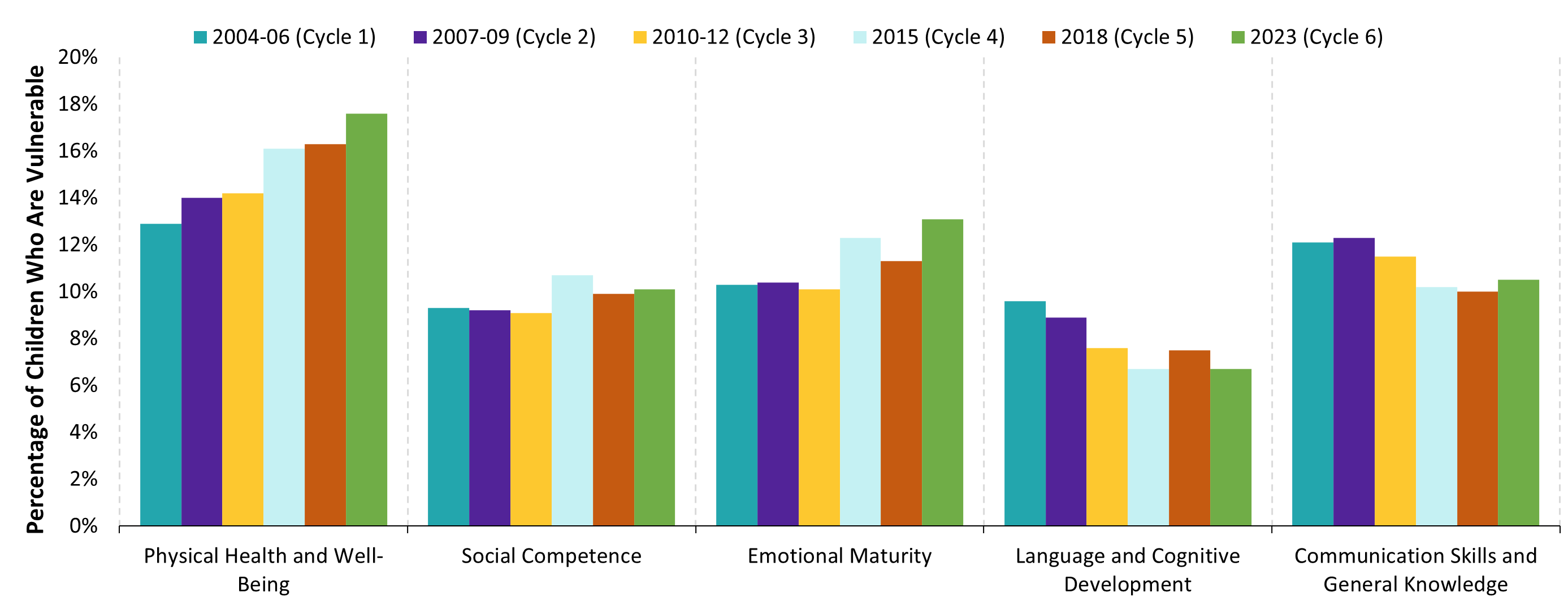
| Cycle | 2004–06 (Cycle 1) % | 2007–09 (Cycle 2) % | 2010–12 (Cycle 3) % | 2015 (Cycle 4) % | 2018 (Cycle 5) % | 2023 (Cycle 6) % |
|---|---|---|---|---|---|---|
| Physical health and well-being | 12.9 | 14.0 | 14.2 | 16.1 | 16.3 | 17.6 |
| Social competence | 9.3 | 9.2 | 9.1 | 10.7 | 9.9 | 10.1 |
| Emotional maturity | 10.3 | 10.4 | 10.1 | 12.3 | 11.3 | 13.1 |
| Language and cognitive development | 9.6 | 8.9 | 7.6 | 6.7 | 7.5 | 6.7 |
| Communication skills and general knowledge | 12.1 | 12.3 | 11.5 | 10.2 | 10.0 | 10.5 |
Data source: Offord Centre for Child Studies, McMaster University.
Figure 3: Percentage of children who are vulnerable in one or more EDI domains, Cycles 1 to 6
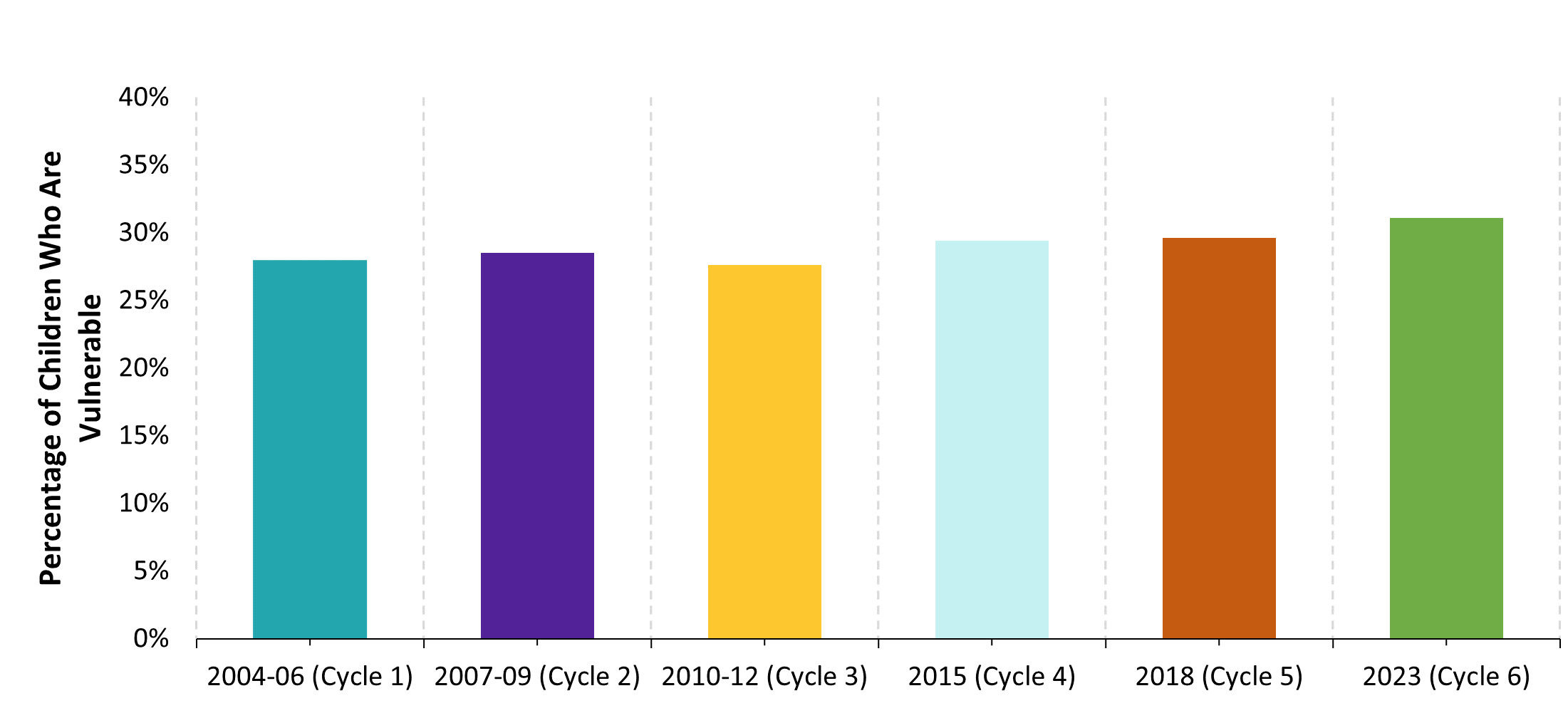
| Cycle | Percentage of children vulnerable in one or more domains % |
|---|---|
| 2004–06 (Cycle 1) | 28.0 |
| 2007–09 (Cycle 2) | 28.5 |
| 2010–12 (Cycle 3) | 27.6 |
| 2015 (Cycle 4) | 29.4 |
| 2018 (Cycle 5) | 29.6 |
| 2023 (Cycle6) | 31.1 |
Data source: Offord Centre for Child Studies, McMaster University.
Part 3: The federal-provincial early learning and child care agreements
Ontario acknowledges the Government of Canada's support in connection with the Multilateral Early Learning and Child Care Framework and the Canada-Ontario Early Learning and Child Care Agreement, Canada-Ontario Canada-wide Early Learning and Child Care Agreement, and Canada-Ontario Early Learning and Child Care Infrastructure Fund Agreement. Part 3 of this document outlines Ontario's progress towards meeting early learning and child care goals under these agreements.
Canada-Ontario Canada-wide Early Learning and Child Care (CWELCC) Agreement
In March 2022, Ontario signed the CWELCC agreement with the federal government that is helping to reduce fees for families, increase access to spaces, and support the child care workforce.
Priorities
Ontario’s Action Plan under the CWELCC Agreement outlines the key principles and priorities for this funding as well as the actions to be taken in the fiscal year 2024-2025 to work towards the goal of implementing CWELCC. The Action Plan sets objectives and targets that align with five priority areas:
- Affordability: average parent fees for children under six in participating child care programs were reduced 50%, from 2020 levels, by the end of December 2022 and will be further reduced to $10 per day inclusive of fee subsidies by the end of fiscal year 2025-26 for licensed child care spaces
- Increasing access: 86,000 new licensed child care spaces (above 2019 levels) for children under six in participating child care programs will be created by the end of 2026, and expansion will be supported in geographic areas and diverse communities where it is needed the most
- Enhancing quality: improvements to wage compensation and professional development opportunities to support the recruitment and retention of qualified professionals working in licensed child care, to support the number of RECEs and qualified staff to make up 60% of the workforce in licensed child care by 2025–26
- Supporting inclusion: more children from diverse communities and populations (such as, Indigenous, Francophone, Black and other racialized groups, newcomers, low-income families and children with special needs), can access high-quality, inclusive child care by 2025–26
- Strengthening data/reporting: Ontario’s data and reporting systems will be modernized and upgraded to effectively support implementation and measure success by 2025–26
2024 Consultations and Engagements
As part of the CWELCC agreement, Ontario has committed to extensive stakeholder engagement. In Spring 2024, Ontario initiated a series of virtual consultation sessions with 29 stakeholder groups to gather valuable input on the key pillars under the CWELCC agreement, including affordability, access, inclusion, workforce, quality and implementation and ongoing supports. Additionally, a survey for parents and guardians was open for three weeks to collect feedback on these pillars directly from families, which received close to 11,000 responses.
The consultations and survey were key opportunities to hear from a broad range of stakeholders, including families, child care providers, experts, Indigenous peoples, official language minority communities and other interested parties. These engagements were essential in shaping the direction of Ontario’s early years and child care system and are an important step in finalizing Ontario’s Action Plans.
Reporting on progress
Ontario’s CWELCC Action Plan outlines the indicators that are used to measure progress and commits to reporting on the results achieved according to the indicators and targets starting in the fiscal year 2024–25.
The sections below outline expenditures on the CWELCC initiatives for 2024–25, followed by the progress achieved, according to the indicators and targets under the five priority areas.
| CWELCC | Actual Expenditures 2024–25 ($ million) |
|---|---|
| Allocations to Service System Managers: Fee Reduction and Workforce Compensation | 1,520.7 |
| Allocations to Service System Managers: Start-up Grants | 157.4 |
| Allocations to Service System Managers: Emerging Issues | 90.3 |
| Allocations to Service System Managers: Professional Learning | 13.9 |
| Allocations to Service System Managers: Municipal Administration | 55.4 |
| Allocations to Service System Managers: Cost-Based Allocation | 1,004.1 |
| Allocations to Service System Managers: Local Priorities | 4.6 |
| Early Childhood Education Qualification Upgrade Program (ECE QUP) | 2.0 |
| Provincial Administration | 9.9 |
| Total CWELCC Expenditures | 2,858.2 |
Priority Area 1 - Affordability
In Ontario’s 2024-2025 Action Plan, the province committed to providing funding to licensed child care operators enrolled in the CWELCC system to support:
- a fee reduction of up to 25% for children aged 0 to 5 years retroactive to April 1, 2022
- a 50% fee reduction on average for children aged 0 to 5 years by the end of 2022
- $10 per day average child care fees for children aged 0 to 5 years by the end of fiscal year 2025–26
For families to receive reduced fees, individual child care licensees must enrol in the CWELCC system through their local service system manager.
By December 31, 2022, Ontario had met its first two fee reduction targets. Retroactive to April 1, 2022, parent fees for eligible children in CWELCC enrolled child care (frozen as of March 2022) were reduced by up to 25%, and then by up to 52.75% by December 31, 2022. Effective January 1, 2025, parent fees decreased to a maximum of $22/day and $19/day on average for all eligible children in CWELCC-enrolled centres/agencies.
Table 12 shows a reduction in mean parent fees by about 50% or more across all age groups and settings among CWELCC-enrolled programs as of December 31, 2024, when compared to the mean parent fees as of March 31, 2022.
| Age group | 2022 ($) | 2025 ($) (CWELCC only) | % Reduction Compared to 2022 (%) |
|---|---|---|---|
| Infant (Full Day) | 75.01 | 34.67 | -53.77 |
| Toddler (Full Day) | 62.76 | 28.17 | -55.11 |
| Preschool (Full Day) | 55.46 | 24.55 | -55.74 |
| Kindergarten (Full Day) | 49.29 | 21.11 | -57.18 |
| Kindergarten (Before and After School) | 26.07 | 13.00 | -50.12 |
| Age group | 2022 ($) | 2025 ($) (CWELCC only) | % Reduction Compared to 2022 (%) |
|---|---|---|---|
| Younger than 2 years (Full Day) | 48.69 | 22.88 | -53.02 |
| 2 to 3 years (Full Day) | 47.30 | 22.14 | -53.20 |
| 4 to 5 years (Full Day) | 43.57 | 19.83 | -54.48 |
| 4 to 5 years (Before and After School) | 27.17 | 13.38 | -50.75 |
Data source: 2022 and 2025 Licensed Child Care Operations Surveys, Ontario Ministry of Education (data as of March 31, 2022 and December 31, 2024, respectively). The 2025 Survey collected data as of December 31, 2024, prior to the introduction of a $22 per day cap for CWELCC-enrolled children; the mean daily child care fees are based on data from licensed child care programs enrolled in the CWELCC system. CWELCC fee reductions may be reduced by less than 50 per cent due to the $12 per day floor.
Priority Area 2 - Access
To increase access, Ontario is committed to creating 86,000 new licensed child care spaces for children aged 0 to 5 years (above 2019 levels) in participating child care programs by December 31, 2026. The province is working with service system managers to ensure affordable child care is available in the communities that need it most.
Start-up Grants
In December 2022, Ontario announced a $213 million Start-up Grant program to support the creation of new child care spaces in targeted regions and for underserviced communities and populations. Service system managers have identified their priority neighbourhoods and populations in their Directed Growth Plans, and licensees can apply for Start-up Grants through their service system managers.
Information about the grant was provided to service system managers in the CWELCC Guidelines released in June 2023, including a notional allocation of $54.8 million to support child care space creation in 2023.
In March 2024, Ontario released an additional $75.3 million in Start-up Grant funding to service system managers, for a total of $160.7 million in the 2024 calendar year. About $151 million in additional funds have also been allocated for 2025. This amounts to a total of $366.5 million in investments in Start-up Grants since 2023.
In 2024, the province also increased service system manager flexibility in allocating Start-up Grants to eligible centre-based licensees by removing the funding cap of $90 per square foot and by lowering the number of child care spaces for a grant of up to $350,000 in funding from every 50 to every 20 child care spaces created. Eligible home child care licensees can now receive grants of up to $1,200 per CWELCC space created, to a maximum of $7,200 per home provider, an increase from $1,000 per CWELCC space created and a previous maximum of $6,000 per home provider (see Table 13). These changes were implemented to address sector feedback on the need for more flexibility, to provide available funding sooner and to better align with actual space creation costs, while supporting Directed Growth.
| Child care space type | Prior Start-up Grant funding amounts per child care space | New Start-up Grant funding amounts per child care space | Net increase per child care space |
|---|---|---|---|
| Centre-based | $7,000 | $9,000 | $2,000 |
| Home-based | $1,000 | $1,200 | $200 |
In 2024, Start-up Grants supported 8,810 net new licensed child care spaces, among which:
- 6,701 were in centres and 2,109 in homes
- 933 were for infant, 2,749 for toddler and 5,128 for preschool
- 3,498 were for-profit and 5,312 not-for-profit.
footnote 13
Space increase
The number of licensed child care spaces for children aged 0 to 5 years, regardless of their CWELCC enrollment status, are shown in Table 14. As of March 2025, there are 359,544 licensed spaces for children aged 0 to 5 years in Ontario, an increase of 70,433 spaces from the 2019 level.
The number of CWELCC spaces for children aged 0 to 5 years are summarized in Table 15 for the available time points. As of March 2025, 328,610 licensed child care spaces in centres and homes are enrolled in the CWELCC system and 39,499 net new CWELCC spaces have been created towards the commitment of 86,000 spaces under the agreement.
| Year | 2019 | 2022 | 2023 | 2024 | 2025 |
|---|---|---|---|---|---|
| Auspice (Not-for-profit) | 194,815 | 205,673 | 222,765 | 227,237 | 233,639 |
| Auspice (For-profit) | 81,444 | 90,492 | 94,601 | 99,209 | 105,416 |
| Age Group (Infant) | 13,626 | 15,260 | 15,715 | 16,142 | 16,753 |
| Age Group (Toddler) | 46,865 | 51,888 | 53,894 | 56,314 | 59,405 |
| Age Group (Preschool) | 112,042 | 119,846 | 123,731 | 127,860 | 133,954 |
| Age Group (Kindergarten) | 103,308 | 108,247 | 123,014 | 125,118 | 127,942 |
| Age Group (Family age) | 418 | 924 | 1,012 | 1,012 | 1,001 |
| Total | 276,259 | 296,165 | 317,366 | 326,446 | 339,055 |
| Year | 2019 | 2022 | 2023 | 2024 | 2025 |
|---|---|---|---|---|---|
| Age Group (Younger than 2 years) | 3,554 | 4,255 | 4,067 | 5,464 | 5,983 |
| Age Group (2 to 3 years) | 5,350 | 5,870 | 7,080 | 10,801 | 12,187 |
| Age Group (4 to 5 years) | 3,948 | 2,351 | 2,488 | 2,448 | 2,319 |
| Total | 12,852 | 12,476 | 13,635 | 18,713 | 20,489 |
| Year | 2019 | 2022 | 2023 | 2024 | 2025 |
|---|---|---|---|---|---|
| Not-for-profit Total | 207,667 | 218,149 | 236,400 | 245,950 | 254,128 |
| For-profit Total | 81,444 | 90,492 | 94,601 | 99,209 | 105,416 |
| Total | 289,111 | 308,641 | 331,001 | 345,159 | 359,544 |
Data source: Child Care Licensing System and Licensed Child Care Operations Survey, Ontario Ministry of Education. For spaces in centres, data as of March 31 of each year. For enrollment in homes, data as of March 31, 2018, and 2022, respectively for 2019 and 2022; data as of December 31, 2022, 2023, 2024, for enrollment in homes respectively for 2023, 2024 and 2025. The data represent all licensed child care programs, regardless of whether they are enrolled in the CWELCC system and include spaces operated by First Nations.
| Type (Setting/Auspice) | 2022 | 2023 | 2024 | 2025 |
|---|---|---|---|---|
| Setting: Centres | 287,590 | 295,708 | 304,706 | 308,129 |
| Setting: Homes | 14,150 | 18,974 | 20,692 | 20,481 |
| Auspice: Not-for-profit | 227,518 | 237,026 | 245,270 | 247,537 |
| Auspice: For-profit | 74,222 | 77,656 | 80,128 | 81,073 |
| Total | 301,740 | 314,682 | 325,398 | 328,610 |
Data source: CWELCC enrollment reports from CMSMs/DSSABs. For the purposes of the CWELCC Agreement, all home child care agency licensees (as defined under the Child Care and Early Years Act, 2014) are deemed to be not-for-profit licensed child care, regardless of auspice. Data for 2022, 2023, and 2024 are as of end of December 2022, December 2023, and December 2024, respectively. Interim data for 2025 as of end of March 2025 is provided for 2025.
Priority Area 3 - Inclusion
Ontario is committed to building a child care system for all children by developing an inclusion plan that supports child care access for children in low-income families, vulnerable children, children from diverse communities, Francophones and Indigenous children.
Informed by sector consultations, Ontario released the finalized Access and Inclusion Framework in June 2023. The Framework supports service system managers in developing and implementing local service plans with increased focus on access as it relates to inclusion.
The Framework has maintained its close link with the Directed Growth strategy to create spaces in communities most in need — the allocation of nearly 86,000 net new child care spaces to service system managers — and the province’s CWELCC commitments under Ontario’s Action Plan.
The province will continue to engage with the sector on potential enhancements to the Access and Inclusion Framework, on data gathering and assessment of barriers to access and inclusion and on workforce and data collection initiatives to support ongoing CWELCC policy and program development.
The province is engaging with Indigenous partners to develop a collaborative plan to support Indigenous children and families’ access to affordable, high-quality and culturally appropriate early learning and child care. The province continues ongoing bilateral and trilateral conversations with the Government of Canada and Indigenous governments and organizations, including but not limited to First Nations, Métis, and Urban Indigenous partners.
Special Needs Resourcing
The province provides Special Needs Resourcing funding to service system managers and First Nations to support the inclusion of children with special needs in eligible licensed child care settings, including home child care, camps and authorized recreation programs, at no additional cost to parents/guardians and caregivers. Under Ontario Regulation 138/15, a “child with special needs” means a child whose cognitive, physical, social, emotional, or communicative needs, or whose needs relating to overall development, are of such a nature that additional supports are required for the child. Funding for Special Needs Resourcing may only be used to hire services to support the inclusion of children with special needs, provide professional development opportunities to staff working with children with special needs, or purchase or lease specialized equipment and supplies to support children with special needs.
In 2024, a total of $147.3 million (9.2% of provincial funding) was spent on Special Needs Resourcing, benefiting a total of 52,490 children.
French-language and bilingual programs
Ontario has committed to maintaining or increasing the level of licensed child care spaces offering French-language programs and bilingual programs for children aged 0 to 5 years by 2025–26. The province also plans to continue to meet or exceed the number of French spaces for children aged 0 to 5 years proportional to the population of French-speaking people in Ontario.
In 2021, there were 19,900 licensed child care spaces offering French-language programs and 5,600 licensed spaces offering bilingual programs for children aged 0 to 5 years. Since then, there’s been growth in both categories. As of March 31, 2025, there were 22,067 spaces offering French-language programs and 6,364 spaces offering bilingual programs for children aged 0 to 5 in the province. Approximately, 6.5% of licensed child care spaces 0-5 were in French-language programs, exceeding the French-speaking community’s population share of about 4%.
Priority Area 4 - Workforce and Quality
Under the CWELCC system, Ontario is supporting the recruitment and retention of the child care workforce through improved compensation for lower-wage earners and the development of strategies to improve recruitment and retention.
Wage Enhancement
In November 2023, a comprehensive child care workforce strategy was announced to support the recruitment and retention of RECEs through further improvements to wage compensation and professional development opportunities.
In 2025, the wage floor increased to $24.86 per hour for RECE program staff and $25.86 per hour for RECE child care supervisors and RECE home child care visitors. The wage eligibility ceiling increased to $27.00 per hour for RECE program staff and $30.00 per hour for RECE child care supervisors and RECE home child care visitors. Eligible RECEs received an up to $1 per hour wage increase on January 1, 2025, as long as their wages were below the wage eligibility ceiling.
The provincially funded Wage Enhancement Grant (WEG) also supports a wage enhancement for eligible child care professionals working in licensed child care settings. The wage floor and annual wage increase are calculated after the Wage Enhancement Grant has been accessed.
According to data reported by service system managers, in 2024:
- 12,937 RECE program staff, 907 RECE supervisors and 82 RECE home child care visitors were supported by the wage floor.
- 21,357 RECE program staff, 2,197 RECE supervisors and 131 RECE home child care visitors were supported by the annual wage increase.
footnote 17
The table below outlines the wage ranges for full-time RECE program staff, supervisors and home child care visitors working in licensed child care. From March 2022 to December 2024, wage increases are shown across all three categories.
| Hourly Wage Range | RECE Program Staff 2022 (%) | RECE Program Staff 2025 (%) | RECE Supervisors 2022 (%) | RECE Supervisors 2025 (%) | RECE Home Child Care Visitors 2022 (%) | RECE Home Child Care Visitors 2025 (%) |
|---|---|---|---|---|---|---|
| $15.00–$19.99 | 32.4 | 0.4 | 7.8 | 0.2 | 6.5 | 0.7 |
| $20.00–$25.00 | 43.8 | 24.4 | 26.3 | 4.7 | 17.4 | 4.9 |
| $25.01–$28.59 | 14.7 | 41.2 | 24.2 | 16.4 | 27.0 | 20.1 |
| $28.60–$29.99 | 2.5 | 10.8 | 7.4 | 9.5 | 10.0 | 7.8 |
| $30.00–$32.49 | 2.2 | 12.1 | 8.9 | 20.5 | 8.3 | 29.1 |
| $32.50–$34.99 | 2.4 | 6.4 | 7.5 | 14.4 | 7.0 | 14.6 |
| $35.00–$37.49 | 1.0 | 2.6 | 4.7 | 10.1 | 7.4 | 3.4 |
| $37.50–$39.99 | 0.6 | 0.9 | 3.6 | 6. 8 | 3.9 | 2.6 |
| $40.01+ | 0.4 | 1.4 | 9.5 | 17.3 | 12.6 | 16.8 |
| Total | 100.0 | 100.0 | 100.0 | 100.0 | 100.0 | 100.0 |
Data source: Licensed Child Care Operations Surveys, Ontario Ministry of Education. The 2022 survey refers to data as of March 31, 2022, and the 2025 survey refers to data as of December 31, 2024.
Percentage of Qualified Staff
Under the Child Care and Early Years Act, 2014 (CCEYA), a qualified employee for any licensed age group shall be an employee who is a member in good standing of the College of Early Childhood Educators, or is otherwise approved by a ministry director (director approved) under the Act. As of December 31, 2024, there were 40,669 full-time program staff employed by licensed child care centres, of which 24,186 (59.5%) were Registered Early Childhood Educators (RECEs) and a total of 27,085 (66.6%) were RECEs or director approved (see Table 17).
| Staff Type | 2022 | 2023 | 2024 | 2025 |
|---|---|---|---|---|
| Number of full-time RECE program staff | 19,112 | 20,947 | 22,600 | 24,186 |
| Number of full-time director-approved program staff | 2,632 | 2,545 | 3,265 | 2,899 |
| Subtotal: number of full-time qualified program staff | 21,744 | 23,492 | 25,865 | 27,085 |
| Total number of full-time program staff | 32,445 | 35,967 | 40,359 | 40,669 |
| Percentage of full-time qualified program staff (%) | 67.0 | 65.3 | 64.1 | 66.6 |
Data source: Licensed Child Care Operations Surveys, Ontario Ministry of Education. The 2022, 2023, 2024, and 2025 surveys refer to data as of March 31, 2022, December 31, 2022, December 31, 2023 and December 31, 2024, respectively.
Professional Development
In 2025, Canada and Ontario invested $18.5 million in professional development and other initiatives, to improve recruitment and retention of the Registered Early Childhood Educator (RECE) workforce and other program staff, and to support the implementation of the CWELCC Agreement.
This funding will support professional learning opportunities that build capacity of the early years and child care sector to support the provision of high-quality programs that align with How Does Learning Happen? Ontario’s Pedagogy for the Early Years, 2014. Access to continuous professional learning opportunities can support higher levels of staff engagement, growth, recognition, professional efficacy and satisfaction. Enhancing current professional learning supports to include mental health information for the child care and early years workforce will promote more meaningful relationships, enriched experiences and a greater sense of well-being for children, educators and families.
| Indicators | Targets | Results |
|---|---|---|
| Number of program staff and supervisors (RECE and non-RECE) supported through Professional Learning. | 75% of program staff and supervisors enrolled in one professional learning day | In 2024, 41,318 program staff and supervisors (RECE and non-RECE) were supported through Professional Learning, representing approximately 90.9% of full-time program staff and supervisors in the licensed child care sector. |
| Number of child care programs (centre-based and home child care agencies) and EarlyON Centres supported | 50% of child care programs and EarlyON Centres supported through Professional Learning. | In 2024, 3,183 (about 47%) child care programs and EarlyON Centres were supported through Professional Learning. |
| Number of individuals participating in mentorship programs | 25% of new program staff and supervisors participating in mentorship programs | In 2024, 12,839 individuals participating in mentorship programs. |
| Number of applications approved (including Francophone and Indigenous applications approved) under the ECE QUP. | Support approximately 1,700 ECE students through the ECE QUP grants. | In 2024–25, a total of 2,496 applications were approved under the ECE QUP. |
| Number of ECE graduates supported with one-time CECE registration fees | Support approximately 400 graduates with one-time ECE registration fees | In 2024-25, 96 ECE graduates were supported with one-time CECE registration fees. |
Priority Area 5 – Implementation and Ongoing Supports
Ontario is committed to ensuring the implementation of the CWELCC agreement is done in a manner that reflects Ontario’s principles of accountability and transparency.
To achieve this, Ontario is developing an IT solution to support greater consistency across the province, reduce administrative burden across the sector (especially for families), and support data collection and analysis, including reporting to the federal government on key indicators associated with the CWELCC system.
In 2024–25, 2.3% of the CWELCC expenditures was used for administration of CWELCC initiatives at the provincial and municipal level including associated IT costs and the implementation of the digital transformation initiative mentioned above.
Canada-Ontario Early Learning and Child Care Agreement
The federal government committed $400 million in their 2016 budget and an additional $7 billion over 10 years in their 2017 budget, to establish a Multilateral Early Learning and Child Care Framework with provinces and territories. Under the framework, the federal government, provinces and territories agreed to work together over time to achieve broad long-term goals for early learning and child care systems that are high-quality, accessible, affordable, flexible and inclusive. Provinces and territories also agreed to report annually on progress made in relation to the framework and on the impact of federal funding, while reflecting the priorities of each jurisdiction in early learning and child care.
On June 12, 2017, Ontario was the first province to sign an agreement under the framework, known as the three-year Canada-Ontario Early Learning and Child Care (ELCC) Agreement. Under the agreement, the federal government agreed to allocate $439 million to Ontario over three years (2017–18, 2018–19 and 2019–20).
This section highlights Ontario’s progress in working towards increasing quality, accessibility, affordability, flexibility and inclusion in early learning and child care under the Canada-Ontario ELCC Agreement.
Expenditures and actions
Under the ELCC agreement, Ontario received $220.2 million in federal funding in the 2024-25 fiscal year, which included $7.3 million carried forward from the 2023-24 fiscal year. Ontario’s actual expenditures in the 2024–25 fiscal year were $209.8 million.
The 2024-25 funding supported the following three action areas:
- affordable, high-quality licensed child care
- EarlyON Child and Family Centres
- high-quality training and professional learning opportunities for the early years and child care workforce
| Areas | Federal allocations | Actions | Actual expenditures ( $ million) |
|---|---|---|---|
| High-Quality Licensed Child Care | Ontario allocated $145.6 million of the federal funding for increased subsidies and access to licensed child care in Ontario. | The federal funding was provided to service system managers through provincial-municipal service agreements. In November 2023, service system managers received a consolidated 2024 service agreement and funding guidelines for licensed child care and EarlyON Child and Family Centres, including funding under the Canada-Ontario ELCC Agreement. In November 2024, funding guidelines were updated to reflect the new Cost-Based Funding approach, effective January 1, 2025. Consolidated 2025 service agreements that incorporated corresponding updates were also released. | $145.6 |
| EarlyON Child and Family Centres | Ontario allocated $60.7 million of the federal funding to support EarlyON Child and Family Programs. | The federal funding was provided to service system managers to support 776 main EarlyON Child and Family Centre locations, 533 mobile/satellite EarlyON Child and Family Centre locations and 83 EarlyON Child and Family Centres offering virtual supports across Ontario. | $60.7 |
| Professional Development | Ontario allocated $2.0 million of the federal funding to increase the number of students supported through the Early Childhood Educators Qualifications Upgrade Program. | The federal funding was provided through grants that were made available for 2024-25 to support individuals working in eligible early years and child care settings to obtain an early childhood education diploma or leadership certification. | $2.0 |
| Professional Development | Ontario allocated $5.5 million of the federal funding to support professional learning for the early years and child care workforce. | The federal funding was provided to support culturally relevant professional learning strategies for Francophone and First Nation, Métis, Inuit and Indigenous staff working in the child care and early years sector. | $1.5 |
Data source: Ontario Ministry of Education.
Licensed child care indicators
The indicators reported in this section are reflective of the areas of investment under the agreement for increasing quality, accessibility, affordability, flexibility and inclusion in licensed child care.
Quality
Staff qualifications
Ontario Regulation 137/15 under the CCEYA sets the minimum requirements for staff qualifications in licensed child care centres and home child care agencies, including requirements for the ratio of employees to children, the maximum number of children in a group and the proportion of employees that must be qualified employees in licensed child care centres, which varies for different age groups (see Table 20). The minimum requirements are as follows:
A supervisor shall be a person who:
- is a member in good standing of the College of Early Childhood Educators, has at least two years of experience providing licensed child care and is approved by a director under the Act; or
- in the opinion of a director under the Act, is capable of planning and directing the program of a child care centre, being in charge of children and overseeing staff.
A qualified employee for any licensed age group shall be an employee who:
- is a member in good standing of the College of Early Childhood Educators; or,
- is otherwise approved by a director under the Act.
With respect to a licensed junior school age group or a licensed primary/junior school age group, the following are also qualified employees:
- an individual who has a diploma or degree in child and youth care;
- an individual who has a diploma or degree in recreation and leisure services; or,
- an individual who is a member in good standing with the Ontario College of Teachers.
A home child care visitor is an employee of a home child care agency who monitors and provides support at licensed home child care premises. A home child care visitor shall be a person who:
- is a member in good standing of the College of Early Childhood Educators, has at least two years of experience working with children under 13 years old, and is approved by a director under the Act; or
- is, in the opinion of a director under the Act, capable of providing support and supervision at a home child care premises.
| Age categories | Age range | Ratio of employees to children | Maximum number of children in group | Proportion of employees that must be qualified employees |
|---|---|---|---|---|
| Infant | Younger than 18 months | 3 to 10 | 10 | 1/3 |
| Toddler | 18 months or older but younger than 30 months | 1 to 5 | 15 | 1/3 |
| Preschool | 30 months or older but younger than 6 years | 1 to 8 | 24 | 2/3 |
| Kindergarten | 44 months or older but younger than 7 years | 1 to 13 | 26 | 1/2 |
| Primary/junior school age | 68 months or older but younger than 13 years | 1 to 15 | 30 | 1/2 |
| Junior school age | 9 years or older but younger than 13 years | 1 to 20 | 20 | 1/1 |
Data source: Child Care and Early Years Act, 2014, Ontario Ministry of Education.
For further information about child care rules in Ontario, see Child Care Rules in Ontario.
The province monitors and enforces staff qualification requirements in all licensed child care centres and home child care agencies. Centres and agencies meet the requirements by employing supervisors, staff and home child care visitors who are RECEs, or through director approvals as described above. It is estimated that:
- 82% of licensed child care centres employed at least one RECE for supervisor positions.
- 98% of licensed home child care agencies employed at least one RECE for all home child care visitor positions.
Pedagogical framework
How Does Learning Happen?: Ontario’s Pedagogy for the Early Years, 2014 (HDLH) is a professional learning resource for educators and those working in early years, child care, and child and family programs. It supports pedagogy and program development in early years and child care settings by outlining goals for children, expectations for programs, and providing education on the four foundations that are important for children’s well-being and healthy development: belonging, well-being, engagement and expression. HDLH also stresses the importance of children’s learning and development through their relationships with other children, educators, and families. The Minister’s policy statement on programming and pedagogy and specific regulations under the CCEYA are in place to ensure child care licensees embed HDLH into practice.
As of March 31, 2025, all licensed child care centres and home child care agencies had achieved compliance with the requirements regarding the development and implementation of a program statement that is consistent with HDLH either before their licence was first issued or before it was renewed. The province continues to support the implementation of the HDLH pedagogy in licensed child care programs in the province.
Access
As of March 31, 2025, there were 532,525 licensed child care spaces for children aged 0 to 12 years in centres across the province, with 16,070 spaces added to the system over the previous year (see Table 21). It is estimated that there are enough spaces in licensed child care centres in 2024-25 for 26.4% of children aged 0 to 12 years in the province.
| Year |
|
|
|
|
|
|
|
|
|
|
|---|---|---|---|---|---|---|---|---|---|---|
| Child population aged 0 to 12 (million) | 1.94 | 1.95 | 1.97 | 1.98 | 1.99 | 1.98 | 1.99 | 2.00 | 2.03 | 2.02 |
| Spaces in Licensed Child Care Centres (million) | 0.39 | 0.41 | 0.43 | 0.45 | 0.46 | 0.46 | 0.47 | 0.51 | 0.52 | 0.53 |
| Percentage of children aged 0 to 12 for whom there are licensed child care spaces (%) | 20.1 | 20.9 | 21.7 | 22.5 | 23.2 | 23.4 | 23.8 | 25.2 | 25.5 | 26.4 |
Data source: Child population data from Summer 2025 population projections, Ontario Ministry of Finance. Space data from the Child Care Licensing System, Ontario Ministry of Education (as of March 31 of each year).
Affordability
The funding under the Canada-Ontario ELCC Agreement supports new full or partial fee subsidies and increased access through the following priorities:
- Supporting children aged 0–6 years through additional fee subsidies, increased access, broadly reducing licensed child care fees and by increasing affordability or not-for-profit community-based capital projects (excluding capital projects for child care programs that run during school hours for kindergarten and school age children).
- Supporting children aged 0–12 years through additional fee subsides, increased access or broadly reducing licensed child care fees and by increasing affordability.
In 2024, 106,070 children in Ontario received fee subsidies.
It is estimated that 66% of children who receive fee subsidies live in families with incomes of $40,000 and below (see Table 22).
| Family income | Percentage (%) |
|---|---|
| $20,000 and below | 36 |
| $20,001–$40,000 | 31 |
| $40,001–$60,000 | 21 |
| $60,001–$80,000 | 8 |
| $80,001–$100,000 | 3 |
| $100,000 and above | 1 |
| Total | 100 |
Data source: Estimated percentages derived from data collected in Education Finance Information System Ontario Ministry of Education. Final figures are subject to change pending ministry review.
Flexibility and inclusion
Non-standard hours
Flexibility in child care service delivery is important for meeting the needs of parents and caregivers who work non-standard schedules. In Ontario, a small proportion of licensed child care centres and home child care providers offer care during non-standard hours:
- 8.3% of child care centres reported the availability of weekend care and less than 1% reported the availability of care during the evening or overnight.
- 6.0% of home child care providers reported the availability of weekend care. 4.6% reported the availability of evening care and 2.4% reported the availability of overnight care.
Special Needs Resourcing
The province provides Special Needs Resourcing funding to service system managers and First Nations to support the inclusion of children with special needs in licensed child care settings, including home child care, camps and authorized recreation programs, at no additional cost to parents/guardians and caregivers.
A total of 52,490 children were funded through Special Needs Resourcing in 2024, the most recent year for which there is data available.
Indigenous-led child care centres
A total of 42 licensed child care centres reported that they were Indigenous-led organizations operating in urban and rural communities.
French-language and bilingual child care
As of March 31, 2025, a total of 317 centres offered French-language programs and 113 centres offered bilingual programs.
Children in licensed child care by income
The ministry does not collect income data from families that enroll their children in licensed child care. This indicator is estimated using the number of licensed child care spaces in the province and data on the distribution of families across income levels from Statistics Canada.
As of March 31, 2025, there were 532,525 licensed child care spaces for children aged 0–12 years in Ontario. Approximately 10.0% of families with children in the province earned a family income below $40,000, 38.9% earned between $40,000 and $100,000 and 51.1% earned above $100,000.
It is estimated, based on the income distribution, that:
- about 53,000 spaces are used by children from families with income below $40,000
- more than 207,000 spaces are used by children from families with income between $40,000 and $100,000
- about 272,000 are used by children from families with income above $100,000
EarlyON Child and Family Centres indicators
The indicators reported in this section are reflective of the areas of investment under the Canada-Ontario ELCC Agreement for increasing quality, accessibility, affordability, flexibility and inclusion in child and family centres.
Quality
Staff qualifications
Experiences in EarlyON Child and Family Centres are designed to foster positive outcomes and support nurturing relationships for children and their parents/guardians and caregivers based on the latest evidence and research. RECEs play a key role in delivering high-quality early years programs because they have specialized knowledge and expertise in child development and in play and inquiry-based learning.
Every EarlyON Child and Family Centre should employ at least one RECE who oversees all mandatory core services related to supporting early learning and development. If an EarlyON Child and Family Centre is unable to recruit at least one RECE to deliver these core services, the service system manager may grant an exemption from the requirement but must report the number of exemptions to the province.
EarlyON staff who are not RECEs but have more than 10 years of experience in relevant programs can be employed to meet this staffing requirement through a legacy provision.
Pedagogical framework
EarlyON Child and Family Centres are expected to provide programs that reflect the view of children, parents/guardians and caregivers and educators as competent, capable, curious and rich in potential and experience. Guided by How Does Learning Happen? Ontario’s Pedagogy for the Early Years, 2014, EarlyON Child and Family Centres offer an environment that engages parents/guardians and caregivers as co-learners and leaders in influencing positive experiences and outcomes for children, families and the community.
Access, affordability, flexibility and inclusion
As of June 2025, there were 776 main EarlyON Child and Family Centre locations and 533 Mobile/satellite EarlyON Child and Family Centre locations. In addition, there were approximately 83 EarlyON Child and Family Centres offering virtual services support to meet the needs of families across the province.
Of the total number of locations, 285 locations offered non-standard hours, 87 offered French-language programming and 119 offered Indigenous programming.
In 2024, the most recent year for which there are data available, 264,431 children were served by child and family programs at EarlyON centres,
| Item | 2023 | 2024 | Percentage Change (%) |
|---|---|---|---|
| Number of children served | 272,463 | 264,431 | -2.9 |
| Number of visits by children | 2,321,804 | 1,963,264 | -15.4 |
| Number of visits by parents or caregivers | 2,100,816 | 1,678,952 | -20.1 |
Data source: Education Finance Information System, Ontario Ministry of Education. Final figures are subject to change pending ministry review.
Professional learning indicators
The indicators reported in this section are reflective of the area of investment under the agreement for innovative approaches to providing access to high-quality training and professional learning opportunities for the early years and child care workforce.
Early childhood educators’ qualifications upgrade program
This program enables individuals working in eligible child care and early years settings to apply for grants to support them in obtaining an early childhood education diploma and becoming eligible to apply for membership with the College of Early Childhood Educators. The program also provides opportunities for leadership development, targeted to those who are working in supervisory roles or who aspire to do so and who are already RECEs. In addition, the program prioritizes Francophone and First Nations, Métis and Inuit applicants, as well as individuals working under director approvals or Letters of Permission.
Financial support is available to eligible applicants in the form of education grants, travel grants and training allowances. In 2024-25, Ontario allocated $3.5 million in provincial funding, $2 million in federal funding under the ELCC Agreement and $2 million in federal funding under the CWELCC Agreement. In 2024–25, a total of 2,496 applications were approved under the Early Childhood Educators Qualifications Upgrade Program.
Professional learning strategy for Francophone and Indigenous professionals
Given that professional learning needs are often heightened in Francophone and Indigenous communities and fewer supports are available, focused professional learning opportunities have been provided to better meet needs through more targeted, differentiated cultural and regional approaches.
In 2024–25, Ontario allocated $5.5 million in federal funding under the ELCC Agreement to three organizations to support professional learning for Francophone and Indigenous professionals in the early years and child care sector. This funding was allocated to the following organizations:
- Association francophone à l’éducation des services à l’enfance de l’Ontario (AFÉSEO) for early years and child care professionals working in francophone settings
- FIREFLY for early years and child care professionals in First Nations communities on-reserve
- Ontario Aboriginal Head Start Association (OAHSA) for early years and child care professionals working with First Nation, Métis, Inuit, or Indigenous off-reserve
Funds provided to these organizations aim to enhance culturally relevant experiences through the delivery of high-quality child care and early years programs, in alignment with How Does Learning Happen? Ontario’s Pedagogy for the Early Years, 2014. The organizations also create linkages or develop professional learning resources that are responsive to the needs of the sector. In 2024-25, approximately 6,268 child care and early years professionals were supported through the professional learning initiative.
Canada-Ontario Early Learning and Child Care Infrastructure Fund Agreement
In March 2024, Ontario and Canada signed the Canada-Ontario Early Learning and Child Care (ELCC) Infrastructure Fund Agreement for 2023-2024 through 2025-2026. Under this Agreement, Ontario’s allocation is $135,090,115 from 2023-2024 through 2025-2026. The Fund supports infrastructure projects for not-for-profit licensees enrolled in the Canada-wide Early Learning and Child Care (CWELCC) system. Ontario is allocating the total $135,090,115 in funding for the 2025 calendar year.
The goal of the ELCC Infrastructure Fund is to advance inclusion for underserved communities and vulnerable populations through the creation of net new not-for-profit CWELCC spaces focused on:
- rural and remote regions;
- high-cost urban/low-income areas;
- licensees providing care during non-standard hours; and,
- communities with barriers to accessing child care, such as racialized, Indigenous,official language minority communities, and children, parents/guardians, and employees with disabilities.
Results on Ontario's progress under the ELCC Infrastructure Fund will be available in Ontario’s Early Years and Child Care Annual Report for 2026.
2024 Consultations and Engagements
The ministry has held ongoing engagements with the child care sector on CWELCC implementation since 2022, which have included opportunities for the sector to provide feedback on capital funding initiatives in support of CWELCC. Most recently, in winter and spring 2024, the ministry facilitated consultations that elicited sector insights on CWLECC capital funding to help inform the design and implementation of the ELCC Infrastructure Fund.
Footnotes
- footnote[1] Back to paragraph The "family age group" designation allows children of different ages in the same family to be placed in the same group in a play activity room, as long as they are between the ages of 0–12 years. This designation is used by licensed child care centres and came into effect on September 1, 2017.
- footnote[2] Back to paragraph The number of approved homes in 2023-24 and 2024-25 are not comparable to previous years. In October 2023, the province revised the licensing process for approved homes to align with “active homes” operated by home child care agencies, resulting in a change in the number of approved homes.
- footnote[3] Back to paragraph Approved homes" refers to the maximum number of homes that an agency is permitted to contract with.
- footnote[4] Back to paragraph The "family age group" designation allows children of different ages in the same family to be placed in the same group in a play activity room, as long as they are between the ages of 0–12 years. This designation is used by licensed child care centres and came into effect on September 1, 2017.
- footnote[5] Back to paragraph "Active homes" refers to the number of home child care providers that have a contract/agreement with an agency.
- footnote[6] Back to paragraph "Auspice" refers to the ownership and operation of a service. In this report, licensed child care centres are categorized into two types of auspices: not-for-profit and for-profit.
- footnote[7] Back to paragraph Different sets of age categories were used to collect data for licensed child care centres and licensed home child care agencies. Age categories used for licensed child care centres are in accordance with the Child Care and Early Years Act, 2014. These age categories do not apply to licensed home child care.
- footnote[8] Back to paragraph Ontario Regulation 137/15 sets out rules under the Child Care and Early Years Act, 2014 governing staff in licensed child care centres. For each group of children in licensed child care centres, the licensee is required to employ at least one program staff member who is listed on the College of Early Childhood Educators’ Public Register as a member in good standing or who has been otherwise approved by a director. For more information, see “Staff Qualifications” under “Licensed Child Care Indicators”.
- footnote[9] Back to paragraph Data source: EarlyON web page on Ontario.ca, Ontario Ministry of Education.
- footnote[10] Back to paragraph 113,323 EDI questionnaires were analysed for Cycle 1; 110,916 for Cycle 2; 119,494 for Cycle 3; 125,858 for Cycle 4; 123,912 for Cycle 5; and 94,766 for Cycle 6.
- footnote[11] Back to paragraph "Vulnerable" describes children who score below the 10th percentile of the Ontario EDI baseline population scores. This indicates that they are struggling in comparison to the baseline population.
- footnote[12] Back to paragraph Expenditure amounts include both federal and provincial contributions. Final figures are subject to change pending the 2024-25 audit. Numbers may not add due to rounding.
- footnote[13] Back to paragraph Data source: Education Finance Information System, Ontario Ministry of Education. Final figures are subject to change pending ministry review.
- footnote[14] Back to paragraph For the purposes of this CWELCC Agreement, all home child care agency licensees (as defined under the Child Care and Early Years Act, 2014) are deemed to be not-for-profit licensed child care, regardless of auspice.
- footnote[15] Back to paragraph Data source: Education Finance Information System, Ontario Ministry of Education. The total numbers include federal, provincial and municipal funding sources. The percentage cited includes provincial and federal funding under ELCC. Final figures are subject to change pending ministry review.
- footnote[16] Back to paragraph Canadian Heritage (2024). Statistics on official languages in Canada. Canada.ca.
- footnote[17] Back to paragraph Data source: Education Finance Information System, Ontario Ministry of Education. Final figures are subject to change pending ministry review.
- footnote[19] Back to paragraph Expenditure amounts include both federal and provincial contributions. Expenditures amounts per draft 2024-25 audited financial statements. Final figures are subject to change pending the 2024-25 audit.
- footnote[20] Back to paragraph Actual allocations may vary according to the latest population estimates.
- footnote[21] Back to paragraph Expenditures amounts per draft 2024-25 financial statements. Final figures are subject to change pending the 2024-25 audit. Numbers may not add due to rounding.
- footnote[22] Back to paragraph Expenditures amounts per draft 2024–25 financial statements. Final figures are subject to change pending the 2024–25 audit. Numbers may not add due to rounding.
- footnote[23] Back to paragraph Data source: Child Care Licensing System, Ontario Ministry of Education, as of March&31, 2024.
- footnote[24] Back to paragraph The estimation does not account for children cared for in homes contracted with licensed home child care agencies. All the “Percentage of children aged 0–12 for whom there are licensed child care spaces” are updated with the Summer 2025 child population projection data, Ontario Ministry of Finance.
- footnote[25] Back to paragraph Data source: Education Finance Information System, Ontario Ministry of Education. The total number includes federal, provincial and municipal funding sources. Final figures are subject to change pending ministry review.
- footnote[26] Back to paragraph Data source: Education Finance Information System, Ontario Ministry of Education. Final figures are subject to change pending ministry review.
- footnote[27] Back to paragraph Data source: 2025 Licensed Child Care Operations Survey, Ontario Ministry of Education (as of December 31, 2024). Final figures are subject to change pending ministry review.
- footnote[28] Back to paragraph Data source: Education Finance Information System, Ontario Ministry of Education. The total number includes federal, provincial and municipal funding sources. Final figures are subject to change pending ministry review.
- footnote[29] Back to paragraph Data source: 2025 Licensed Child Care Operations Survey, Ontario Ministry of Education (as of December 31, 2024).
- footnote[30] Back to paragraph Data source: Statistics Canada. Table 98-10-0079-01 Census family total income group by census family structure: Canada, provinces and territories, census metropolitan areas and census agglomerations with parts.
- footnote[31] Back to paragraph Data source: Education Finance Information System, Ontario Ministry of Education. Final figures are subject to change pending ministry review.
- footnote[32] Back to paragraph Percentage is an estimate based on the number of children served and the total population of children in the province aged 0–6 years.
- footnote[33] Back to paragraph Data source: Education Finance Information System, Ontario Ministry of Education. Final figures are subject to change pending ministry review.