

Ontario’s Primary Care Action Plan: 1-year progress update
Learn about Ontario’s progress towards connecting every person in Ontario to primary care by 2029.
Overview: Primary Care Action Team
- February 2024: Ontario announced the first expansion of primary care teams in more than a decade, investing more than $110 million to connect up to 328,000 people to primary care.
- December 1, 2024: Based on the success of recent primary care team expansion, Ontario established the Primary Care Action Team (PCAT), led by Dr. Jane Philpott, with a mandate to connect every Ontarian to primary care by 2029.
- January 27, 2025: The government launched the Primary Care Action Plan, with the goal of attaching everyone in Ontario to a publicly funded primary care clinician or team by 2029. This plan is supported by a historic $2.1 billion provincial investment, which builds on the government’s February 2024 investment of $110 million.
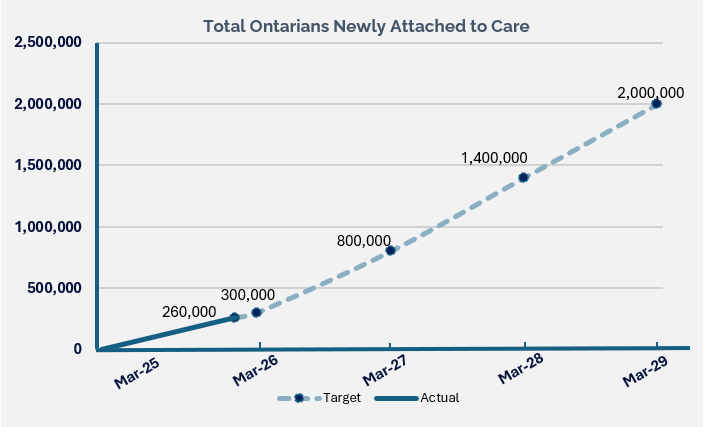
- January 2026: Ontario marked one year since the launch of the Primary Care Action Plan, with the province on track to meet its first-year goal of attaching 300,000 patients in Ontario to primary care.
Investments to date
Through Your Health: A Plan for Connected and Convenient Care, the Ontario government continues to take action to grow the province’s highly skilled health-care workforce and ensure people and their families have access to high-quality care, closer to home, for generations to come.
- Ontario invested $110 million in 2024 to create 78 new and expanded primary care teams, now fully operational and serving over 490,000 people, surpassing the target of 328,000.
- The government is implementing the largest medical school education expansion in more than a decade, adding 340 undergraduate seats and over 550 postgraduate positions over five years.
- In the 2025 Ontario Budget, the government announced an investment of almost $160 million over three years to expand the Ontario Learn and Stay Grant to future family medicine physicians. The grant will cover direct educational costs, including tuition and fees, for those who commit to practising comprehensive family medicine for a term of service anywhere in the province.
- The Practice Ready Ontario program, launched in 2023, accelerates the integration of internationally trained physicians by removing unnecessary re-education requirements.
- Ontario announced $4.2 million to expand nursing education across the province in June 2025. An additional $56.8 million was committed in August 2025 to train 2,200 more nurses.
- Ontario is investing nearly $60 billion to build and upgrade more than 50 new hospitals across the province.
Closing the gap
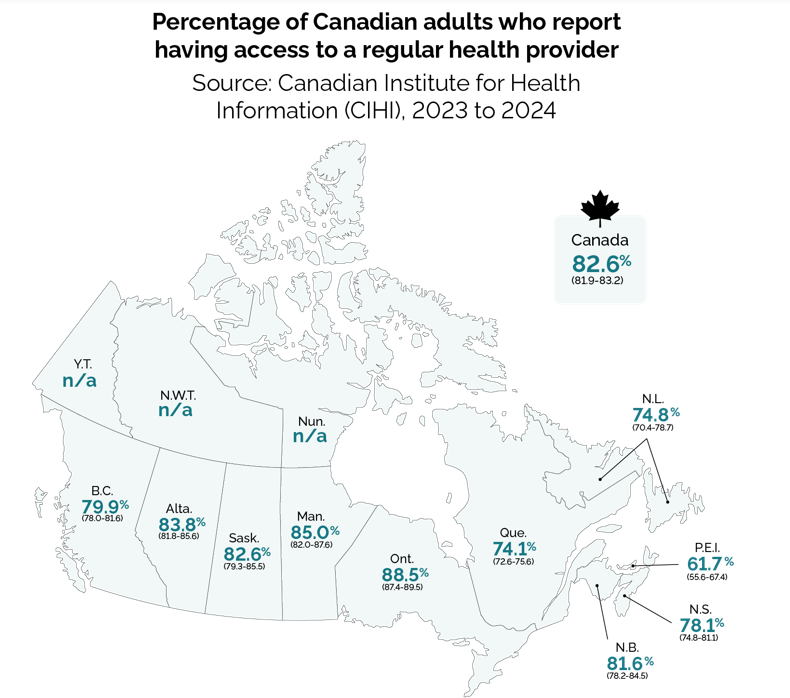
- According to the Canadian Institute for Health Information, Ontario leads the country with access to a regular health-care provider.
- To support the Primary Care Action Team’s mandate, the Ministry of Health worked with INSPIRE-PHC, a network of primary care researchers, to develop an updated methodology for determining how many patients are attached to primary care.
- Based on the updated methodology, as of June 2025, there are approximately 1.98 million people not attached to primary care in the province.
- Initiatives through the Primary Care Action Plan will close the gap for the remaining two million Ontarians who want to connect to primary care, achieving the goal of connecting every person in Ontario to primary care.
Ontario’s Primary Care Action Plan
Mandate: Attach two million more people to primary care by 2029.
Connecting you to a primary care team
- Create and expand up to 300 additional primary care teams. These teams bring together health professionals—such as doctors, nurses, social workers, and dietitians—to provide coordinated, comprehensive care.
- Invest more than $235 million in 2025–26 to establish and expand approximately 130 additional primary care teams across the province, attaching 300,000 more people to primary care this year as a first step toward connecting everyone in the province to primary care.
- In June 2025, Ontario became the first Canadian jurisdiction to pass legislation identifying primary care as the foundation of the health system and outlining what people can expect when accessing care.
- Provide regular public updates on progress and performance in achieving the Primary Care Action Team’s mandate.
Making primary care more connected and convenient
- Modernize Health Care Connect to improve the user and provider experience, with the goal of establishing a wait time target of no more than 12 months.
- Connect everyone (as of January 1, 2025) on the Health Care Connect waitlist to a primary care team by Spring 2026.
- Enhance digital tools for providers and patients, improving patient navigation, reducing administrative burden and improving the referral process.
- Leverage Health811 to view online health records, book an appointment with their primary care provider, and discover care options.
- Set regular performance indicators of primary care teams.
Supporting primary care providers
- Introduce targeted strategies to recruit and retain the workforce needed to support primary care providers and teams, including family doctors, nurse practitioners and other allied health professionals.
- Address administrative burden with digital tools, targeted recruitment and retention strategies for northern and rural communities and ensure all of Ontario’s highly qualified health-care professionals can work to their full scope of practice.
- Add and expand community-based primary care teaching clinics in collaboration with academic institutions and other partners. These clinics train family doctors and other professionals — such as nurse practitioners, physician assistants, and registered nurses — by combining patient care with hands-on learning.
Connecting everyone by 2029
Multiple strategies are being used to attach every person in Ontario to primary care, including but not limited to:
- Funding of up to 300 new and expanded interprofessional primary care teams.
- Clearing the Health Care Connect waitlist (as of January 1, 2025).
- Impact of the 2024–28 Physician Services Agreement.
- Negotiated agreement between the Ministry of Health and the Ontario Medical Association, which will improve access to primary care and help retain and attract new doctors.
- This includes modernizing the Family Health Organization (FHO) model with the goal of enhancing access to ongoing, comprehensive primary care.
- Existing programs, such as Practice Ready Ontario and the Ontario Learn and Stay Grant continue to support the primary care workforce.
Primary care team expansion timelines
February 2024: $110 million investment to fund 78 new and expanded primary care teams, connecting 328,000 people to care.
January 2025: $2.1 billion Primary Care Action Plan released.*
April 2025: Launched 2025–26 call for proposals to create or expand up to 80 primary care teams, attaching 300,000 more people to care.
May 2025: Introduced the Primary Care Act, 2025. Announced investment of $300 million into new and expanded primary care teaching clinics.
June 2025: $235 million investment in 2025–26 to fund 75 proposals for 130 new and expanded primary care teams, attaching 300,000 people by July 2026.
September 2025: Launched 2026–27 call for proposals to create and expand up to 75 primary care teams, attaching 500,000 more people to care.
Spring 2026: Teams selected through the 2026–27 call for proposals receive funding.
*The original investment was for $1.8 billion. Through the Budget 2025 announcement of $300 million into new and expanded primary care teaching clinics, the total investment into the Primary Care Action Plan was increased to $2.1 billion.
Primary Care Action Plan: Targets & timelines
| 2025–26 | 2026–27 | 2027–28 | 2028–29 | Total | |
|---|---|---|---|---|---|
| New people to be attached | 300,000 | +500,000 | +600,000 | +600,000 | 2,000,000 |
| People attached | ~275,000 (as of September 30, 2025) | TBC | TBC | TBC | TBC |
- From January 1 to September 30, 2025, ~275,000 people have been attached to primary care.
- Ontario is on track to meet or exceed its target of 300,000 attached in 2025–26. Full-year data through to the end of 2025 will be available as of June 2026.
2025–26 primary care team expansion
- In April 2025, the Ministry of Health, in collaboration with Ontario Health, launched a call for proposals to create and expand up to 80 new primary care teams to attach 300,000 people to primary care.
- The call targeted 125 communities, identified by postal code, which have the highest number of people not attached to primary care, including those on the Health Care Connect waitlist.
- Teams were expected to establish a plan to attach a high proportion of unattached people in their postal codes, including those on the Health Care Connect waitlist.
- In June 2025, 75 proposals representing over 130 primary care teams were funded, including:
- Six new primary care teams; all others are expansions of existing primary care teams.
- Five primary care teams led by Francophone providers, with many other teams partnering with Francophone organizations.
- 13 new or expanded Indigenous Primary Health Care Organizations.
Impact of primary care teams across the province
Port Arthur Health Centre — Thunder Bay
- New Family Health Team
- $958,500 in funding
- Target of ~3,000 patients attached by July 2026
- Over 3,000 patients attached as of November 30, 2025
Superior Family Health Team — Sault Ste. Marie
- Expanded Family Health Team
- $539,400.00 in funding
- Target of ~1,800 by July 2026
- Over 700 patients attached as of November 30, 2025
Woolwich Community Health Centre — St. Jacobs
- Expanded Community Health Centre
- $913,600 in funding
- Target of ~2,800 patients attached by July 2026
- Over 1,500 patients attached as of November 30, 2025
Erie Shores Family Health Team — Leamington
- Expanded Family Health Team
- $913,600 in funding
- Target of ~2,700 patients attached by July 2026
- Over 1,570 patients attached as of November 30, 2025
Équipe de santé familiale académique Montfort — Ottawa
- Expanded Francophone Family Health Team
- $430,200 in funding
- Target of ~2,300 patients attached by July 2026
- Over 650 patients attached as of November 30, 2025
North Peel Family Health Team — Brampton
- Expanded Family Health Team
- $1,131,000 in funding
- Target of ~2,400 patients attached by July 2026
- Over 1,830 patients attached as of November 30, 2025
Health Care Connect: Ontarians cleared from the January 1, 2025 waitlist
Since the launch of the Primary Care Action Plan, the government has reduced the Health Care Connect waitlist (as of January 1, 2025) by 177,108.
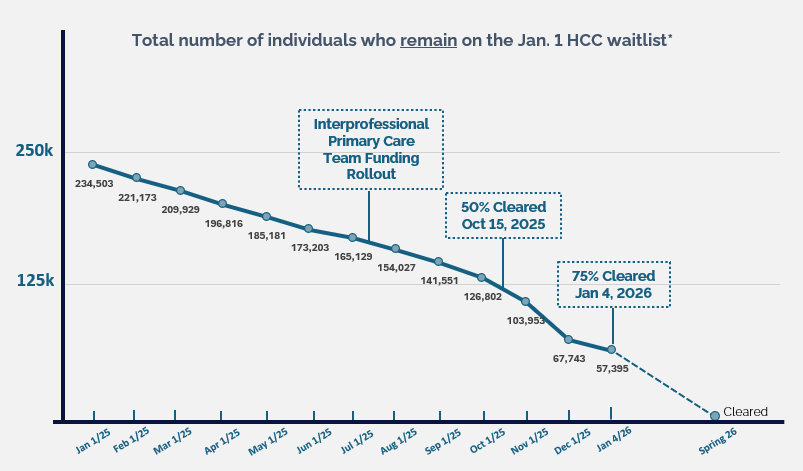
*Data as of January 4, 2026.
Established in 2009, Health Care Connect (HCC) is a provincial program that matches unattached patients seeking attachment with a family doctor or nurse practitioner (NP).
Patients can register for HCC online or over the phone. To be eligible for the program, patients must:
- be eligible for the Ontario Health Insurance Plan
- consent to have their information used to support their attachment to primary care
Care Connectors (CCs) work to connect patients to providers who are best suited to their needs. CCs also conduct outreach to family doctors and NPs to accept patients from the program.
When a provider match is found, a referral is made and an initial appointment is arranged.
It is voluntary for a patient, family doctor, or nurse practitioner to participate in HCC.
More Ontarians attached to ongoing primary care
Ontario leads the country in the percentage of people with regular access to a primary care provider or team and has made further progress with an approximately 275,000 people attached between January 1 and September 30, 2025, for a total of approximately 14 million. This puts Ontario on track to meet or exceed its goal of attaching 300,000 people to primary care in the first year of the Primary Care Action Plan.
| Jan to Mar 2025 | Apr to Jun 2025 | Jul to Sep 2025 | Net new attachments | |
|---|---|---|---|---|
| Net new attachments per quarter | 93,277 | 76,371 | 105,904 | 275,552 |
| Total population attached | 13,834,916 | 13,911,287 | 14,017,191 | N/A |
Attachment estimates are approximately one quarter behind due to data availability.
Next steps
- The 2026–27 call for proposals will invest over $250 million in approximately 75 new and expanded primary care teams to connect 500,000 more people to care, with selection and funding occurring by Spring 2026.
- Selection of locations for primary care teaching clinics and funding to support early capital planning.
- Minister of Health to release annual report outlining how the government is achieving objectives outlined in the Primary Care Act, 2025 in June 2026.
Appendix
Calculating primary care attachment
- To support the Primary Care Action Team’s mandate, the Ministry of Health developed a methodology for determining how many patients are attached to a primary care clinician, such as a family doctor or nurse practitioner.
- This methodology builds upon the previous methodology developed by INSPIRE-PHC, a network of primary care researchers. INSPIRE-PHC provided input and validation throughout the process.
- Key additions in the new methodology include:
- Use of more recent population and patient data.
- Those with care available through rural and northern physician funding catchment areas.
- Inclusion of individuals receiving care from Nurse Practitioner-Led Clinics.
- Updated criteria for defining attachment to physicians providing comprehensive primary care.
- As of September 2025, there were approximately 1.98 million people not attached to primary care in the province.
Steps taken to improve Health Care Connect
- Contacted everyone on the waitlist (as of January 1, 2025) by letter, text, email, and phone to confirm their information, including health needs, address, and whether they still need a primary care provider.
- Created an online option so people registered with HCC can update their information through a web page.
- Removed the de-enrolment requirement so patients don’t have to leave their current provider before registering for HCC (for example, if they are moving or their provider is retiring).
- Strengthened connections between HCC care connectors and local primary care to better match available capacity with demand from those on the HCC waitlist.
- Ontario Health Teams are able to securely access provincial HCC data systems and coordinate local primary care to match patients based on their health needs or preferences.
- Primary care teams funded through the 2025–26 call for proposals (excluding Indigenous Primary Health Care Organizations) must meet specific targets for attaching patients from the HCC waitlist — up to 80% of their total attachments in some cases.