

Appendix F: Provincial Emergency Operations Centre section responsibilities
A summary of the major components of the Provincial Emergency Operations Centre (PEOC) and their core functions follows. The responsibilities of the PEOC staff under each provincial response level will be described in the PEOC Procedures.
F.1. Command and Command Staff
F.1.1. Commander
The responsibilities of the PEOC Commander include:
- providing coordination of allocated emergency response resources
- identifying and resolving operational issues and approve the incident action plan (IAP)
- identifying unresolved issues to be addressed by the Chief, Emergency Management Ontario (EMO), the Commissioner of Emergency Management (CEM) , the Minister of Emergency Preparedness and Response and the Cabinet Committee on Emergency Management (CCEM)
- providing advice, assistance and recommendations to the CEM and the CCEM
- implementing the emergency response decisions made by the CEM and the CCEM
- issuing operational directives and guidance to include advisories and Emergency Bulletins
- consulting with Commanders of emergency operations centres (EOCs) (for example, community EOCs) and ministry actions groups
The PEOC Commander is supported by the following Command Staff:
F.1.2. Safety officer
The safety officer is responsible for monitoring, tracking and ensuring the health and safety of all personnel working at the PEOC.
F.1.3. Liaison officer
The liaison officer serves as the link between the PEOC Commander and other organizations involved in emergency response management outside the provincial emergency response organization (ERO) (for example, other provinces and states).
F.1.4. Emergency information officer
The emergency information officer (EIO) is responsible for coordinating between the PEOC Commander and other staff in the PEOC, and the Provincial Emergency Information Section (PEIS). These responsibilities include:
- ensuring Command-identified emergency public information issues are communicated to the PEIS to be incorporated into the emergency public information messaging
- ensuring that the communication plan, plan amendments and any emergency public information issues that may affect the overall response are communicated to Command and the PEOC
The responsibilities of the PEIS are described in Section 6.15.2.
F.2. Operations Section
The Operations Section, led by the Operations Section Chief, shall:
- implement the IAP
- disseminate information products within the PEOC as well as to the larger emergency management organization
- maintain incident documentation
- provide operational input to the decision-making process
- provide operational input to information and situational awareness products
- implement operational decisions by issuing advice or direction as appropriate
- coordinate operational resources necessary for response
- ensure response coordination between other ministries, federal government and other organizations
- ensure complementarity of actions taken by other ministries and organizations
- deploy staff and teams of staff as required to the site of the emergency
- monitor and coordinate deployed provincial resources
F.3. Planning Section
The Planning Section, led by the Planning Section Chief, shall:
- collect, confirm and analyze incident information
- prepare provincial information products
- manage the planning process, including preparing and documenting the incident action plan for each operational period.
- conduct long-range and/or contingency planning
- develop plans for demobilization in preparation for when the incident winds down
- tracking resources assigned to the incident
- managing the activities of technical specialists assigned to the Planning Section
- working closely with Command and members of the General Staff to be sure that information is shared effectively and results in an efficient planning process to meet the needs of the incident
F.4. Logistics Section
The Logistics Section, under the direction of the Logistics Section Chief, shall:
- obtain, maintain and account for essential personnel, equipment and supplies beyond those immediately accessible to Operations
- develop the telecommunications plan
- providing incident telecommunication or IT services and resources
- manage food services
- set up and maintaining incident facilities
- provide medical services to incident personnel
F.5. Finance and Administration Section
The Finance and Administration Section, under the direction of the Finance and Administration Chief, shall:
- monitor sources of funding
- track and report on the financial usage rate
- track timesheets for incident personnel and equipment
- make reimbursements or compensation as appropriate
- negotiate and administrate contracts as appropriate
- make cost estimates for alternative response strategies
- prepare cost analyses
Figure F-1: PEOC Organizational Chart
- Command and Command Staff
- Safety Officer
- Liaison Officer
- Emergency Information Officer
- Operations Section
- Planning Section
- Logistics Section
- Finance and Admin Section
Download printer-friendly PEOC Organizational Chart (PNG, 68 KB).
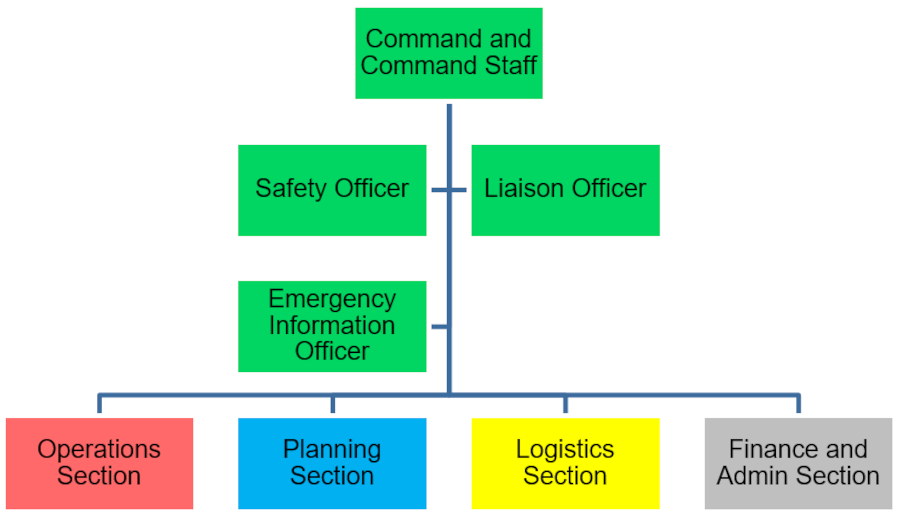
Figure F-1 outlines the incident management structure the Provincial Emergency Operations Centre utilizes including command and command staff and operations, the planning, logistics, and finance and administration sections.