

Context
Overview of FASD
FASD is a diagnostic term used to describe the health effects on the brain and body of individuals prenatally exposed to alcohol.
Children/youth who are living with FASD are often described as friendly, creative, caring, bright, and hard-working.
FASD is a whole-body disorder and a lifelong disability. Individuals who are living with FASD will experience some degree of challenge in daily living and may require support with motor skills, physical health, learning, memory, attention, communication, emotional regulation, and social skills to reach their full potential.
Each individual living with FASD is unique and has both areas of strengths and challenges.
FASD also has wide-ranging and complex effects, including:
- Approximately 90% of individuals living with FASD will experience at least one mental health issue in their lifetime.
footnote 1 - Educational challenges, learning disabilities, and neurodevelopmental diagnoses are common among individuals living with FASD.
footnote 2 - There are high rates of FASD in youth and adult justice systems.
footnote 3 - Individuals living with FASD are 100 times more likely to be diagnosed with a physical health condition than the general population.
footnote 3 - 58% of individuals living with FASD report experiencing difficulties with social competency when interacting with others.
footnote 3 - 32% of children/youth living with FASD are in foster or group care.
footnote 3 - 55% of students living with FASD are reported to display disruptive behaviour in the classroom.
footnote 3
There is no cure for FASD; however, early intervention and appropriate support can improve outcomes for children/youth who are living with FASD and their family/support network. While obtaining an FASD diagnosis can be beneficial for supporting early, tailored intervention, it can also be challenging. As such, a diagnosis is not required to access FASD Coordination Services.
The family/support networks of children/youth living with FASD also demonstrate resilience and strength.
Raising awareness about the unique nature of FASD through knowledge mobilization can help reduce service barriers and support healthier outcomes.
Causes of FASD
FASD is caused by prenatal alcohol exposure.
Alcohol is a neurotoxin that can harm cell development. Prenatal alcohol exposure passes to the developing fetus and may harm the fetus’s brain and body.
Even low levels of prenatal alcohol exposure can impact a child’s development. There is no known safe amount of alcohol to consume during pregnancy.
People may drink alcohol during pregnancy for many reasons, including not knowing they are pregnant. This should be approached with empathy and without judgment. Providing respectful, non‑judgmental support helps improve outcomes for both parents and their children or youth.
Prevalence of FASD
Researchers have estimated that:
- At least 4% of individuals in Canada are living with FASD, which translates to over 1.5 million people.
footnote 3 - 2–3% of children aged 7–9 years in the Greater Toronto Area are living with FASD.
footnote 3 - Up to 11% of children/youth in care in Canada are living with FASD.
footnote 3
FASD is an under-recognized disability and may not always be visible, as most individuals living with FASD do not have physical signs.
Guiding principles
These guiding principles for the delivery of FASD Coordination Services outline the foundational approaches that support the effective implementation of tiered services.
FASD-informed
Services are based on the understanding that FASD is a whole-body, permanent disability with wide-ranging effects on physical, behavioural, cognitive, social, and emotional functioning. FASD Coordinators adjust expectations and make service delivery modifications to align with the child/youth’s unique presentation. This includes recognizing the impact of social determinants of health and potential grief and loss, including for the family/support network.
Child- and family-centred
Services are founded on values, attitudes, and approaches that recognize each child/youth and family/support network as unique and as the experts on their abilities and needs. Services are delivered in a manner that is respectful, empathic, and responsive to these specific needs.
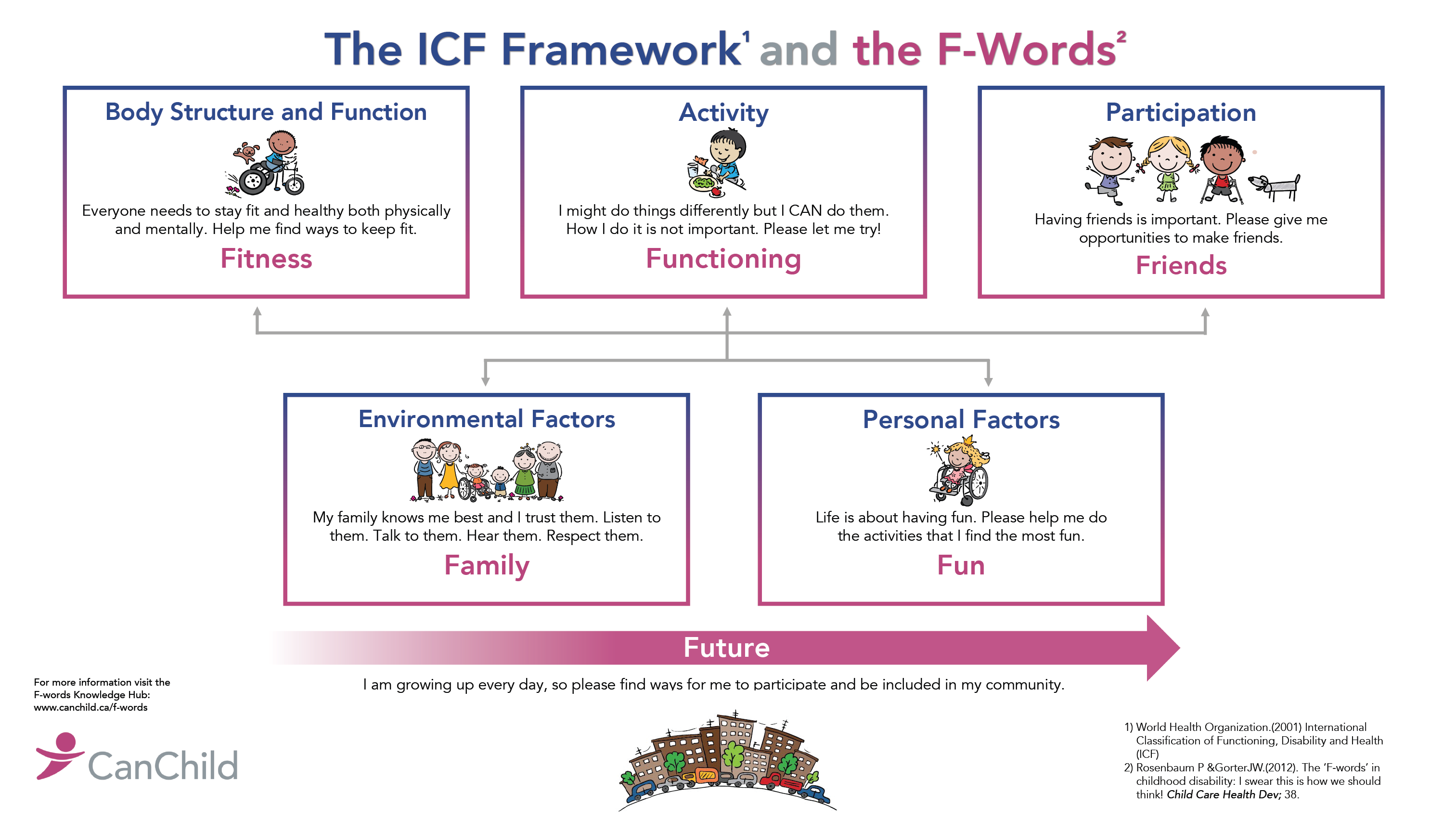
The F-Words for Child Development (Function, Family, Fitness, Friends, and Future) are applied to promote a strengths-based, family-centred, and holistic approach to service delivery by prioritizing meaningful and functional SMART (specific, measurable, achievable, relevant, and time-bound) goals and outcomes.
International Classification of Functioning (ICF) framework of the F-Words for child development
Trauma-informed
FASD Coordinators recognize that children/youth and their families/support networks may have past, current, or intergenerational experiences of abuse, violence, victimization, trauma, or stigmatization. Children/youth who are or may be living with FASD may also experience traumatic events more deeply.
FASD Coordinators understand that observed behaviours may be a form of communication, a reflection of unique patterns of brain functioning, and understandable responses to stress, fatigue, or trauma. FASD Coordinators work to communicate with children/youth in a way that they can understand and to build trust and positive relationships to support psychologically safe environments.
FASD Coordinators also acknowledge their own training and support needs, as they may be at risk of developing vicarious trauma while supporting children/youth and their families/support networks.
Equitable and culturally safer
FASD Coordinators support the diverse needs of families/support networks in culturally safer ways and promote equity, anti-oppression, anti-ableism, and anti-racism. They engage thoughtfully with families/support networks and equity-deserving groups in culturally humble ways that recognize and address intersectionality and power imbalances.
FASD Coordinators also seek to ensure that support for First Nations, Métis, and Inuit children/youth build on their unique cultural strengths by connecting them to service providers from their communities whenever possible, incorporating traditional and/or spiritual practices where appropriate, and valuing holistic identities.
Collaboration and partnerships
FASD Coordinators engage as leaders and collaborators within the broader service system, working with partners in the planning and delivery of child- and family-centred services and supports in their communities. They build relationships with families/support networks, local cross-sector partners, and equity-deserving groups to promote early FASD identification, timely intervention, and access to services.
Seamless service delivery
FASD Coordinators are leaders and drivers of change within their agencies. They apply a systems lens when coordinating services within their service delivery areas so that families/support networks may experience equitable access and a more streamlined and integrated service journey, without having to repeatedly share their story.
Footnotes
- footnote[1] Back to paragraph CanFASD - What is FASD?
- footnote[2] Back to paragraph Pei et al. (2011). Mental health issues in fetal alcohol spectrum disorder.
- footnote[3] Back to paragraph CanFASD. Towards Healthy Outcomes 2.0 (PDF).
- footnote[4] Back to paragraph Flannigan et al. (2018). Strengths Among Individuals with FASD (PDF).