

Performance measurement
Overall approach
Performance measurement helps MCCSS monitor and evaluate the extent to which FASD Coordination Services are achieving their goals, demonstrating progress towards desired outcomes, and supporting informed decision-making. Measuring the progress, outcomes, and impact of FASD Coordination Services is an iterative process, meaning that the ministry may update the guidelines based on implementation learnings and best practices that are developed by FASD Coordinators and community partners.
Performance measurement framework
The performance measurement framework for FASD Coordination Services was developed based on common measures for early intervention and special needs programs related to four outcome domains: service access, experiential, functional, and system outcomes.
The performance measurement framework will be used to monitor the performance of coordinating agencies to address these key questions:
- Are coordinating agencies implementing FASD Coordination Services as outlined? What are the facilitators and barriers to implementation? What impact are FASD Coordination Services having on early identification and awareness of services? Are FASD Coordination Services achieving family-centred service delivery?
- Are FASD Coordination Services building capacity for service providers and families/support networks?
- Are FASD Coordination Services improving coordination and collaboration across FASD service providers?
These questions align with the following immediate, intermediate, and long-term outcomes:
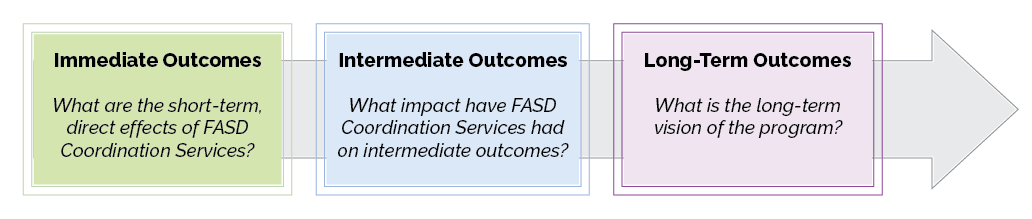
Immediate outcomes (~1-year post-implementation)
- Families/support networks are aware of available FASD services for children/youth who are or may be living with FASD.
- FASD Coordination Services are coordinated and collaborative for children/youth and families/support networks.
Intermediate outcomes (~2-5 years post-implementation)
- Children/youth and families/support network’s FASD Coordination service needs are identified as early as possible.
- Children/youth and families/support networks have equitable access to FASD Coordination services.
- FASD Coordinators have the capacity to support families/support networks of children/youth with FASD.
- Families/support networks have the capacity to support their children/youth with FASD.
- Families/support networks receive family-centred FASD Coordination services to support their children/youth.
Long-term outcomes
- FASD Coordinators and their communities have the capacity to respond to the needs of children/youth and families/support networks living with FASD and fulfill their essential role within a coordinated system of early identification and intervention services.
- Children/youth and families/support networks receive services that improve the child’s/youth’s well-being, including physical, mental, emotional, and social functioning.
Provincial performance monitoring
Performance measures to assess these outcomes are being developed by MCCSS in consultation with community partners and coordinating agencies.
Future reporting requirements may consist of the below approaches to address key questions:
- Service Data
- Supplementary Narrative Reporting