
A changing lake
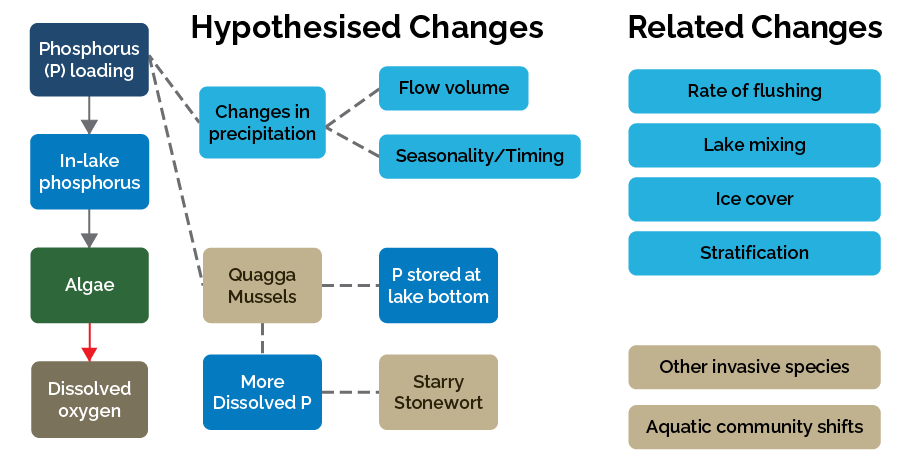
The connection between phosphorus inputs to a lake and its water quality has been the foundation of lake management for over 6 decades (Vollenweider 1979), including for Lake Simcoe (left side Figure 54). However, Lake Simcoe no longer appears to be functioning as previously understood. There appear to have been dramatic changes in the delivery to and cycling of phosphorus in the lake that have been largely driven by changes in the climate and new invasive species.
Re-evaluation of established lake management relationships
The relationships connecting phosphorus loading into Lake Simcoe and dissolved oxygen concentrations in the deepwater of the lake were described by Nicholls (1997) in the 1990s (left side of Figure 54). These relationships were used to set goals and targets in the LSPP related to the restoration of the lake’s coldwater fish community. The relationships were continually evaluated in the following years. Up to 2009, observations for Lake Simcoe corresponded to these well-established and widely-used ecological relationships (Young et al. 2011, Young and Jarjanazi 2015). However, after 2009, phosphorus loading no longer appeared to be a good predictor of end of summer dissolved oxygen (DO), suggesting changes had occurred in the lake. Beginning in 2010 and in every year except 2021, measured deepwater DO was much higher than would be predicted from phosphorus loadings (averaged over 5 years) using the well-established relationship (Figure 55).
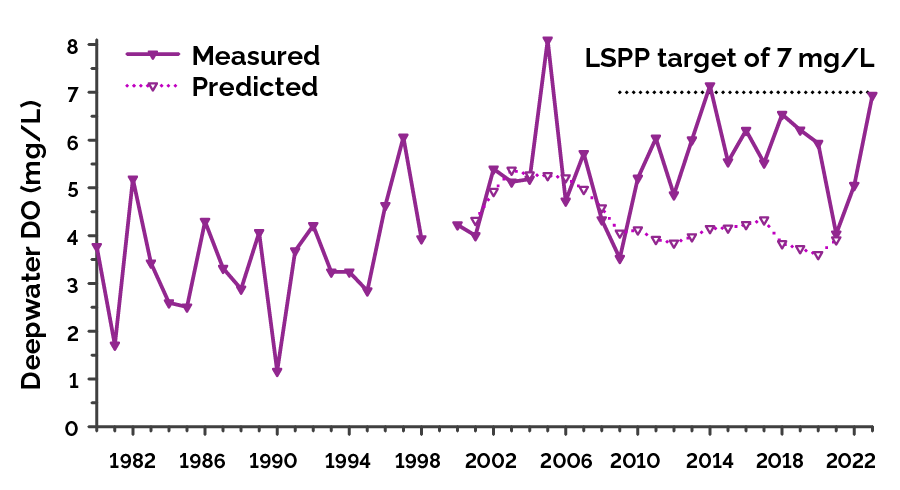
Analyses identified that 2 of the relationships connecting phosphorus loads to dissolved oxygen concentration have changed:
- 1st relationship: After 2009, while phosphorus loads into the lake at times were still high, the concentration of phosphorus in the lake had continued to decline (as was discussed in the Water Quality section). Thus, in-lake phosphorus concentration was lower than expected based on phosphorus loading measurements.
- 2nd relationship: With lower phosphorus concentrations in lake water from 2009 onwards, the amount of phytoplankton, which is measured by chlorophyll-a, was also expected to be low because phosphorus is typically the limiting nutrient for phytoplankton growth. This indeed was observed (see Water Quality section). However, chlorophyll-a was even lower than would be expected. Possible explanations for the lower chlorophyll-a concentration are that phytoplankton was either:
- not being produced
- being consumed, most likely by dreissenid mussels as abundances of zooplankton grazers were also low at this time
Changes in delivery of phosphorus input to the lake
With a changing climate affecting air temperatures and precipitation patterns, both the timing and quantity of phosphorus inputs to the lake have also changed substantially in recent years. The largest delivery of phosphorus to the lake historically occurred during spring when the snow melted. More recently, however, there have been rain events that, because of the timing, cannot infiltrate into the soil and instead flow rapidly into tributaries increasing flow volume and the amount of phosphorus.
In summer, there have been high-volume downburst rain events and in winter, rain, rather than snow, has been falling on frozen ground. For example, a 62.6 mm rain event fell overnight on June 22, 2017, causing widespread flooding in downtown Newmarket and delivering 12.6 tonnes of phosphorus to the lake (11% of the annual load). Likewise, a winter rain event in February 2018 delivered 9% of the annual load.
In these 2 months alone, 52 tonnes of phosphorus was delivered to the lake, contributing to the very high phosphorus load in the 2017 hydrologic year based on data collected by the LSRCA with support from the MECP. These changes are identified in the middle of Figure 54 as hypotheses about changes to phosphorus input to the lake. Shifts in the timing of delivery of phosphorus to the lake are likely affecting how the lake responds, especially through seasonal processes such as biological uptake of phosphorus.
Changes in phosphorus cycling in the lake
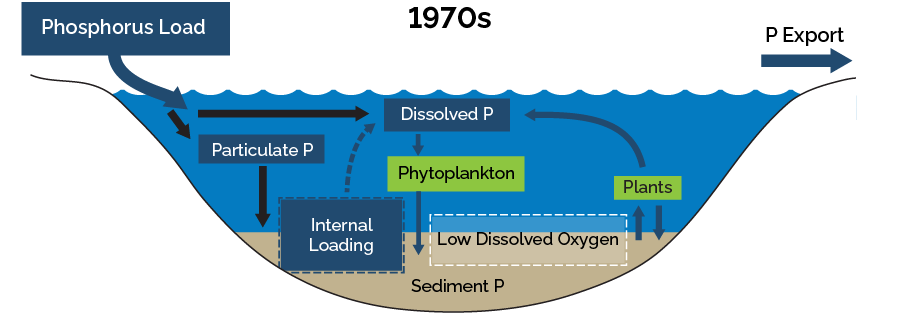
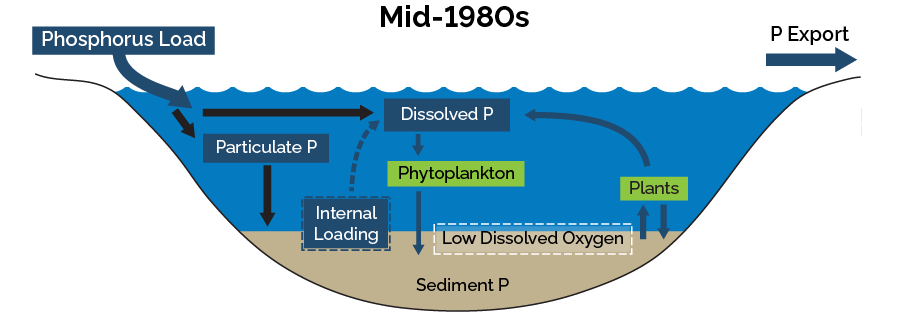
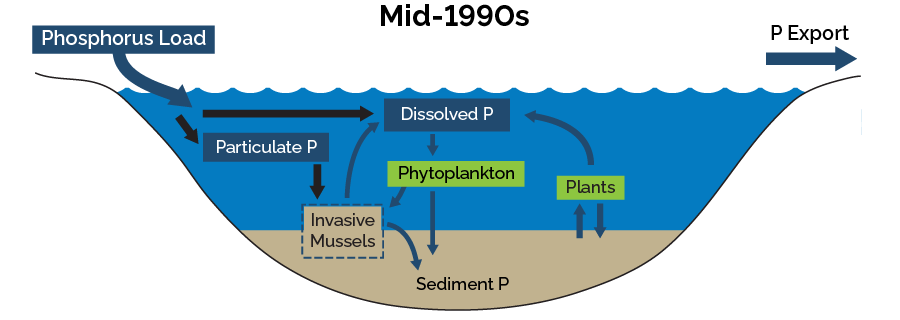
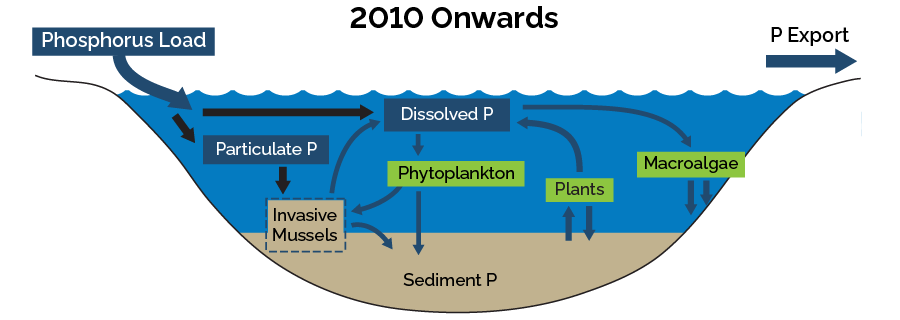
The changes in phosphorus cycling driven by invaders (as described below in Figure 56c, d) have been further complicated by changes in the timing and magnitude of seasonal processes due to climate change. Changes in seasonal air temperatures, leading to earlier and longer stratified periods, could be leading to changes in the timing and duration of biological growth and phosphorus cycling. Additionally, changes in the timing of feeding by invasive mussels further complicates the seasonality of phosphorus cycling.
During the zebra mussel period, Baranowski et al. (2013) suggested that the fall phytoplankton ‘bloom’ in Lake Simcoe was eliminated. Zebra mussels, however, only covered the nearshore lake bottom while quagga mussels cover the entire bottom of the lake and can feed at cooler temperatures. Thus, following quagga mussel dominance, there have been additional losses of phytoplankton in the late winter and spring when the lake is well-mixed.
Similarly in Lake Michigan, lake productivity declined in spring following the establishment of quagga mussels (Pilcher et al. 2017). The loss of primary production could be having further effects on zooplankton and higher trophic levels.
Timeline of Changes in Lake Simcoe
The following 4 diagrams (Figure 56) summarize the different dominant processes and ecological responses in Lake Simcoe over 4 key time periods starting in the 1970s. They highlight the influence of management actions, climate change and invasive species on phosphorus dynamics, including internal loading, benthification and biological uptake, and underscore the importance of these changes in lake functioning. Research in collaboration with partners into these complex changes is ongoing.